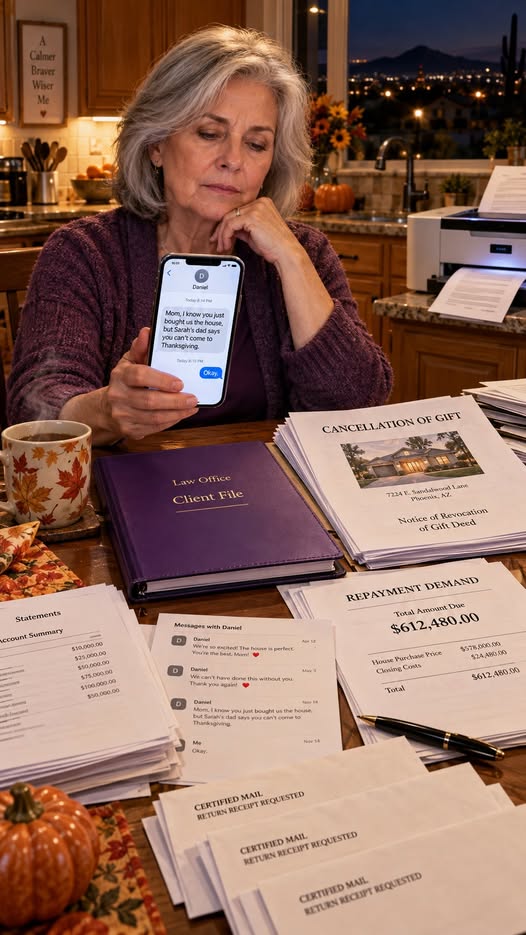
“My son sent me a message:
“Mom, I know you just bought
us the house, but Sarah’s dad says
you can’t come to Thanksgiving.”
I stared at the screen,
thought about the $350,000
I had spent to give him
a home, and typed one word back:
“Okay.”
That night, I stopped being everybody’s wallet
and started being the woman
who was about to take everything back—starting
with the house they thought
was already theirs.
I was standing in the fancy
grocery store on Oak Avenue in Phoenix,
the one I only go to
on holidays, holding a pumpkin
in one hand and my phone
in the other.
Around me, carts were full of turkeys
and cranberries, kids arguing over pies,
grandparents picking out tablecloths.
Regular families getting ready
for regular Thanksgiving dinners in homes
where they were actually wanted.
On my screen, the message
from my son, Danny, sat there
like it was nothing:
“Mom, I know you just bought us
the house, but Sarah’s dad doesn’t want
you coming to Thanksgiving.
Sarah thinks it’s better this way.
We’ll see you some other time.”
I typed a dozen replies
in my head—about respect, about gratitude,
about what it means to erase
your own mother for a man
she’s met twice—and deleted every single one.
In the end, I just wrote,
“Okay,” hit send, and left
a full shopping cart sitting
in the produce section.
My name is Margaret Gray.
I’m 60 years old,
a retired school employee in Phoenix, Arizona,
and I spent six years
of my life eating sandwiches,
driving my old car, skipping vacations
and nice dinners so I could save
enough to buy my son a home.
Not help with a down payment,
not co-sign a loan—buy it outright.
$350,000 of my retirement money
and every spare dollar I could
scrape together, all wrapped into
what I thought was the biggest
“I love you” a mother could give.
It wasn’t the first time
I’d stepped in.
I’d paid $28,000 for their wedding
because Sarah’s parents “couldn’t afford”
the big party they insisted on.
Sent $12,000 when his car died,
$6,000 when bills stacked up,
$10,000 for furniture because Sarah didn’t want
anything “used” in her apartment.
I was there for every crisis,
every “Mom, hate to ask but…,”
every “just until next paycheck.”
The thank-you’s got shorter.
The visits got fewer.
The calls only came
when something was wrong.
And then, the week I signed
the papers to give them a house,
a man named Richard—her father, not mine—decided
I wasn’t welcome at the Thanksgiving table
in that very house.
My son agreed.
Back at home, the purple notebook
from the lawyer’s office sat
on my kitchen table under the bright
Arizona kitchen lights, full of contracts
and signatures I’d been too proud
and too excited to read carefully.
That night, I made myself real tea,
the good kind I used to save
for special occasions, and read every line
I’d ignored that morning.
“One month waiting time… can be taken
back under certain conditions.”
“Unless something big changes that makes
the gift not make sense anymore.”
Something big had changed.
By two in the morning,
my printer was spitting out bank statements,
old checks, and screenshots of every text
where Danny had asked
for “just a little help.”
The number at the bottom
made my stomach twist:
$185,000 over the years,
on top of the house.
I wasn’t just being generous.
I was being used.
The next day, instead of driving
to a fancy grocery store,
I drove downtown to a glass building
with an American flag fluttering out front
and took the elevator
to the tenth floor.
My lawyer, Linda Martinez,
listened to the whole story without interrupting,
flipped through my purple notebook
and my stack of proof,
and finally looked up.
“In Arizona, Margaret,” she said,
tapping a paragraph with her pen,
“gross ingratitude matters.
Big gift, immediate rejection?
You have every right to take
the house back during the 30-day window.
And as for the money—they don’t just
owe you gratitude.
They owe you repayment.”
I signed the new papers
with the same pen I’d used
to give the house away,
only this time I was signing
to cancel the gift and demand
what I was owed.
That afternoon, while the sun dropped
behind the Phoenix skyline,
a certified letter started its journey
to my son’s office
and another to the little house
he thought was his.
By the time his phone lit up
with the words “Cancellation of Gift”
and a demand to repay
$28,000 in loans within 60 days,
I had already done the hardest part:
I stopped being the mother
they could safely take for granted.
What happened when those letters landed
in their hands—and how far I went
with my final step—is a story
my son will never forget”
The first call came
while I was washing a teacup.
Danny’s name flashed beside the sink.
For a moment,
my hand moved toward the phone
with the same old urgency.
Something had happened.
He needed me.
Then I remembered the message.
I dried my hands slowly.
“Hello, Danny.”
“What is this?”
No greeting.
No question about how I was.
Just the rustling of paper
and a breath coming too fast.
“Did you get the letter?”
“Mom, you sent this to my office.”
“The delivery required a signature.”
“My receptionist saw the envelope.”
“Did she open it?”
“No, but—”
“Then she saw an envelope.”
He went quiet.
Behind him, someone said something muffled.
Sarah.
I recognized the sharpness
even without recognizing the words.
“You can’t do this,” he said.
“We already moved in.”
“I know.”
“Our furniture is here.”
“I know that, too.”
“You gave us the house.”
“I signed a conditional transfer agreement.”
A cupboard shut in his background.
Hard.
“Since when do you talk like that?”
Since I had learned
what my own signature meant.
But I didn’t say that.
“Since I read the papers.”
He exhaled into the receiver.
“Over one dinner?”
The kitchen clock ticked.
A droplet slipped from the faucet
into the empty metal sink.
“It wasn’t one dinner, Danny.”
“You know Richard can be difficult.”
“Yes.”
“And Sarah’s under a lot of pressure.”
“Yes.”
“So you understand.”
“I understand you chose
the easiest person to disappoint.”
He didn’t answer.
I leaned against the counter.
My knees were trembling,
which made me angry with myself
until I realized trembling
didn’t mean I was wrong.
“Mom, we can fix Thanksgiving.”
There it was.
The table suddenly had room.
The chair had materialized.
My money had restored my importance
before my hurt had reached him.
“How?”
“We’ll tell Richard you’re coming.”
“And yesterday?”
“What?”
“Yesterday, when you told me
I couldn’t come.
Was there anything to fix then?”
He made a frustrated sound.
“I’m trying to apologize.”
“You haven’t apologized.”
Another silence.
This one lasted longer.
“Fine. I’m sorry.”
I closed my eyes.
I could hear the little boy
who had once said those words
after breaking a neighbor’s window.
Back then, he had meant them.
Back then, he had stood
beside me on the front step,
holding his allowance in both hands.
Now he was standing
inside a house I had bought,
trying to recover the house
without examining the window.
“Please speak to Linda
about the next steps,” I said.
“You’re making me call a lawyer
to talk to my own mother?”
“You can talk to me.
The property goes through Linda.”
“Unbelievable.”
I watched the last water bead
slide down the teacup.
“Goodnight, Danny.”
He was still speaking
when I ended the call.
I put the phone down.
Then I sat on the kitchen floor.
Not because I had collapsed.
Because the chair seemed too far away,
and I needed something solid
beneath me.
The tile was cool.
The refrigerator hummed.
I cried with my hand
pressed against my mouth
so the sound wouldn’t fill the house.
There was nobody there to hear it.
That was the worst part.
There was nobody there
to tell me I had done
the right thing.
And for the first time,
I had to decide that myself.
The following morning,
Linda asked me to come back.
She had the escrow file
open on her desk,
with colored tabs protruding
from three different sections.
Before we discussed Danny,
she folded her hands.
“I need to make something clear.”
My stomach tightened.
“Did I misunderstand?”
“I spoke too broadly yesterday.”
The room seemed to lose temperature.
Linda kept her voice steady.
“An unkind Thanksgiving message
doesn’t automatically undo a completed gift.
Your protection comes from these documents.”
She turned the file toward me.
The purchase had closed
into my ownership.
The later transfer to Danny and Sarah
had been placed in escrow,
subject to conditions
and a written withdrawal period.
They had received temporary occupancy
while the transfer was pending.
The deed intended for them
had not been released or recorded.
Linda touched the clause
I had barely noticed
during the first appointment.
“You reserved a right
to withdraw before release.
That is what we’re exercising.
I should have centered that yesterday.”
I stared at my own initials.
Three little letters.
M.G.
I remembered signing them
while Danny smiled across the table.
I had been thinking
about curtains.
About a backyard grill.
About grandchildren who didn’t exist yet.
Linda had been thinking
about what happened
if the dream went wrong.
“So it isn’t a judge
deciding whether they loved me enough.”
“No,” she said.
“And I don’t want you
building your decisions around that idea.”
My shoulders eased.
Not because the news was pleasant.
Because it was solid.
There was a document.
A process.
Something firmer than the question
of whether I deserved a chair.
“And the money?”
She separated two piles.
“Gifts here. Documented loans here.”
The wedding payment was a gift.
So were years of groceries,
holiday trips, insurance premiums,
and expenses I had covered
without asking to be repaid.
Pain didn’t change their category.
The recoverable twenty-eight thousand
came from three later advances
with written promises of repayment.
The car.
The overdue bills.
The furniture Sarah had insisted upon.
Linda showed me the messages.
Danny had typed,
“We’ll pay you back.”
Sarah had replied to one thread,
“Monthly payments once we’re settled.”
They had never started.
“The full hundred eighty-five thousand
isn’t a bill we can send
because you’re hurt,” Linda said.
I looked at the larger pile.
It was thicker.
So much thicker.
“I know.”
“Do you?”
I let the question sit.
Then I nodded.
“I want the house protected.
I want the loans addressed.
I don’t want to spend
the rest of my life
trying to collect every dinner.”
Linda closed the gift folder.
“That’s a workable place to begin.”
Outside her window,
Phoenix shone beneath a pale sky.
I had walked into her office
wanting to take everything back.
I left understanding
that some things were gone.
The money spent.
The years.
The evenings I had waited
for a call that never came.
I could not recover them
by printing a bigger number.
But I could stop
giving away the years ahead.
At home,
I opened my banking app.
There were transfers
I had almost forgotten setting up.
A payment toward Danny’s insurance.
A monthly contribution
to an account labeled Emergency Fund.
A streaming subscription
I didn’t even use.
I canceled the voluntary payments.
Then I changed my passwords,
removed the access I had shared,
and called the bank
about my own accounts.
The woman on the phone
asked whether I wanted
a confirmation sent by mail.
“Yes,” I said.
“To my address.”
Afterward, I opened the cupboard
where I kept my good plates.
Four of them.
Blue flowers around the edges.
My husband, Owen,
had bought them at an estate sale
before Danny was born.
He had been gone seven years.
I had stopped using the plates
when eating alone became
something to finish quickly.
That afternoon,
I put soup in a blue bowl.
I set a napkin beside it.
I ate at the table.
The soup tasted ordinary.
The act of sitting down
did not.
Richard arrived before sunset.
His truck blocked half my driveway.
I watched him through the front window
as he climbed out,
straightened his jacket,
and looked at my small house
with the expression people wore
when inspecting something beneath them.
He rang the bell twice.
I opened the inner door
but left the security screen locked.
“Margaret,” he said.
“We need to have a conversation.”
“You can contact my lawyer.”
He gave a thin smile.
“Let’s not make this ugly.”
“It already became ugly.”
“I’m sure you’re upset.
But young couples need space
to establish their own family traditions.”
“I agree.”
He paused.
My agreement seemed to inconvenience him.
“That’s why,” I continued,
“they should establish them
in a home they can afford.”
His smile disappeared.
“You promised them stability.”
“And they promised repayment
on money they borrowed.”
“That’s between you and Danny.”
“The house is between me
and the people handling its transfer.”
Richard stepped closer.
The screen separated us
by less than a foot.
“You don’t understand
what you’re interfering with.”
Something in his voice changed.
Not louder.
Less polished.
“What am I interfering with?”
He looked toward his truck.
Then back at me.
“A family’s future.”
“Whose family?”
His jaw shifted.
“Sarah is my daughter.”
“Danny is my son.”
“You’re going to destroy their marriage
to teach them a lesson?”
“I’m going to protect my retirement.”
He laughed once.
A dry, contemptuous sound.
“At your age,
what do you need all that for?”
The question landed quietly.
It was almost a gift.
For months,
I had been wondering
whether I imagined the way
they counted my life as finished.
There it was.
Said through my own doorway.
“For living,” I told him.
Then I shut the inner door.
My heart pounded
as if I had run a mile.
Through the wood,
I heard him say my name again.
I didn’t answer.
A minute later,
his truck started.
I waited until the engine faded
before I let myself breathe.
That night,
I called my sister June.
We hadn’t had a proper conversation
in nearly a year.
She lived outside Tucson.
We exchanged birthday messages.
Weather updates.
Photographs of flowers.
The careful little scraps
people use to avoid admitting
they have become strangers.
She answered on the fourth ring.
“Margaret?”
“I’m not calling about money.”
The words escaped
before I could stop them.
June was silent.
Then she said,
“Well, that’s a strange hello.”
I laughed.
It broke halfway through.
“Are you busy?”
“Not anymore.”
I told her about the text.
The house.
The letters.
I left out nothing
except the sound I made
on the kitchen floor.
When I finished,
she didn’t immediately condemn Danny.
She didn’t tell me
I should have known better.
She asked,
“Have you eaten?”
“Yes.”
“Something besides toast?”
“Soup.”
“Homemade?”
“From a can.”
“That counts.”
I pressed my fingers
against my forehead.
“Were you angry with me?”
“When?”
“All those times
you asked me to visit.”
June took a breath.
“I was hurt.”
“I thought you understood
how much Danny needed.”
“I did understand.
That was the problem.”
The house felt very quiet.
“You always had to rescue him,”
she continued.
“And if somebody suggested
you might want a life
outside doing that,
you heard it as criticism.”
I remembered a phone call
two summers earlier.
June had invited me
to spend three days with her.
I had canceled
because Danny wanted help
choosing appliances.
He had gone shopping with Sarah
while I waited for measurements.
“I’m sorry,” I said.
“I’m sorry, too.
I could have said it kinder.”
We sat inside that small agreement.
Two sisters,
both old enough to know
an apology didn’t rewind anything.
Then June asked,
“What are you doing Thursday?”
I looked toward the cupboard.
Four blue plates.
An empty dining table.
“I don’t know.”
“Come here.”
“I don’t want to be
the sad person everyone invites
because she has nowhere else.”
“Good,” June said.
“Come as my sister.
Bring the potatoes.”
I covered my eyes.
For the first time all week,
I cried without feeling ashamed.
Sarah texted the next morning.
Could we meet without everyone else?
I waited an hour
before answering.
A café near Linda’s office.
Eleven o’clock.
I chose a public place
because I wanted to listen
without being cornered.
Sarah was already there
when I arrived.
No polished greeting.
No comment about my clothes.
Her hair was tied back,
and there were dark circles
beneath her eyes.
She had ordered only water.
“Thank you for coming.”
I sat across from her.
“What did you want to say?”
She rubbed a damp ring
on the tabletop with her thumb.
“My father said
you wanted a quiet Thanksgiving.
He said Danny had spoken to you.”
“Danny’s message didn’t say that.”
“I know.”
She looked up.
“I knew before he sent it.”
The admission changed the air.
“Then why repeat your father’s story?”
“Because it sounds better.”
I let her hear
how long I took to answer.
“Yes,” I said.
“It does.”
Her eyes filled.
She blinked hard.
“I wanted you there.
But Dad said there were things
we needed to discuss privately.”
“What things?”
“His business.”
The café grinder roared.
A waitress passed carrying white mugs.
Sarah reached into her bag
and pulled out her phone.
“My father has a renovation company.
He’s behind on several projects.”
“How far behind?”
“I don’t know anymore.”
She showed me a message.
Richard had sent it
before the Thanksgiving argument.
We can discuss the financing Thursday.
No need to involve Margaret yet.
I read it twice.
“What financing?”
Sarah swallowed.
“He wanted Danny to consider
using the house as collateral
after the transfer.”
The room narrowed
to the phone between us.
“For your father’s business?”
“He said it would be temporary.
A bridge.
That it would help everyone.”
“And you believed him?”
“I wanted to.”
I sat back.
The café chair creaked.
There it was.
The thing Richard had said
I didn’t understand.
They weren’t only planning dinner.
They were planning
what my sacrifice could fund next.
“Was an application submitted?”
Sarah’s face changed.
“I found something yesterday.”
She opened an email attachment.
The first page
displayed the address of the house.
On another page,
beneath language about owner consent,
was my signature.
My actual signature.
Copied from a document
I had signed for escrow.
For a moment,
I couldn’t hear the café.
“Did you sign that?”
Sarah asked quietly.
“No.”
Her fingers began to shake.
“I didn’t think you had.”
“Who prepared it?”
“My father sent the file.
Danny forwarded property documents
when Dad asked for them.
I don’t know
who changed what after that.”
“Did Danny know about this page?”
“He says he didn’t.”
“What do you know?”
She looked at the screen.
Then at me.
“I know the signature isn’t permission
just because it exists somewhere else.”
I took out my phone.
“I need you to send
the entire email to Linda.
Not screenshots.
The attachment and the thread.”
She nodded.
Then her hand stopped.
“He’s my father.”
“Yes.”
“If this becomes something serious—”
“It already is serious.”
A tear slipped down her cheek.
I did not reach across the table.
There were moments
when comfort became an escape route.
This was one of them.
Sarah sent the email.
I watched her press the button.
Then I stood.
“Are you leaving?”
“I need to speak to Linda.”
“What about us?”
I looked at her.
For the first time,
she seemed younger
than the woman who had selected
a wedding venue
I could barely afford.
“I don’t know yet.”
She nodded slowly.
“I suppose that’s fair.”
It was the first fair thing
either of them had said
without immediately asking
what fairness would cost me.
Linda contacted the escrow officer
before the day ended.
Then she contacted the lender
identified in the attachment.
The proposed transfer stayed frozen.
No deed was released.
No loan had closed.
The lender wanted the original email,
the owner’s confirmation,
and a statement explaining
how the signature had appeared.
Linda explained each step
before asking me to authorize it.
“Once we report this,
you may be asked questions
by people outside this office.”
“I understand.”
“This isn’t a way
to frighten Richard into apologizing.”
“I don’t want an apology from him.”
“What do you want?”
I thought of his truck.
His voice through the screen.
What do you need all that for?
“I want him to stop
using my name.”
Linda nodded.
“That’s a clear answer.”
Danny called that evening.
His voice sounded different.
Not softer.
Stripped.
“Sarah showed you.”
“Yes.”
“Mom, I didn’t put
your signature on anything.”
“Did you send him the documents?”
“Yes.”
“Did you know why he wanted them?”
“He said he was checking
what financing might be available later.”
“For his company.”
“Yes.”
“And did you tell him
I hadn’t agreed?”
Danny breathed unevenly.
“I thought once the house was ours—”
“The house wasn’t yours yet.”
“I know that now.”
“No,” I said.
“You knew there was a waiting period.
You signed the same agreement.”
He didn’t argue.
The silence told me
more than his explanations had.
“I thought it was paperwork,” he said.
“That’s what you thought
when I paid for the wedding, too.
Paperwork.
When I moved money
from my retirement account.
Paperwork.”
“Mom—”
“It was six years, Danny.”
My voice cracked.
I had managed the lawyers.
The signature.
Richard at the door.
But my son,
finally quiet enough to hear me,
brought the real hurt back.
“It was six years
of telling myself
the things I wanted could wait.”
“I didn’t ask you
to skip vacations.”
“No.
You asked me to solve problems.
I decided the rest.”
I gripped the phone tighter.
“And that is my responsibility.
But when you learned
I would always say yes,
you stopped asking
what yes cost.”
He made a sound
I hadn’t heard from him
since Owen’s funeral.
A breath that couldn’t quite enter.
“I’m sorry.”
This time,
the words didn’t come
with a proposed solution.
I sat down.
“I need some distance.”
“How much?”
“I don’t know.”
“Can I call Thursday?”
“I’m spending Thanksgiving with June.”
“Oh.”
He sounded surprised
that another place existed
where I could be wanted.
“I’ll cooperate with Linda,” he said.
“About everything.”
“That would be a beginning.”
Thursday morning,
I packed potatoes into a casserole dish.
I tucked it into a towel
and set it on the passenger seat.
Then I went back inside
for Owen’s old cardigan.
Not because I needed it
in the Arizona weather.
Because on difficult days,
the weight of it
still felt like his hand
resting across my shoulders.
At a traffic light,
my phone lit up.
Danny.
Happy Thanksgiving, Mom.
I’m sorry for what I did.
There was no invitation.
No demand.
No reference to the house.
I read it
while the light stayed red.
Then I placed the phone facedown.
June opened her front door
before I reached the porch.
She was wearing an apron
with flour on the pocket.
“You’re early.”
“You said ten.”
“I always say ten.
Everybody else hears eleven.”
She took the casserole.
Then she looked at me.
“Oh, Margaret.”
I tried to smile.
It didn’t hold.
She put the potatoes down
on a little table
and wrapped her arms around me.
For a while,
neither of us spoke.
Her house smelled
of sage and warm bread.
Somewhere inside,
a radio played an old song
our mother used to hum.
There were people in the kitchen.
June’s neighbor Evelyn,
whom I had met years earlier.
A couple from her walking group.
A young woman
whose flight home had been canceled.
Nobody asked
why my son wasn’t with me.
Nobody watched me
as though I might fall apart
and spoil the meal.
Evelyn handed me a peeler.
“Carrots,” she said.
“I’ve been demoted.”
“From what?”
“Supervising.”
I laughed.
A proper laugh.
It startled both of us.
We cooked.
We burned one tray of rolls.
June blamed the oven
until Evelyn pointed out
she had forgotten the timer.
At dinner,
the young woman talked
about her first year teaching.
I told her
I had spent decades
in a school office.
Attendance.
Lost jackets.
Frightened children
waiting for parents who were late.
She asked whether I missed it.
“Some parts.”
“Which parts?”
I thought for a moment.
“The things nobody put
in the job description.”
A child who needed breakfast.
A mother who needed help
understanding a form.
A teenager who lingered
because home didn’t feel safe.
June watched me
from the other end of the table.
“You were good at that.”
“I liked being useful.”
“You can be useful
without disappearing,” she said.
Nobody turned the remark
into a speech.
We passed the potatoes.
We argued about pie.
And the ordinary movement
of plates and conversation
did something inside me
that no legal document could do.
It reminded me
that belonging could be quiet.
That I didn’t have to buy
the right to reach
for the butter.
Later,
June and I washed dishes.
The others were outside,
watching the sky turn copper
above her backyard wall.
“I thought you’d be married
to Danny forever,” June said.
I looked at her.
She winced.
“That came out wrong.”
“No,” I said.
“I know what you mean.”
After Owen died,
I had poured everything
that had once filled our marriage
into being necessary to our son.
The planning.
The worry.
The daily proof of love.
Danny had been grieving, too.
At first,
helping him had helped me.
Then helping became the only thing
I knew how to offer.
“I didn’t know what to do
with all the empty space,” I said.
June rinsed a plate.
“So you filled his.”
“Yes.”
She set the plate upright.
“And he let you.”
“Yes.”
We stood there
without trying to make
either truth cancel the other.
Then she dried her hands.
“You can come here
when nobody needs anything.”
I nodded.
“I’d like to learn that.”
The meeting happened
the following Tuesday.
Linda insisted
on a conference room
at her office.
Danny and Sarah sat together.
Richard arrived separately.
He came in carrying
a leather folder
and the certainty
of a man accustomed
to louder voices winning.
Linda did not offer him
the chair at the head.
She placed the documents
in the middle of the table.
“The transfer has been withdrawn
under the signed agreement.”
Richard opened his mouth.
Linda continued.
“Temporary occupancy will end
through the written process
set out in your documents.
We’ll establish the date
and retrieval arrangements today.”
“You’re exploiting a technicality,” he said.
Linda looked at him.
“A signed condition
is not a surprise technicality.”
“It was understood
this was a family gift.”
“It was understood
the transfer was conditional.”
He turned toward me.
“Margaret, look at your son.”
I did.
Danny was pale.
His hands rested flat
on the table.
For once,
he didn’t look away.
“I am,” I said.
Richard spread his arms.
“You can see what you’re doing.”
“I can see
what we’re all doing.”
He shut his folder.
“Fine.
Tell her she’s invited.
Tell her she can host
every Thanksgiving from now on.
Is that what this is about?”
Sarah stared at him.
“No, Dad.”
He ignored her.
“You want acknowledgment?
Here.
Thank you for your generosity.
Now let’s stop this nonsense.”
Linda placed a second document
beside the escrow agreement.
The altered lender attachment.
Richard’s gaze dropped.
His face changed
so quickly I might have missed it
if I hadn’t spent days
watching for that exact change.
“That was preliminary,” he said.
“My signature wasn’t preliminary,” I replied.
“You sign so many things.
There may have been confusion.”
“I didn’t sign this.”
Danny spoke.
“Dad, whose computer made the attachment?”
Richard snapped his head toward him.
“Don’t call me Dad
while you’re questioning me
like some investigator.”
Danny’s lips parted.
Then closed.
Sarah leaned forward.
“You told me
Mom Gray had agreed.”
I had never heard her
call me that before.
I didn’t let the name
distract me from the question.
“I told you
we would work it out,” Richard said.
“No.
You said she had agreed.”
He pushed back his chair.
“I’m not sitting here
being accused by my own daughter.”
“Then answer.”
Sarah’s voice shook.
But she held his gaze.
Linda raised a hand.
“The authenticity concern
has been reported to the lender.
We are preserving the records.
This meeting will not replace
their review or any investigation.”
Richard looked at me.
“You did that?”
“Yes.”
“You could have called me.”
“You came to my house.
You asked what I needed
my money for.”
He rubbed his forehead.
“That was taken out of context.”
“What context would make it kind?”
He had no answer.
The silence that followed
was the first silence
I had ever seen him lose.
Linda moved on.
Loan acknowledgments.
Occupancy dates.
Utilities.
Personal belongings.
Things with numbers and signatures,
too plain for Richard
to bend into a performance.
Danny agreed
to stop further financing discussions.
Sarah agreed to preserve
the full correspondence with her father.
Richard stood.
“We’re leaving.”
Sarah remained seated.
“No,” she said.
“I’m staying.”
He looked at Danny.
Danny didn’t move either.
Richard waited.
The leather folder
hung from his hand.
For years,
he had mistaken obedience
for proof that everyone agreed.
Now he had to cross
the conference room alone.
The door clicked shut.
Sarah covered her face.
Danny started to reach for her,
then stopped.
He looked at me instead.
“There’s something else
I need to say.”
Linda glanced at him.
“About the documents?”
“About Thanksgiving.”
I sat still.
He swallowed.
“Richard didn’t send that message.
I did.”
“We know,” Sarah whispered.
“No.
I mean I had choices.”
He pressed his palms together.
“I could have told him no.
I could have called Mom.
I could have had
an uncomfortable conversation with Sarah.
Instead, I made Mom carry it.”
Sarah lowered her hands.
“I helped.”
Danny nodded.
“Yes.
But I don’t get to hide
behind your father.”
He looked at me.
“I knew you’d be hurt.
I thought you’d get over it.
Because you always had.”
There was the truth.
No polished version.
No misunderstanding.
Just the terrible confidence
of being loved
by someone he had stopped protecting.
“I need you to understand something,”
I said.
“The house isn’t going back
because you finally said that.”
His face tightened.
Then he nodded.
“I know.”
“If you apologize
only while there’s something to recover,
I can’t tell
what you’re apologizing for.”
“I know.”
He wiped his eyes
with the heel of his hand.
“I want to learn how
to say it anyway.”
I looked down
at the purple notebook.
For the first time,
I didn’t need to open it
to hold my ground.
They found a rental
on the other side of Phoenix.
Two bedrooms.
Older cabinets.
No kitchen island.
Sarah told Linda
the landlord allowed pets,
although they didn’t have one.
I remembered hearing that detail
and feeling something loosen.
She had looked for a place
where life could happen.
Not simply a place
that looked impressive in photographs.
The move took place
after the required notices
and arrangements were completed.
I did not change locks
while their things were inside.
I did not shut off utilities.
I did not arrive
with a sheriff
for the pleasure of an audience.
A property manager Linda recommended
handled the inspection and keys.
I asked to come
only after the truck was loaded.
The house looked smaller
with the furniture gone.
Sunlight stretched
across the living room floor.
There were pale rectangles
where pictures had hung.
A few scuffs near the hallway.
One empty nail hole
above the kitchen doorway.
Danny stood beside the counter
holding the keys.
Sarah waited on the porch.
“We repaired the shelf,” he said.
“Linda has the receipt.”
“Thank you.”
“The garage remote is here.”
He placed it down.
“And both mailbox keys.”
I nodded.
He looked around the room.
“We were supposed
to have a life here.”
“You will have a life
somewhere else.”
He rubbed his thumb
against the key ring.
“I didn’t mean
for all this to happen.”
“I believe that.”
His eyes lifted.
“But not meaning it
didn’t prevent it,” I said.
“No.”
He held out the keys.
I took them.
They were warm from his hand.
For a second,
I remembered his kindergarten backpack.
How he had gripped its strap
on the first morning,
wanting me to leave
and stay
at exactly the same time.
He was still my son.
That truth made the moment harder.
It did not make
the boundary less necessary.
At the door,
he turned back.
“Can I hug you?”
The question surprised me.
He had not assumed.
I thought about it.
“Not today.”
His mouth trembled.
“All right.”
Outside,
Sarah stood up from the porch step.
“I’m sorry, Margaret.”
I nodded.
She didn’t ask
whether I had forgiven her.
They walked to the truck.
Danny helped her climb in,
then went around
to the driver’s side.
I stayed on the porch
until the truck disappeared.
When I stepped back inside,
the house echoed.
I stood in the kitchen
where I had imagined
a crowded Thanksgiving table.
There was no victory music.
No satisfaction sharp enough
to erase the sadness.
Just an empty house,
and a woman
who had finally kept
a promise to herself.
Richard tried another approach
two days later.
A post appeared online.
No mention of the copied signature.
No mention of the escrow agreement.
Just a wounded father
describing a cruel woman
who had “taken back”
her son’s home
because she couldn’t control his marriage.
A cousin sent it to me.
Then another.
My phone filled
with questions disguised as concern.
I sat at the kitchen table
and read the post once.
Then I called Linda.
“Do I have to answer this?”
“No,” she said.
“We’ll preserve it.
If specific false claims continue,
we’ll address them directly.”
“What do I tell my family?”
“The amount you want them to know.”
I wrote one short message.
The house transfer was conditional.
I withdrew it
under our signed agreement.
There are additional matters
being handled through appropriate channels.
I will not discuss
private financial details online.
Then I sent it
to the relatives who had asked.
Not to strangers.
Not to an audience
Richard could use again.
Danny called that evening.
“I saw what he posted.”
“I know.”
“I told him to remove it.”
“What did he say?”
“That I’d turned against family.”
I waited.
Danny took a breath.
“I told him
you were family before he was.”
I closed my eyes.
It was something
I had needed to hear
before any letter existed.
Hearing it late
still mattered.
A week later,
Danny sent me a copy
of the correction
he had shared
with the same relatives.
He took responsibility
for excluding me.
He confirmed
that the house transfer
had not been completed.
He said the disagreement
was not about controlling his marriage.
He did not blame Sarah
to make himself look better.
At the bottom,
he wrote,
Please stop contacting my mother
to demand explanations.
She has already carried enough.
I read that sentence
three times.
Then I put the phone down
and went outside
to water my plants.
Trust didn’t return
because of one sentence.
But sometimes,
a sentence opened a window
in a room
that had been airless.
The financial part
was less dramatic
than anyone expected.
Danny and Sarah
did not have twenty-eight thousand dollars
hidden somewhere.
They had savings,
some furniture they could sell,
and two incomes
they had never properly budgeted together.
I could have insisted
on the original sixty-day demand
and pursued the next legal steps
when they failed.
Linda showed me the options.
I thought carefully
before choosing.
They paid five thousand dollars upfront.
The remaining balance
went into a written repayment agreement,
with fixed monthly payments
over forty months.
No new advances.
No casual promises.
No changing the arrangement
in a late-night phone call.
“I don’t want
to become their collection department,”
I told Linda.
“Then we structure it
so you don’t have to.”
The payments went through
the agreed system.
I received confirmations.
I didn’t have to ask.
The wedding money stayed a gift.
So did the other money
I had given freely.
Accepting that was difficult.
Some mornings,
I still thought
about what it could have bought.
A trip with June.
A better car sooner.
More years without worry.
But I stopped reopening
the old statements.
They had shown me the pattern.
They didn’t have to become
the rest of my life.
Instead,
I made an appointment
with a financial planner.
I took every account statement
and asked questions
I should have asked years earlier.
What could I safely spend?
What did I need
to protect?
What would retirement look like
if I stopped subsidizing
two other adults?
For the first time,
someone studied my future
as though it belonged to me.
Afterward,
I walked into a bakery
and bought a slice
of lemon cake.
I ate it there.
I didn’t take half home
to make the purchase
feel more responsible.
That sounds like a small thing.
It was.
Small things were where
I had first disappeared.
They were also
where I began returning.
Danny started counseling.
He told me
during a phone call
that lasted eleven minutes.
He didn’t announce it
like a ticket
he could exchange for forgiveness.
He simply said
he was trying
to understand his habits.
Sarah began going, too.
They met together
with someone who helped them
talk about money
without assigning either parent
a permanent role as rescuer.
Their first real budget
included groceries,
rent,
transportation,
the loan payment,
and a category Sarah named
Things We Can’t Afford Yet.
When Danny told me that,
I smiled.
“Good category.”
“It’s a long one.”
“It usually is.”
He laughed quietly.
Then the call ended
without an emergency.
I sat there afterward,
trying to identify
the unfamiliar feeling.
It took me a moment.
I had enjoyed
talking to my son.
Nothing had been purchased.
Nothing had been promised.
We had simply spoken.
Richard’s situation
moved much more slowly.
The lender’s review
led to requests for records.
Those records led
to questions about the attachment,
the company’s finances,
and the source
of the copied signature.
Linda helped me
give a clear statement.
I answered only
what I actually knew.
No guesses.
No embellishments
to make Richard look worse.
The truth had enough weight
without my adding to it.
Danny and Sarah
provided their messages and emails.
Richard called Sarah repeatedly
before she stopped answering.
He said
she was destroying him.
He said
her mother would have been ashamed.
He said
a good daughter
would know what to delete.
Sarah preserved those messages, too.
One afternoon,
she called and asked
whether she could come by.
I said yes,
for an hour.
She arrived carrying nothing.
No flowers.
No cake.
No gesture
that asked me
to soften the conversation.
She sat on my patio,
holding a glass of water.
“My mother died
when I was nineteen,” she said.
I already knew that.
But I didn’t know
what came next.
“Afterward, Dad said
we only had each other.”
A hummingbird hovered
near the red feeder.
“He says it now
whenever I disagree.”
I watched the bird
dart toward the fence.
“That must be hard.”
“It is.”
She stared into her glass.
“But I used it
on Danny, too.”
“How?”
“I told him
if he loved me,
he’d help keep Dad calm.”
She wiped her cheek.
“I knew what it felt like
to be trapped by that sentence.
And then I said it
to somebody else.”
I let her finish.
“The furniture,” she continued.
“The wedding.
All the things
I said we needed.
I thought if things looked right,
nobody would see
how frightened I was.”
“Frightened of what?”
“Being ordinary.
Being judged.
Dad always talked about people
who had fallen behind.”
I looked at my patio chairs.
One had a repaired arm.
The cushions didn’t match.
“Ordinary can be peaceful,” I said.
She smiled sadly.
“I’m starting to see that.”
Then she turned toward me.
“But none of that excuses
what I did to you.”
“No,” I said.
“It doesn’t.”
She nodded.
“I’m not asking it to.”
That was why
I could listen.
Before she left,
she asked about the plants.
I told her
which survived the heat
and which I had learned
not to buy again.
For ten minutes,
we talked about something living
without anyone
trying to claim it.
After she drove away,
I stayed on the patio.
I didn’t feel
that everything was healed.
I felt
that healing had become possible
without pretending
nothing had happened.
I put the house
on the market
when I was ready.
Not the week they left.
Not in a burst
of anger.
I had it cleaned.
The small repairs completed.
The locks changed
after possession had been returned.
I stood in each room
with the agent
and listened to practical advice.
The price.
The photographs.
The market.
I resisted the temptation
to turn the sale
into a statement.
It was a house.
A good house.
Somebody could build
an honest life there.
When the first offer came,
it was too low.
I declined it.
The second buyer
wanted contingencies
I wasn’t comfortable accepting.
I declined that, too.
My agent seemed surprised
by how calmly I said no.
I was surprised myself.
A few weeks later,
a woman named Nicole Harris
made an offer
supported by her financing
and the usual inspection conditions.
She had a young daughter.
She worked at a hospital.
None of those facts
entitled her to my house.
But the terms were sound,
and the price was fair.
I accepted.
At the inspection,
she asked
about the tree
near the back fence.
“Does it give much shade?”
“In the afternoon.”
“My daughter loves reading outside.”
I pictured a child
beneath the branches,
knees tucked up,
a book balanced on her lap.
For the first time,
I imagined someone else’s future
in that house
without feeling robbed of mine.
The sale closed
months after the Thanksgiving message.
After expenses,
I did not become richer
than I had been.
I simply recovered
most of what I had risked.
Enough to restore
the part of retirement
I had nearly handed away.
Enough to sleep differently.
I met Linda
for the final signing.
She slid the documents toward me.
“Take your time.”
I read every page.
She didn’t smile
until I finished.
Outside,
I stopped on the sidewalk.
The city sounded
exactly as it had
on the day
I first drove downtown.
Traffic.
Footsteps.
A flag snapping
in a dry breeze.
But I wasn’t carrying
a stack of proof
that I had been used.
I was carrying papers
showing I could move forward.
Two days later,
an envelope arrived
from Nicole.
I expected
a question about the garage
or a misplaced manual.
Inside was a letter
and a photocopy
of an old school photograph.
Thirty children.
A teacher in the middle.
A little girl
near the front
with uneven bangs
and a cardigan
buttoned wrong.
I knew the school.
I knew the year.
Then I recognized
the little girl.
Nicole Ramirez.
Before she became
Nicole Harris.
I sat down
before reading the letter.
Mrs. Gray,
I thought I recognized you
at the inspection,
but I wasn’t sure
until I heard your voice.
You probably remember hundreds of children.
I remember one office.
My mother lost her job
when I was in fourth grade.
I came to school hungry
and said I felt sick
because I was embarrassed.
You gave me breakfast
without making me explain
in front of anyone.
Later, you helped my mother
fill out forms.
I remember you saying,
“You don’t have to earn breakfast.”
She had written
those words in quotation marks.
Seven ordinary words.
I had said them
and forgotten.
A child had carried them
for more than twenty years.
The letter continued.
When my daughter starts school,
I hope someone notices her
the way you noticed me.
We already put a chair
under the tree.
Thank you for the house.
And for the office.
I held the page
against my chest.
Then I laughed
and cried together
in a way
that made no sense
until it made perfect sense.
For months,
I had been looking
at what generosity had cost me.
Here was something
I had given
that had not emptied me.
A breakfast.
A little patience.
A sentence spoken
without asking for anything back.
The difference wasn’t
that one gift was small
and another was expensive.
The difference was
that I had been allowed
to remain a person
while giving it.
I called June.
She listened
while I read the letter.
Then she said,
“There you are.”
“What?”
“The woman I’ve been trying
to get back.”
I wiped my face.
“I think I’ve missed her, too.”
I wrote to Nicole.
I told her
I did remember her mother.
I remembered her determination.
I remembered the way
Nicole always returned
borrowed pencils sharpened.
I wished them happiness
in the house.
I did not tell her
what had happened there before.
The walls didn’t need
to inherit my family’s hurt.
She deserved
her own beginning.
The investigation into Richard
ended long after
I had stopped checking
for news every morning.
There were interviews.
Requests for more records.
A period
when nothing seemed to happen.
Then Linda called
to tell me
there had been charges
connected to the forged consent
and attempted financing.
Richard eventually entered a guilty plea.
The court process
gave him chances
to deny responsibility,
then required him
to speak clearly
about what he had done.
I attended the sentencing
because I wanted
to hear the truth
in a room
where he couldn’t interrupt it.
Danny came separately.
Sarah sat beside him.
Richard looked smaller
in his suit.
Not harmless.
Just smaller
than the voice
I had carried in my head.
His lawyer spoke
about financial pressure
and a business
he had tried to save.
The judge listened.
Then asked Richard
whether he understood
that another person’s signature
was not a resource
available for his convenience.
“Yes,” he said.
I watched his hands.
They were clasped tightly.
He received a sentence
that included a period in custody,
followed by supervision
and financial obligations
set by the court.
It did not restore
every relationship he had damaged.
It did not solve
every complaint involving his business.
Those matters followed
their own processes.
But this one
had an answer.
He had used my name
without permission.
There were consequences.
Afterward,
we stood outside
beneath a white Arizona sky.
Sarah leaned against a column.
Danny stood near her.
Nobody spoke
for a little while.
Then Sarah said,
“I kept hoping
he’d look at me
and say he was sorry.”
I knew
what that waiting felt like.
“He may not,” I said.
Her face crumpled.
“I know.”
Danny put an arm
around her shoulders.
He didn’t tell her
to stop crying.
He didn’t make promises
about her father changing.
He stayed.
I watched him do
the simplest thing
and understood
how much he still had
to learn.
How much
he was finally learning.
On the way home,
I pulled into
the Oak Avenue grocery store.
The same store.
The same produce section.
For several seconds,
I stood beside the pumpkins,
although Thanksgiving
was still months away
and they were only
small decorative ones
stacked in a seasonal display.
I remembered
the cart I had abandoned.
The phone.
The bright store lights
turning cruel around me.
A clerk asked
whether I needed help.
“No,” I said.
“Thank you.”
I picked up
a bag of oranges.
Then fresh bread.
Then the good tea.
At the checkout,
the cashier asked
whether I had found everything.
“Yes.”
This time,
I took my groceries home.
The next Thanksgiving
was smaller
than the ones
I had once imagined.
June came to my house.
Evelyn drove up with her.
I had gotten to know her
through visits
and the occasional long phone call.
She brought a pie
and complained
that June had criticized
her crust all morning.
June denied it
with the expression
of a guilty woman.
Danny and Sarah
were not there.
I had told them
I wasn’t ready
for a holiday table together.
They respected it.
Danny dropped off
a loaf of bread
the day before.
He rang the bell,
handed it to me,
and stayed on the porch.
“I made it,” he said.
I looked at the loaf.
One side had risen
more than the other.
“Owen would have called that character.”
Danny smiled.
“Dad called everything character
when he didn’t know
how to fix it.”
We both laughed.
Then neither of us did.
“He would have been disappointed in me,”
Danny said.
I held the bread
against my sweater.
“Yes.”
His eyes filled.
I didn’t rescue him
from the answer.
After a moment,
I added,
“He would also have wanted
you to do better.”
Danny nodded.
“I’m trying.”
“I can see that.”
Those four words
seemed to reach him
more deeply
than forgiveness would have
if I had offered it too soon.
He left.
I carried the loaf inside
and sliced it for dinner
the following day.
It was good bread.
Not because he was my son.
Because he had made
good bread.
I liked
being able to tell
the difference.
Winter passed.
Then spring.
I started volunteering
one morning each week
at a school reading program.
I told the coordinator
exactly how many hours
I wanted to give.
When she asked
whether I could add
another afternoon,
I checked my calendar.
I had planned
to have lunch with June.
“I’m not available,” I said.
The coordinator nodded.
“All right.”
No anger.
No collapse.
No accusation
that I didn’t care enough.
I thought about
that ordinary acceptance
all the way home.
I bought a newer car.
Not extravagant.
Reliable.
The air conditioning worked
without a strange rattle.
I took June
on a trip
we had discussed
for nearly ten years.
Three nights near the coast.
We walked slowly.
We argued
over which restaurant
looked least touristy.
We ate at
the touristy one anyway.
One evening,
we sat on a balcony
with the ocean dark
beyond the rail.
June asked
whether I regretted
taking the house back.
I thought about it.
“No.”
“Any part?”
“I regret
how long it took me
to notice what was happening.”
She turned her glass
between her hands.
“You noticed
when you could bear
to notice.”
“I could have done it sooner.”
“Maybe.”
She didn’t hand me
an easy excuse.
That was one reason
I trusted her again.
“But you did it,” she said.
Below us,
waves moved
through the darkness.
I breathed in
the salt air.
“I did.”
The relationship with Danny
returned in small pieces.
A Saturday lunch.
A walk
through a public garden.
A phone call
in which he asked
about the reading program
and remembered
the name of a child
I had mentioned before.
Sometimes,
we still stumbled.
Once,
he began a sentence
with the old familiar words.
“Mom, hate to ask, but—”
He stopped himself.
I waited.
Then he laughed,
embarrassed.
“I was going to ask
whether you had
Dad’s old socket set.”
“I do.”
“Could I borrow it?”
“Yes.”
“Just the socket set.”
“I understood.”
He returned it
three days later,
cleaned and complete.
Inside the lid,
he had placed a note.
Thank you.
I realized
I was smiling
after he left.
Another time,
Sarah asked whether
I could help choose
a birthday present
for Danny.
She told me her budget
before telling me her ideas.
There was no suggestion
that I might contribute.
We spent an hour
in a secondhand bookstore.
She bought him
a history book
and a little framed photograph.
The photograph showed
the two of them
outside their rental,
laughing
beside a tomato plant
that had grown
almost nothing.
“It died after this,”
she told me.
“Most things do
if you photograph them
instead of watering them.”
She laughed.
I hadn’t realized
how much easier she was
when she wasn’t trying
to look above
the life she actually had.
Over lunch,
she told me
she was maintaining distance
from her father.
He had written
several letters.
Some blamed Danny.
Some blamed me.
One accused her
of abandoning him.
She had sent
a single response
through an appropriate channel.
She wished him well.
She would not discuss
my money,
their marriage,
or the case.
Future contact
would require respect
and accountability.
He had not replied
in a way
that met those conditions.
“Do you think
I’m being cruel?”
She asked it quietly.
I put down my fork.
“I think you’re grieving
the father you wanted.”
Her eyes lowered.
“That feels disloyal.”
“I know.”
“What if he never changes?”
“Then your boundary
still has a purpose.”
She nodded.
It wasn’t a happy answer.
But it let her
stop waiting
for happiness
to make the answer valid.
A little more than
a year after the sale,
Danny and Sarah
told me
they were expecting a baby.
They invited me
to lunch
before sharing the news
with everyone else.
Danny looked nervous
in a way
I recognized immediately.
Sarah held his hand
beneath the table.
“We wanted you to know,”
he said.
My first feeling
was joy.
My second
was fear of what joy
might ask me to forget.
I sat with both.
Then I smiled.
“I’m happy for you.”
Sarah began to cry.
“I didn’t know
whether you would be.”
“Of course I am.”
Danny looked down.
“We also wanted
to say something else.”
I waited.
“We’ve made a budget.
We’re looking into childcare.
We’re not telling you
because we expect you
to pay for anything.”
I watched his face.
He wasn’t reciting
a speech somebody else
had written.
He was trying
to make the ground
safe beneath us.
“Thank you,” I said.
“You can be Grandma,”
Sarah added,
“without becoming the emergency plan.”
That sentence
nearly undid me.
I had wanted
to be a grandmother
for years.
I had imagined
tiny sweaters,
sticky hands,
a child asleep
against my shoulder.
I had also feared
being handed
another life
to finance
in exchange for belonging.
Hearing Sarah name
that difference
allowed me
to feel the joy fully.
When their daughter was born,
they named her Lily.
They did not
name her after me
as a gesture
of repair.
They chose
a name they loved.
I appreciated that,
too.
I met her
in the hospital
the following afternoon.
Danny placed her
in my arms
with the care
of someone carrying
a glass of water
filled to the rim.
She opened her eyes.
Gray-blue.
Unfocused.
Her fingers moved
against the blanket.
For a moment,
all the years
collapsed into one breath.
Danny had been
that small.
Owen had stood
beside my hospital bed
with tears
he didn’t bother hiding.
I felt his absence
as sharply
as I felt
the baby’s warmth.
Danny noticed.
“Thinking about Dad?”
“Yes.”
He sat beside me.
“I am, too.”
We watched Lily
make a tiny,
furious face.
“What do you think
he’d say?” Danny asked.
I smiled.
“That she has character.”
Danny laughed
with tears in his eyes.
Then he looked at me.
“I’m sorry he isn’t here.”
“So am I.”
There was nothing
to fix in that.
We let it be sad.
Then Lily stretched
one hand
out of the blanket,
and the room
became new again.
I brought a small gift.
A soft quilt.
A book.
No envelope
hidden underneath.
Nobody looked for one.
During the months
that followed,
I visited
when we agreed to visit.
I babysat occasionally
because I wanted to,
not because someone
had announced
that I would.
When I said
I had plans,
Danny said,
“Have a good time.”
Sarah sent photographs.
Sometimes Lily.
Sometimes a meal
they were proud of cooking.
Sometimes nothing more
than the little garden
outside the rental.
A family
learning to show me
their life
without sending
an invoice beside it.
There were difficult conversations
along the way.
Once,
Danny asked
whether I still thought
of the old message
when I saw him.
We were sitting
on a park bench.
Lily slept
in her stroller.
“Yes,” I said.
He stared
at his hands.
“Every time?”
“Not every time.”
He nodded.
“I wish I could
take it back.”
“I know.”
“I keep trying
to explain why
I was that person.”
“Have you found
an explanation?”
“Several.”
“And?”
“None of them
make it all right.”
I looked at him.
“That sounds useful.”
He breathed out
a small, unhappy laugh.
For a while,
we watched a child
chase a bright ball
across the grass.
Then Danny said,
“I used to think
you liked solving everything.”
“I did.”
He turned toward me.
“I also liked
being your mother.
Those aren’t
the same thing.”
His eyes filled.
“I didn’t understand.”
“I didn’t always
understand it myself.”
The stroller shifted
as Lily stirred.
Danny rocked it gently
with one hand.
“What does being
my mother look like now?”
I considered the question.
“It looks like this.”
He glanced
at the stroller.
“At sitting with you.
Hearing what you’re thinking.
Telling you
what I really think.
Letting you
have your own life.”
“And yours?”
“Keeping mine.”
He nodded slowly.
“I want that for you.”
I had waited
a long time
to hear it.
But the words
didn’t feel wasted
because they arrived late.
They felt like
a door opening
onto a place
we could still reach.
Evelyn needed surgery
the following summer.
Nothing dramatic.
A hip
that had troubled her
for years.
June helped arrange
her meals.
I drove down
to spend two afternoons
with her.
On the second day,
she asked why
I had come.
“Because you’re my friend.”
She shifted
against her pillows.
“You didn’t have to.”
“I know.”
We looked
at each other.
Then she smiled.
“That’s a good reason.”
I understood
what she meant.
Care given freely
felt different
from care extracted
through fear.
I could help
without vanishing.
I could leave
when I needed to.
She could thank me
without making it
a down payment
on the next obligation.
On the drive home,
I stopped
at a scenic overlook.
Just stopped.
There had been years
when every extra minute
felt stolen
from somebody’s need.
That afternoon,
the desert spread
beneath a wide sky,
and I stood there
until the light changed.
Nobody was waiting
for me to solve anything.
The world
did not fall apart.
The forty payments
arrived one by one.
Some months,
Danny sent
a separate message
about ordinary things.
Other months,
only the payment confirmation came.
I never confused
the money
with an apology.
It was repayment.
The apology lived
in how he treated me
when there was
nothing to gain.
The final payment arrived
in early November,
nearly four years
after the message
that had changed everything.
I was making coffee.
The confirmation appeared
on my phone.
Remaining balance:
Zero.
I read it.
Then I read it again.
For a moment,
I thought I would feel
something enormous.
Instead,
I felt quiet.
One promise
had finally been completed.
Not negotiated away.
Not forgotten
after enough time passed.
Completed.
Danny called
that afternoon.
“Did it arrive?”
“Yes.”
“Good.”
We were both silent.
Then he said,
“Thank you
for giving us
a way to repay it.”
“You did the repaying.”
“I know.”
His voice thickened.
“I just wanted
to say that.”
I looked toward
the patio door.
The afternoon sun
lay across the floor.
“Thank you
for keeping the agreement.”
He breathed out.
“Mom?”
“Yes?”
“Could we talk
about Thanksgiving?”
The word
still carried its old shadow.
But shadows
could get smaller.
“What did you have in mind?”
He hesitated.
“We’d like
to have dinner together.
Wherever you’re comfortable.
We can cook.
We can bring everything.”
I smiled.
“You don’t have
to bring everything.”
“I know.
I just mean
we’d like to contribute.”
I looked
at Owen’s blue plates.
They no longer
lived unused
in the cupboard.
I used them
for breakfast sometimes.
For dinner
with June.
For ordinary Tuesdays
when no celebration
had authorized
the good things.
“Come here,” I said.
Danny didn’t answer
right away.
“Are you sure?”
“Yes.”
Then I added,
“I’m inviting you.
Not settling anything.
Not starting over
as if nothing happened.”
“I understand.”
“And June
and Evelyn are coming.”
“Good.”
“Sarah’s welcome.”
His breath caught.
“I’ll tell her.”
“Tell her
to bring the carrots.”
He laughed.
“Just carrots?”
“Just carrots.”
The morning of Thanksgiving,
I woke
before the alarm.
The house was quiet.
Not empty.
Quiet.
There was a difference
I had spent years
learning to hear.
I put on
the good tea.
I opened
the patio curtains.
The sky
was barely pink
above the neighbor’s roof.
In the kitchen,
I set out
the blue plates
and two additional ones
I had bought
because I liked them.
They didn’t match.
Neither did
the chairs.
For once,
nothing had to match
to belong.
June arrived first,
carrying a casserole
and an opinion
about my oven temperature.
Evelyn followed
with the same pie
she always claimed
was easy.
“It took three hours,”
June told me.
“Traitor,” Evelyn said.
I kissed
both their cheeks.
Danny and Sarah
arrived at eleven.
Lily ran ahead
with a paper bag
clutched against her coat.
“Grandma!”
I knelt
as carefully
as my knees allowed.
She wrapped herself
around my neck.
Her hair smelled
like strawberries.
“I made something.”
“I can’t wait
to see it.”
She reached
into the bag
and pulled out
a paper pumpkin.
Crooked eyes.
A smile
much too large
for its face.
Inside,
she had drawn
seven people
around a table.
One was purple.
One appeared
to have four arms.
“That’s Daddy,” she explained.
“Of course.”
“Those are
his cooking hands.”
I looked up
at Danny.
He was holding
a roasting pan.
His eyes shone.
Sarah stood beside him
with the carrots
and a small bouquet
from their garden.
Nothing expensive.
A few flowers
that had survived
the season.
“Happy Thanksgiving, Margaret,” she said.
“Happy Thanksgiving.”
I stepped aside.
“Come in.”
Danny went
to the kitchen.
Sarah asked
where I wanted
the flowers.
Lily followed June
to investigate
the pie.
Nobody waited
for me
to direct
every movement.
Nobody expected
me to serve
before I sat.
For a while,
I stood
in the doorway
and watched.
The oven opened.
Someone laughed.
Evelyn told Danny
his bread looked better
than last year’s.
He agreed.
June asked Sarah
for the recipe
she had used.
Lily announced
that she did not
like carrots,
then ate
a piece of one
to prove
she was generous.
It was ordinary.
Gloriously ordinary.
Danny looked up
and found me
watching them.
“Everything okay?”
“Yes,” I said.
“Everything’s okay.”
At the table,
there was
one empty chair
for a few minutes
while Danny finished
bringing dishes in.
I watched it.
Four years earlier,
an empty chair
had meant
I wasn’t wanted.
Now it meant
someone was busy
helping.
The difference
was not lost
on me.
Before we ate,
Danny cleared his throat.
I felt myself
brace.
He noticed.
“I’m not making
a big speech,” he said.
June leaned forward.
“Good.
The potatoes are cooling.”
We laughed.
Danny smiled,
then looked
around the table.
“I’m grateful
we’re here.”
That was all.
No performance.
No request
for public forgiveness.
No story
about how much
he had suffered.
Just gratitude
with no bill attached.
We passed
the dishes.
We ate.
We told stories
about Owen.
The time
he tried
to fix
a ceiling fan
and accidentally
turned the lights
off in
three rooms.
The year
he dropped
the turkey
and insisted
the kitchen floor
had been cleaned
that very morning.
Danny remembered
things I had forgotten.
June corrected
details I had improved
over time.
Lily listened
with solemn interest,
then asked
whether Grandpa
had also possessed
four cooking hands.
“Yes,” Danny said.
“But he didn’t
always use them wisely.”
After dinner,
I began
to gather plates.
Sarah touched
my wrist gently.
Not to stop me
as though
I were fragile.
To ask.
“Would you like us
to handle this?”
I looked
at the table.
At the plates.
At my son
already carrying
an empty dish.
“Yes,” I said.
“I would.”
I took
my tea
to the patio.
June joined me.
The air
was cooling.
Inside,
water ran.
Lily sang
something that seemed
to have
only one lyric.
Danny and Sarah
laughed over it.
June settled
into the chair
beside mine.
“How does it feel?”
I considered
the question.
There had been
so many answers
over the years.
Angry.
Frightened.
Lonely.
Proud.
Still hurt.
Not as hurt.
Learning.
Now,
I listened
to my family
inside my house.
My house.
My life.
A place
they were welcome
because I chose
to welcome them.
“It feels
like dinner,” I said.
June smiled.
“That’s a good answer.”
“It took a while.”
“Most good answers do.”
We sat
without speaking.
The sky turned
from gold
to lavender.
A bird landed
on the fence,
then vanished
into the neighbor’s tree.
Later,
Danny came outside
carrying a small plate.
A slice
of lemon cake.
“I saved you some.”
I looked
at the cake.
Then at him.
“How did you know?”
“June told me
it’s your favorite.”
He set
the plate down.
Then he asked,
“Can I sit?”
I moved
the extra chair
closer.
He sat.
For a moment,
we listened
to the dishes
being put away.
“I know
this doesn’t erase
what happened,” he said.
“No.”
“I’m grateful
you let us
be here anyway.”
I looked
at his hands.
Older now.
A small scar
near one knuckle.
Hands that had
worked,
cooked,
held his daughter,
and finally
carried their share.
“I’m glad
you came.”
He nodded,
but didn’t stand.
There was something else.
I waited.
“I found
an old photograph
when we moved.”
“Which one?”
“You and Dad
at the school picnic.
I’m asleep
against your shoulder.”
I remembered.
A hot afternoon.
Owen’s crooked tie.
Danny exhausted
after running
through sprinklers.
“I used to look
at that picture
and think
you must have
been happiest
when I needed you.”
I said nothing.
He swallowed.
“Now I think
you were happy
because you loved me.”
I felt
my eyes fill.
“Yes,” I said.
“I loved you.”
“And you
were a person
before that picture.”
“Yes.”
“A whole person.”
I nodded.
He looked
toward the kitchen,
where Lily
was asking Sarah
whether pie counted
as a vegetable.
“I want her
to know that
about her mother.
And about you.”
I reached
for his hand.
Not because
I had forgotten.
Not because
the house
or the money
had become unimportant.
Because he had
finally seen
what I had
been trying
to protect.
He gripped
my fingers carefully.
“I love you, Mom.”
“I love you, too.”
There was room
for both sentences
and everything
that had happened
between them.
When they left,
Lily insisted
her paper pumpkin
remain on display.
I put it
on the kitchen wall
with a small magnet.
Danny hugged me
at the door.
This time,
I let him.
Sarah thanked me
for the meal.
June and Evelyn
stayed long enough
for one more
cup of tea.
Then their car
pulled away, too.
I locked
the front door.
I turned off
the kitchen light.
For a while,
I stood
in the soft glow
from the living room lamp.
The house smelled
of bread,
flowers,
and the faint sweetness
of lemon cake.
The rooms
were quiet again.
I was alone.
I was
not abandoned.
On the table,
beside my teacup,
lay Lily’s drawing.
Seven people.
A crowded table.
One woman
with gray hair
and a blue dress.
“That’s you,”
she had told me.
I picked it up
and looked closely.
My little paper self
had no wallet.
No envelope.
No keys
held out
for someone else
to take.
She had
a fork
in one hand
and a smile
on her face.
I placed
the drawing
beside Owen’s photograph.
Then I took
my tea outside.
The desert night
had settled
over the neighborhood.
Somewhere nearby,
a gate clicked.
A dog barked once.
A car passed
and disappeared.
I sat
in my own chair,
beneath my own sky,
with enough
for tomorrow.
And when
the tea cooled,
I went inside
to make
another cup.