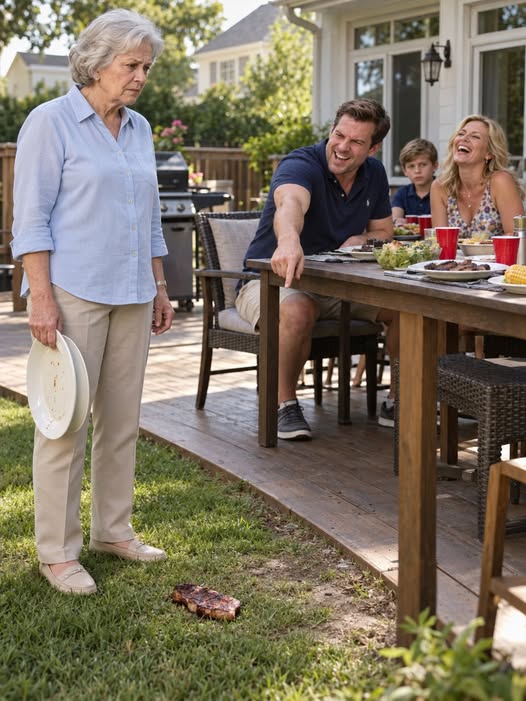
At Sunday’s barbecue, my son threw
my steak onto the ground
and said, “Want meat?
Go chew it at the nursing home,
you useless old woman!”
The next day, I packed my bags
and sold the house.
My phone rang 28 times.
He begged for forgiveness,
but…
“Pick it up,” my son said,
staring at the steak
he had just thrown into the dirt.
I stood beside my own patio table,
sixty-nine years old,
surrounded by people eating food
I had bought,
on a deck I had paid to build.
Cedric smirked.
“Want meat? Go chew it
at the nursing home,
you useless old woman.”
Jessica laughed.
Actually laughed.
My grandchildren, eight and ten,
watched without saying anything.
For a second, all I heard
was the hiss of the grill
and somebody’s ice rattling inside
a plastic cup.
I bent slowly, my knees aching,
and picked up the steak.
“Cedric,” I said, brushing dirt from it.
“What did you just say?”
He rolled his eyes.
“Oh, come on, Mom.
Don’t be dramatic.
It was a joke.”
A joke.
That word had excused
nearly everything for years.
The $800 worth of golf equipment
he had charged to my credit card
without asking.
The way Jessica rearranged my furniture
after they moved into my house “temporarily.”
The laundry they left
outside my bedroom door.
The dinners they expected at six.
Six months earlier,
Cedric and Jessica had lost their apartment
after falling behind on rent.
“Just until we get back on our feet,”
Cedric had promised.
Within a week, my guest room
had become their bedroom,
my kitchen had become Jessica’s territory,
and my living room
had become their family room.
When I finally asked
when they planned to move,
Cedric laughed.
“Why would we?
This setup works perfectly.”
Perfectly for them.
At the barbecue,
he pointed toward the kitchen.
“Get me another steak.
And bring another beer.”
I looked at him.
Then at the dirty steak
in my hand.
Something inside me became very quiet.
I walked into the kitchen
and dropped the meat into the trash.
On the refrigerator were photographs
of Cedric as a little boy:
missing front teeth,
baseball uniforms,
birthday cakes,
school pictures.
I had worked three jobs
after his father left.
Private school.
Sports equipment.
College tuition.
Every time I went without something,
I told myself it was temporary.
Every time he needed more,
I found more.
And now my grown son
was sitting on patio furniture
I had purchased,
ordering me around inside a house
he already spoke about
as if it belonged to him.
I carried out another steak and beer.
He took both without looking at me.
That was the moment I decided.
I was finished.
That night,
the house finally went quiet.
Cedric and Jessica went upstairs
after leaving plates, bottles, and food
across the kitchen.
I did not clean any of it.
Instead, I sat at the table
with a legal pad.
At the top, I wrote one sentence.
What belongs to me?
The answer surprised me.
The house.
My savings.
My time.
My future.
My life.
Before sunrise,
I made my first call.
Dave was the son-in-law
of my friend Martha
and a local real estate agent.
He answered with a sleepy voice.
“Tatum?”
“I need to sell my house.”
A pause.
“When?”
“Now.”
He was sitting at my kitchen table
by 7:30,
documents spread between two mugs of coffee.
Upstairs, Cedric and Jessica
were still sleeping.
Dave walked through the house quietly,
taking pictures and making notes.
In the kitchen,
he lowered his voice.
“This neighborhood is hot.
I may already have cash buyers.”
“How fast?”
“If the numbers work?
Very fast.”
“Do it.”
He studied me for a second.
“You’re sure?”
I looked toward the staircase.
“I’ve never been more sure.”
What Cedric never understood
was that he had been planning
his future around my property for years.
He told friends
the house would eventually be his.
The four-bedroom suburban house
was worth nearly $400,000.
In Cedric’s mind,
it was not my retirement.
It was his inheritance.
He also did not know
I had changed my will months earlier.
After Christmas dinner,
when he mocked me in front of relatives
and then asked to borrow money
before dessert,
I had quietly removed his name
from several things.
I never told him.
There had been no point.
Until now.
By noon,
Dave called.
“Full asking price.
Cash.”
I gripped the phone.
“How soon can they close?”
“Seventy-two hours.”
“Accept it.”
Outside,
Cedric was floating in my pool.
Jessica was complaining
that lunch was late.
Neither noticed me carrying boxes
into my bedroom.
I packed thirty-eight years carefully.
My mother’s jewelry.
My father’s books.
My grandmother’s quilt.
The small ceramic angels
I had collected over the years.
Everything else could stay.
Dave found me a two-bedroom apartment
across town
with a small balcony overlooking a garden.
The lease included one detail
I loved immediately.
No long-term guests.
Tuesday evening,
Cedric noticed paperwork
on the kitchen counter.
“Mom, what’s this?”
My pulse jumped.
“Insurance papers.”
He glanced at the first page
for maybe two seconds.
“Whatever.”
Then he returned to the television.
I stood in the hallway watching him.
His future was sitting six feet away
in black ink,
and he could not be bothered
to read it.
Wednesday morning,
the moving truck arrived at eight.
Boxes disappeared.
Furniture rolled through the front door.
Walls that had been crowded
with my life became bare.
At 10:30,
Cedric finally came downstairs.
He stopped halfway down the staircase.
His hair was wild.
His T-shirt was wrinkled.
His face changed
as he looked around
the empty living room.
“What is going on?”
I wrapped my last ceramic angel
in bubble wrap.
“I’m moving.”
He laughed once,
but there was no humor in it.
“Moving where?”
“My apartment.”
Behind him,
Jessica appeared at the top
of the stairs.
Cedric’s eyes moved from the boxes
to the movers,
then back to me.
“Mom, what about the house?”
I taped the box shut.
“The house is sold.”
The color drained from his face.
“You can’t sell this house.”
I picked up my purse.
“I already did.”
His mouth opened,
but nothing came out.
Then the front doorbell rang.
Dave stood outside
holding the final closing folder,
and behind him,
at the curb,
a black SUV had just pulled in.
For one extraordinary second,
I thought Cedric might actually faint.
His hand tightened around the banister.
He looked at Dave,
then toward the vehicle outside.
“Who the hell is that?”
Dave stepped through the doorway.
“The buyers are here
to discuss the final arrangements.”
“Buyers?”
Cedric’s voice cracked.
“You brought buyers into my house?”
I felt something sharp
move through my chest.
Not fear this time.
Recognition.
Even now,
with my belongings disappearing
into the moving truck,
he could not bring himself
to call the house mine.
“Your house?” I asked quietly.
Cedric turned toward me.
“You know what I mean.”
“No, actually.
I don’t think I do.”
The SUV’s passenger door opened.
A woman stepped out,
perhaps ten years younger than me,
wearing dark trousers
and a cream-colored blouse.
She carried a leather folder
beneath one arm.
Another woman climbed out
from the driver’s side.
She wore a charcoal business suit.
Neither looked particularly intimidating.
They didn’t need to.
Cedric watched them approach
with the expression of a man
seeing his carefully arranged future
collapse in broad daylight.
Dave introduced the first woman.
“This is Nora Shaw.
She’s purchasing the property.”
Nora extended her hand.
“Mrs. Tatum, it’s lovely meeting you.”
I shook it.
“Just Tatum is fine.”
She smiled.
“Then please call me Nora.”
The second woman introduced herself
as Nora’s attorney, Grace Patel.
Cedric stepped between us.
“Hold on.
Nobody is purchasing anything.
There’s been some kind of mistake.”
Grace opened her folder.
“Mr.?”
“Cedric.
I’m her son.”
“I see.”
Her expression remained professional.
“The purchase agreement has been signed.
Closing is scheduled for tomorrow.”
Cedric looked from her
to the documents in Dave’s hands.
“Then cancel it.”
Nobody answered immediately.
He pointed at me.
“Mom, tell them.”
I looked straight into his eyes.
“No.”
His jaw tightened.
“What do you mean, no?”
“I mean the house is being sold.
I have already made my decision.”
“You can’t just decide something like this!”
“Actually,” Grace said,
“the owner certainly can.”
Jessica appeared behind Cedric.
She had changed into jeans,
but her hair remained tangled.
“What about us?”
Her eyes were wide.
“What about the children?”
I had anticipated that question.
It had kept me awake
for most of Tuesday night.
I turned toward her.
“The buyers know you’re living here.
They’ve agreed to a transition arrangement.
You’ll receive proper written notice
and the time required by law.
Nobody is being thrown outside today.”
Jessica pressed her lips together.
“But where are we supposed to go?”
For six months,
I had asked myself
almost the same question.
Not about a physical address.
About where I could go
to feel respected.
Where I could close a door
without someone demanding dinner.
Where I could sit down
without being asked to get up.
Where I could spend my money
without Cedric calculating
what might someday remain for him.
“I don’t know, Jessica,” I answered.
“You and Cedric will need
to make those decisions.”
Cedric gave a bitter laugh.
“You’re unbelievable.”
I looked at him.
“Yesterday, you thought I was useless.
Today, I’m unbelievable.
Which is it?”
Dave lowered his eyes.
Nora remained silent.
Jessica looked toward the kitchen.
Cedric’s face reddened.
“That barbecue thing again?
You’re destroying our lives
over one stupid joke?”
There it was.
The word.
Again.
I felt the familiar temptation
to explain away my hurt.
To tell him
that perhaps I was sensitive.
That perhaps he hadn’t meant it.
That families sometimes said things
they regretted.
I had made those excuses
for nearly forty years.
Instead, I asked one question.
“Did you see me laughing?”
Cedric blinked.
“What?”
“When you threw my dinner
into the dirt,
did you see me laughing?”
His eyes shifted.
“That’s not the point.”
“It is exactly the point.”
“Mom—”
“Did I laugh?”
His mouth tightened.
“No.”
“Did I ask you to stop?”
He stared at me.
“Probably.”
“You remember what I said.”
He turned toward Jessica.
“Are you hearing this?”
She didn’t answer.
I took one step closer.
“I asked you what you meant.
You told me to stop being dramatic.
Then you ordered another steak.”
“Because I was hungry!”
His voice echoed
through the empty living room.
For a moment,
nobody moved.
Then Nora spoke.
“Mr. Cedric,
perhaps this conversation
should happen privately.”
Cedric turned on her.
“You stay out of this!”
Grace closed her folder.
“Please don’t speak to my client
that way.”
Something shifted in the room.
Not because Grace raised her voice.
She didn’t.
But because, for once,
Cedric had spoken disrespectfully
and someone had challenged him.
Without apologizing.
Without laughing.
Without immediately making peace.
His eyes traveled around the room.
Dave.
Grace.
Nora.
Me.
Nobody was taking his side.
He looked almost bewildered.
And suddenly,
I understood something painful.
My son had grown accustomed
to never facing a consequence
that I couldn’t soften for him.
Every mistake had met
another chance.
Every unpaid bill,
another check.
Every insult,
another excuse.
I had confused protecting him
with preventing him from growing.
Now he was forty-three years old,
and he was furious
that the world contained boundaries.
He stepped toward me.
“After everything I’ve been through,
you’re doing this?”
I held my purse tightly.
“What have you been through, Cedric?”
He stared.
“You know what happened
with my job.
You know we lost the apartment.”
“I know.
That’s why I opened my door.”
“And now you’re closing it.”
“I opened my door.
You made me afraid
to walk through my own kitchen.”
He actually flinched.
For one instant,
I saw the little boy
who used to wait
by the living room window
for a father who never returned.
Then he looked away.
“You’re twisting everything.”
“No.
I’m finally saying it clearly.”
Behind us,
one of the movers appeared.
“Ma’am?
We’ve finished loading.”
His voice was hesitant.
He had probably heard everything.
I nodded.
“Thank you.”
He disappeared toward the truck.
Cedric looked at my purse.
Then at the last cardboard box.
His expression changed again.
Anger gave way
to a kind of desperate calculation.
“Okay, fine.
You want an apology?”
My stomach sank.
He continued before I answered.
“I’m sorry.
There.
Happy?”
I looked at him.
“Sorry for what?”
He threw up his hands.
“For the stupid steak!”
“And?”
“And whatever else
you think I did.”
“Cedric.”
My voice was very soft.
“An apology isn’t a receipt
you hand someone
to get their property back.”
His face hardened.
“You’ll regret this.”
Perhaps I would.
Perhaps there would be lonely evenings
when I missed the familiar rooms.
Perhaps I would wake at night
wondering whether I had been cruel.
I knew the cost
of leaving would not be nothing.
But I also knew
the cost of staying.
“I might grieve this,” I said.
“But I won’t regret
choosing to live.”
Cedric turned away.
He kicked a loose piece
of packing paper across the floor.
Jessica followed him into the kitchen.
I heard her whisper something.
He answered too loudly.
“She’ll change her mind.
She always does.”
That sentence hurt
more than I expected.
Because he wasn’t guessing.
He was remembering.
Every boundary I had erased.
Every promise I had broken
to myself.
Every time I had said
this would be the last time.
He was counting on history.
For once,
history was wrong.
I signed the remaining documents
at the folding table
Dave had brought inside.
Grace explained the closing arrangements.
The buyers would complete
their purchase the following day.
Cedric and Jessica would receive
the required legal notices
and a reasonable opportunity
to arrange their departure.
Nora had agreed
to handle the transition
through her property manager.
I would not be responsible
for forcing anyone out.
No shortcuts.
No midnight eviction.
No confrontation in the driveway.
Just the lawful end
of an arrangement
that had already cost me
far too much.
When the paperwork was finished,
Nora touched my arm.
“May I say something?”
I nodded.
“My husband and I
have been searching for a home
for our daughter and her family.
They’ve had a difficult few years.”
A small ache passed through me.
She continued.
“We’re not trying
to hurt your family.
We’ll handle the transition respectfully.”
“Thank you,” I whispered.
Nora looked toward the staircase.
“Your house has been loved.
I could tell
even during the first viewing.”
I almost laughed.
She had seen photographs.
Dave’s photographs.
The flowers I planted.
The polished dining table.
The handmade curtains.
The room I painted yellow
when Cedric was little.
She hadn’t seen
what those rooms had become.
“Just make it a happy place,”
I told her.
She squeezed my hand.
“We intend to.”
Then a quiet voice
came from behind me.
“Grandma?”
I turned.
My grandson stood
at the bottom of the staircase.
Eli.
Ten years old.
Barefoot.
Wearing the blue dinosaur pajamas
I had bought him last Christmas.
His little sister, Sophie,
stood two steps above him.
She was eight.
Her stuffed rabbit dangled
from one hand.
Neither child looked angry.
They looked frightened.
And my heart almost broke.
“Grandma,” Eli whispered,
“are you leaving us?”
I crossed the room immediately.
“Oh, sweetheart.”
I knelt despite my aching knees.
“No.
I’m moving to another home.
That’s different.”
Sophie descended the remaining steps.
“Daddy says you’re mad at everybody.”
I looked at her carefully.
“I’m hurt by something
that happened between the grown-ups.
But I am not angry with you.”
“Are you mad at Daddy?”
I brushed a strand of hair
from her forehead.
“I’m disappointed in his choices.”
“Will you stop loving him?”
The question struck me
so deeply that I closed my eyes.
For a second,
I was standing in another room,
thirty-five years earlier,
holding my crying little boy.
He had asked me
why his father didn’t love him
enough to stay.
I had promised him
that I would never leave him.
I had believed love meant
remaining available
no matter what happened.
Now I had to explain
what I hadn’t understood then.
“No, Sophie,” I said.
“I won’t stop loving your daddy.
But loving somebody
doesn’t mean letting them
hurt you.”
Eli studied me.
“Even when they’re family?”
“Especially then, sweetheart.
Family should be where
you feel safest.”
Sophie began crying.
I gathered both children
into my arms.
For a moment,
the house disappeared.
There were only two small bodies
pressed against mine.
Two children who had watched
their father humiliate me
and hadn’t known what to do.
I held them tightly.
“You can call me every day.
We can visit the park.
We can bake cookies.
You can sleep over sometimes
when your parents arrange it.
My apartment has two bedrooms.”
Sophie drew back.
“Does it have a backyard?”
“It has a garden.”
“With flowers?”
“Lots of them.”
She considered this.
“Can we plant strawberries?”
Something warm returned
to my chest.
“Yes, sweetheart.
We can plant strawberries.”
Eli remained quiet.
Then he whispered,
“I should’ve helped you.”
I looked at him.
“Helped me with what?”
His eyes filled.
“When Dad threw your steak.
I wanted to pick it up.
But I thought he’d get mad.”
I felt tears burning.
“Oh, Eli.”
I put my hands
on his small shoulders.
“That was not your job.”
“But he was being mean.”
“Yes.
He was.”
“Then why didn’t anybody stop him?”
I had no answer
that a ten-year-old deserved to carry.
So I gave him the truth
he needed most.
“The adults should have handled it.
You did nothing wrong.”
He leaned against me.
And for the first time
since Sunday afternoon,
I cried.
Not because Cedric had hurt me.
Not because I was leaving.
But because my grandson
had learned to fear conflict
before he had learned
how to name it.
I kissed both their foreheads.
“Be kind to each other.
And always tell someone
when something feels wrong.”
Sophie wiped her nose.
“Promise you’ll call tonight?”
“I promise.”
Behind them,
Cedric stood in the kitchen doorway.
He had heard us.
His face was unreadable.
I waited.
For one moment,
I thought he might say something.
Anything.
Instead, he looked away.
That hurt too.
But this time,
I let it hurt
without changing my decision.
Dave carried my final box outside.
Martha had arrived
in her little silver sedan.
She stood beside it,
holding a travel mug
and looking worried.
When she saw my face,
she opened her arms.
I walked into them.
Neither of us spoke.
After a moment,
she whispered,
“Ready?”
I looked back once.
The house stood beneath
the same maple trees
I had planted decades earlier.
The front steps needed paint.
The porch light hung slightly crooked.
A wind chime moved
beside the kitchen window.
I remembered Cedric
learning to ride his bicycle
in that driveway.
His first scraped knee.
His first report card.
His graduation photographs.
The night he brought Jessica home
and announced he was getting married.
I remembered holding Eli
the day he was born.
Then Sophie.
There had been so much love
inside those walls.
And so much exhaustion.
I took a long breath.
“Yes,” I told Martha.
“I’m ready.”
As I climbed into her car,
Cedric appeared on the porch.
“Mom!”
I turned.
He stood with his arms crossed.
“You can’t expect me
to forgive you for this.”
I looked at him
through the open car door.
“I’m not asking you to.”
Then I sat down.
Martha started the engine.
We drove away.
I didn’t look back again.
Not because I didn’t care.
Because I cared so deeply
that another look
might have broken my resolve.
For the first ten minutes,
Martha let me sit quietly.
Then she reached across
and squeezed my hand.
“You did a difficult thing.”
I stared at the houses
passing beyond the window.
“I think I just destroyed
my relationship with my son.”
“Maybe,” she said.
Then she added,
“Or maybe you stopped him
from destroying the last
healthy part of it.”
I looked at her.
She kept her eyes
on the road.
“You know what worried me most?”
I shook my head.
“You stopped calling me.”
I frowned.
“What?”
“We used to have lunch
every other Wednesday.
Remember?”
Of course I remembered.
Our lunches at the little café
near the public library.
Chicken salad.
Hot tea.
Two hours of gossip and laughter.
Sometimes three.
I hadn’t gone
in nearly five months.
“Jessica needed help
with the children,” I said automatically.
Martha glanced at me.
“And the book club?”
I looked down.
“Cedric said those women
were a bad influence.”
“Because we told you
to stop paying his bills.”
Despite everything,
I almost smiled.
“And your painting classes?”
“I didn’t have time.”
“Your birthday dinner?”
I swallowed.
“They forgot.”
Martha was silent.
Then she said something
I would remember for years.
“Tatum, I watched you disappear
one favor at a time.”
The tears returned.
This time,
I didn’t try stopping them.
I cried for the woman
who had worked until midnight
to keep a roof
over her son’s head.
I cried for the mother
who had missed vacations,
turned down invitations,
worn the same winter coat
for eleven years
so Cedric could have
the things other children had.
I cried for the birthdays
when he had forgotten to call.
For the Christmas dinners
I spent cooking
while everyone else opened presents.
For the afternoons
when I sat in my car
outside the grocery store,
trying to understand why
I dreaded going home.
And I cried
because I still loved him.
That was the hardest part.
I hadn’t stopped loving Cedric.
I had simply reached
the end of what love
could reasonably ask me to endure.
Martha drove without speaking.
When we finally reached
the apartment building,
she parked beneath a flowering tree.
“Welcome home,” she said.
I looked up.
A modest brick building.
White balconies.
Trimmed hedges.
An elderly gentleman
watering flowers near the entrance.
A young woman pushing a stroller.
Nothing grand.
Nothing expensive.
Nothing resembling the house
I had just sold.
And yet,
as I stepped onto the sidewalk,
I felt something unfamiliar.
Relief.
The apartment manager, Ellen,
met us in the lobby.
She handed me my keys.
“Everything’s ready, Mrs. Tatum.
The movers finished unloading upstairs.”
“Thank you.”
She smiled.
“And the garden club meets Thursdays.
You’re welcome anytime.”
I almost answered
that I was too busy.
Then I remembered.
I wasn’t.
I had nowhere
I was required to be.
Nobody waiting for dinner.
Nobody demanding clean shirts.
Nobody planning my afternoon
without asking permission.
“I might just do that,” I said.
We took the elevator upstairs.
My apartment was on the third floor.
The front door opened
into a small living room
filled with afternoon sunlight.
There were cardboard boxes everywhere.
My old blue sofa
stood beneath the window.
My grandmother’s quilt
rested across its back.
The ceramic angels
were arranged on a shelf
near the balcony door.
Martha had already brought
a small vase of yellow tulips.
Beside it,
she had placed a card.
I picked it up.
Inside were four words.
You are allowed happiness.
I stared at them.
Then I sat down
on the floor.
Martha lowered herself beside me,
despite complaining knees.
We laughed through our tears.
For the first time
in longer than I could remember,
I didn’t feel responsible
for making anyone else comfortable.
I was just a woman
sitting on her own floor,
inside her own home,
with a friend
who wanted nothing
except to see her happy.
That evening,
I ate scrambled eggs
and buttered toast.
At six o’clock,
I looked automatically
toward the kitchen.
My body expected
someone to call my name.
Nobody did.
At six-fifteen,
I poured myself another cup of tea.
At six-thirty,
I sat on the balcony
watching the garden below.
A woman walked a small dog.
Somebody watered the roses.
The breeze smelled of damp earth.
I had forgotten
how peaceful ordinary life
could feel.
Then my phone rang.
Cedric.
I watched his name
flash across the screen.
My hand moved toward it.
Then stopped.
I let it ring.
He called again.
And again.
Within forty minutes,
there were nine missed calls.
The messages began arriving.
The first was furious.
“You have completely lost your mind.”
The second was accusing.
“You embarrassed me
in front of complete strangers.”
The third was threatening.
“I’ll get a lawyer.
You can’t get away with this.”
The fourth was different.
“Mom, please answer.”
I listened without moving.
Then came another.
“Jessica’s crying.
The kids are upset.
How can you do this?”
I pressed the phone
against my chest.
For a moment,
I felt the old panic.
The old obligation.
I should fix this.
I should explain.
I should send money.
I should go back.
The thoughts arrived
with frightening ease.
Then I looked around
my little apartment.
At the quilt.
The flowers.
The balcony.
My untouched cup of tea.
I remembered Eli asking
why nobody had stopped his father.
And I understood
that returning would teach him
something terrible.
That a person could behave cruelly
and still demand
everything remain exactly as before.
I put the phone
face down on the table.
Then I called Sophie.
Jessica answered.
Her voice was cold.
“What?”
“I promised the children
I’d call tonight.”
A pause.
Then, quietly,
“Fine.”
Sophie came onto the phone.
“Grandma!”
The joy in her voice
nearly undid me.
“Hello, my strawberry girl.”
She giggled.
“Did you find the garden?”
“I did.”
“Did you see any strawberries?”
“Not yet.
We’ll have to grow our own.”
We talked about flowers.
And rabbits.
And the spelling test
she had tomorrow.
Eli came onto the line
and asked whether the apartment
had room for board games.
I told him yes.
Then he asked something
I hadn’t expected.
“Grandma, are you scared
sleeping there by yourself?”
I looked around.
The quiet rooms
seemed suddenly very large.
“A little,” I admitted.
“Why?”
“Because everything is new.”
He considered this.
Then he said,
“When I started fifth grade,
I was scared too.
But it got better.”
I smiled through my tears.
“Then I suppose
I’ll get better too.”
When the call ended,
Jessica came back on.
For several seconds,
she said nothing.
Then she asked,
“Are you really not coming back?”
“No.”
“Even if Cedric apologizes?”
I took a breath.
“An apology wouldn’t undo the sale.”
She made a small sound.
Something between a sigh
and a bitter laugh.
“You’ve changed.”
I looked toward the balcony.
“Yes,” I said.
“I think I have.”
She disconnected.
I placed the phone
beside my cup.
Then I went to bed
without washing a single dish.
There were only two
in the sink.
And both belonged to me.
The next morning,
I woke at six,
the hour I had risen
for almost forty years.
My first instinct
was to start breakfast.
Cedric liked his eggs fried.
Jessica preferred oatmeal.
Sophie wanted waffles.
Eli refused bananas.
I stood halfway
between the bedroom
and the kitchen
before remembering.
None of those preferences
were my responsibility anymore.
I laughed.
A small,
astonished laugh.
Then I went back to bed.
I slept until eight-thirty.
At nine,
I made coffee.
At nine-fifteen,
I ate a peach
standing beside the balcony.
At ten,
Dave called.
“Everything’s on schedule.”
My heart began beating faster.
“The closing?”
“Tomorrow’s deadline is still good.
The final documents are being processed.”
“Any problems?”
“Nothing that changes the agreement.”
I closed my eyes.
He continued.
“Grace is handling
the occupancy details.
You don’t need to go back.”
“Thank you, Dave.”
He was quiet for a moment.
“Tatum, I want you to know
something.”
“What?”
“My mother-in-law told me
you raised Cedric alone.”
“Yes.”
“She said you worked
three different jobs.”
“For a while.”
“And still found time
to help at his school.”
I swallowed.
Dave’s voice softened.
“You’ve spent your whole life
showing up for people.
It’s okay to show up
for yourself now.”
When we hung up,
I sat at the little dining table.
The sunlight moved
across the wooden surface.
I opened my legal pad.
The one I had used
on Sunday night.
On the first page,
beneath my question,
were five answers.
The house.
My savings.
My time.
My future.
My life.
I turned to a clean page.
Then I wrote another question.
What do I want?
I stared at it.
For a surprisingly long time,
I couldn’t think
of a single answer.
That frightened me.
I had spent so many years
asking what everyone else needed
that my own wants
felt like a foreign language.
Eventually,
I wrote three things.
A quiet morning.
A painting class.
A garden.
Then I added another.
To see my grandchildren
without being treated
like hired help.
I looked at the list.
It wasn’t extravagant.
There was no cruise.
No expensive car.
No luxury vacation.
Just a handful
of ordinary pleasures
I had somehow forgotten
I was allowed to want.
My phone buzzed.
Cedric again.
Fourteen missed calls now.
A message followed.
“Mom, seriously.
We need to talk money.”
I stared at those words.
Not about how I felt.
Not about the children.
Not even about
the home where he had grown up.
Money.
The conversation had finally reached
the subject that mattered most
to him.
I didn’t answer.
Instead,
I put on my shoes
and went downstairs.
The garden club was gathering
beside a row of raised flowerbeds.
Four women were working
around a table
covered with soil and seedlings.
Ellen waved me over.
“Everyone, this is Tatum.
She just moved in.”
A silver-haired woman smiled.
“Do you like roses?”
“Very much.”
“Then you’re in the right place.”
Someone handed me a trowel.
Nobody asked me
to fetch a drink.
Nobody complained
about the temperature.
Nobody told me
what I should be doing
with my afternoon.
They asked my opinion
about the placement
of a little red rosebush.
And then,
astonishingly,
they listened.
I spent almost two hours
with my hands in the soil.
When I returned upstairs,
there was dirt beneath my fingernails
and a smile on my face.
My phone showed
twenty-three missed calls.
I left it alone.
At four that afternoon,
Dave called again.
This time,
his voice sounded lighter.
“Tatum?
Congratulations.”
I gripped the kitchen counter.
“The sale?”
“Closed.
The funds are in escrow
for final disbursement.
The deed has been recorded.”
I sat down.
For several seconds,
I couldn’t speak.
Thirty-eight years.
Thirty-eight years
of mortgage payments.
Property taxes.
Roof repairs.
Storm damage.
Frozen pipes.
Leaking faucets.
Birthday parties.
Christmas mornings.
And one terrible barbecue.
All of it
had become part
of a life I was leaving behind.
Dave waited.
“Tatum?”
“I’m here.”
“Are you okay?”
I looked at the ceramic angels
beside my balcony.
“I think so.”
Then my voice broke.
“Oh, Dave.
I think I really am.”
He gave me a moment.
“The buyers have the property now.
Grace has arranged
the occupancy notices.
You don’t need
to manage Cedric’s departure.”
“Good.”
“And Tatum?”
“Yes?”
“You got the full asking price.”
I exhaled slowly.
After the remaining mortgage,
closing costs,
and moving expenses,
there would still be enough
for a comfortable retirement.
Not unlimited wealth.
Not a fortune.
But safety.
The kind I had worked
my entire adult life
to provide for someone else.
For the first time,
that someone could be me.
I thanked Dave.
Then I called Martha.
She answered immediately.
“Well?”
“It’s done.”
A silence.
Then she whooped so loudly
I had to move
the phone from my ear.
“We’re going out tonight!”
I laughed.
“Martha, I’m exhausted.”
“Then we’re ordering food.
I’m bringing dessert.”
I looked at the clock.
Four-thirty.
There was still daylight.
For a moment,
I wanted to tell her
that I had too much to do.
Then I remembered
there was no rush.
No dinner schedule.
No laundry waiting
outside my bedroom.
No grown man
demanding another beer.
“Chocolate cake?” I asked.
“Obviously.”
We were still laughing
when another call appeared.
Cedric.
Number twenty-four.
I let it ring.
By the time Martha arrived,
the number had reached twenty-seven.
She brought Chinese takeout,
a chocolate cake,
and a bottle of sparkling cider.
We sat on the balcony
with our shoes off.
At seven-forty,
my phone lit up again.
Cedric.
Twenty-eight.
Martha glanced at it.
“Do you want to answer?”
I studied the screen.
Then I nodded.
“Yes.
I think I do.”
I picked up.
“Hello, Cedric.”
There was a sharp inhale.
“Mom?”
“Yes.”
“Thank God.
I’ve been calling you all day.”
“I know.”
“Why wouldn’t you answer?”
I glanced at Martha.
She stood quietly
and carried our empty plates
inside.
I waited until she disappeared.
Then I answered.
“Because you needed time
to understand that I meant no.”
Cedric was silent.
Then his voice cracked.
“Mom, I’m sorry.”
I closed my eyes.
There were the words
I had wanted to hear
for so many years.
“I’m sorry about the barbecue.
I’m sorry I yelled.
I’m sorry I called you names.”
For a moment,
hope lifted inside me.
Maybe he finally understood.
Maybe the fear of losing me
had opened something
that my patience never could.
Then he continued.
“So just call Dave.
Tell him you’ve changed your mind.
We can work this out.”
The hope collapsed.
I stared at the garden.
“Cedric, the sale is complete.”
“Then make them undo it.”
“They can’t.”
“Offer them more money!”
“I won’t.”
His breathing grew louder.
“Mom, please.
I’m begging you.
We don’t have anywhere to go.”
“You have time
to arrange somewhere.”
“We don’t have the money!”
“You and Jessica
will need to make a plan.”
He gave a desperate laugh.
“This is insane.
You have almost four hundred grand,
and you’re leaving your own son homeless?”
I waited for my pulse
to settle.
“Cedric, I don’t have
four hundred thousand dollars
sitting in my purse.
I sold an asset
I spent decades paying for.
I still need somewhere to live.
I still have bills.
Medical expenses.
A retirement to protect.”
“I’m your son!”
“I know.”
“Doesn’t that mean anything?”
I looked down
at the old wedding ring
I no longer wore
but kept in my jewelry box.
A reminder of promises
that hadn’t survived reality.
“It means I love you.
It doesn’t mean
you own my future.”
He began crying.
I had heard Cedric cry
hundreds of times.
When his father left.
When he broke his wrist.
When his first girlfriend
broke his heart.
When Eli was born.
But this crying sounded different.
Desperate.
Frightened.
Angry beneath the grief.
“Mom, please.
Please forgive me.”
My own tears began falling.
“I want to, Cedric.”
“Then help us!”
“And that’s the problem.”
“What?”
“You keep treating forgiveness
like another form of financial assistance.”
He didn’t answer.
I continued carefully.
“If I forgive you,
that doesn’t mean
you move back into my home.
It doesn’t mean
I hand over my savings.
It doesn’t mean
I pretend Sunday never happened.”
“You’re making me pay forever
for one mistake.”
“No, sweetheart.”
My voice shook.
“I’m finally refusing
to pay for yours.”
He went silent.
For a moment,
I heard the faint sound
of Sophie talking
somewhere in the background.
I could picture the kitchen.
The same old table.
The same refrigerator.
The photographs still hanging
where I had left them.
Then Cedric whispered,
“Dad left.
Now you’re leaving too.”
My throat tightened.
There it was.
The deepest wound.
The one I had tried
to protect him from
by giving him everything.
I gripped the balcony railing.
“Your father left you
when you were a child.
You had no say in that.
I am leaving a house
because I’m being mistreated.
Those are not the same thing.”
“Feels the same.”
“I understand
that it might feel that way.”
He began breathing unevenly.
“But I’m not abandoning you.
I’m telling you
that we need a different relationship.
One where we both matter.”
Another silence.
Then he asked,
“Are you still going
to leave me the money?”
I closed my eyes.
The question came so quietly
that I almost missed it.
Almost.
And something inside me
settled into place.
Not anger.
Not hatred.
Certainty.
“Goodnight, Cedric.”
“Wait.
Mom, I didn’t mean—”
“I hope you find
a place for your family.
I hope you take care
of your children.
And I hope someday
you understand why
I couldn’t stay.”
I ended the call.
My hands were trembling.
Martha returned
with two cups of tea.
She didn’t ask
what he had said.
She simply put one cup
beside me.
Then she sat down.
I stared out
at the darkening garden.
After several minutes,
I whispered,
“He asked about the inheritance.”
Martha exhaled.
“Oh, Tatum.”
“He cried.
He apologized.
And then he asked
whether he was still
getting my money.”
She put her hand
over mine.
For the first time,
I didn’t feel compelled
to make excuses for him.
I didn’t say
he was under pressure.
I didn’t say
he was only frightened.
I didn’t say
he hadn’t meant it.
I simply let the truth
sit between us.
My son had forgotten
that I was a person.
He had started seeing me
as a house,
a bank account,
and a future inheritance.
And I had allowed
that terrible misunderstanding
to grow for years.
That night,
after Martha went home,
I took the legal pad
from my dining table.
I turned to a fresh page.
At the top,
I wrote one word.
Boundaries.
Underneath,
I began making a list.
No loans.
No access to my accounts.
No surprise visits.
No insults.
No using the grandchildren
to demand money.
And one final condition.
Any relationship with Cedric
would have to be built
on respect,
not dependence.
I read the list twice.
Then I put it
beside my bed.
I expected to feel cruel.
Instead,
I slept.
Deeply.
Peacefully.
For almost nine hours.
Friday morning brought rain.
Not a storm.
Just a steady,
gentle rain
that blurred the garden
beyond my balcony.
I stood in the kitchen
watching droplets collect
on the railing.
For years,
rain had meant chores.
Checking the basement.
Moving the patio cushions.
Inspecting the gutters.
Worrying about the roof.
Now it meant
I could sit with coffee
and listen.
I found an old paperback
inside one of my boxes.
It was a mystery novel
I had bought three summers earlier.
A receipt still marked page forty-two.
I remembered the afternoon
I had started reading it.
Cedric had called
because his car needed repairs.
I had put the book down,
found my checkbook,
and never returned to the story.
Now I opened it again.
I made it to page sixty-three
before my phone buzzed.
Not Cedric.
My younger sister, Ruth.
I answered.
“Morning.”
“Tatum, what on earth
have you done?”
I closed the book.
Apparently,
the family telephone network
was working perfectly.
“Good morning to you too.”
“Cedric says you’ve sold the house
and left him with nothing.”
“That isn’t quite true.”
“He says you’re acting irrationally.”
I felt my stomach tighten.
“Does he?”
“He says you’re confused.
That someone might be
taking advantage of you.”
I stared at the rain.
For years,
I had defended Cedric
from people who questioned
his decisions.
Now he was questioning mine
to the very people
who knew me longest.
“Ruth,
do I sound confused?”
A pause.
“No.”
“Did I forget my own address?”
“Of course not.”
“Did I accidentally sell
a four-bedroom house
for its full asking price?”
She sighed.
“Tatum.”
“Then perhaps
I’m making a decision
he doesn’t like.”
Ruth was quiet.
Then she surprised me.
“I was there Sunday.”
I gripped the phone.
“I know.”
“I saw the steak.”
I didn’t speak.
“I heard what he said.”
My throat tightened.
“Then why didn’t you say anything?”
A long silence followed.
Finally,
she whispered,
“Because I thought
you would handle it.
You always handle everything.”
I closed my eyes.
There it was again.
The invisible weight
of being the dependable one.
People assumed
that because I survived humiliation,
it hadn’t injured me.
Because I smiled afterward,
I wasn’t hurting.
Because I kept serving dinner,
nothing serious had happened.
“You watched him
throw food at my feet,”
I said.
“And you waited for me
to make everyone comfortable again.”
Ruth began crying.
“I did.
I’m sorry.”
For once,
the apology wasn’t followed
by a request.
She didn’t ask me
to cancel anything.
She didn’t demand
that I protect Cedric.
She simply said,
“I should have stood beside you.”
That mattered.
More than I expected.
“I wish you had.”
“I know.”
We sat quietly
with the truth between us.
Then Ruth asked,
“What do you need?”
It was such an unfamiliar question
that I couldn’t answer immediately.
Finally,
I said,
“I need you
not to carry messages
between Cedric and me.
And I need you
to stop telling people
that keeping the peace
is more important
than treating me respectfully.”
“I can do that.”
“Good.”
“And Tatum?”
“Yes?”
“Can I come see
your new place?”
I looked toward my balcony.
“Sunday afternoon.
Bring cookies.”
Ruth laughed through her tears.
“I’ll bring the good ones.”
When we hung up,
I returned to my book.
But I couldn’t concentrate.
My mind kept replaying
what she had admitted.
She saw.
She heard.
She stayed silent.
I realized something
that troubled me deeply.
Cedric hadn’t created
our family’s habits alone.
We had all participated.
He demanded.
I provided.
Others watched.
Then everyone pretended
that was what a loving family
was supposed to look like.
Changing those habits
would mean disappointing
more people than my son.
I was prepared
to disappoint them.
That afternoon,
I met with my attorney,
Helen Kline.
Helen had helped me
revise my will
after the disastrous Christmas dinner.
She was a practical woman
with silver-framed glasses
and a manner
that discouraged unnecessary drama.
Her office smelled
of coffee and polished wood.
When I explained
what had happened,
she listened without interrupting.
Then she opened a notebook.
“Let’s separate the emotional issues
from the financial ones.”
I nodded.
She reviewed the sale documents.
My updated will.
My retirement accounts.
My insurance.
My credit card statements.
Then she asked,
“Does Cedric have access
to any of your financial accounts?”
“No.
But he knows quite a lot
of my personal information.”
She looked up.
“Then we’ll update your passwords
and review your security settings.”
We also requested a replacement
for the credit card
he had used without permission.
Helen recommended
documenting the unauthorized charge
and keeping all communication
about repayment in writing.
She didn’t promise
that every problem
could be solved overnight.
There might be uncomfortable conversations.
Perhaps legal decisions.
Certainly paperwork.
But I could protect myself
without allowing anger
to make those decisions for me.
Then she asked about my will.
“Do you want
to change it again?”
I looked toward the window.
The rain had stopped.
A narrow strip of sunlight
crossed the desk.
“I don’t want
to make my grandchildren pay
for their parents’ behavior.”
Helen nodded.
“You don’t have to.”
We discussed education accounts
for Eli and Sophie.
Money that would be managed
independently of their parents.
Not an extravagant fortune.
Not the proceeds
of an entire house.
A carefully chosen amount
after securing my retirement
and future care.
Enough to help them
when they were older.
Enough to tell them
that my love remained.
Not enough
to endanger my own security.
“And Cedric?” Helen asked.
I looked at my hands.
“I removed him
from the main inheritance months ago.”
“Do you want
to reconsider that?”
I took a long breath.
“No.”
She waited.
I continued.
“Maybe someday
we’ll have a better relationship.
I hope we do.
But inheritance shouldn’t become
the prize for behaving decently.”
Helen gave a small nod.
“That’s a distinction
worth keeping.”
Before I left,
she handed me a folder
containing updated recommendations.
I held it against my chest
on the walk to my car.
For most of my life,
financial paperwork had meant
someone else needed something.
Tuition.
Rent.
Medical bills.
Car payments.
Emergency loans.
Now those papers
represented my own protection.
It felt strange.
And right.
I stopped at a bakery
on the way home
and bought a slice
of lemon cake.
Only one slice.
I ate it slowly
at my kitchen table.
There was no reason
to share it.
Nobody accused me
of being selfish.
Nobody complained
that chocolate would have been better.
A tiny pleasure.
But entirely mine.
The following week,
Jessica asked to meet me.
Her text arrived Tuesday evening.
Could we talk?
Without Cedric?
I read it several times.
Then I replied
with the address
of a café
near my apartment.
Thursday.
Two o’clock.
She arrived twelve minutes early.
I noticed immediately
that she looked tired.
There were shadows
beneath her eyes.
Her hair was pulled back
without its usual careful styling.
She carried a large handbag
and kept adjusting
the strap on her shoulder.
When she saw me,
she stood.
“Hi, Tatum.”
“Hello, Jessica.”
I sat across from her.
For a moment,
neither of us spoke.
Then she said,
“I suppose you’re happy now.”
I put down my menu.
“About what?”
“Cedric’s miserable.
We’re trying to find somewhere affordable.
The children keep asking questions.
Everything is falling apart.”
I studied her.
“Do you think
I wanted the children hurt?”
She looked away.
“I don’t know anymore.”
I felt the familiar impulse
to defend myself.
To explain the sale.
To prove I was kind.
But I had already explained.
And I was tired
of treating another person’s discomfort
as evidence of my guilt.
“Jessica,
why did you ask me here?”
She stared at her hands.
Then her expression changed.
The resentment slipped.
Something more vulnerable appeared.
“Because I need to apologize.”
I waited.
She swallowed.
“I laughed on Sunday.”
“Yes.”
“When Cedric threw your steak.”
“Yes.”
“I knew it wasn’t funny.”
My chest tightened.
She continued.
“I watched your face.
I saw how hurt you were.
And I laughed anyway.”
“Why?”
Her eyes filled.
“Because agreeing with him
was easier than challenging him.”
I said nothing.
She rubbed her forehead.
“Cedric gets angry
when someone embarrasses him.
He makes everything
about loyalty.
If I don’t take his side,
he says I’m against him.”
I listened.
I could recognize that pattern.
I had lived with it.
But I also recognized
the danger of excusing her choices
because Cedric made them easier.
“Jessica,
you were an adult
at that table.”
“I know.”
“You could have said
that it wasn’t funny.”
“I know.”
“You could have helped me.”
She wiped her eyes.
“I know.”
For a moment,
we simply sat there.
Then she reached
into her handbag
and withdrew a folded paper.
It wasn’t a bill.
It was a list
of apartment viewings.
Three addresses.
Two application deadlines.
A column of rent amounts.
“We’re looking,” she said.
“Good.”
“Cedric keeps saying
you’ll change your mind.”
“I won’t.”
“I told him that.”
I looked at her.
She gave a tired laugh.
“He didn’t like hearing it.”
A waitress approached.
We ordered tea.
When she left,
Jessica spoke again.
“There’s something else
you should know.”
I waited.
“Cedric told me
you had promised him the house.”
I felt a cold sensation
move through my stomach.
“When?”
“Before we moved in.
He said you’d eventually
put it in his name.”
I stared at her.
“I never promised that.”
“I believe you now.”
The words were quiet.
“He told me
we were only waiting
until you felt ready
to move somewhere smaller.”
I thought of the photographs
on my refrigerator.
The dinners.
The lawn.
The house I had maintained
while Cedric made plans
I had never agreed to.
“He was planning my retirement
without including me.”
Jessica nodded.
“I think he was.”
I looked down
at my untouched tea.
“And you believed him?”
“I wanted to.”
“Why?”
She closed her eyes.
“Because I was scared.
We were behind on everything.
I thought if the house
was eventually ours,
we’d finally be safe.”
I understood the fear.
I had lived with financial fear
for many years.
But understanding it
didn’t make the decisions acceptable.
“Jessica,
you weren’t safe
because you owned something.
You were comfortable
because someone else
was paying the bills.”
She lowered her head.
“I know that now.”
I waited.
Then I asked,
“What are you going to do?”
She straightened.
“I called my old supervisor.
The dental office needs help
with billing and scheduling.
They’re willing to interview me.”
“That’s good.”
“And Cedric’s looking
at warehouse positions.”
I nodded.
She watched me carefully.
“That’s all you’re going to say?”
“What would you like me to say?”
She hesitated.
Then gave a small,
embarrassed smile.
“I don’t know.
I think I expected
you to offer money.”
I felt a painful little laugh
escape my throat.
“So did I.”
We both looked down.
The waitress returned
with our tea.
For several minutes,
we talked about the children.
Sophie had cried
when she learned
the old house
wasn’t theirs anymore.
Eli had been unusually quiet.
Jessica said he had asked
whether adults were allowed
to be mean to grandparents.
“He asked me
why I laughed,” she whispered.
I looked at her.
“What did you tell him?”
“At first,
I said it was a misunderstanding.”
My heart sank.
“Jessica.”
“I know.”
She nodded quickly.
“Then I went back
and told him the truth.”
“What truth?”
“That I was wrong.
That laughing at someone
who was being humiliated
was cruel.
Even when everybody else
pretended it was harmless.”
I felt something soften.
Not enough
to erase what happened.
But enough
to recognize a beginning.
“He needed to hear that.”
She nodded.
Then she leaned forward.
“Tatum,
please don’t disappear
from their lives.”
“I won’t.”
“Even if things
between Cedric and you
don’t get better?”
I looked at her steadily.
“My love for Eli and Sophie
doesn’t depend
on their father’s behavior.
But you and Cedric
must not use them
to pressure me.”
“I understand.”
“And visits need to be planned.
I won’t be available
every time someone needs
free childcare.”
Her eyes lowered.
“That’s fair.”
I wasn’t sure
she truly believed it yet.
But she had heard me.
That was a beginning.
When we stood to leave,
Jessica looked uncertain.
Then she asked,
“Can I hug you?”
I considered it.
A year earlier,
I would have said yes
without thinking.
Not because I wanted to.
Because refusing
would have seemed unkind.
Now I listened
to my own feelings.
“Not today,” I said gently.
She blinked.
Then nodded.
“Okay.”
We stood awkwardly
beside the café table.
Then she said,
“I’m really sorry, Tatum.”
I studied her face.
“I believe you regret it.”
Her eyes filled again.
“I do.”
“Then show me
what you do differently.”
She nodded.
And for once,
that was enough.
I walked home alone.
The air smelled
of freshly cut grass.
Near the apartment entrance,
the elderly gentleman
I had seen watering flowers
was sitting on a bench.
He tipped his hat.
“Afternoon, neighbor.”
“Afternoon.”
“Beautiful day.”
“It really is.”
He smiled.
“Garden’s looking better already.
Those roses you planted
are taking nicely.”
I glanced toward the flowerbeds.
The little red rosebush
had three new buds.
I felt a sudden,
unexpected surge of happiness.
Something I had planted
was growing.
Without being demanded.
Without being taken.
Without anyone deciding
it belonged to them.
I stayed outside
until the sunlight softened.
That evening,
I unpacked the final box
from my old bedroom.
Inside were photographs,
a few letters,
and a blue sketchbook
I hadn’t opened
in almost twenty years.
The cover was bent.
The pages smelled faintly
of old paper.
I sat on the floor
and turned them carefully.
There were pencil drawings
of flowers.
A street corner.
My mother’s hands.
Cedric sleeping
when he was a toddler.
A portrait of Martha
with terrible proportions
and an enormous nose.
I laughed so loudly
that I startled myself.
At the back of the sketchbook,
I found a drawing
of a little cottage.
A garden.
A narrow porch.
A woman sitting outside
with a cup in her hand.
Beneath it,
in my younger handwriting,
I had written:
Someday, a quiet life.
I stared at those words.
For almost twenty years,
I had carried that dream
inside a cardboard box.
Not because it was impossible.
Because I kept postponing it.
There was always
something more urgent.
Something Cedric needed.
A problem to solve.
A bill to pay.
A promise to fulfill.
I ran my fingers
over the faded pencil lines.
Then I got up,
found my phone,
and registered
for a beginner watercolor class.
The first session
was Saturday morning.
I paid for it myself.
And for the first time
in many years,
I didn’t wonder
whether anyone else
would approve.
Saturday arrived
with clear skies
and a breeze that smelled
of approaching autumn.
The classroom was above
a small art supply store.
Eight students sat
around two long tables.
Some were younger.
Some were older.
One man had never painted
anything beyond a bedroom wall.
Our instructor, Lillian,
had bright red glasses
and paint on her sleeve.
She handed each of us
a sheet of thick paper.
“Today,” she announced,
“we’re going to paint something badly.”
Everybody laughed.
I raised an eyebrow.
“On purpose?”
“Absolutely.
Perfection is boring.
We’re here to notice things.”
I looked at the blank paper.
For a moment,
I felt strangely nervous.
There was nobody
to tell me what to paint.
Nobody waiting for the result.
Nobody depending
on my success.
Lillian put a bowl of lemons
in the middle of the table.
“Choose what catches your eye.”
I chose the smallest lemon.
It was slightly misshapen,
with a tiny green spot
near the stem.
My first attempt
looked like a yellow potato.
My second looked worse.
By the third,
I was laughing.
Genuinely laughing.
A woman beside me,
whose name was June,
leaned over.
“Mine looks like a boiled egg.”
We compared paintings.
Then laughed even harder.
And for two whole hours,
I forgot about Cedric.
I forgot about the house.
I forgot about lawyers,
closing documents,
and unanswered questions.
I was simply Tatum.
Sixty-nine years old.
Painting a terrible lemon.
And having a wonderful time.
When I got home,
I placed the painting
on my kitchen counter.
Then I called Martha.
“I have something to show you.”
She came over that afternoon.
I held up the paper.
She stared at it.
Then said,
“That’s a very cheerful potato.”
I nearly dropped it
from laughing.
We sat on the balcony
until the evening air cooled.
Martha told me
about a trip she’d always wanted
to take to the coast.
I told her
about the watercolor class.
Then we began planning
a weekend away.
Not immediately.
Not recklessly.
A simple trip
when things settled.
An ocean view.
A quiet restaurant.
Maybe an art gallery.
I felt excitement
that had nothing to do
with rescuing anyone.
That night,
before going to bed,
I hung my terrible lemon
on the refrigerator.
Where Cedric’s photographs
had once covered every inch
of available space,
there was now
one crooked watercolor.
I stood looking at it.
Then I whispered,
“Welcome back.”
I wasn’t speaking
to the painting.
I was speaking
to myself.
The first real test
of my new boundaries
came eleven days later.
It wasn’t Cedric
who called.
It was Sophie.
I answered immediately.
“Hello, strawberry girl.”
She didn’t giggle.
“Grandma?”
“Yes, sweetheart?”
“Daddy says you don’t
want us anymore.”
I sat down.
The kitchen suddenly felt
very quiet.
“Who told you that?”
“Daddy said
you sold our home
because you were tired
of taking care of us.”
I closed my eyes.
For several seconds,
I was furious.
Not the explosive anger
Cedric had always displayed.
Something colder.
More protective.
My granddaughter was eight.
She should have been worrying
about spelling words
and missing crayons.
Not whether her grandmother
had rejected her.
“Sophie,
listen to me carefully.”
“Okay.”
“I love you.
I will always love you.
I moved because
the grown-ups needed to change
how we were living.
You did nothing wrong.”
“Then why can’t
we stay in the house?”
I took a slow breath.
“Because the house
was mine to sell.
And your mommy and daddy
need a home
that they take responsibility for.”
She was quiet.
Then she whispered,
“Is Daddy bad?”
The question hurt.
“No, sweetheart.
People aren’t always
just good or bad.
But people can make
very hurtful choices.
And they need
to take responsibility
when they do.”
“Can you still
come to my school play?”
I almost cried.
“Of course.”
“Even if Daddy’s there?”
“Even then.”
She exhaled.
“Okay.”
Then she whispered,
“I miss your pancakes.”
I smiled through my tears.
“I miss making them
for you too.”
“Could we make some
at your apartment?”
“Yes.
When your parents arrange a visit.”
“Can they have blueberries?”
“Absolutely.”
That earned a tiny laugh.
After we hung up,
I sat motionless
for several minutes.
Then I sent Cedric
one short message.
Please do not tell the children
that I abandoned them.
They deserve the truth
without being asked
to take sides.
He answered almost immediately.
So now you’re accusing me
of being a bad father?
I didn’t respond.
He sent another.
You’re ruining this family.
I put the phone away.
The old version of me
would have spent hours
trying to calm him down.
The new version
understood something simpler.
A boundary didn’t require
the other person’s approval
to remain a boundary.
Later that evening,
Jessica called.
She sounded exhausted.
“Tatum,
I’m sorry about Sophie.”
I told her
what my granddaughter had said.
Jessica was silent.
Then she sighed.
“I didn’t know
he’d told her that.”
“Please make sure
it doesn’t happen again.”
“I will.”
“And Jessica?”
“Yes?”
“Please don’t tell the children
that they have to choose
between loving their father
and loving me.”
Her answer came quietly.
“I won’t.”
I believed she wanted
to keep that promise.
But I also knew
that promises needed actions.
I had spent too long
trusting words alone.
The following Saturday,
Jessica brought Eli and Sophie
to a small park
near my apartment.
She stayed nearby
with a book.
I appreciated that.
It was our first visit
without Cedric.
Sophie ran toward me
carrying a paper bag.
“Grandma!”
She threw herself
into my arms.
Eli followed more slowly,
but his smile
was enormous.
Inside the bag
were three cookies.
Slightly burned.
Unevenly shaped.
Covered in far too many sprinkles.
“We made them ourselves,”
Sophie announced.
“With Mom.”
I looked toward Jessica.
She gave a small wave.
“That’s wonderful,” I said.
We spent the morning
feeding ducks,
watching squirrels,
and drawing silly animals
with sidewalk chalk.
Eli challenged me
to a game of checkers
at a picnic table.
He won twice.
The third time,
I beat him.
He stared at the board.
“Grandma!”
I laughed.
“What?”
“You tricked me!”
“You underestimated me.”
He grinned.
Then his expression changed.
He looked toward Jessica,
who was sitting
beneath a nearby tree.
“Grandma,
can I ask something?”
“Always.”
“Did you have fun
when we lived together?”
The question surprised me.
“Sometimes.
I loved having you
and Sophie nearby.”
“But not all the time?”
I thought carefully.
“No.
Not all the time.”
He traced a circle
on the wooden table.
“Were you sad?”
“Yes.”
“Because of Dad?”
“Because of how
some things were happening.”
He nodded.
Then he said,
“I was sad sometimes too.”
I waited.
“Dad got mad a lot
when we lost the apartment.
He didn’t yell at me much.
But he yelled at Mom.
And sometimes at you.”
I felt my heart sink.
“Did you tell anyone?”
He shook his head.
“I thought it was normal.”
Those words stayed with me
for a long time.
I reached across
and held his hand.
“Eli,
being frustrated is normal.
Having problems is normal.
But making people afraid
isn’t how we solve them.”
He looked at me.
“Do grown-ups ever
learn to stop?”
I swallowed.
“Some do.
When they decide
to take responsibility
and practice doing better.”
He thought about that.
Then he nodded.
“Okay.”
We played another game.
This time,
I let him teach me
a strategy he’d learned
from a school friend.
I didn’t correct him.
I didn’t lecture him.
I listened.
And when he won,
he threw both hands
into the air.
His laughter echoed
across the park.
I watched him
and made myself a promise.
Whatever happened with Cedric,
these children would have
at least one place
where love didn’t require fear.
As autumn deepened,
my new life began developing
a rhythm of its own.
Mondays were quiet mornings.
Tuesdays,
I called the grandchildren.
Wednesdays,
Martha and I resumed
our lunches.
Thursdays belonged to the garden club.
Saturdays were for painting.
Not every day was wonderful.
Some mornings,
I woke with a heavy heart.
I missed the old maple trees.
I missed the kitchen window
above the sink.
I missed the sound
of the pool filter
humming through summer evenings.
Sometimes I dreamed
I was back in my old bedroom.
I would wake
expecting to hear
Cedric calling from downstairs.
For a few seconds,
I wouldn’t remember
that I had left.
Then I would see
the unfamiliar ceiling.
The curtains I’d chosen.
The little watercolor
on the wall.
And I would remind myself
that grief wasn’t proof
of a mistake.
You could miss something
and still be right
to leave it behind.
One afternoon,
Nora sent me a photograph.
The old house.
The front yard.
The maple trees.
And beneath the photograph,
a short message.
The transition is complete.
Everyone moved out
according to the agreed arrangements.
Thank you for your cooperation.
I stared at the picture.
I had known
the day was coming.
Still,
something in me tightened.
The house was no longer mine.
The family I had raised
was no longer living there.
My old life
had truly ended.
A second photograph arrived.
Nora’s daughter
stood on the front porch
with her husband
and two young children.
The smaller child
was holding a yellow balloon.
The older one
was pointing toward the garden.
They looked happy.
A third message followed.
My grandchildren are already arguing
about who gets
the bedroom overlooking the maple tree.
I smiled.
Cedric had once claimed
that room was too small
for his television.
I had used it
as a sewing room.
Now a child would sleep there.
Perhaps hang stars
from the ceiling.
Perhaps watch squirrels
through the window.
Perhaps feel safe.
I replied,
May the house hold
many happy memories for them.
Nora answered,
Thank you.
We’ll take good care of it.
I put the phone down
and cried for a while.
Not because I wanted
to undo the sale.
But because thirty-eight years
deserved to be mourned.
That evening,
I took my grandmother’s quilt
onto the balcony.
I wrapped it around my shoulders
and watched the sunset.
Then I whispered
a quiet goodbye
to the woman
who had spent decades
trying to keep everything together.
I hoped she knew
she had done enough.
A week later,
Jessica called with news.
They had found
a two-bedroom rental
above a small row
of neighborhood shops.
The bedrooms were smaller.
There was no pool.
No separate dining room.
No large backyard.
But the building
was near the children’s school,
and the rent was manageable
with careful budgeting.
Jessica had started working
at the dental office.
Cedric had accepted
an entry-level position
at a distribution center.
The pay was lower
than his previous job.
The hours were early.
He was angry about both.
But he was working.
“It’s not fancy,” Jessica admitted.
“The kitchen barely fits
two people.”
I remembered all the years
I’d spent in small apartments
before buying my house.
“A kitchen doesn’t have
to be fancy
to make a good dinner.”
She laughed softly.
“No.
I guess it doesn’t.”
Then she hesitated.
“Cedric’s having a hard time.”
I looked toward my garden.
“I imagine he is.”
“He says he feels
like he’s failed.”
I felt a familiar ache.
“Losing an apartment
doesn’t make someone a failure.”
“I know.”
“Having a smaller home
doesn’t make someone a failure.”
She was quiet.
Then I added,
“But refusing to take responsibility
can hurt everyone around you.”
Jessica sighed.
“He doesn’t like
hearing that.”
“I know.”
There was a pause.
Then she said,
“I think he’s beginning
to hear it anyway.”
I hoped she was right.
But I didn’t build
my happiness around that hope.
For the first time,
I allowed Cedric’s choices
to belong to Cedric.
I could love him.
I could worry.
I could wish him well.
I could even grieve
what he was going through.
But I didn’t have
to fix it.
That realization
changed more than my relationship
with my son.
It changed how I saw
the rest of my life.
I scheduled the doctor’s appointment
I had postponed twice.
I joined the library again.
I bought a pair
of comfortable walking shoes.
I replaced the old coat
with the broken zipper.
I invited Ruth
to spend an afternoon
looking through family photographs.
We found one
of our mother,
standing in a vegetable garden,
wearing an enormous straw hat.
Ruth laughed.
“Remember how she used
to boss the tomatoes around?”
I smiled.
“She claimed
they grew better
when she talked to them.”
We spent hours remembering
our childhood.
Some memories were funny.
Others were painful.
When the sunlight began fading,
Ruth touched my hand.
“Tatum,
I owe you another apology.”
I looked at her.
“For what?”
“For assuming
you’d always be okay
because you always seemed strong.”
I watched the garden
outside the window.
“I wasn’t always okay.”
“I know that now.”
She squeezed my hand.
“I’d like to be
a better sister.”
My eyes filled.
“I’d like that too.”
We made a new agreement.
No family messages
passed through third parties.
No pretending cruelty
was harmless.
No demanding
that one person sacrifice everything
to keep everyone else comfortable.
And once a month,
we would have lunch together.
Just us.
No grandchildren.
No family emergencies.
No discussions
about what Cedric needed.
Ruth smiled.
“What will we talk about?”
I laughed.
“Perhaps we’ll finally find out.”
By November,
the garden outside my balcony
had changed color.
The roses had faded.
The maples had turned gold.
My painting instructor
announced a small exhibition
for the winter community festival.
Every student could contribute
one finished piece.
I nearly declined.
The thought of strangers
looking at my work
made my stomach flutter.
But Lillian wouldn’t let me
dismiss myself so easily.
“You’ve spent weeks
learning to look closely,”
she said.
“Now let someone else
see what you’ve noticed.”
I chose to paint
the view from my balcony.
Not exactly as it appeared.
I included the little red rosebush.
The stone path.
The bench beneath the trees.
And a pale patch
of morning sunlight
falling across the garden.
In the corner,
almost hidden,
I painted a small ceramic angel
standing among the flowers.
It took me
four Saturday classes
to finish.
The first attempt
was too dark.
The second looked flat.
I started over.
Lillian showed me
how to leave white spaces
where light should fall.
“Don’t paint every inch,”
she told me.
“Sometimes what you leave untouched
is what makes the picture breathe.”
I thought about that
all the way home.
What you leave untouched.
What you stop filling.
What you allow
to remain open.
I had spent my life
filling every silence
with an apology.
Every problem
with another sacrifice.
Every empty space
with someone else’s needs.
Now,
for the first time,
I was learning
to leave room.
For quiet.
For joy.
For myself.
One evening,
as I worked
on the final details,
my phone buzzed.
A message from Cedric.
Not a demand.
Not an accusation.
Just six words.
Could we talk somewhere neutral?
I stared at it.
I felt a tightness
in my shoulders.
My first instinct
was to refuse.
My second
was to say yes immediately
because he had asked politely.
I did neither.
Instead,
I waited until morning.
Then I replied,
We can meet at the café
near the public library.
Saturday at eleven.
I am willing to talk.
I am not willing
to argue about the house
or give you money.
He answered an hour later.
Okay.
Thank you.
Two short sentences.
No accusations.
No dramatic promises.
I didn’t know
whether they meant anything.
But they were different.
And different
was enough reason
to listen carefully.
Saturday morning,
I arrived at the café
ten minutes early.
I ordered tea.
I chose a table
near the window.
The same café
where Martha and I
had spent so many afternoons
laughing over lunches.
At eleven exactly,
Cedric walked in.
For a moment,
I barely recognized him.
He wasn’t wearing
his usual expensive golf shirt.
His jacket was faded.
There were dark circles
beneath his eyes.
His hair was shorter,
his face thinner.
He looked older
than I remembered.
Not dramatically.
Just enough
to remind me
that the past months
had changed him too.
He saw me
and stopped.
Then he approached slowly.
“Hi, Mom.”
“Hello, Cedric.”
He sat across from me.
For several seconds,
we looked at each other.
Then he asked,
“How’s the apartment?”
“Good.”
“Do you like it?”
“I do.”
He nodded.
“That’s good.”
Silence settled between us.
He folded his hands.
Unfolded them.
Looked out the window.
Then back at me.
“I didn’t come
to ask for money.”
I waited.
He swallowed.
“I know you probably
don’t believe that.”
“I don’t know
what to believe yet.”
He nodded slowly.
“Fair.”
A waitress brought my tea.
Cedric ordered coffee.
When she walked away,
he took something
from his jacket pocket.
An envelope.
He placed it
on the table between us.
I didn’t touch it.
“What’s this?”
“Eighty dollars.”
I looked at him.
He lowered his eyes.
“Toward the golf equipment
I bought with your card.”
I stared at the envelope.
It was such a small amount
compared with everything
that had happened.
Yet I felt my throat tighten.
Not because of the money.
Because he had remembered.
He had finally recognized
that taking something
without permission
wasn’t the same
as receiving a gift.
“I sold the clubs,”
he said.
“Didn’t get much.
And we’ve got bills.
But I can send
eighty every month
until the eight hundred
is paid back.”
I looked at him.
“Why?”
His expression tightened.
“Because I took something
that wasn’t mine.”
I said nothing.
He stared at the table.
“And because
I kept pretending
you owed it to me.”
The waitress returned
with his coffee.
He thanked her.
Then he waited
until she had gone.
“Mom,
I need to say something.
Please let me finish
before you answer.”
I nodded.
He drew a shaky breath.
“I was cruel to you.”
The words seemed difficult
for him to speak.
“Not just Sunday.
For a long time.”
I held my teacup
with both hands.
He continued.
“I knew you were tired.
I knew Jessica and I
were taking advantage.
Every time you asked
when we’d move,
I acted like
you were being unreasonable.”
His eyes filled.
“I kept telling myself
you didn’t mind.
That you liked
having everyone around.
That you didn’t need
all that space anyway.”
He swallowed.
“But I think
I knew better.”
I studied his face.
This wasn’t the confident man
who had stood beside the grill
and ordered me
to pick food from the dirt.
This was someone
struggling to look
at what he had done.
I didn’t know yet
whether the change would last.
But I could recognize
the difficulty of honesty.
Cedric reached for a napkin.
“I told myself
you’d never leave.
After Dad left,
I thought you were
the one person
who would always stay.”
I felt an old wound
open in my chest.
He continued.
“And somewhere along the way,
I stopped thinking
I had to treat you well
to have a relationship with you.”
He looked at me.
“I thought being your son
was enough.”
Tears slipped down my face.
“It should be enough
to receive my love,”
I whispered.
“But not permission
to hurt me.”
He nodded.
“I know.”
Then he said something
I had never heard
from him before.
“I think I’ve been
a terrible example
to my children.”
I went still.
“Eli asked me
why I made Grandma cry.”
His voice broke.
“He said he’d been scared
to help you.
Scared I’d yell at him.”
Cedric pressed the napkin
against his eyes.
“Mom,
I didn’t even know
he was scared of me.”
I let him cry.
I didn’t rush
to tell him
that he was a wonderful father.
I didn’t soften
what Eli had experienced.
Cedric needed to feel
the weight of it.
Not to punish himself forever.
But to understand
that his behavior
had consequences beyond me.
After a while,
he wiped his face.
“I apologized to him.
And Sophie.
I told them
what I did was wrong.
That you didn’t abandon us.
That selling the house
was your decision,
and I had no right
to make you feel guilty.”
I felt my heart
begin to ache.
“Thank you for telling them.”
“I should have told them
from the beginning.”
“Yes.”
He nodded.
Then he looked down.
“I started talking
to a counselor.”
That surprised me.
“Really?”
He gave a humorless laugh.
“Jessica insisted.
At first,
I thought it was stupid.”
“And now?”
He stared at his coffee.
“Now I think
I’ve spent my whole life
being angry about things
I never learned
how to deal with.”
I listened carefully.
He continued.
“I was angry Dad left.
Angry we never had money.
Angry my friends
had things I didn’t.
Angry that I worked hard
and still lost the apartment.”
His fingers tightened
around the cup.
“And I took
a lot of that anger
out on you.”
I nodded.
“You did.”
“Because I knew
you’d forgive me.”
I felt a sharp ache.
“That doesn’t make it right.”
“No.”
He looked directly at me.
“It makes it worse.”
For several seconds,
I couldn’t speak.
Then he asked,
“Do you hate me?”
The question sounded
like it had come
from somewhere very young.
“No, Cedric.”
His eyes filled.
“I don’t hate you.”
He exhaled shakily.
“But I don’t trust you
the way I used to.
And I can’t pretend
that one conversation
repairs everything.”
He nodded.
“I know.”
“I still need
my independence.
My home.
My finances.
My own decisions.”
“I understand.”
“And if we rebuild
our relationship,
it needs to be different.”
He looked at me.
“How?”
I thought carefully.
“We can visit.
We can talk.
We can share meals.
But I won’t pay
your household expenses.
I won’t accept insults.
And if you become cruel,
I’ll end the conversation
until we can speak respectfully.”
Cedric stared at the table.
Then nodded.
“Okay.”
“And the children
must never be used
to pressure me.”
“I won’t do that again.”
I studied him.
“I hope not.”
He nodded again.
Then pushed the envelope
a little closer.
“Please take it.”
I looked at the money.
Then at my son.
For the first time,
he wasn’t reaching
across a table
to take something from me.
He was offering
to return something.
I picked up the envelope.
“Thank you.”
His face crumpled.
“I don’t deserve
you saying thank you.”
“Perhaps not.
But I can still appreciate
a responsible choice.”
He gave a shaky laugh.
Then he asked,
“Can I hug you?”
The same question Jessica
had asked weeks earlier.
I looked at him.
I wanted to.
I was frightened to.
Both feelings were true.
“Not yet,” I whispered.
His eyes filled.
But he didn’t argue.
“Okay, Mom.”
We finished our drinks.
We talked briefly
about his new job.
The early mornings.
The heavy boxes.
The supervisor who insisted
everyone arrive on time.
Cedric complained once
about the strict schedule.
Then caught himself.
“Actually,
it’s probably good for me.”
I smiled.
“A little structure
never hurt anybody.”
He smiled back.
For the first time,
the smile didn’t seem forced.
When we stood to leave,
he held the door open.
“Mom?”
“Yes?”
“I’m proud of you.”
I stared at him.
He looked embarrassed.
“I mean,
selling the house.
Starting over.
Doing all these things.
I know it couldn’t
have been easy.”
I felt tears return.
“Thank you, Cedric.”
He nodded.
Then stepped outside.
I watched him walk
toward an old sedan
parked across the street.
It wasn’t the car
he used to drive.
The expensive one
he had loved showing off.
That car was gone.
Like the golf clubs.
Like the pool.
Like the house
he had mistaken
for an inheritance.
He climbed into the sedan.
Before starting the engine,
he looked toward me.
I raised one hand.
He raised his.
Then he drove away.
I stood outside
for several minutes.
The air was cold.
Leaves moved
along the sidewalk.
I had not forgiven everything.
I had not forgotten.
And I had not
changed my boundaries.
But for the first time
since Sunday afternoon,
I felt something
other than pain
when I thought of Cedric.
I felt a little hope.
Not the old hope
that one day
he would become grateful
if I gave enough.
A different hope.
One rooted in the possibility
that he might finally learn
to give something back.
Not money.
Not gifts.
But accountability.
Respect.
And the kind of love
that doesn’t require
someone else to disappear.
The weeks that followed
didn’t transform everything overnight.
Cedric didn’t become
a different person
because he’d apologized once.
Jessica didn’t suddenly forget
how difficult their marriage
had become.
The children still worried
about their parents arguing.
And I still experienced mornings
when the sadness
arrived without warning.
Real change, I discovered,
was rarely dramatic.
It didn’t always arrive
with speeches or tears.
Sometimes it came
in small, ordinary decisions.
A phone call
that didn’t become an argument.
A bill paid
without asking someone else for help.
A harsh word
stopped before it escaped.
An apology offered
without expecting something in return.
Every month,
Cedric sent eighty dollars.
The payments arrived
on the agreed dates.
Sometimes with a short message.
Payment sent.
Sometimes with nothing.
I never reminded him.
I never praised him excessively.
I simply acknowledged
that he was keeping his word.
That mattered.
He also kept attending counseling.
Jessica told me
they had started
several sessions together.
Some went badly.
Others left them exhausted.
But they continued.
And something unexpected happened.
Their little rental apartment
began becoming a home.
Jessica bought curtains
from a discount store.
Cedric repaired a broken kitchen drawer.
Eli built a bookshelf
with his father’s help.
Sophie painted flowers
on a wooden picture frame.
They cooked dinners together.
Sometimes the meals were terrible.
Sometimes they ate sandwiches.
Sometimes they disagreed
about money and schedules.
But they were beginning
to understand something
I wished I’d taught Cedric
many years earlier.
A home wasn’t valuable
because it was expensive.
It was valuable
because everyone inside it
could feel safe and respected.
One December afternoon,
Jessica sent me a photograph.
Eli and Sophie
stood beside a tiny Christmas tree
in their apartment.
The tree was crooked.
The decorations didn’t match.
A paper star
tilted sideways at the top.
I smiled immediately.
Then another photograph arrived.
Cedric was kneeling
beside the tree,
trying to untangle
a string of lights.
Sophie had placed
a ridiculous Santa hat
on his head.
He was laughing.
Really laughing.
Not at someone else’s expense.
Not because he had embarrassed
anybody.
Just laughing
with his children.
I sat looking
at the photograph
for several minutes.
Then I sent a message.
The tree looks beautiful.
Jessica answered.
The kids decorated it themselves.
They’re so proud.
I smiled.
So they should be.
That evening,
I put up
my own little Christmas tree.
It was barely
four feet tall.
I decorated it
with old glass ornaments
I’d kept for decades.
One was shaped
like a silver bell.
Another resembled
a tiny blue bird.
At the very top,
I placed the smallest
of my ceramic angels.
Then I stepped back.
For thirty-eight years,
Christmas decorating
had been an enormous undertaking.
Boxes from the attic.
Outdoor lights.
Garlands.
Matching stockings.
Perfectly wrapped presents.
A twelve-pound turkey.
A dining table
that had to accommodate everyone.
I had spent so much time
making Christmas magical
for other people
that I rarely enjoyed it myself.
Now my little tree
stood beside the window,
its lights reflecting
in the balcony glass.
I poured myself tea,
put on an old Christmas record,
and sat watching it.
Nothing needed fixing.
Nobody complained
the tree was too small.
Nobody asked
why I hadn’t purchased
more expensive decorations.
I liked it exactly
as it was.
A week before Christmas,
the winter art exhibition opened.
It was held
in the community center,
a modest building
with tall windows
and a wooden floor
that creaked beneath people’s shoes.
Paintings lined the walls.
Landscapes.
Flowers.
Portraits.
Still lifes.
One particularly unfortunate painting
of a brown horse
that looked slightly like
a confused dog.
June had painted it.
She was standing nearby,
laughing with her husband.
When she saw me,
she waved enthusiastically.
“Tatum!
Come see the horse!”
I laughed.
“Has it improved?”
“Not remotely!”
We stood together,
admiring its magnificent awkwardness.
Then Lillian approached.
“Your painting is over here.”
She led me
toward the far wall.
And there it was.
My garden.
The stone path.
The bench.
The sunlight.
The little red rosebush.
And almost hidden
among the flowers,
my ceramic angel.
Beneath the painting
was a small card
with my name.
Tatum.
Just Tatum.
Not Cedric’s mother.
Not someone’s grandmother.
Not the woman
who cooked for everyone.
Not the owner
of a suburban house.
My name.
Beside something
I had created.
I felt tears gathering.
Lillian noticed.
“What’s wrong?”
I shook my head.
“Nothing.”
Then I smiled.
“Absolutely nothing.”
Martha arrived first.
She wore a purple coat
and carried her phone
ready for photographs.
Ruth came next,
bringing a small bouquet
of white carnations.
Then Eli and Sophie
rushed through the entrance.
“Grandma!”
Sophie ran straight
toward my painting.
“Did you make that?”
“I did.”
She stared.
“It’s so pretty!”
Eli leaned closer.
“Is that your garden?”
“Yes.”
He pointed
toward the bottom corner.
“What’s that?”
“One of my ceramic angels.”
He grinned.
“I knew it!”
Jessica joined us.
She looked at the painting
for a long time.
“Tatum,
I had no idea
you could do this.”
I smiled.
“Neither did I.
Not anymore, anyway.”
She shook her head.
“It’s beautiful.”
Then a familiar voice
came from behind us.
“It really is.”
I turned.
Cedric stood
a few feet away.
He wore a clean shirt
and a dark jacket.
He had brought
a small bouquet
of yellow tulips.
For a moment,
I didn’t know
what to say.
He looked nervous.
“Jessica said
you were showing a painting.”
I nodded.
“I invited you both.”
“I know.
I just didn’t realize
how good you were.”
He looked back
at the watercolor.
Then at me.
“Did you paint
when I was little?”
“Sometimes.”
“I don’t remember.”
“I stopped
when you were young.”
“Why?”
I considered the question.
“Life became busy.”
He studied me.
“With me?”
I smiled sadly.
“With raising you.
And work.
And all the things
that needed doing.”
Cedric looked down.
Then back at the painting.
“I never asked
what you wanted to do.”
I felt a small ache.
“No,” I said.
“You didn’t.”
He swallowed.
Then asked something
that surprised me.
“What did you want
before I was born?”
For a moment,
I couldn’t answer.
Because I had spent decades
thinking about Cedric’s childhood.
His favorite toys.
His favorite foods.
His dreams.
His disappointments.
His accomplishments.
But he had never asked
about the young woman
I had been before him.
The woman
who loved drawing.
Who wanted to travel.
Who dreamed
of a cottage near the water.
Who collected pictures
of gardens
and painted birds
on scraps of paper.
“I wanted to study art,”
I said finally.
Cedric stared.
“Really?”
“Yes.”
“Why didn’t you?”
I took a breath.
“Because I needed to work.”
He looked at me.
Then lowered his eyes.
For several seconds,
neither of us spoke.
Finally,
he whispered,
“I’m sorry I never knew that.”
I looked at him.
And this time,
I heard something different
beneath the apology.
Curiosity.
Not about my money.
Not about the house.
Not about what I could provide.
About me.
“Tatum?”
We both turned.
An elderly woman
stood beside my painting.
She wore a blue scarf
and held a program
from the exhibition.
“Are you the artist?”
I smiled.
“Yes.”
She studied the watercolor.
“There’s something very peaceful
about this one.”
“Thank you.”
“Would you consider selling it?”
I blinked.
“Selling it?”
She nodded.
“I’d love to hang it
in my sunroom.”
For a second,
I genuinely thought
she was joking.
My little painting.
The one I’d almost abandoned
because the shadows were wrong.
Someone wanted to buy it.
I looked toward Lillian.
She smiled encouragingly.
Then I looked
at the woman.
“I’m honored,
but I’d like to keep
this particular painting.”
She nodded graciously.
“I understand.”
Then I surprised myself.
“But perhaps
I could paint another.”
Her face brightened.
“Would you?”
“I could try.”
“I’d be delighted.”
We exchanged contact information.
When she walked away,
Sophie threw both arms
around my waist.
“Grandma!
You’re a real artist!”
Everyone laughed.
But Cedric didn’t.
He was looking at me
with an expression
I couldn’t quite understand.
Later,
when the children wandered away
to admire another painting,
he approached quietly.
“Mom?”
“Yes?”
“I’m really proud of you.”
I smiled.
“Thank you.”
He looked around the room.
“At first,
I thought selling the house
was the worst thing
you could’ve done.”
I waited.
He continued.
“But I look at you now,
and you’re doing
all these things
I didn’t even know
you wanted to do.”
His eyes filled.
“I think I was
so busy seeing you
as my mother
that I forgot
you were a person
with your own life.”
I felt tears
slide down my cheeks.
“Yes, Cedric.”
I touched the frame
of my painting.
“I think you did.”
He nodded.
Then he held out
the yellow tulips.
“These are for you.
Not for anything.
Just because I know
you like them.”
I accepted them.
“Thank you.”
He smiled uncertainly.
Then he asked,
“Could you tell me
more about your painting classes
sometime?”
I looked at him.
“I’d like that.”
And I meant it.
That Christmas,
I did something
I had never done before.
I didn’t host
an elaborate family dinner.
I didn’t spend
three days cooking.
I didn’t purchase gifts
I couldn’t afford.
I didn’t exhaust myself
trying to make everyone happy.
Instead,
I invited Martha and Ruth
to a simple lunch
at my apartment.
We ate soup,
fresh bread,
and lemon cake.
We exchanged small presents.
We listened to music.
We laughed.
Then, later that afternoon,
I visited Cedric’s family.
Not because they demanded it.
Because they invited me.
And because I wanted to go.
Jessica met me
at the apartment door.
“Merry Christmas, Tatum.”
“Merry Christmas.”
She stepped aside.
The apartment smelled
of roasted chicken
and cinnamon.
Eli sat on the carpet
building a complicated model airplane.
Sophie was arranging
her dolls around the Christmas tree.
Cedric stood in the kitchen
wearing an apron.
I almost laughed.
Not because he looked ridiculous.
Because I couldn’t remember
the last time
I’d seen him cooking.
He noticed my expression.
“What?”
“Nothing.”
He raised an eyebrow.
“Mom.”
I smiled.
“I’m enjoying the view.”
He laughed.
“Well,
don’t get too excited.
I may have burned the carrots.”
From the table,
Jessica called,
“You definitely burned the carrots!”
We all laughed.
And I noticed something.
Nobody seemed afraid
of the laughter.
Cedric grinned.
“Fine.
Nobody gets carrots.”
Sophie looked up.
“Good!”
More laughter.
Then Cedric walked
toward the living room.
He looked at Sophie.
“Want to help me
set the table?”
She nodded eagerly.
Together,
they placed the plates.
I watched him
show her where the forks belonged.
When she accidentally dropped one,
it clattered loudly
onto the floor.
Sophie froze.
Only for a second.
But I saw it.
So did Cedric.
He looked at her.
Then at the fork.
And he said gently,
“It’s okay, sweetheart.
Everybody drops things.”
She relaxed.
He picked up the fork,
put it in the sink,
and reached for another.
Such a small moment.
Almost invisible.
But I remembered Eli
sitting across from me
at the park,
wondering whether adults
could learn to stop
making people afraid.
That afternoon,
I saw the beginning
of an answer.
Dinner wasn’t perfect.
The carrots were burned.
The chicken was slightly dry.
The gravy was lumpy.
But everybody ate.
Everybody laughed.
And nobody was humiliated.
When we finished,
I instinctively reached
for the empty plates.
Cedric stopped me.
“Mom.
Leave those.”
I froze.
He smiled.
“You’re a guest.”
I looked at him.
Then at the table.
Jessica was already standing,
gathering dishes.
Cedric began stacking plates.
Eli carried napkins
toward the kitchen.
Sophie collected cups.
For a moment,
I simply sat there.
Watching them work together.
I had spent so many holidays
serving my family
that being served by them
felt almost unreal.
Cedric noticed my expression.
“You okay?”
I nodded.
Then laughed softly.
“I’m learning.”
He smiled.
“Me too.”
After dinner,
we exchanged gifts.
Sophie gave me
a handmade ornament
painted with strawberries.
Eli gave me
a bookmark decorated
with a tiny watercolor garden.
Jessica gave me
a set of paintbrushes.
And Cedric handed me
a narrow rectangular package.
It was wrapped
in ordinary brown paper.
No expensive ribbon.
No elaborate bow.
I opened it carefully.
Inside was a simple wooden frame.
At first,
I didn’t understand.
Then I noticed
the photograph inside.
It showed Cedric
at about seven years old.
He was standing
on the front porch
of our old house.
His front teeth were missing.
He wore a red sweater.
And beside him,
kneeling with one arm
around his shoulders,
was me.
Young.
Tired.
Smiling.
My hair was longer.
My face softer.
I remembered that day.
It had been taken
the first autumn
after I bought the house.
We had barely
enough furniture
to fill the rooms.
The mortgage terrified me.
I was working evenings
at a grocery store
after finishing my daytime job.
But I had been proud.
So proud.
We had a home.
Cedric sat beside me.
“I found it
while we were packing.”
I touched the glass.
“I thought this was lost.”
He nodded.
“I found it
behind some old books.”
Then he looked
at my face.
“Mom,
do you remember
what you told me
that day?”
I shook my head.
He smiled sadly.
“You said
this house was proof
that we could survive anything.”
My throat tightened.
“I might have.”
“I remember it.”
He looked at the photograph.
“And I think
I misunderstood you.”
I turned toward him.
He continued.
“I thought the house
was what made us safe.”
His voice trembled.
“But it wasn’t.”
I waited.
“It was you.”
For a moment,
I couldn’t breathe.
He looked down.
“And then I treated you
like you weren’t important
unless you gave me
the house.”
Tears blurred the photograph.
“Cedric.”
He shook his head.
“Please.
I need to finish.”
I nodded.
“You worked so hard
to give me a good childhood.
And instead of being grateful,
I acted like
you owed me
the rest of your life.”
His eyes filled.
“I can’t give you back
all those years.”
I held the frame tightly.
He continued.
“But I can stop
taking the ones
you still have.”
Silence settled around us.
Not an uncomfortable silence.
A gentle one.
In the kitchen,
Jessica was washing dishes.
The children were arguing
about which Christmas movie
they wanted to watch.
The little tree glowed
beside the window.
And my son
was finally looking at me
without asking for anything.
I reached out
and touched his hand.
“Thank you, Cedric.”
His eyes filled.
Then he whispered,
“Can I hug you now?”
I looked at him.
For months,
I had been afraid
that allowing him close
would mean surrendering
everything I’d fought to protect.
But I had learned
that boundaries were not walls
built to prevent love.
They were doors
that could be opened
when it was safe.
I stood.
“Yes,” I whispered.
“You can.”
He rose immediately.
Then wrapped his arms
around me.
For a moment,
I was holding
the little boy
who used to cling
to my coat
when thunderstorms frightened him.
But he wasn’t little anymore.
He was a grown man
who had hurt me deeply.
A man who still had
work to do.
A man whose apology
didn’t erase the past.
And yet,
he was also my son.
I held him.
We cried quietly.
Then I whispered,
“I love you, Cedric.”
He held me tighter.
“I love you too, Mom.”
I closed my eyes.
And for the first time
in a very long time,
those words felt
like something we could build upon.
Not because everything
had been repaired.
But because neither of us
was pretending anymore.
The next few months
were not without difficulties.
There were disagreements.
There were awkward conversations.
Cedric sometimes slipped
into old habits.
Once,
during a family outing,
he became impatient
when Eli spilled a drink.
His voice rose sharply.
Eli’s shoulders tightened.
I saw it.
So did Cedric.
He stopped speaking.
Took a breath.
Then knelt beside his son.
“I’m sorry, Eli.
I shouldn’t have snapped at you.”
Eli looked uncertain.
Cedric continued.
“It’s just a drink.
We can clean it up.”
He fetched napkins.
Together,
they wiped the table.
Then Cedric looked at me.
He knew I’d noticed.
I gave a small nod.
Not approval
of the raised voice.
Recognition
of the correction.
Because healing wasn’t
never making another mistake.
It was learning
not to defend the mistake
when you recognized it.
Over time,
those moments became less frequent.
The children grew more relaxed.
Jessica stopped apologizing
every time she asked
whether I was available
for a visit.
She learned
that sometimes my answer
would be no.
And she learned
that no
didn’t mean I disliked her.
Sometimes I was painting.
Sometimes Martha and I
had plans.
Sometimes I was tired.
Sometimes I simply wanted
a quiet afternoon.
None of those reasons
required an elaborate explanation.
The first time
I declined babysitting
because I had theater tickets,
Jessica seemed surprised.
Then she smiled.
“Have fun, Tatum.”
I almost asked
whether she was upset.
Instead,
I said,
“Thank you.”
And I went
to the theater.
Martha and I laughed
until our sides ached.
Afterward,
we bought ice cream
despite the cold weather.
I felt twenty years younger.
Not because the years
had disappeared.
But because I had finally
stopped treating enjoyment
as something
I needed to earn
through exhaustion.
Spring arrived quietly.
The garden turned green.
Tiny leaves unfolded
on the trees.
Birds returned
to the balcony railings.
And one Saturday morning,
Sophie arrived
carrying a little packet
of strawberry seeds.
“Grandma!”
She held them up
like a treasure.
“Remember our promise?”
I laughed.
“Of course I do.”
We spent the morning
preparing two large planters.
Eli helped carry soil.
Sophie insisted
on placing every seed herself.
I showed her
how to make shallow holes.
How to cover them gently.
How to water
without washing everything away.
She worked with extraordinary seriousness.
Finally,
she stood back.
“Now what?”
“We wait.”
She frowned.
“How long?”
I smiled.
“Growing things takes time.”
She considered that.
Then looked toward Eli.
“Just like Grandma’s roses?”
“Exactly.”
Eli crouched beside the planters.
“Can we put our names
on little signs?”
“Of course.”
We made signs
from wooden craft sticks.
One for Sophie.
One for Eli.
And one for me.
Tatum.
My granddaughter looked
at all three names.
Then smiled.
“Now we all have
something growing together.”
I felt tears
prick my eyes.
“Yes, sweetheart.
We do.”
That afternoon,
after Jessica collected the children,
I sat on the balcony
with a cup of tea.
The little planters
stood near the railing.
Three wooden signs
leaned above the dark soil.
Nothing had sprouted yet.
But something had begun.
I looked toward the garden.
Then toward my apartment.
I thought about
how frightened I’d been
the first night here.
How impossible
the future had seemed.
How much guilt
I’d carried
for choosing myself.
And how different
my life had become.
I had friends
who knew my schedule
because we shared plans,
not because they needed favors.
A sister
who had learned
to stand beside me.
A daughter-in-law
who was beginning
to understand respect.
Grandchildren
who were learning
that love and boundaries
could exist together.
And a son
who was slowly becoming
someone I could trust again.
Not perfectly.
Not immediately.
But honestly.
One morning in early summer,
I received a letter
from Helen Kline.
The final estate arrangements
were complete.
I had secured
my retirement savings.
My medical directives
were updated.
My finances
were protected.
And after carefully reviewing
what I could afford,
I had established
education funds
for Eli and Sophie.
Independent accounts.
Professionally managed.
Protected from being used
for their parents’ expenses.
The children would benefit
when they were older,
according to the arrangements
Helen had prepared.
I hadn’t told Cedric yet.
Not because I wanted
to hurt him.
But because I no longer wanted
money to become
the center of our family.
The grandchildren
didn’t need to know
about accounts and documents
while they were still young.
They needed
ordinary childhood memories.
Picnics.
Books.
Baking.
Laughter.
Strawberry plants.
And a grandmother
who was healthy enough
to enjoy being alive.
I put the letter
inside my desk.
Then I opened
the old legal pad
from Sunday night.
The original question
was still there.
What belongs to me?
I read the answers.
The house.
My savings.
My time.
My future.
My life.
I smiled at the first one.
The house.
That answer
was no longer true.
But the others were.
And somehow,
losing the first
had helped me reclaim
everything beneath it.
I turned the page.
Then wrote another sentence.
What I leave behind
should come from love,
not from fear.
I sat looking
at those words.
They felt right.
The inheritance
wouldn’t be a reward
for Cedric’s obedience.
It wouldn’t be a weapon
to punish him.
It wouldn’t be payment
for future affection.
I would provide
for my grandchildren
because I wanted
to help them begin
their adult lives
with greater possibilities.
And I would protect
my own retirement
because my life
wasn’t already over.
I still had years
I hoped to enjoy.
Years to paint.
To travel.
To laugh.
To grow old
without apologizing for it.
A few weeks later,
Cedric sent the final payment
for the golf equipment.
Eighty dollars.
Exactly as promised.
No request attached.
No emotional message.
Just a payment confirmation.
And a short note.
That’s the last installment.
I know it doesn’t fix everything.
I wanted you to know
I kept my word.
I read the message twice.
Then answered,
Thank you for following through.
He replied,
You shouldn’t have had
to ask me.
I sat quietly
for a moment.
Then smiled.
He was right.
I shouldn’t have.
But the fact
that he understood that now
meant more than the money.
A week afterward,
he called with another question.
“Mom?”
“Yes?”
“Would you like to come
to a barbecue on Sunday?”
I went very still.
A barbecue.
On Sunday.
For a moment,
I smelled the old grill.
Heard the laughter.
Saw the steak
lying in the dirt.
My knees seemed
to remember the pain
of bending down.
Cedric heard my silence.
Then spoke carefully.
“You don’t have to.
I just thought
we could use the picnic area
near your apartment.
Jessica and the kids
would like to come.
Martha too,
if she wants.”
I looked toward my balcony.
The strawberry plants
had finally begun producing fruit.
Small red berries
hung beneath the leaves.
“Who’s cooking?” I asked.
He laughed nervously.
“Me.”
“And who’s cleaning?”
“Also me.”
I smiled despite myself.
“And who’s buying the groceries?”
“Mom.”
His voice softened.
“I am.”
I felt my chest tighten.
Then he added,
“I’m inviting you.
I’m not asking you
to do anything.”
I looked at the planters.
At the garden.
At the little apartment
that had become my refuge.
For a moment,
I considered saying no.
I had every right.
And I knew Cedric
would have to accept it.
That knowledge mattered.
It meant saying yes
could finally be a choice.
Not a surrender.
“I’d like that,” I said.
His relief was audible.
“Really?”
“Yes.
Sunday sounds lovely.”
The day arrived
beneath a clear blue sky.
The summer air
was warm but gentle.
Martha helped me carry
a bowl of fruit
toward the picnic area.
I had brought it
because I wanted to.
Not because anyone
had demanded it.
The garden was blooming.
Red roses.
White daisies.
Purple lavender.
The raised beds
overflowed with green leaves.
Near the communal grill,
Cedric stood wearing an apron.
Jessica was arranging paper plates.
Eli and Sophie
were chasing bubbles
across the lawn.
Ruth had already claimed
a chair beneath the trees.
When she saw us,
she waved.
“Tatum!
Over here!”
I smiled.
“Coming!”
Cedric looked up.
“Hi, Mom.”
“Hello, sweetheart.”
He approached
and kissed my cheek.
Then took the fruit bowl
from my hands.
“Let me get that.”
I watched him
carry it to the table.
A year earlier,
he would have barely noticed
I was holding anything.
Now he noticed.
And helped.
Not because I was helpless.
Because I mattered.
Sophie ran toward me.
“Grandma!
The strawberries!”
She pointed excitedly
toward the planters.
Several berries
had turned bright red.
“We picked three!” she announced.
“Eli ate one already.”
Eli looked offended.
“It was tiny!”
Sophie crossed her arms.
“It was still ours!”
I laughed.
“Then we’d better
pick the rest together.”
We walked toward the balcony garden
and collected the ripe berries.
Only six remained.
But Sophie insisted
we divide them fairly.
One for Eli.
One for her.
One for me.
One for Cedric.
One for Jessica.
And one for Martha.
Ruth pretended to protest.
“What about me?”
Sophie considered this
with great seriousness.
Then broke her own berry
into two uneven pieces.
“Here, Aunt Ruth.”
Ruth accepted
the smaller half
as though it were
a precious jewel.
“Thank you, darling.”
We laughed.
And I realized
how different
the laughter felt.
Nobody was being humiliated.
Nobody was afraid
to make a mistake.
Nobody was the joke.
We were simply happy.
At noon,
Cedric announced
that the food was ready.
He carried a platter
of grilled vegetables
to the table.
Then came the chicken.
And finally,
the steaks.
I felt my heart
give a small, painful twist.
Cedric noticed.
Of course he did.
He placed the platter
on the table.
Then walked toward me.
For a moment,
the sounds around us faded.
The children were laughing.
Martha was talking to Ruth.
Jessica was pouring lemonade.
But I could see
only my son.
He stood before me
holding an empty plate.
“Mom?”
“Yes?”
He looked
at the steaks.
Then back at me.
“Would you like one?”
Such a simple question.
So ordinary.
And yet,
it carried the memory
of everything
that had brought us here.
The old deck.
The dirty steak.
The cruel words.
The house.
The moving truck.
The twenty-eight phone calls.
The apologies
that hadn’t been enough.
The months of distance.
The difficult conversations.
The small acts
of responsibility.
The slow rebuilding
of something broken.
I looked into his eyes.
“Yes, Cedric,” I said.
“I would.”
He smiled.
“How do you want it?”
“Medium.”
“Coming right up.”
He selected a steak.
Placed it carefully
on my plate.
Then added vegetables
without being asked.
He handed it to me.
“Here you go, Mom.”
I accepted it.
“Thank you, sweetheart.”
He nodded.
Then hesitated.
I could see
there was something else
he wanted to say.
“Mom?”
“Yes?”
He took a breath.
“I know this doesn’t
make up for that day.”
I felt tears gathering.
“I know.”
He looked down.
“I still think about it.”
“So do I.”
His eyes filled.
“I wish I could
take it back.”
I reached out
and touched his arm.
“You can’t.”
He nodded.
“I know.”
Then I added,
“But you can keep choosing
to be better.”
He looked at me.
“And I will.”
I believed
he wanted to.
More importantly,
I had seen him trying.
I wasn’t trusting
a dramatic promise anymore.
I was trusting
the evidence of changed behavior.
Slowly.
Carefully.
Without surrendering
the things I’d reclaimed.
Cedric returned to the grill.
I sat down
beneath the trees.
Martha leaned toward me.
“You okay?”
I looked at my plate.
Then toward my son.
Then at the grandchildren
running across the grass.
“Yes,” I whispered.
“I really am.”
She smiled.
And for a while,
we simply ate.
The steak was delicious.
But that wasn’t
what made the meal special.
It was the absence of fear.
The freedom
to enjoy something
without waiting
for the next insult.
The pleasure
of being treated
like a guest,
a mother,
a grandmother,
and a person.
All at once.
After lunch,
Cedric and Jessica
cleared the tables.
Eli carried the cups.
Sophie gathered napkins.
Ruth helped Martha
pack away the leftover fruit.
I offered to assist.
Cedric smiled.
“Mom,
go enjoy the garden.”
I raised an eyebrow.
“Are you ordering me around?”
His eyes widened.
For half a second,
the old anxiety
passed across his face.
Then he smiled sheepishly.
“No, ma’am.
I’m suggesting
you take a well-deserved break.”
I laughed.
“Much better.”
He laughed too.
Then returned
to washing the serving utensils.
I walked toward the garden.
The afternoon sun
filtered through the leaves.
A breeze stirred
the flowers.
Near the rosebush,
Sophie was crouching
beside one of the planters.
I sat next to her.
“What are you doing?”
She pointed.
“Look!”
A tiny green shoot
had appeared
where we’d planted
another handful of seeds.
I smiled.
“It’s growing.”
She nodded eagerly.
“Grandma,
will it become strawberries too?”
“If we take care of it.”
She considered that.
Then looked at me.
“Did you grow too?”
I blinked.
“What do you mean?”
She pointed
toward my apartment.
“Mom says you’re happier now.
And Daddy says
you did something brave.”
My throat tightened.
I looked at the little plant.
Then at my granddaughter.
“Yes, sweetheart.”
I smiled.
“I think I did grow.”
She grinned.
“Like the strawberries?”
I laughed softly.
“A little like the strawberries.”
She leaned against me.
We sat together
watching the flowers move
in the breeze.
And I thought
about something
I’d never understood
when I was younger.
Growing wasn’t always
about becoming bigger.
Sometimes it meant
learning what you needed.
Sometimes it meant
letting go of something
that was hurting you.
Sometimes it meant
finding enough courage
to begin again
when everyone expected you
to remain exactly where you were.
Sophie rested her head
against my shoulder.
“Grandma?”
“Yes?”
“Can we plant more
next year?”
I kissed her hair.
“Of course we can.”
“Even if you’re old?”
I laughed.
“Especially if I’m old.”
She smiled.
Then ran off
to join her brother.
I remained
beside the planter.
For a long time,
I watched my family
across the garden.
Cedric was helping Eli
fold the picnic chairs.
Jessica was laughing
with Martha.
Ruth stood nearby,
talking to one
of my gardening friends.
Sophie was chasing
a butterfly.
And I sat there,
sixty-nine years old,
with soil beneath my fingernails
and sunlight on my face.
My life looked nothing
like the one
I’d imagined
a year earlier.
I no longer owned
the large suburban house.
I no longer had
a private pool.
I no longer hosted
enormous family dinners.
My kitchen was smaller.
My furniture was simpler.
My mornings were quieter.
And I had never
felt more at home.
Later that evening,
after everyone had gone,
I returned to my apartment.
The rooms were peaceful.
Sunset painted
the balcony windows gold.
I washed the fruit bowl,
dried it,
and placed it away.
Then I checked
the little strawberry plants.
Sophie had left
one ripe berry
hidden beneath a leaf.
I smiled.
I picked it carefully.
Washed it.
And took it
onto the balcony.
The garden below
was quiet now.
The picnic tables
had been cleaned.
The chairs were stacked.
The grill had cooled.
Everything was in order.
I sat down
in my favorite chair.
And ate the strawberry.
Sweet.
Small.
Perfect.
Then I reached
for my legal pad.
The same yellow pad
I’d opened
on the worst Sunday
of my life.
Its pages were bent.
Some were stained
with coffee.
Others contained lists,
plans,
questions,
and reminders.
I turned
to the very beginning.
What belongs to me?
I looked at those words.
Then I thought
about the woman
who had written them.
She had been frightened.
Exhausted.
Lonely.
She had believed
that giving enough
would eventually make
everyone appreciate her.
She had mistaken
being needed
for being loved.
She had spent years
making herself smaller
so other people
could take up more space.
I wished
I could reach backward
through time
and hold her hand.
I wished
I could tell her
that the future
would be difficult.
That she would cry.
That people would accuse her
of being selfish.
That her own son
would beg,
threaten,
apologize,
and beg again.
That some relationships
would change forever.
And others
would become stronger
because she finally
told the truth.
I wished
I could tell her
that one day,
her grandchildren
would plant strawberries
on her balcony.
That her sister
would become her friend again.
That she’d paint pictures
someone actually wanted to buy.
That she’d laugh
at a terrible watercolor horse.
That she’d take trips
to places
she’d only dreamed about.
That she’d sit
in the sunshine
without a single person
demanding her time.
And that her son,
the boy she’d loved
through every difficult year,
might finally learn
that loving his mother
meant respecting her freedom.
I picked up my pen.
Under the original question,
I wrote one final answer.
Me.
I belong to me.
I looked at it
for a long time.
Then I closed the notebook.
Outside,
the last sunlight
was slipping behind the trees.
A bird settled
on the balcony railing.
Somewhere below,
a neighbor was laughing.
The air smelled
of roses
and warm earth.
My phone buzzed once.
A message from Cedric.
Thank you for coming today, Mom.
We loved having you there.
I smiled.
Then answered.
I loved being there.
Goodnight, sweetheart.
He replied.
Goodnight, Mom.
Love you.
I placed the phone
beside my chair.
I didn’t wait
for another message.
I didn’t wonder
whether he needed something.
I didn’t prepare myself
for a demand.
I simply watched
the evening settle
over the garden.
And I knew
that the greatest thing
I’d gained
wasn’t the money
from selling my house.
It wasn’t the apartment.
It wasn’t even
the freedom
to spend my days
however I pleased.
It was the knowledge
that I could love my family
without losing myself.
That I could forgive
without surrendering my boundaries.
That I could grow older
without becoming invisible.
That my worth
had never depended
on how much
I gave away.
I thought again
of that terrible Sunday.
The steak in the dirt.
The laughter.
The humiliation.
My son’s cruel words.
He had told me
to go eat
at a nursing home.
As though being old
meant I no longer deserved
a place at the table.
He had been wrong.
So terribly wrong.
I didn’t need
to beg for a seat
at anyone else’s table.
I could choose
where I belonged.
I could build
a life of my own.
And I could invite people
who understood
that love wasn’t ownership.
It was respect.
It was kindness.
It was the freedom
to be fully yourself
and still be welcomed.
I leaned back
in my chair.
Closed my eyes.
And listened
to the wind
moving through the flowers.
For thirty-eight years,
I had given my family
everything I knew how to give.
Now,
at sixty-nine,
I was finally giving myself
something too.
A future.
A home.
A life.
And peace.
Real peace.
The kind that doesn’t demand
you become someone smaller
to keep it.
I opened my eyes
one last time
before the stars appeared.
The little strawberry plants
stood beside the railing,
their leaves moving gently
in the evening breeze.
Tomorrow,
there would be more sunlight.
More possibilities.
More ordinary moments
worth living for.
And for the first time
in longer than I could remember,
I wasn’t waiting
for someone else
to tell me
what tomorrow should be.
It was mine.
All of it.
And I intended
to enjoy every moment.