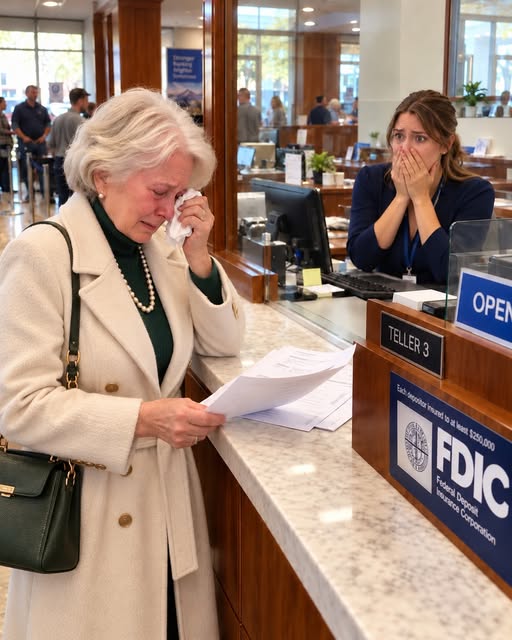
The bank manager placed the sealed envelope on the counter, then looked at me with an expression I couldn’t understand.
“Mrs. Whitmore,” she said quietly, “before you open this, I need you to sit down.”
My name is Eleanor Whitmore. I was sixty-five years old, wearing a faded gray coat I’d owned for nearly twelve winters, and carrying a handbag whose broken zipper I’d repaired with a safety pin.
I had come to the bank because I was running out of choices.
Not because I wanted to revisit my marriage.
Not because I wanted to think about Gregory.
And certainly not because I expected anything extraordinary.
I simply needed enough money to pay for medical treatment.
Yet the woman standing before me looked as though she was about to deliver news that would change my life.
“Is something wrong?” I whispered.
She glanced toward the young teller.
Then back at me.
“Your account has been flagged for special handling because of instructions attached to it.”
My stomach tightened.
“What instructions?”
She hesitated.
“Instructions concerning a sealed letter and a financial arrangement established five years ago.”
I stared at her.
“By my ex-husband?”
She nodded.
I felt the familiar ache of his name before she even said it.
Gregory.
The man who had walked away from thirty-seven years of marriage without turning around.
The man who had handed me a bank card outside the courthouse as though it were payment for a lifetime of devotion.
The man whose final words to me had been, “It should help you get by.”
I looked down at the envelope.
My full name was written across the front.
Eleanor Margaret Whitmore.
In Gregory’s handwriting.
I recognized the long curve of the E and the sharp angle of the W.
For thirty-seven years, I’d seen that handwriting on grocery lists, birthday cards, mortgage documents, and little notes he used to leave beside my coffee cup.
Now, five years after our divorce, it was staring back at me.
I suddenly felt as though I couldn’t breathe.
“Please,” I whispered. “Just tell me how much money is in the account.”
The manager pulled out a chair.
“Mrs. Whitmore, the available balance is considerably higher than the original amount.”
I gripped the counter.
“How much higher?”
She turned the computer screen slightly, careful to keep it from the view of other customers.
Then she pointed to a number.
I stared.
Read it again.
And felt the room tilt beneath me.
$487,216.43.
For several seconds, I couldn’t understand what I was seeing.
There were too many digits.
Too many numbers.
Too much money.
I had expected three thousand dollars.
Perhaps less, if Gregory had lied.
But nearly half a million?
My knees weakened.
The manager reached for my arm.
“Mrs. Whitmore?”
I whispered, “There must be a mistake.”
She shook her head.
“We’ve verified the account information.”
I looked at her.
“That’s impossible.”
She gently guided me toward a chair.
“Let’s go somewhere private.”
I followed her into a small office with cream-colored walls, a polished wooden desk, and a window overlooking the street.
Outside, Minneapolis traffic moved through the gray morning.
People hurried along the sidewalk carrying coffee cups and briefcases.
The world continued as though nothing had happened.
But inside that office, my entire life had just been turned upside down.
The manager introduced herself as Patricia Reynolds.
She offered me water.
I declined.
My hands were shaking too badly to hold a glass.
Patricia placed the envelope in front of me.
“Mrs. Whitmore, this letter was deposited with the bank five years ago. Our records indicate that you were to receive it when you first requested access to the account after that date.”
I stared at the envelope.
“Gregory left it?”
“Yes.”
“Why?”
Patricia’s expression softened.
“I believe the letter may explain.”
I looked down.
The envelope was sealed.
For five years, it had waited for me.
Through every freezing winter.
Every unpaid bill.
Every night I went to sleep hungry.
Every morning I woke wondering how much longer I could continue.
I had carried that bank card like a wound.
And all along, something extraordinary had been waiting behind it.
But before I opened the letter, one terrible thought crossed my mind.
What if Gregory had been laughing at me all this time?
What if this was another cruel game?
I took a breath.
Then broke the seal.
Inside were three folded pages.
And the first sentence made my heart stop.
Eleanor, if you’re reading this, then you’ve finally decided that your life matters more than your pride.
I stared at those words.
My vision blurred.
I wanted to tear the letter in half.
How dare he?
How dare the man who abandoned me lecture me about pride?
I had spent five years cleaning strangers’ homes.
Five years wearing shoes with holes in the soles.
Five years pretending I wasn’t hungry when my children called.
And he was telling me that my suffering was about pride?
I almost stopped reading.
But then I saw the next sentence.
I know you hate me, and I don’t blame you.
My fingers tightened around the paper.
There are things I should have told you before I walked out of that courthouse. Things I was too ashamed and too frightened to explain.
I swallowed.
The money on that card was never meant to be a farewell gift.
I read the sentence again.
Then again.
It was meant to be the beginning of something I hoped would give you the freedom you spent thirty-seven years giving everyone else.
My throat tightened.
I continued.
But I made the worst mistake of my life by believing that money could explain what words could not.
I looked toward Patricia.
She sat quietly across from me.
I returned to the letter.
Eleanor, I need you to know that the account was established in your name. The money placed in it belongs to you under the arrangement we made, and the bank can explain the details. I cannot take it back simply because you are angry with me.
My hands began trembling harder.
I know you will be angry. You should be. I handled our marriage, our divorce, and the truth terribly.
Then came the sentence that made me cover my mouth.
But there is something about the final years of our marriage that you never knew.
I stopped breathing.
For thirty-seven years, I had believed I knew Gregory Whitmore.
He had been a hardworking man.
Quiet.
Practical.
Sometimes stubborn.
But never cruel.
At least, not until the end.
Our marriage hadn’t been perfect.
No marriage lasting nearly four decades ever is.
We argued about money.
About work.
About whether the children should be allowed to make their own mistakes.
But we had built a life together.
We had raised two children.
Buried our parents.
Paid off our mortgage.
Celebrated birthdays and anniversaries.
And held each other through difficult times.
Then, almost overnight, Gregory changed.
He became distant.
Stopped eating dinner with me.
Spent long evenings away from home.
And began locking his office door.
When I asked what was wrong, he said he was tired.
When I asked whether there was someone else, he refused to answer.
Eventually, he told me he wanted a divorce.
No explanation.
No discussion.
Just the end.
I had begged him to reconsider.
He had looked at me with cold, exhausted eyes and said, “Eleanor, it’s over.”
I had never understood why.
Now, sitting in a bank office five years later, I was finally reading his explanation.
Three years before our divorce, I discovered that the company I’d spent most of my career building was in serious financial trouble.
I frowned.
Gregory had worked in commercial equipment distribution.
He wasn’t wealthy.
We had lived comfortably, but carefully.
He had spent decades building relationships with suppliers and customers.
I knew the business had experienced difficult years.
But he had never told me it was in danger.
I kept reading.
I had trusted the wrong business partner. There were liabilities I didn’t fully understand, obligations that threatened everything we’d saved, and decisions I had made without discussing them with you.
My stomach tightened.
I was ashamed, Eleanor. More ashamed than I can explain.
I remembered the final years of our marriage.
The late nights.
The silence.
The tension.
The way Gregory seemed to age ten years in a single winter.
I believed that separating our finances and ending our marriage would protect you from the consequences of my mistakes. I now understand that I should have been honest and sought proper advice with you instead of making that decision alone.
I closed my eyes.
So that was his explanation.
He had been afraid.
Afraid of losing the business.
Afraid of losing our savings.
Afraid of admitting he’d made mistakes.
And instead of trusting me, he’d pushed me away.
I felt anger rising through my chest.
Because even if every word were true, it didn’t excuse what he’d done.
I would have stood beside him.
I would have helped.
We could have faced the problem together.
Instead, he had treated me like a burden he needed to remove.
I turned the page.
During the divorce, the financial settlement was more complicated than you were told in our final conversation. The card I handed you was linked to a separate account that had been funded through a lawful arrangement established for your benefit.
I frowned.
I remembered signing documents.
So many documents.
I had been devastated.
Exhausted.
Barely able to think.
My attorney had explained the settlement, but I had been so focused on the loss of my marriage that much of the financial language had passed through my mind like fog.
I remembered being told that certain proceeds would be placed in a protected account.
But Gregory had handed me the card and said there were three thousand dollars.
I had assumed that was all.
The original account balance was three thousand dollars because the larger transfer had not yet been completed when I gave you the card. I should have told you that. I should have made sure you understood the settlement. Instead, I walked away.
I stared at the words.
Then I looked up.
“Patricia,” I whispered, “what exactly is this account?”
She leaned forward.
“It’s an individually owned deposit account in your name. The original balance was three thousand dollars. Additional funds were credited over time from a settlement-related source, and interest accrued. We can provide the complete transaction history.”
I swallowed.
“Settlement-related?”
She nodded.
“The records indicate that the larger deposits were associated with a financial arrangement documented at the time of your divorce.”
I looked down at the letter.
The money wasn’t a mysterious gift Gregory could reclaim whenever he wished.
It was money connected to a settlement I had never properly understood.
Money that had been sitting in my name while I struggled to survive.
A terrible mixture of relief and anger filled my chest.
I continued reading.
The business was eventually sold. After the legitimate obligations were resolved, the portion designated for you was transferred according to the settlement arrangement. The bank has the records. I want you to verify everything independently.
My eyes filled.
I know this doesn’t make up for the way I treated you.
I nodded through tears.
No.
It didn’t.
I know money cannot replace the years we lost.
I pressed the letter against my chest.
And I know you may never forgive me.
For a moment, I couldn’t see the page.
Then I read the final paragraph.
But Eleanor, please do one thing for me. Live. Buy the warm coat you always said you didn’t need. Eat the meals you used to skip so the children could have more. See the places you dreamed of visiting. Get the medical care you deserve. And stop believing that your needs should always come last.
I began crying.
Not softly.
Not gracefully.
I cried the way I had wanted to cry outside that courthouse five years earlier.
The way I had wanted to cry during every lonely winter night.
The way I had wanted to cry when I couldn’t afford groceries.
Patricia quietly placed a box of tissues beside me.
I covered my face.
And for several minutes, I couldn’t speak.
When I finally looked up, she said gently, “Would you like some time alone?”
I shook my head.
“No.”
My voice sounded strange.
“I need to understand something.”
She nodded.
“Of course.”
I looked at the computer screen.
“Is the money really mine?”
“Yes. The account is titled in your name, and you are the authorized owner. We’ll provide the account documents and transaction records so you can review them.”
I swallowed.
“And I can use it?”
“Yes, subject to the account’s normal terms and applicable banking requirements.”
I stared at her.
“Even for medical treatment?”
Her expression softened.
“Mrs. Whitmore, you don’t need to justify spending your own money on your health.”
That was when I started crying again.
Because for five years, I had believed I had nothing.
And now someone was telling me that I didn’t need permission to take care of myself.
Patricia helped me review the account information.
She explained the deposits.
The interest.
The identification requirements.
The available withdrawal options.
She also recommended that I consult an independent financial adviser and a tax professional before making large transfers.
I agreed.
For the first time in years, I wasn’t thinking about how to survive until Friday.
I was thinking about how to rebuild my life.
Before leaving, I asked one more question.
“Patricia, do you know where Gregory is now?”
She hesitated.
“The bank can’t disclose another customer’s private information.”
I nodded.
“Of course.”
Then she glanced toward the letter.
“Perhaps he included contact information.”
I looked at the final page.
There, beneath his signature, was an address.
Not in Minneapolis.
Not even in Minnesota.
A small town in Wisconsin.
I stared at it.
And something inside me shifted.
For five years, I had imagined Gregory living comfortably somewhere.
Perhaps with another woman.
Perhaps traveling.
Perhaps enjoying the freedom he’d claimed to want.
I had pictured him laughing over expensive dinners while I counted coins for bread.
Now I wondered whether any of those assumptions were true.
But before I could think about Gregory, I had something more important to do.
I needed to take care of myself.
That afternoon, I called the clinic.
The receptionist recognized my voice.
“Mrs. Whitmore?”
“Yes.”
“Are you calling about your treatment appointment?”
I swallowed.
“Yes.”
She hesitated.
“Were you able to arrange the payment?”
I looked down at the bank documents spread across my kitchen table.
Then smiled through tears.
“Yes,” I whispered. “I was.”
She sounded relieved.
“That’s wonderful. We can schedule you for next week.”
I closed my eyes.
For the first time in months, I felt hope.
Not certainty.
Not a guarantee that everything would be fine.
But hope.
And that was enough.
I scheduled the appointment.
Then called my daughter, Rebecca.
She answered on the third ring.
“Mom?”
I smiled.
“Hello, sweetheart.”
“Are you okay?”
I hesitated.
For years, I had answered that question with the same lie.
I’m fine.
Don’t worry.
Everything’s okay.
But not this time.
“No,” I said quietly. “I haven’t been okay.”
There was silence.
Then Rebecca’s voice changed.
“Mom, what’s wrong?”
I sat down.
And told her everything.
The hunger.
The unpaid bills.
The clinic.
The bank card.
The account.
The letter.
By the time I finished, Rebecca was crying.
“Mom, why didn’t you tell us?”
My heart tightened.
“Because you have your own family to care for.”
She began sobbing.
“Mom, you’re our family.”
I covered my mouth.
She continued.
“You should never have been going hungry.”
I closed my eyes.
“I didn’t want to burden you.”
Her voice broke.
“Please don’t ever say that again.”
I began crying.
Because suddenly, I understood something.
I had spent so many years protecting my children from worry that I had denied them the chance to love me in return.
That evening, Rebecca arrived with her husband and their two children.
My son, Thomas, came an hour later.
They crowded into my tiny rented room.
For the first time, I felt embarrassed by the water stains on the ceiling.
The old blankets.
The cracked dishes.
The nearly empty refrigerator.
Rebecca opened the refrigerator and went completely still.
“Mom.”
I looked down.
There was half a carton of milk.
Two eggs.
And a small container of leftover soup.
She turned toward me.
“Is this all you’ve been eating?”
I couldn’t answer.
Thomas looked around the room.
Then sat down heavily.
“Mom, why didn’t you tell us how bad it was?”
I stared at my hands.
“Because I thought I could manage.”
Rebecca began crying again.
My grandson, eight-year-old Oliver, walked toward me.
“Grandma?”
I looked down.
“Yes, sweetheart?”
He wrapped his arms around my waist.
“You can come live with us.”
I began crying.
I held him tightly.
And for a moment, all the money in the world seemed less important than the warmth of that small embrace.
We talked for hours.
I showed Rebecca and Thomas the bank documents.
The letter.
The transaction history.
They were stunned.
Thomas read Gregory’s letter twice.
Then placed it on the table.
“Mom, this doesn’t make what Dad did okay.”
I nodded.
“I know.”
Rebecca wiped her eyes.
“He should have told you.”
“Yes.”
Thomas looked at me.
“But the money is yours. You need to use it.”
I took a breath.
“I intend to.”
He smiled faintly.
“Good.”
Then Rebecca said something that made me laugh through tears.
“And tomorrow, we’re taking you shopping.”
I blinked.
“Shopping?”
She nodded firmly.
“For a proper winter coat.”
I looked down at my faded gray coat.
Then laughed.
For the first time in years, I laughed without feeling guilty.
The following morning, Rebecca arrived at nine.
She brought coffee.
Fresh pastries.
And a determination that reminded me painfully of myself when I was younger.
We went to a department store.
I hadn’t entered one in years.
The bright lights.
The beautiful displays.
The rows of warm coats.
Everything felt overwhelming.
Rebecca led me toward a rack of winter jackets.
“Try this one.”
I looked at the price.
Four hundred and twenty dollars.
I nearly dropped it.
“Rebecca, absolutely not.”
She smiled.
“Mom.”
“That’s too much.”
She took the coat from the hanger.
“Try it on.”
I hesitated.
Then slipped my arms into the sleeves.
It was soft.
Warm.
Beautiful.
A deep navy blue.
The kind of coat I’d admired on other women but never imagined buying for myself.
Rebecca stood behind me.
She looked at my reflection.
Then began crying.
“Mom, you look beautiful.”
I stared at the mirror.
The woman looking back at me seemed older than I remembered.
Her hair was silver.
Her face lined.
Her shoulders slightly bent.
But there was something else.
A softness in her expression.
A little spark.
A reminder of the woman I had been before poverty and heartbreak convinced me I no longer deserved anything good.
I touched the coat.
Then whispered, “I’ll take it.”
Rebecca laughed through tears.
And I felt as though I’d just made the bravest purchase of my life.
Over the following weeks, I began treatment.
My doctors reviewed my condition and developed a plan.
There were appointments.
Tests.
Medications.
And difficult days when I felt exhausted.
But I no longer had to choose between medical care and groceries.
I could afford transportation.
Proper meals.
Warm clothing.
And a safe place to recover.
I also began working with an independent financial planner.
A woman named Susan Keller.
She reviewed my bank records, retirement benefits, monthly expenses, and long-term needs.
She explained that having a substantial account balance didn’t mean I should spend carelessly.
I agreed.
After five years of poverty, I understood the value of every dollar.
We developed a budget.
Set aside funds for medical care.
Created an emergency reserve.
And discussed housing options.
I didn’t want luxury.
I wanted security.
A warm home.
A reliable car.
Enough money for groceries.
And the peace of knowing I wouldn’t have to choose between medicine and food.
Three months later, I moved into a small apartment with large windows and a balcony overlooking a quiet courtyard.
The first night, I stood in the bedroom and stared at the ceiling.
No water stains.
No peeling paint.
No cold air slipping through the window.
I turned on the heat.
Warm air filled the room.
Then I sat on the bed and cried.
Not because I was sad.
Because I was safe.
I had almost forgotten what that felt like.
But even as my life improved, Gregory’s letter remained in my thoughts.
I read it several times.
Sometimes with anger.
Sometimes with sadness.
Sometimes with questions.
I couldn’t understand why he’d chosen silence.
Why he hadn’t contacted me after the larger deposits were made.
Why he’d let five years pass without making sure I knew the money existed.
The more I thought about it, the more I realized I needed answers.
Not because I wanted him back.
Not because I wanted to reopen our marriage.
But because I wanted to understand the truth.
One afternoon, I called the number listed beneath his address.
It rang four times.
Then a woman answered.
“Hello?”
My stomach tightened.
For a moment, I couldn’t speak.
“Hello?” she repeated.
I swallowed.
“I’m looking for Gregory Whitmore.”
There was a pause.
“May I ask who’s calling?”
“My name is Eleanor.”
Silence.
Then the woman’s voice softened.
“Oh.”
My heart began pounding.
“Is he there?”
Another pause.
“Mrs. Whitmore, my name is Helen. I’m Gregory’s sister.”
I closed my eyes.
Helen.
Of course.
Gregory’s younger sister had moved to Wisconsin years earlier.
We hadn’t spoken since the divorce.
“Helen,” I whispered.
“Eleanor.”
Her voice trembled.
“I wondered if you would ever call.”
I gripped the phone.
“Where is Gregory?”
There was a long silence.
Then Helen said something that made my knees weaken.
“Eleanor, Gregory has been very ill.”
I sat down.
“What?”
She took a breath.
“He’s been receiving treatment for a serious heart condition.”
My chest tightened.
“How long?”
“Several years.”
I closed my eyes.
“Why didn’t anyone tell me?”
Helen’s voice broke.
“He asked us not to.”
I felt anger rise.
“Of course he did.”
She was silent.
I continued.
“He always thought he could decide everything for everyone.”
Helen sighed.
“I know.”
I looked toward the window.
“Is he dying?”
She hesitated.
“His health is fragile. But I don’t want to frighten you unnecessarily. He’s receiving medical care.”
I swallowed.
“Does he know I found the account?”
“No.”
I looked down at the letter.
Then whispered, “I need to speak with him.”
Helen was quiet.
Finally, she said, “I’ll ask whether he’s willing.”
Two days later, she called back.
“Eleanor?”
“Yes?”
“Gregory would like to see you.”
I closed my eyes.
For five years, I had imagined what I would say if I ever saw him again.
Sometimes I imagined shouting.
Sometimes I imagined walking past him without a word.
Sometimes I imagined asking whether he’d ever loved me.
But now, with the opportunity finally before me, I felt strangely uncertain.
I didn’t know whether I wanted to see him.
I only knew I needed to understand what had happened.
Rebecca offered to drive me to Wisconsin.
I accepted.
The journey took several hours.
We passed fields.
Small towns.
Quiet roads lined with trees.
I watched the landscape through the window.
My hands rested on my lap.
The navy coat lay folded beside me.
Rebecca glanced over.
“Mom, are you nervous?”
I smiled sadly.
“Yes.”
She reached for my hand.
“You don’t have to do this.”
I nodded.
“I know.”
She looked at me.
“Then why are you going?”
I stared out the window.
“Because I spent five years wondering why my marriage ended.”
My voice trembled.
“And I don’t want to spend the rest of my life wondering.”
When we arrived, Helen met us outside a modest house near the edge of town.
She looked older.
Her hair was completely gray.
But her smile was familiar.
She hugged me tightly.
“Eleanor.”
I held her.
For a moment, we were two women who had once shared family dinners, holidays, and decades of memories.
Then Helen stepped back.
“He’s inside.”
I took a breath.
Rebecca squeezed my hand.
“I’ll wait here.”
I nodded.
Then followed Helen into the house.
The living room was simple.
A comfortable sofa.
A small fireplace.
Bookshelves.
Photographs.
And an old wooden clock ticking softly on the mantel.
Gregory sat in an armchair near the window.
When I saw him, I stopped.
He looked so different.
Thinner.
Older.
His hair almost completely white.
His shoulders narrower.
But his eyes were the same.
The same blue-gray eyes I’d looked into on our wedding day.
The same eyes that had watched our children take their first steps.
The same eyes that had looked away from me outside the courthouse.
He stood slowly.
“Eleanor.”
My throat tightened.
“Gregory.”
For several seconds, we simply stared at each other.
Then he whispered, “You look well.”
I almost laughed.
Five years.
Five years of hunger.
Cold.
Loneliness.
And now he was telling me I looked well.
I sat across from him.
“Gregory, I found the account.”
He closed his eyes.
“I know.”
I frowned.
“How?”
“Helen told me you called.”
I looked at him.
“Nearly half a million dollars.”
He nodded.
“Yes.”
I took a breath.
“Why didn’t you tell me?”
He looked down.
“I thought the bank would.”
I stared at him.
“You thought?”
He swallowed.
“I left instructions.”
I felt anger rising.
“Gregory, I spent five years believing you had given me three thousand dollars and walked away.”
His eyes filled.
“I know.”
“No,” I said sharply. “You don’t know.”
He looked up.
I continued.
“I cleaned houses until my hands bled.”
His face changed.
“I skipped meals.”
Tears filled his eyes.
“I lived in a room where the windows froze from the inside.”
He covered his mouth.
“And I nearly collapsed because I couldn’t afford proper treatment.”
Gregory began crying.
I stared at him.
“Do you understand what your silence cost me?”
He nodded through tears.
“I do now.”
I shook my head.
“You don’t get to call that protection.”
He closed his eyes.
“I know.”
I leaned forward.
“You don’t get to abandon me, hide the truth, and then tell yourself you were doing something noble.”
His shoulders shook.
“I know.”
I took a breath.
“Then why?”
He stared at the floor.
For a long time, he didn’t speak.
Then he whispered.
“Because I was a coward.”
The room went silent.
He looked up.
“I was ashamed.”
I stared at him.
“I’d made mistakes in the business. Serious mistakes. I thought I could fix them without telling you.”
His voice trembled.
“But every time I tried, things got worse.”
I waited.
He continued.
“I convinced myself that if I separated you from the business and ended the marriage, I could protect you from the fallout.”
I shook my head.
“You could have told me.”
He nodded.
“I should have.”
“We were married for thirty-seven years.”
His eyes filled.
“I know.”
“We faced everything together.”
He began crying.
“I know.”
I looked away.
Then whispered.
“Until you decided I wasn’t worth trusting.”
He covered his face.
And for the first time, I saw Gregory understand what he’d truly done.
He hadn’t simply ended our marriage.
He had taken away my ability to make decisions about my own life.
He had decided what I could handle.
What I should know.
And what kind of future I deserved.
Without asking me.
I sat back.
“Why didn’t you contact me after the money was deposited?”
He wiped his eyes.
“I tried once.”
I frowned.
“When?”
“About a year after the divorce.”
I stared at him.
“I never heard from you.”
He nodded.
“I called your old number. It was disconnected.”
I closed my eyes.
I had changed numbers when I could no longer afford the plan.
Gregory continued.
“I thought about writing.”
I looked at him.
“But you didn’t.”
He shook his head.
“No.”
“Why?”
His voice broke.
“Because I was afraid you’d send the letter back.”
I stared at him.
Then laughed bitterly.
“So you let me live without knowing.”
He lowered his head.
“Yes.”
I sat quietly.
For a moment, I felt the full weight of everything we’d lost.
Thirty-seven years of marriage.
Five years of silence.
And a future that could never be recovered.
Gregory looked toward me.
“Eleanor, I never stopped caring about you.”
My eyes filled.
I took a breath.
“Caring isn’t enough, Gregory.”
He nodded.
“I know.”
“Love without honesty isn’t the kind of love I needed.”
His face crumpled.
“I know.”
I looked toward the window.
Then said quietly.
“I don’t know whether I can forgive you.”
He nodded.
“I understand.”
I stood.
Gregory looked up.
“Eleanor?”
I turned.
He hesitated.
“Are you happy now?”
The question surprised me.
I thought about my new apartment.
My warm coat.
My treatment.
My children.
My grandchildren.
The peace of waking up without wondering whether I could afford breakfast.
I smiled faintly.
“I’m learning.”
His eyes filled.
“Good.”
I walked toward the door.
Then stopped.
“Gregory?”
He looked up.
“Yes?”
I took a breath.
“Thank you for making sure the money was legally mine.”
His eyes filled.
I continued.
“But I wish you’d trusted me enough to tell me the truth.”
He nodded.
“So do I.”
I left without hugging him.
Without promising to return.
Without pretending everything was repaired.
Because some wounds don’t disappear simply because someone finally explains how they were made.
Outside, Rebecca stood beside the car.
When she saw my face, she opened her arms.
I walked into them.
And cried.
She held me tightly.
For a long time, neither of us spoke.
Then she whispered.
“Mom, are you okay?”
I took a breath.
For the first time, I answered honestly.
“Not completely.”
She nodded.
I looked toward the house.
“But I think I will be.”
Over the following months, my life continued changing.
My health improved with treatment and consistent care.
I regained strength.
Started walking every morning.
And began cooking meals I actually wanted to eat.
Not just whatever was cheapest.
I bought fresh fruit.
Vegetables.
Good bread.
And occasionally, flowers for my kitchen table.
The first time I bought a bouquet simply because I liked it, I stood in the grocery store smiling like a little girl.
It cost twelve dollars.
For years, I would have considered that an impossible luxury.
Now I understood that joy didn’t always need a practical justification.
I began volunteering at a community center that helped older adults navigate difficult transitions.
Some had lost spouses.
Some were struggling financially.
Some had been abandoned by people they trusted.
I didn’t tell everyone my story.
But when someone felt ashamed of needing help, I understood.
When someone apologized for asking a question, I understood.
And when someone insisted they were fine while their eyes filled with tears, I understood that too.
One afternoon, a woman named Margaret came into the center.
She was seventy-two.
Recently widowed.
And frightened about managing her finances.
She sat across from me, twisting a tissue between her fingers.
“I don’t want to bother anyone,” she whispered.
I smiled gently.
“Margaret, asking for help isn’t bothering someone.”
Her eyes filled.
“I’ve always handled things myself.”
I nodded.
“So have I.”
She looked at me.
“Then you understand.”
I smiled.
“More than you know.”
That afternoon, I helped her find the appropriate financial counseling resources.
And as she left, she hugged me.
“Thank you,” she whispered.
I watched her walk away.
Then sat quietly for a moment.
Because I realized something.
The years of hardship hadn’t been meaningless.
They had taught me compassion.
But that didn’t mean the hardship had been necessary or deserved.
I could use what I’d learned without pretending the suffering had been a gift.
One evening, Thomas invited me to dinner.
His wife had made roast chicken.
The grandchildren were laughing.
And the house smelled of warm bread.
We sat around the table.
For the first time in years, I didn’t feel like an outsider watching everyone else live comfortably.
I felt like part of the family.
After dinner, Thomas walked me to the door.
“Mom?”
I smiled.
“Yes?”
He hesitated.
“I’ve been thinking about something.”
I waited.
He looked down.
“When Dad left, I should have checked on you more.”
My heart tightened.
“Thomas.”
He shook his head.
“No, Mom. Let me say it.”
I nodded.
He continued.
“You always told us you were fine. And I wanted to believe you because I had so much going on.”
His eyes filled.
“I should have asked more questions.”
I touched his cheek.
“Sweetheart, you were doing your best.”
He swallowed.
“Maybe. But I want to do better.”
I smiled through tears.
“Then let’s do better together.”
He hugged me.
And for the first time, I understood that rebuilding my life wasn’t something I had to do alone.
Months later, Helen called.
Gregory’s health had worsened.
He had been hospitalized.
She didn’t ask me to come.
She simply wanted me to know.
I sat quietly after the call.
For a long time, I stared at the wall.
Then I opened the wooden box where I’d once kept the bank card.
The box was still there.
The card had been replaced after the account review.
But I had kept the original.
Not because I wanted to remember Gregory’s cruelty.
But because it reminded me of the moment I finally chose to survive.
I held the card in my hand.
Then looked toward the window.
I thought about the man I’d married.
The young Gregory who had worked two jobs so we could afford our first apartment.
The father who carried our sleeping children upstairs.
The husband who brought me flowers on our anniversary.
And the man who had walked away without explaining why.
Both versions were real.
The kindness didn’t erase the harm.
And the harm didn’t erase every good memory.
I realized I didn’t need to simplify our marriage into one story.
It had been beautiful.
It had been difficult.
And it had ended painfully.
All of those things could be true.
I called Helen.
“I’d like to visit.”
She sounded relieved.
“Of course.”
This time, I went alone.
Gregory was sitting beside a hospital window when I arrived.
He looked tired.
But he smiled when he saw me.
“Eleanor.”
I sat beside him.
“Hello, Gregory.”
For several minutes, we talked about ordinary things.
The weather.
The children.
The grandchildren.
He asked about my health.
I told him I was improving.
He smiled.
“I’m glad.”
Then he looked toward the window.
“Eleanor, there’s something I’ve wanted to ask you.”
I waited.
He swallowed.
“Do you think there was ever a chance we could have saved our marriage?”
The question hung between us.
I thought about it carefully.
Then answered.
“Yes.”
His eyes filled.
I continued.
“If you’d told me the truth.”
He looked down.
“If you’d trusted me.”
Tears rolled down his cheeks.
“If you’d let me stand beside you instead of deciding everything alone.”
He covered his face.
I took a breath.
“But we can’t go back.”
He nodded.
“I know.”
I looked at him.
“We can only decide what to do with the time we have now.”
He wiped his eyes.
“What does that mean?”
I smiled sadly.
“It means I don’t want to spend the rest of my life hating you.”
His face crumpled.
“But it doesn’t mean I want our marriage back.”
He nodded.
“I understand.”
I reached for his hand.
It felt familiar.
Older.
Thinner.
But familiar.
“Gregory, I forgive you for being afraid.”
He began crying.
I continued.
“But I won’t pretend your choices didn’t hurt me.”
He squeezed my hand.
“I wouldn’t ask you to.”
I nodded.
“Good.”
For a long time, we sat quietly.
Two people who had shared nearly four decades.
Who had loved each other.
Hurt each other.
And finally found a way to speak honestly.
When I left, Gregory smiled.
“Eleanor?”
I turned.
“Yes?”
“I’m proud of you.”
I looked at him.
Then smiled faintly.
“I’m proud of me too.”
That was the last time I saw him alive.
Three weeks later, Helen called.
Gregory had passed away peacefully.
I sat on my sofa holding the phone.
For a long time, I couldn’t speak.
I had known his health was fragile.
But knowing doesn’t make loss easy.
I cried.
Not because I wanted our marriage back.
Not because I regretted protecting myself.
But because someone who had been part of my life for thirty-seven years was gone.
The man who knew me when I was young.
The father of my children.
The person who had shared so many ordinary days with me.
Gone.
At his memorial, I sat beside Rebecca and Thomas.
There were photographs of Gregory as a young man.
At work.
On family vacations.
Holding the children.
Standing beside me on our wedding day.
I looked at that photograph for a long time.
The bride was twenty-three.
Smiling.
Hopeful.
Certain that love would be enough.
I wanted to reach into the photograph and tell her something.
Love matters.
But so does honesty.
So does trust.
And so does the courage to face difficult things together.
After the service, Helen approached me.
“Eleanor.”
I smiled sadly.
“Helen.”
She handed me a small envelope.
“Gregory asked me to give you this after he was gone.”
My chest tightened.
Another envelope.
Another message.
For a moment, I almost laughed through tears.
Gregory had spent so much of his life unable to say difficult things aloud.
And now, even after death, he was still leaving letters.
I opened it that evening at home.
Inside was a single page.
Eleanor,
If you’re reading this, then my time has ended.
I have spent years regretting the way I treated you.
I thought I was protecting you by making decisions alone. In truth, I was protecting myself from the shame of admitting I had failed.
You deserved honesty.
You deserved partnership.
And you deserved the chance to decide your own future.
I am grateful that you came to see me.
I am grateful that you found the account.
And I am grateful that you are finally living the life you deserve.
Please don’t spend another day believing that your needs are less important than anyone else’s.
Buy the flowers.
Take the trip.
Eat the good bread.
Laugh with our grandchildren.
And when you think of me, I hope you can remember some of the good years without feeling obligated to forget the painful ones.
You were the strongest person I ever knew.
I just wish I had been brave enough to stand beside you.
Gregory.
I folded the letter.
Placed it in the wooden box.
And cried.
Then I made a cup of tea.
Sat beside the window.
And watched the evening settle over Minneapolis.
For the first time, I felt that the story of our marriage had finally reached its end.
Not a perfect ending.
Not the one I’d imagined when I was twenty-three.
But an ending that allowed me to move forward.
The following spring, I took my first real vacation in more than twenty years.
Rebecca and I traveled to the coast of Maine.
We stayed in a small inn overlooking the ocean.
Every morning, we walked along the shore.
Collected shells.
Drank coffee.
And watched the waves.
One afternoon, we sat on a bench overlooking the water.
Rebecca looked at me.
“Mom, are you happy?”
I thought about the question.
Five years earlier, I would have said yes even if I wasn’t.
I would have smiled.
Changed the subject.
And insisted everything was fine.
But now I answered honestly.
“Yes.”
Rebecca smiled.
“Really?”
I nodded.
“Really.”
I looked toward the ocean.
“Not because everything turned out the way I wanted.”
She waited.
“But because I finally understand that my life isn’t over.”
Her eyes filled.
I continued.
“I’m sixty-five, Rebecca. I spent so many years believing that my best days were behind me.”
She squeezed my hand.
“And now?”
I smiled.
“Now I think some of them are still ahead.”
We sat quietly.
The waves rolled toward the shore.
The sky stretched endlessly above us.
And I felt something I hadn’t felt in years.
Freedom.
Not the kind that comes from having money.
Although financial security had changed my life.
But the freedom of knowing I could make choices.
I could say no.
I could ask for help.
I could take care of myself.
And I didn’t have to earn the right to be comfortable by suffering first.
Today, I still live in my small apartment.
I still budget carefully.
I still compare prices at the grocery store.
And I still feel a little guilty sometimes when I buy something just because I want it.
Old habits take time to change.
But I no longer skip meals to prove a point.
I no longer pretend I’m fine when I’m not.
And I no longer believe that accepting money legally belonging to me means surrendering my dignity.
The bank account changed my circumstances.
But the greatest change happened inside me.
I learned that pride can become a prison when it prevents us from accepting help.
I learned that silence can cause as much damage as cruelty.
And I learned that a woman who has spent her life caring for others deserves care too.
Sometimes I think about that morning at the bank.
The young teller staring at her screen.
The manager approaching with a sealed envelope.
The number that seemed impossible.
And the letter that finally revealed what Gregory had hidden.
I had walked into that bank expecting three thousand dollars.
Enough to begin treatment.
Enough to buy medicine.
Enough to survive another month.
Instead, I discovered nearly half a million dollars that had been waiting in an account bearing my name.
But the money wasn’t the most important discovery.
The most important discovery was that I still had a future.
A future that belonged to me.
Not Gregory.
Not my children.
Not the bank.
Me.
Last week, I bought a new wooden box.
A beautiful one with a carved lid.
I placed Gregory’s letters inside.
Along with the old bank card.
Then I added a photograph of myself standing on the coast of Maine.
In the photograph, I’m wearing my navy blue coat.
My silver hair is blowing in the wind.
And I’m smiling.
Not politely.
Not because someone asked me to.
But because I’m genuinely happy.
I placed the box on a shelf beside my favorite books.
Then I looked around my apartment.
The warm rooms.
The comfortable furniture.
The flowers on the table.
The sunlight streaming through the windows.
And I smiled.
Because five years earlier, I had believed my life was over.
I had believed thirty-seven years of marriage had ended with a bank card and three thousand dollars.
I had believed that surviving meant enduring whatever came next.
But I was wrong.
My life hadn’t ended outside that courthouse.
It had simply taken a painful turn.
And when I finally walked into the bank five years later, I discovered that the next chapter was still waiting to be written.
I may have lost my marriage.
I may have lost years to poverty and heartbreak.
And I may never fully understand why Gregory chose silence instead of honesty.
But I found something I hadn’t realized I’d lost.
Myself.
And at sixty-five, that was worth more than any amount of money.
THE END.