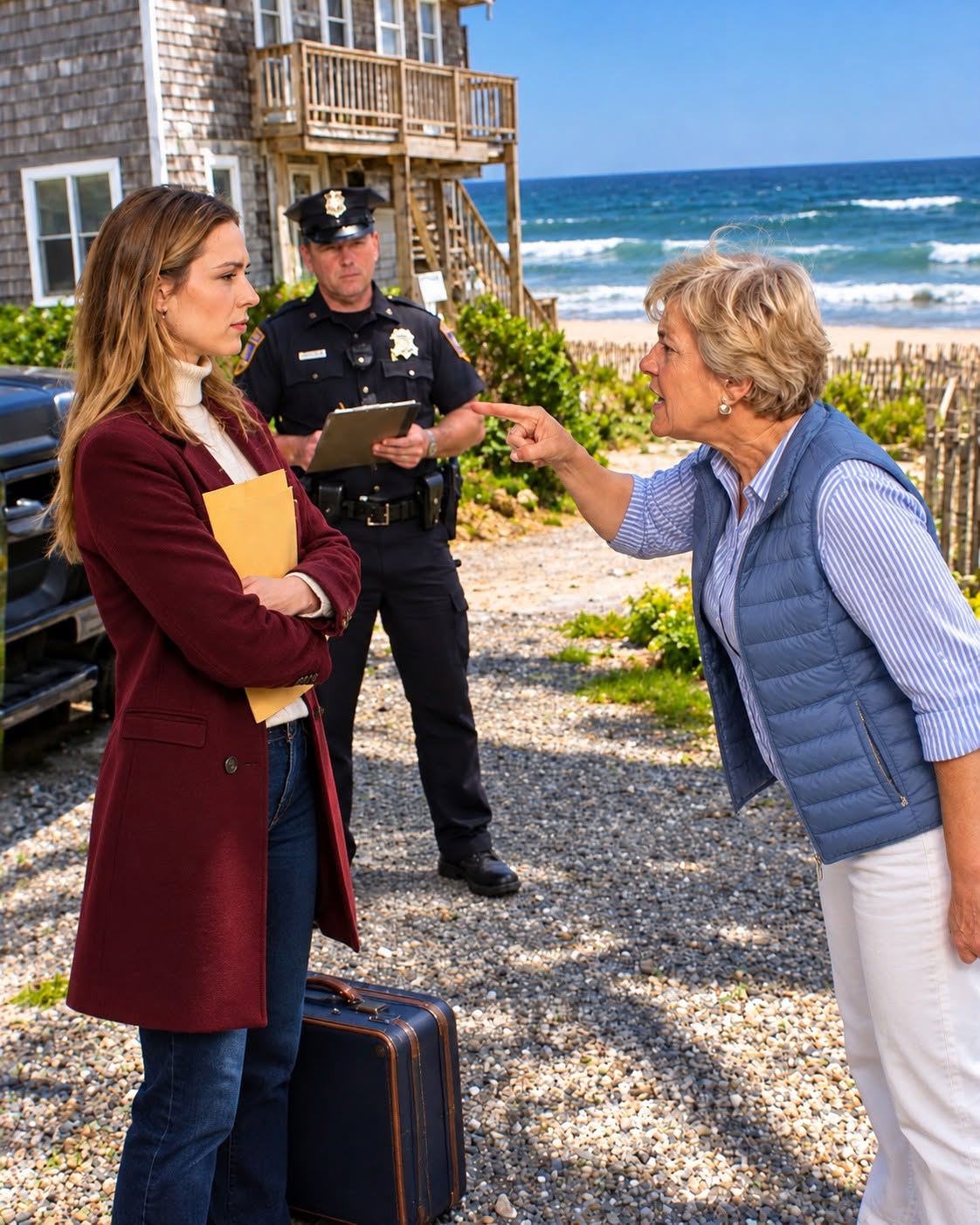
The unfamiliar number had a North Carolina area code.
I stared at the message.
“Ms. Rebecca Bennett? This is Thomas Reed from Coastal Security Services. We’ve completed the lock replacement at 418 Oceanview Drive. Mrs. Diana Bennett instructed us to send the final invoice to you because she says you’re responsible for maintaining the property.”
For a moment, I couldn’t believe what I was reading.
Diana had banned me from the beach house.
Changed every lock.
Threatened to have me arrested if I entered.
And then instructed the locksmith to send me the bill.
I actually laughed.
Not because it was funny.
Because after fourteen years of enduring Diana’s entitlement, I had finally encountered something so outrageous that anger seemed inadequate.
I typed a response.
“Thank you, Mr. Reed. Please email me a copy of the invoice and the work authorization, including the name of the person who approved the changes.”
His reply arrived two minutes later.
“Of course, ma’am. Is there a problem?”
I looked at the manila folder resting on my desk.
Inside was a certified copy of the deed.
The trust agreement.
And a letter my mother had written shortly before she died.
I smiled.
“Possibly. My attorney will contact you.”
Then I called Evelyn.
Evelyn Carter had been my mother’s attorney for more than twenty years.
She was sixty eight now, with short silver hair, sharp blue eyes, and a voice that could make a roomful of corporate executives stop talking.
My mother trusted her completely.
So did I.
When Evelyn answered, I didn’t bother with pleasantries.
“Diana changed the locks.”
“I saw your message.”
“She also told the locksmith to bill me.”
There was silence.
Then Evelyn laughed.
It was a short, incredulous sound.
“Rebecca, please tell me you have that in writing.”
“I do.”
“Excellent. Forward it.”
I sent the message.
Evelyn continued, “And don’t go to the property tonight.”
“I wasn’t planning to.”
“Good. We need to handle this properly.”
I sat down.
“She claims Dad transferred the house to her last month.”
Evelyn’s voice changed.
“That’s what concerns me.”
I looked at the documents.
“Can he even do that?”
“Not if the property remains owned by the trust and he has no authority to transfer it.”
I swallowed.
“Then why would she say it?”
Evelyn paused.
“Either she’s lying, she’s mistaken, or someone has attempted a transfer that needs immediate investigation.”
I stared at the wall.
The beach house.
My mother’s house.
The one place where I could still remember what life felt like before cancer took her away.
I took a breath.
“What do we do?”
Evelyn’s answer was immediate.
“We verify the public records, notify the appropriate parties, and make sure nobody takes another step based on Diana’s claims.”
My name is Rebecca Bennett.
I’m thirty two years old, and for most of my adult life, I’ve been the unwanted reminder of a marriage my father preferred to forget.
My mother, Caroline Bennett, died when I was seventeen.
She was forty six.
Beautiful.
Warm.
Stubborn in the best possible way.
She taught high school literature, collected seashells, and believed that every problem became easier to understand after a long walk beside the ocean.
The beach house was her favorite place in the world.
It stood on a quiet stretch of the North Carolina coast, a two story cottage with white railings, pale blue shutters, and a wraparound porch.
My maternal grandparents bought it in the early 1970s.
When they died, they left it to my mother.
She spent years repairing it.
Replacing the roof.
Restoring the floors.
Repainting the shutters.
Planting hydrangeas along the walkway.
She called it Blue Heron Cottage.
I called it home.
Not because I lived there year round.
But because it was the only place where my mother seemed completely happy.
My father, Richard Bennett, never loved the cottage the way she did.
He preferred golf resorts.
Luxury hotels.
Places with room service and valet parking.
He complained about the sand.
The salt air.
The old plumbing.
And the way the porch furniture needed repainting every few years.
Mom would laugh.
“Richard, not everything beautiful needs to be convenient.”
He would shake his head.
But he usually smiled.
At least in the early years.
Later, things changed.
My parents began arguing.
Dad spent more time away from home.
Mom became quieter.
And when she got sick, the distance between them grew into something I didn’t understand until much later.
Three months before her death, Mom asked me to sit beside her bed.
She was weak.
Her hair had thinned.
Her hands were cold.
But her eyes were clear.
“Rebecca, sweetheart, I need you to promise me something.”
I took her hand.
“Anything.”
She smiled sadly.
“Don’t promise before you hear the question.”
I tried to smile.
“Okay.”
She reached toward the bedside table and picked up a thick envelope.
My name was written across the front.
“These are important documents.”
I frowned.
“What kind?”
“The beach house.”
I looked at her.
“What about it?”
She took a slow breath.
“I’ve arranged for it to be held in a trust for you.”
I stared.
“Mom, why?”
She squeezed my hand.
“Because I want you to have somewhere that will always feel like yours.”
My eyes filled.
“But Dad…”
She shook her head gently.
“Your father has his own resources.”
I swallowed.
She continued.
“This house came from my parents. I want it to remain with you.”
I nodded.
“Okay.”
Then she said something I didn’t fully understand until fourteen years later.
“Rebecca, being family doesn’t mean someone gets to take what belongs to you.”
After Mom died, I couldn’t bear to visit the cottage for nearly a year.
Every room reminded me of her.
The blue ceramic bowls.
The books beside the fireplace.
The old rocking chair.
The framed photograph of us building a sandcastle when I was seven.
I was afraid that walking through those rooms without her would break me.
Then, eighteen months after her funeral, Dad married Diana.
She was forty one.
Elegant.
Ambitious.
And extraordinarily skilled at making insults sound like helpful observations.
She had a daughter named Madeline, who was twelve at the time.
Madeline was not the problem.
She was a child.
Sometimes spoiled.
Sometimes demanding.
But mostly shaped by the adults around her.
Diana was different.
She entered our family as though she had purchased it.
She reorganized the kitchen.
Replaced family photographs.
Changed holiday traditions.
And began referring to my mother’s belongings as clutter.
The first time she suggested selling Blue Heron Cottage, I was nineteen.
We were having dinner.
Dad was carving roast chicken.
Diana set down her wineglass.
“Richard, that beach property must be worth a fortune now.”
Dad shrugged.
“Probably.”
She smiled.
“We could sell it and buy something more practical.”
I looked up.
“It’s not for sale.”
Diana turned toward me.
“Rebecca, adults are talking.”
I stared at her.
Dad said nothing.
I took a breath.
“Mom left the cottage to me.”
Diana laughed.
“Oh, sweetheart, you don’t understand how these things work.”
I looked at Dad.
He avoided my eyes.
That was the first time I realized Diana intended to make my mother’s home her own.
Over the next fourteen years, Diana treated Blue Heron Cottage as a family vacation property.
At first, I allowed it.
I was in college.
Then graduate school.
Then beginning my career in corporate communications.
I lived in Charlotte, later moved to Atlanta, and eventually settled in a downtown apartment where my work kept me busy.
The cottage sat empty much of the year.
Dad asked whether he could occasionally use it.
I agreed.
Mom had loved having family there.
I didn’t want the place to become a museum.
But permission slowly turned into expectation.
Diana began inviting friends.
Hosting holiday weekends.
Arranging birthday celebrations.
Replacing decorations without asking.
And introducing the cottage as her beach house.
Whenever I corrected her, she smiled.
“Oh, Rebecca. Must everything be about legal technicalities?”
I usually let it go.
That was my mistake.
Not because I lacked rights.
But because I had allowed silence to become a habit.
Three years before the lock incident, I visited the cottage for Memorial Day weekend.
I arrived Friday evening.
Diana was standing in the kitchen with two friends.
She looked startled.
“Rebecca? What are you doing here?”
I smiled.
“Spending the weekend.”
She frowned.
“We have guests.”
I looked around.
“I can see that.”
She crossed her arms.
“You should have called.”
I stared at her.
“Diana, it’s my mother’s house.”
Her smile vanished.
“Your father has been maintaining this property for years.”
I took a breath.
“Some expenses have been shared. The trust has also paid for maintenance and insurance.”
One of her friends looked uncomfortable.
Diana’s face reddened.
“Don’t embarrass me.”
I looked at her.
“Then please stop pretending I need permission to visit.”
That weekend was miserable.
Diana complained about everything.
The groceries.
The bedrooms.
The parking.
The temperature.
By Sunday, I left early.
And for the next three years, I visited less frequently.
I told myself it wasn’t worth the conflict.
I was wrong.
Because every time I stepped away, Diana stepped further in.
Then came Madeline’s graduation.
She was twenty six now, completing a graduate program in marketing.
I was genuinely happy for her.
We had never been especially close, but she had always been kinder to me when her mother wasn’t around.
Two months before the ceremony, I sent her a congratulatory card and a gift.
She thanked me.
Then mentioned that Diana was planning a party at the beach house.
I smiled.
“That sounds lovely.”
Madeline hesitated.
“Mom said she was going to invite you.”
I nodded.
“Okay.”
The invitation never arrived.
I didn’t make a fuss.
I assumed Diana preferred to host the event without me.
Then photographs appeared online.
Dozens of guests.
Catered food.
White flowers.
A champagne tower.
A large banner reading:
CONGRATULATIONS, MADELINE!
And beneath one photograph, Diana had written:
“So sad Rebecca couldn’t make time for her family, but we’re celebrating anyway!”
I stared at the caption.
Then sent Madeline a private message.
“Congratulations again. I hope you had a wonderful celebration. Just so you know, I wasn’t invited, but I’m glad you enjoyed the weekend.”
She replied an hour later.
“Wait. Mom told me you refused to come.”
I sighed.
“She didn’t invite me.”
Madeline sent three question marks.
Then wrote:
“I’m sorry. I didn’t know.”
I thought that would be the end of it.
Apparently, Diana considered the truth an act of war.
Three days later, she called to ban me from the cottage.
The morning after that call, Evelyn contacted the county register of deeds.
She reviewed the property’s recorded history.
The trust documents.
The most recent filings.
And the status of the title.
At eleven fifteen, she called me.
“Rebecca, we have a problem.”
My stomach tightened.
“What kind?”
“A deed was recorded last month purporting to transfer the property.”
I stood.
“To Diana?”
“Yes.”
I stared at the wall.
“How?”
Evelyn took a breath.
“The document appears to have been signed by your father.”
I closed my eyes.
Dad.
Of course.
I had expected Diana to push boundaries.
But I had still hoped my father would protect the one thing my mother wanted me to keep.
I swallowed.
“Does that mean she owns it?”
“No.”
Evelyn’s voice was firm.
“A recorded deed is not necessarily a valid conveyance. Your father cannot transfer an interest he does not own merely by signing a document.”
I sat down.
“So what happens?”
“We need to examine the instrument, identify how it was prepared, and take appropriate legal action to address the title issue.”
I looked toward the folder.
Mom’s handwriting.
The underlined word IMPORTANT.
I took a breath.
“Do it.”
Evelyn explained that the cottage was owned by the Caroline Bennett Family Trust.
The trust had been properly established during my mother’s lifetime.
The property had been conveyed into it.
I was the beneficiary.
And after reaching the age specified in the trust, I had become the acting trustee.
My father was not the trustee.
He had no ownership interest that allowed him to transfer the property to Diana.
Whatever he had signed could not simply override the trust’s ownership.
But that didn’t mean we could ignore the filing.
A cloud on title could create serious problems.
Especially if Diana attempted to borrow against the property, sell it, or represent herself as the owner.
Evelyn began preparing the necessary legal response.
She also contacted a local attorney who handled real estate disputes in the county where the cottage was located.
His name was Jonathan Pierce.
He had practiced property law along the coast for more than twenty years.
And when he reviewed the documents, he said something that made me feel both relieved and furious.
“Ms. Bennett, the trust’s recorded ownership is clear. We need to address this unauthorized transfer promptly.”
That afternoon, I called Dad.
He answered on the third ring.
“Rebecca.”
His voice sounded tired.
“Hi, Dad.”
“Is everything okay?”
I stared at the city outside my window.
“Did you sign a deed transferring Mom’s beach house to Diana?”
Silence.
Then he sighed.
“Rebecca, it’s complicated.”
I closed my eyes.
“No. It’s a yes or no question.”
He paused.
“Yes.”
My chest tightened.
“Why?”
He sounded irritated.
“Diana has put a lot of effort into maintaining that place.”
I stared.
“That doesn’t make her the owner.”
“Rebecca…”
“Mom left it in trust for me.”
He sighed.
“I know what your mother wanted.”
My voice trembled.
“Then why did you sign it?”
He became defensive.
“Diana said it was time to simplify things.”
I stared at the phone.
“Simplify what?”
“The property arrangements.”
I almost laughed.
“Dad, you don’t own the property.”
He was silent.
I continued.
“You can’t transfer something that belongs to the trust.”
He sounded uncomfortable.
“Diana said the paperwork could be handled.”
I closed my eyes.
“Did you speak to an attorney?”
He hesitated.
“Not my usual one.”
My stomach sank.
“Dad.”
He sighed.
“Rebecca, I don’t want to fight about this.”
I took a breath.
“Neither do I.”
Then I said quietly, “But Mom’s wishes are not negotiable.”
Dad became angry.
“Your mother has been gone fourteen years.”
The words hit harder than I expected.
I stared at the wall.
He continued.
“At some point, we have to move forward.”
I swallowed.
“Moving forward doesn’t mean erasing her.”
He was silent.
I continued.
“She left that house to me because she wanted me to have it.”
Dad sighed.
“Diana has made it a family gathering place.”
I closed my eyes.
“It already was a family gathering place.”
My voice broke.
“Before Diana ever saw it.”
He said nothing.
I took a breath.
“Dad, I’m going to handle this through my attorney.”
He sounded alarmed.
“Rebecca, don’t make this a legal battle.”
I stared at the phone.
“Then you shouldn’t have signed a deed for property you didn’t own.”
I ended the call.
And cried.
The next week was exhausting.
Evelyn and Jonathan coordinated the legal response.
They reviewed the recorded deed.
The trust instrument.
The chain of title.
And the circumstances surrounding the attempted transfer.
They also sent formal notices to Diana and my father explaining the trust’s position and demanding that no further action be taken to interfere with the property.
The locksmith provided the work order and invoice.
The security company confirmed who had requested the lock changes.
A local property manager inspected the exterior of the cottage with proper authorization.
Photographs documented the new locks and the condition of the property.
I was advised not to force entry or create a confrontation.
So I waited.
Not because Diana had won.
Because I wanted the matter resolved in a way that would protect the property and avoid unnecessary escalation.
Diana reacted exactly as I expected.
First came angry messages.
“You’ve humiliated your father.”
Then accusations.
“You always hated me.”
Then threats.
“You’ll regret involving lawyers.”
I forwarded everything to Evelyn.
I didn’t respond.
Eventually, Diana sent a message that revealed how little she understood the situation.
“Your mother is gone. She doesn’t get to control this family forever.”
I stared at those words.
For fourteen years, I had tried to convince myself Diana’s behavior came from insecurity.
Maybe jealousy.
Maybe fear of being compared with my mother.
But this was different.
She wasn’t merely trying to build her own place in the family.
She was trying to erase the person whose memory made her uncomfortable.
I put down my phone.
And for the first time, I stopped feeling guilty about setting boundaries.
Two weeks later, Madeline called.
I almost didn’t answer.
Then I remembered she hadn’t created this conflict.
“Hello?”
“Rebecca?”
Her voice sounded shaky.
“Hi, Madeline.”
There was a pause.
Then she whispered, “Mom says you’re suing her.”
I took a breath.
“My attorneys are addressing a property issue.”
She was quiet.
Then she asked, “Is the beach house really yours?”
I closed my eyes.
“Yes.”
She swallowed.
“Mom told me Dad gave it to her.”
“He signed a document attempting to transfer it. But the property belongs to a trust Mom created for me.”
Madeline was silent.
Then she whispered, “I didn’t know.”
I nodded.
“I believe you.”
She took a breath.
“Rebecca, I’m sorry about the graduation party.”
My eyes filled.
“You don’t need to apologize for your mother’s choices.”
She hesitated.
“But I believed her.”
I looked down.
“That’s understandable. She’s your mother.”
Madeline began crying.
“I thought you hated me.”
My chest tightened.
“What?”
She continued.
“Mom always said you resented me because Dad loved me more.”
I closed my eyes.
For years, Diana had been telling each of us that the other was jealous.
Creating distance.
Then using that distance as proof that we couldn’t get along.
I took a breath.
“Madeline, I never hated you.”
She began crying harder.
“I didn’t know.”
I smiled sadly.
“Neither did I.”
We talked for nearly an hour.
About childhood.
Family dinners.
Holidays.
The cottage.
The ways Diana had kept us apart.
Madeline told me that when she was younger, she had wanted to be close to me.
But Diana repeatedly warned her that I would never accept her.
I told her I had often felt unwelcome in my father’s home.
We began recognizing how many misunderstandings had been encouraged by someone else.
Before ending the call, Madeline said something that surprised me.
“Rebecca, I don’t want the beach house.”
I smiled faintly.
“I know.”
She continued.
“And I don’t think Mom should have changed the locks.”
My eyes filled.
“Thank you.”
She hesitated.
“Would you ever let me visit again?”
I looked toward the window.
The ocean was hundreds of miles away.
But I could almost hear it.
“Of course.”
A month after Diana’s phone call, the attorneys reached an important agreement.
Diana and my father agreed not to assert ownership or interfere with the property while the title issue was being formally resolved.
The lock changes would be reversed through an authorized locksmith.
The property would be inspected.
And the disputed deed would be addressed through appropriate corrective documentation and legal procedures.
The matter wasn’t magically solved by a single letter.
There were filings.
Signatures.
Costs.
And uncomfortable conversations.
But the trust’s ownership records provided a strong foundation.
Eventually, the improper deed was formally resolved.
And Blue Heron Cottage remained where my mother had intended.
In the trust established for me.
The day I returned to the beach house, the sky was bright blue.
I drove from Atlanta early in the morning.
The road narrowed as I approached the coast.
The air began smelling of salt.
And when I turned onto Oceanview Drive, my heart started pounding.
There it was.
Blue Heron Cottage.
White railings.
Pale blue shutters.
The old porch.
The hydrangeas Mom had planted.
I parked.
For a moment, I couldn’t move.
Then I stepped out.
The ocean breeze lifted my hair.
I walked toward the porch.
And stopped.
The rocking chair was gone.
Mom’s rocking chair.
The one she had bought at an antique market when I was six.
The one where she used to sit with a blanket over her knees, reading novels while I played in the sand.
I stared at the empty space.
My chest tightened.
Then I noticed something else.
The blue ceramic planters were gone.
The old brass porch lantern had been replaced.
And the little wooden sign Mom had painted was missing.
BLUE HERON COTTAGE.
I stood there.
For a long time, I couldn’t speak.
Then I unlocked the door.
Inside, the house smelled different.
Expensive candles.
Artificial flowers.
New furniture polish.
Diana had replaced the old floral curtains with heavy beige drapes.
The living room walls had been painted gray.
The bookshelves held decorative objects instead of Mom’s novels.
And the framed family photographs were gone.
I walked slowly through the rooms.
Every change felt like another piece of Mom being erased.
But then I stopped.
The hardwood floors Mom had restored.
The staircase where she measured my height every summer.
The kitchen window overlooking the dunes.
The little alcove where she kept seashells.
The house hadn’t disappeared.
It had simply been covered over.
And coverings could be changed.
I called Evelyn from the living room.
“I’m here.”
“How does it look?”
I swallowed.
“Different.”
She was quiet.
Then asked, “Is there damage?”
“Nothing obvious yet. But a lot of Mom’s things are missing.”
Evelyn took a breath.
“Document what you find. We can review whether any items were improperly removed and what remedies may be available.”
I nodded.
“Okay.”
She paused.
“Rebecca?”
“Yes?”
“Take your time.”
My eyes filled.
“Thank you.”
I spent the afternoon taking photographs.
Room by room.
Closet by closet.
Cabinet by cabinet.
I compared what remained with old photographs and inventories.
Some of Mom’s belongings had been placed in storage.
Others had been moved into a locked utility room.
A few were missing.
I didn’t immediately accuse anyone of stealing.
I wanted to know the facts.
But I also knew I would no longer allow the cottage to be treated as though my mother’s wishes were irrelevant.
That evening, I sat on the back steps.
The ocean stretched before me.
The sun was beginning to set.
I remembered being eight years old, sitting beside Mom with sand on my knees.
She had pointed toward the waves.
“Rebecca, do you know why I love the ocean?”
I shook my head.
She smiled.
“Because it reminds me that things can change without disappearing.”
I looked at her.
“What does that mean?”
She laughed.
“One day you’ll understand.”
For years, I thought she meant the tides.
The way the water moved in and out.
The way storms reshaped the shoreline.
But sitting there at thirty two, I wondered whether she had meant something else.
That love could remain even after someone was gone.
That memories could survive changes.
That a place could be altered without losing everything it represented.
I began crying.
Not because I had lost the house.
Because I had finally come home.
The next morning, Dad arrived.
I saw his car pull into the driveway.
My stomach tightened.
He stepped out slowly.
He looked older than I remembered.
His hair was almost completely gray.
His shoulders were slightly stooped.
For a moment, I saw the father who used to carry me on his shoulders when I was little.
Then I remembered the deed.
The phone call.
The way he had said my mother was gone and we needed to move forward.
He approached the porch.
“Rebecca.”
I stood.
“Dad.”
He looked at the house.
Then at me.
“May I come in?”
I hesitated.
Then nodded.
“Yes.”
We sat in the living room.
For several minutes, neither of us spoke.
Then Dad looked around.
“Diana changed a lot.”
I nodded.
“Yes.”
He swallowed.
“I didn’t realize how much.”
I stared at him.
“You were here.”
He looked down.
“I know.”
I waited.
Then he said quietly, “I owe you an apology.”
My chest tightened.
He continued.
“I should never have signed that deed.”
I looked at him.
“Why did you?”
He rubbed his forehead.
“Diana kept saying she needed security.”
I said nothing.
He continued.
“She said she had spent years taking care of the house.”
I nodded.
“And you believed that gave her ownership?”
He looked down.
“I didn’t think it through.”
My voice trembled.
“Dad, Mom thought it through.”
His eyes filled.
I continued.
“She created a trust.”
He nodded.
“She signed documents.”
He wiped his eyes.
“She wanted me to have this place.”
His voice broke.
“I know.”
I took a breath.
“Then why was Diana’s happiness more important than Mom’s wishes?”
Dad covered his face.
For a long time, he didn’t answer.
Finally, he whispered, “Because I was afraid of losing another marriage.”
I stared.
He lowered his hands.
“Diana said if I didn’t put the property in her name, it meant I didn’t trust her.”
I shook my head.
He continued.
“She said I was still living in Caroline’s shadow.”
His eyes filled.
“And I didn’t know how to make her happy.”
I looked at him.
“So you tried to give her something that wasn’t yours.”
He nodded.
“Yes.”
I sat back.
For years, I had imagined Dad was simply indifferent.
Now I saw something more painful.
He had been willing to sacrifice my mother’s wishes to avoid conflict in his second marriage.
I took a breath.
“Dad, you can’t build peace by taking something from someone else.”
He nodded slowly.
“I know.”
I looked down.
Then I said, “You hurt me.”
His face crumpled.
“I know.”
“You made me feel like Mom’s memory was an inconvenience.”
He began crying.
I continued.
“And you let Diana treat me like a guest in the one place Mom wanted me to have.”
Dad covered his eyes.
“I’m sorry, Rebecca.”
I believed he was sorry.
But I also knew that apologies didn’t erase years of silence.
We talked for nearly two hours.
About Mom.
Diana.
The cottage.
The years after the funeral.
Dad admitted that he had avoided difficult conversations because he didn’t want arguments.
He had convinced himself that keeping everyone happy meant saying yes to whoever demanded the most.
I looked at him.
“That isn’t keeping everyone happy.”
He nodded.
“I know.”
“It’s choosing the loudest person.”
He lowered his eyes.
“You’re right.”
For the first time in years, I felt as though he was actually listening.
Not defending.
Not explaining.
Not asking me to be the bigger person.
Listening.
Before leaving, Dad stood on the porch.
He looked at the empty space where Mom’s rocking chair had been.
Then he said quietly, “Caroline loved sitting there.”
My eyes filled.
“Yes.”
He swallowed.
“I remember.”
I looked at him.
“Do you know where the chair went?”
He hesitated.
“I think Diana put it in storage.”
I nodded.
“Then I’d like it back.”
Dad looked at me.
“Of course.”
I took a breath.
“And Dad?”
He turned.
“Yes?”
“Please don’t make promises about this house to anyone without asking me.”
He nodded.
“I won’t.”
I looked at him.
“I mean it.”
He met my eyes.
“I understand.”
Over the next several weeks, I began restoring Blue Heron Cottage.
Not perfectly.
Not all at once.
But carefully.
I hired a local contractor to repaint the living room.
I replaced the heavy curtains with light linen panels.
I returned Mom’s books to the shelves.
I cleaned the kitchen cabinets.
And I searched through the storage unit where Diana had placed several boxes of belongings.
There, beneath a stack of holiday decorations, I found the wooden sign.
BLUE HERON COTTAGE.
The paint was chipped.
The corners were worn.
But Mom’s handwriting was still visible.
I sat on the floor of the storage unit holding it against my chest.
And cried.
I also found the rocking chair.
It was scratched.
One leg needed repair.
But it was still solid.
I hired a local woodworker to restore it.
When he asked whether I wanted it repainted, I shook my head.
“No.”
He looked surprised.
“Are you sure?”
I smiled.
“My mother painted it herself.”
He nodded.
“Then we’ll preserve as much of the original finish as possible.”
Two weeks later, the chair returned to the porch.
I placed a soft blue cushion on it.
Then sat down.
The ocean breeze moved through my hair.
And for a moment, I could almost hear Mom laughing beside me.
Madeline visited that summer.
She arrived carrying a small bouquet of white daisies.
I met her at the door.
She looked nervous.
“Hi.”
I smiled.
“Hi.”
She held out the flowers.
“These are for you.”
My eyes filled.
“Thank you.”
She looked around.
“The house looks beautiful.”
I smiled.
“I’m trying to bring it back.”
She nodded.
Then her expression changed.
“Rebecca, I need to tell you something.”
I looked at her.
“What?”
She swallowed.
“I didn’t know Mom had changed the locks until after she did it.”
I nodded.
“I believe you.”
She continued.
“And I didn’t know Dad had signed that deed.”
I took a breath.
“Okay.”
Her eyes filled.
“I don’t want you to think I was part of it.”
I reached for her hand.
“Madeline, I don’t.”
She began crying.
I hugged her.
And for the first time since we became stepsisters, the embrace didn’t feel awkward.
We spent the afternoon walking along the beach.
We talked about work.
Relationships.
Childhood memories.
The things we had misunderstood about each other.
At one point, Madeline stopped.
“Rebecca?”
“Yes?”
“Can I ask you something?”
I smiled.
“Of course.”
She looked toward the ocean.
“Why didn’t you tell everyone the house was yours years ago?”
I thought about it.
Then answered honestly.
“Because I didn’t want to fight.”
She nodded.
I continued.
“And because I thought if I was generous enough, everyone would eventually respect my boundaries.”
Madeline looked at me.
“Did it work?”
I laughed softly.
“No.”
She smiled sadly.
Then I said, “Generosity isn’t the same as giving people unlimited permission.”
She nodded.
“I think I’m learning that too.”
Diana never apologized directly.
At least, not during the first year.
She sent messages through Dad.
Complained about legal fees.
Accused me of dividing the family.
And insisted I had embarrassed her.
I didn’t argue.
I simply maintained the boundaries established after the dispute.
No unauthorized guests.
No changing locks.
No property alterations without approval.
No representing the cottage as someone else’s property.
Family visits could still happen.
But they required my permission and respect for the house.
That was all.
Nearly eighteen months after the lock incident, I received a letter from Diana.
It was handwritten.
Three pages.
The first page was defensive.
She explained how much time she had spent maintaining the cottage.
How many holidays she had organized.
How much she loved the property.
Then, near the end, her tone changed.
“I suppose I should acknowledge that I was wrong to tell you that you were banned.
I believed Richard had the right to give me the house.
I should have checked.
And I should not have spoken about your mother the way I did.”
I stared at the words.
Then continued.
“I know we have never been close. I have often felt that Caroline’s memory left no room for me in this family. That was unfair of me to place on you.”
I put the letter down.
For years, I had imagined receiving an apology.
I thought it would feel triumphant.
But it didn’t.
It felt sad.
Because so much pain had come from a woman who believed that being loved required replacing someone who was gone.
I read the letter again.
Then wrote a brief response.
“Diana,
Thank you for acknowledging what happened.
My mother’s memory was never a competition. You did not need to erase her to have a place in this family.
I appreciate your apology.
The boundaries concerning Blue Heron Cottage will remain in place.
I hope we can treat each other with greater respect in the future.
Rebecca.”
I mailed it the following morning.
Two years after Diana changed the locks, I began a new tradition.
Every September, I invited a small group of friends and family to Blue Heron Cottage for a weekend.
Nothing elaborate.
Just good food.
Long walks.
Board games.
Music.
And evenings on the porch.
Dad came the first year.
Madeline came too.
Diana declined.
I didn’t pressure her.
The second year, she attended for one afternoon.
She was quiet.
Polite.
A little uncomfortable.
But she didn’t criticize the decorations.
She didn’t call the cottage hers.
And she didn’t tell me where I could sit.
It wasn’t a perfect reconciliation.
But it was a beginning.
One evening, Dad and I sat on the porch watching the sunset.
He looked toward Mom’s rocking chair.
Then smiled faintly.
“Your mother would love what you’ve done.”
My eyes filled.
“Do you think so?”
He nodded.
“Yes.”
I looked toward the ocean.
“I hope so.”
Dad was quiet for a moment.
Then he said, “Rebecca, I wish I’d protected this place better.”
I took a breath.
“Me too.”
He nodded.
“I know.”
We sat quietly.
Then he looked at me.
“Thank you for letting me come back.”
I smiled sadly.
“Dad, I never wanted to keep you away.”
His eyes filled.
I continued.
“I just needed you to understand that loving Diana didn’t mean you had to forget Mom.”
He nodded.
“I understand now.”
Later that night, after everyone had gone to bed, I walked through the cottage.
The floors creaked softly beneath my feet.
The kitchen smelled of fresh bread.
The living room shelves held Mom’s books.
The wooden sign hung beside the front door.
And on the porch, the rocking chair moved gently in the breeze.
I stopped beside the staircase.
There, beneath several layers of paint, were the faint pencil marks Mom had made every summer to record my height.
Age six.
Age seven.
Age eight.
Age nine.
I ran my fingers over the marks.
For fourteen years, I had been afraid that losing the cottage would mean losing the last tangible pieces of my mother.
But standing there, I realized something.
Mom had never been contained inside these walls.
She was in the stories I remembered.
The lessons she taught me.
The kindness she showed strangers.
The way she laughed at the ocean.
The way she believed I deserved a place in the world that belonged to me.
The cottage mattered.
But her love had always been larger than the house.
People sometimes ask why I didn’t simply confront Diana the moment she called.
Why I didn’t shout.
Why I didn’t tell her about the trust.
Why I thanked her for changing the locks.
The answer is simple.
I had spent fourteen years trying to make Diana listen.
Arguing hadn’t worked.
Explaining hadn’t worked.
Appealing to Dad hadn’t worked.
So when she finally announced that she had changed the locks, I recognized something important.
She had created a clear, documented problem.
And I could address that problem without becoming the person she expected me to be.
I didn’t need to threaten her.
I didn’t need to break into the cottage.
I didn’t need to humiliate her in front of the family.
I needed the documents.
The attorney.
The property records.
And the patience to let the facts speak.
My mother had prepared those documents fourteen years earlier.
She knew how much the cottage meant to me.
She knew it had belonged to her parents.
She knew she wanted it to remain in our family.
And perhaps, in the final months of her life, she understood that love alone wasn’t always enough to protect something important.
Sometimes love needed planning.
Sometimes it needed paperwork.
Sometimes it needed someone willing to say no.
Mom gave me all three.
Last summer, I found another letter tucked inside one of her old books.
It was folded between the pages of a novel she loved.
My name was written on the outside.
I recognized her handwriting immediately.
My hands trembled as I opened it.
“Rebecca, my darling girl,
If you find this, I hope you’re sitting somewhere peaceful.
Maybe on the porch.
Maybe beside the ocean.
Maybe with a cup of tea in your hand.
I don’t know what your life will look like when you’re older.
I don’t know whom you’ll love, where you’ll live, or what challenges you’ll face.
But I hope you remember something.
You are allowed to take up space.
You are allowed to have things that belong to you.
You are allowed to say no.
And you are allowed to protect your peace without apologizing for it.
I hope this little house always reminds you that you were loved before you ever had to prove yourself to anyone.
All my love,
Mom.”
I sat on the floor and cried.
Not because I was frightened.
Not because I was angry.
But because after so many years, my mother had found another way to remind me who I was.
I’m thirty four now.
Blue Heron Cottage is still standing.
The white railings have been repaired.
The pale blue shutters have been repainted.
The hydrangeas bloom every summer.
And the old rocking chair sits on the porch, exactly where Mom wanted it.
Sometimes Dad visits.
Sometimes Madeline comes for a weekend.
Occasionally, Diana joins us for lunch.
Our family is not perfect.
There are still awkward conversations.
Old wounds.
Things that cannot be undone.
But the boundaries are clear.
And for the first time in years, I no longer dread the sound of my phone ringing.
I think about that evening in my apartment sometimes.
The sunset reflecting against the glass.
The unfinished email.
The city lights.
Diana’s triumphant voice.
“You’re banned from the family beach house forever. I changed every lock.”
She believed those words would devastate me.
She thought changing the locks meant changing ownership.
She thought my father’s signature could erase my mother’s wishes.
And she thought my silence meant surrender.
But she was wrong.
I wasn’t silent because I was powerless.
I was silent because I knew the truth.
And because I had finally learned that not every battle needs to be fought through shouting.
Sometimes the strongest response is to remain calm, protect your rights, and let the evidence establish what belongs to whom.
If you’ve ever had someone try to push you out of a place where you belong, I hope you remember this.
You don’t have to earn respect by surrendering what matters to you.
You don’t have to allow someone else’s insecurity to erase your history.
You don’t have to choose between kindness and boundaries.
And you don’t have to become cruel to stand up for yourself.
My mother didn’t leave me the beach house so I could use it as a weapon.
She left it because she loved me.
Because it was part of our family’s history.
Because she wanted me to have somewhere I could return when life became difficult.
I almost lost sight of that while trying to keep everyone else comfortable.
But I didn’t lose the house.
And more importantly, I didn’t lose what it represented.
That night, Diana called to tell me I was banned forever.
I thanked her.
Then I opened the folder my mother had left behind.
Fourteen years earlier, Mom had signed documents protecting the cottage.
She couldn’t have known every detail of what would happen.
She couldn’t have predicted the graduation party.
The changed locks.
The disputed deed.
Or the ugly words Diana would eventually say.
But she knew one thing.
She wanted her daughter to have a home.
And she made sure her wishes were recorded.
Now, whenever I stand on the porch at sunset, I think about Mom.
The ocean turns gold.
The waves roll toward the shore.
The old rocking chair creaks softly beside me.
And I remember her voice.
“Rebecca, not everything beautiful needs to be convenient.”
I smile.
Because she was right.
Protecting Blue Heron Cottage wasn’t convenient.
It required difficult conversations.
Legal work.
Patience.
And the courage to disappoint people who had become accustomed to getting their way.
But it was worth it.
Not because Diana lost.
Not because Dad apologized.
Not because the trust documents proved what I already knew.
It was worth it because I finally stopped treating my mother’s gift as something I needed permission to keep.
Diana changed every lock.
She told me I was forbidden to return.
She even warned the police that I might try to enter.
But there was one thing she couldn’t change.
The truth.
She could replace the locks.
She could repaint the walls.
She could move the furniture.
She could tell everyone the cottage belonged to her.
But she couldn’t rewrite my mother’s trust.
She couldn’t turn my father’s unauthorized signature into ownership.
And she couldn’t erase the love that had made that little house a home long before she arrived.
The beach house was never a prize Diana had won.
It was never a reward my father could give her.
It was my mother’s legacy.
And my responsibility to protect.
My name is Rebecca Bennett.
My stepmother once told me I was banned from my own family’s beach house.
I thanked her for the update.
Then I called my attorney.
And two years later, I’m sitting on the porch of Blue Heron Cottage, listening to the waves while the sun disappears beyond the dunes.
The front door is unlocked.
My mother’s rocking chair is beside me.
Her letter rests safely inside the house.
And for the first time in a very long time, everything feels exactly as it should.
Because Diana could change the locks.
But she could never change who the house belonged to.
And she could never take away the place my mother had saved for me.