“For five Christmases, my children found a reason
I wasn’t invited.
“We’re keeping it small this year, Mom.”
“The kids already have plans.”
“Everything changed at the last minute.”
There was always an excuse.
So I learned to smile,
say I understood,
and hang up before they heard
my voice break.
I mailed presents to my grandchildren.
Cooked Christmas dinner for one.
And pretended the twelve empty chairs
around my dining table didn’t hurt.
After my husband died,
I told myself this was simply
what happened.
Families changed.
Children became busy.
Traditions disappeared.
Then my eight-year-old grandson
accidentally told me the truth.
“Grandma, why aren’t you coming
for Christmas again?”
I stared at his face
on the tablet.
“I didn’t know there were plans yet.”
Behind him, Michael’s living room
was already glowing with garland,
red ribbon, and a fully decorated Christmas tree.
My grandson frowned.
“But Mom already has the Christmas folder.
Everybody’s name is in it.”
A moment later, my daughter-in-law appeared.
The second she realized
what I had heard,
her expression changed.
She gently took the tablet from him.
“Oh, Eleanor,” she said carefully.
“We’re still figuring things out.”
I smiled.
“Of course.”
That night,
I didn’t check the family group chat.
Instead, I opened a real estate listing
I had quietly saved for months.
A mountain house on five wooded acres.
Floor-to-ceiling windows.
Snow-covered ridges.
A massive stone fireplace.
Asking price: $1.2 million.
My children assumed I lived
on a retired teacher’s pension.
They had never bothered asking
about the investments my late husband
and I had built over forty years.
The next morning,
I toured the property.
Standing beside those enormous windows
as snow settled over the trees,
I felt something
I hadn’t felt at Christmas in years.
Peace.
“I’ll take it,” I told the realtor.
Two weeks later, the keys were mine.
I told no one.
I decorated with white lights,
candles, fresh greenery, and one small tree.
I baked bread while snow fell outside.
And for the first time,
I didn’t set places for people
who might never come.
Then Michael found out.
“You bought another house?”
“Yes.”
“In the mountains?”
“Yes.”
His questions came fast.
How had I paid for it?
Who would maintain it?
Wasn’t it isolated?
Was buying something that expensive
“wise at my age”?
He never asked the one question
that mattered.
“Are you happy, Mom?”
Two days later,
my security camera sent an alert.
Michael’s SUV was creeping up my driveway.
I watched him step out,
photograph the house,
circle the property,
and peer through the windows.
Then he drove away without knocking.
By morning,
all three of my children had messaged me.
How could I afford a house like this?
Why hadn’t I told them?
“We need to talk.”
I ignored every message.
Later that afternoon,
I returned from grocery shopping
and stopped in my kitchen.
Something was wrong.
One chair sat slightly out of place.
The entry bench had been moved.
I opened the security app.
At 2:17 p.m.,
Samantha and Daniel had arrived.
Samantha reached into her purse.
And pulled out a key.
I watched my own children
unlock my front door.
They opened closets.
Inspected bedrooms.
Examined furniture.
Walked through my home
as if I were already gone.
“With all these bedrooms,
everyone can stay here,” Samantha said.
Daniel nodded.
“Michael’s already making Christmas plans.”
Then Samantha laughed.
“We’ll surprise her.
It’s not like she’ll say no
once we’re already here.”
I replayed that sentence twice.
Then I called Marcus,
my attorney and one
of my late husband’s closest friends.
After that,
I called James,
the security professional
who had installed my monitoring system.
We quickly discovered what had happened.
Michael had convinced my realtor’s office
that I needed help managing the move.
An assistant, believing him,
had mistakenly given him a spare key.
I didn’t confront my children.
I didn’t warn them.
I changed the locks.
Deactivated the spare key.
Updated the security system.
Saved every recording.
And Marcus prepared the necessary legal documents.
Then Christmas Eve arrived.
At 3:30 p.m.,
three SUVs turned into my driveway.
Michael.
Samantha.
Daniel.
Their spouses.
Their children.
Suitcases.
Wrapped gifts.
Enough luggage for several days.
Nobody had called.
Nobody had asked.
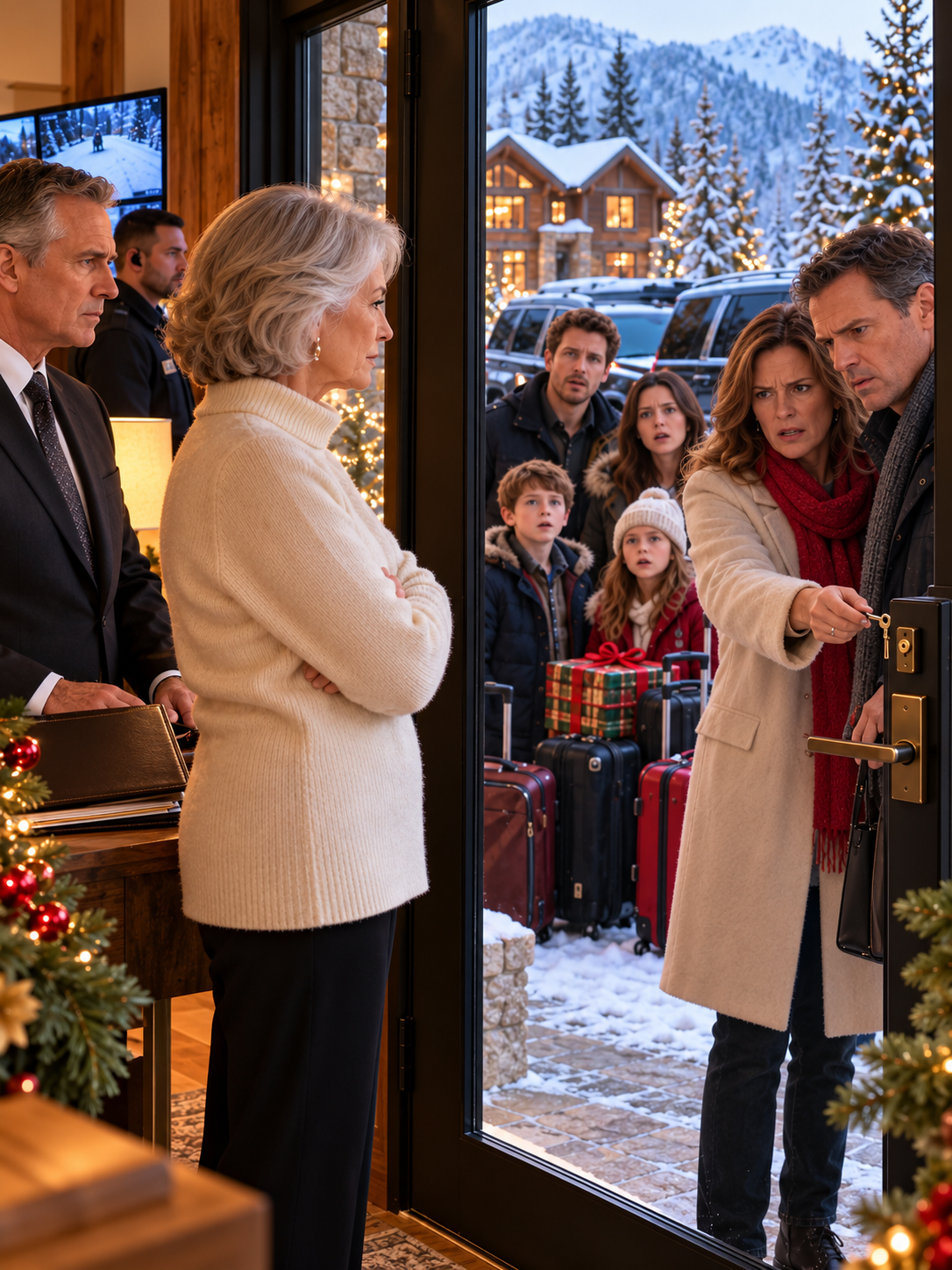
Samantha marched toward the front door
wearing a confident smile.
Behind me,
Marcus placed a legal folder
on the entry table.
James watched the security monitors.
Every camera was recording.
Samantha slid the spare key
into the lock.
Nothing happened.
She frowned.
Tried again.
Michael took the key from her
and twisted harder.
Still nothing.
Then he slowly lifted his eyes
toward the glass.
And saw me standing inside.
He saw Marcus beside the legal documents.
He saw James watching the security screens.
And suddenly,
every smile outside my door disappeared.
For several seconds, nobody moved.
Snow drifted between us.
Michael’s hand remained wrapped
around the useless key.
Samantha looked from Marcus
to the security camera above the porch.
Daniel took one step backward.
I had imagined this moment
during the previous two nights.
In some versions, I shouted.
In others, I cried.
Sometimes I pictured myself opening the door
and demanding an explanation
for five years of humiliation.
But standing there,
watching my children stare through the glass,
I felt something unexpected.
I was no longer frightened
of disappointing them.
I pressed the intercom button.
“Please step away from my door.”
Michael blinked.
“Mom?”
“You heard me.”
Samantha leaned toward the camera.
“Mom, what’s going on?”
I watched her smile return,
smaller and less convincing.
“Is this some kind of joke?”
“No, Samantha.”
She looked over her shoulder.
Behind her, three families stood
beside vehicles loaded with luggage.
My grandchildren wore matching Christmas sweaters.
One carried a stuffed reindeer.
Another had a red gift bag
almost as large as her body.
And there, near Michael’s SUV,
stood my eight-year-old grandson.
Noah.
The little boy who had accidentally revealed
the Christmas folder.
He saw me through the window
and waved enthusiastically.
My throat tightened.
I waved back.
Michael stepped in front of the camera.
“Mom, open the door.”
“Why?”
His expression hardened.
“What do you mean, why?”
“Why should I open it?”
He gave an incredulous laugh.
“Because we’re your family.”
The words hung between us.
For five years,
I had repeated those same words
to myself at Christmas.
They’re your family.
Be understanding.
Don’t make things difficult.
Don’t ask questions.
Don’t spoil the holiday.
Apparently, the rule worked differently
when they wanted something from me.
“Being family doesn’t make this your house.”
Samantha’s smile finally disappeared.
“Oh, come on, Mom.”
She gestured toward the children.
“We drove all this way.”
“Without asking me.”
“We wanted to surprise you.”
“You certainly did.”
Daniel approached the porch.
“Mom, it’s Christmas Eve.
Can we please discuss this inside?”
I looked directly at him.
“Did you discuss entering my house
before you did it?”
His face changed.
Samantha shot him a warning glance.
But I had seen enough
of their silent conversations.
“At 2:17 on Tuesday afternoon,”
I continued,
“you and Samantha let yourselves inside.”
Michael went still.
I watched his eyes move
from the camera to Marcus.
“You searched the bedrooms.
You opened my closets.
You moved things around.
And you planned to bring everyone here
without asking my permission.”
“Mom,” Samantha interrupted,
“we weren’t searching anything.”
I turned slightly.
“James?”
He touched the security monitor.
A recording appeared on the screen.
I didn’t need to play it outside.
Their faces already told me
they understood what I had.
“I have the entire visit recorded.”
Samantha stared through the glass.
“You recorded us?”
“Inside my own home.
Yes.”
“That’s unbelievable.”
I almost laughed.
“Which part?”
Nobody answered.
Marcus stepped toward the intercom.
“Good afternoon, everyone.
I’m Marcus Whitfield,
Eleanor’s attorney.”
Michael straightened.
“I know who you are.”
“Then you understand why I’m here.”
Michael glanced toward the legal folder.
“Mom, seriously?
You brought a lawyer to Christmas?”
I answered before Marcus could.
“No, Michael.
I invited a friend into my home.
You brought yourselves.”
Daniel looked down.
His wife, Leah,
quietly took their daughter’s hand.
Samantha folded her arms.
“This is ridiculous.
We’re not strangers.
We’re your children.”
“And I’m your mother.”
My voice remained steady.
“Not your vacation rental.
Not your retirement account.
And not a woman
who has forgotten how doors work.”
Michael’s jaw tightened.
“Nobody said those things.”
“You didn’t need to.”
The wind picked up.
Loose snow swept across the porch.
Behind Michael, Noah began shivering.
I noticed immediately.
“Please take the children into the cars.
It’s too cold outside.”
For the first time,
Michael looked toward his son.
Then he turned back.
“Then let us inside.”
“No.”
His mouth opened.
The single word seemed to have
knocked the breath from him.
I had said yes
so often over the years
that my children had apparently forgotten
I possessed another answer.
“Mom, we have nowhere to go.”
“There’s a hotel
twenty minutes down the mountain.
Marcus confirmed they have rooms available.”
Samantha gave a disbelieving laugh.
“You checked hotels?”
“Yes.”
“So you knew we were coming?”
“After seeing you inspect my house,
I suspected you’d return.”
Michael’s face flushed.
“We were trying to include you.”
Something inside me ached.
Even now,
he was offering exclusion
as if it were kindness.
“For five Christmases,”
I said quietly,
“you couldn’t find space for me.”
He looked away.
“But now I’ve bought a house
with six bedrooms,
and suddenly there’s room
for everyone?”
No one spoke.
“How extraordinary.”
Samantha pressed her lips together.
“That’s unfair.”
“Is it?”
“We’ve all had difficult years.”
“So have I.”
“You know what I mean.”
“No, Samantha.
I don’t think I do.”
She glanced toward her husband, Paul.
He was standing near their SUV,
holding two suitcases.
For the first time,
he looked deeply uncomfortable.
“Samantha,” he called,
“maybe we should go.”
She ignored him.
“We came here to spend Christmas together.”
I studied her face.
The same dark eyes she’d inherited
from her father.
The same stubborn chin
I’d kissed after childhood arguments.
For one terrible moment,
I remembered her at six,
standing beside our old Christmas tree,
asking if Santa would remember
to bring presents for me too.
I remembered saying
that mothers didn’t need many presents.
Having their children home was enough.
How carelessly I’d taught them
that my wishes could be discounted.
“Samantha, when did you decide
Christmas together included me?”
She stared.
“What?”
“Was it before you found out
about this house?
Or afterward?”
Her mouth closed.
I had my answer.
Michael stepped forward.
“You’re twisting everything.”
“Then explain it.”
He looked at Marcus.
“Can we speak privately?”
“You’re speaking to me now.”
“Without the lawyer.”
I hesitated.
Then I realized something.
Michael wasn’t asking for privacy.
He was asking for an audience
he could control.
“Marcus stays.”
Michael made a frustrated gesture.
“Mom, you’re being unreasonable.”
“No.
I’m being clear.”
Marcus opened the folder.
“Eleanor has authorized me
to deliver formal written notice
that no one may enter this property
without her express permission.”
Samantha looked offended.
“A legal notice?
Against your own children?”
Marcus continued calmly.
“The earlier unauthorized entry
has been documented.
The circumstances surrounding the duplicate key
are also under review.”
Michael interrupted.
“The realtor gave me that key.”
“Because you represented yourself
as authorized to assist Eleanor.”
“I am her son.”
“That isn’t legal authorization.”
The sentence seemed to hit him
harder than anything I’d said.
For a moment,
he looked almost frightened.
Then his expression changed again.
“This is insane.
She’s getting older.
Somebody needs to make sure
she isn’t making terrible financial decisions.”
The porch went silent.
Even Samantha turned toward him.
And I understood.
There it was.
The assumption beneath every question.
The excuse behind the photographs.
The reason they felt entitled
to walk through my house.
They believed my money
was already partly theirs.
They simply hadn’t inherited it yet.
“Michael.”
My voice sounded unfamiliar.
Quiet.
Cold.
Completely awake.
“Look at me.”
He reluctantly raised his eyes.
“I am not incompetent.
I am not confused.
And I have not asked you
to manage my finances.”
“That’s not what I meant.”
“Then stop saying it.”
He stared through the glass.
“I bought this house
after months of careful consideration.
I reviewed my finances.
I consulted professionals.
I arranged maintenance and insurance.
And I paid for it
without borrowing one dollar from you.”
Michael said nothing.
“Do you know how much money
your father and I invested
over forty years?”
He looked uncomfortable.
“No.”
“Do you know
what our portfolio contains?”
“No.”
“Do you know
whether I have any debts?”
He hesitated.
“No.”
“Then how can you possibly know
whether I can afford my home?”
Samantha lowered her gaze.
I let the silence settle.
Then I said the words
I should have spoken years earlier.
“You are allowed to worry about me.
You are not allowed
to take control of me.”
For once,
Michael had no immediate response.
Behind him,
Noah opened the SUV door.
His small face appeared
above the window.
He looked confused.
And suddenly I saw
how easily adult selfishness
could become a child’s heartbreak.
I pressed the intercom again.
“Michael, please bring Noah
close enough to hear me.”
“Mom, don’t involve him.”
“I’m trying not to.”
He hesitated,
then beckoned his son forward.
Noah climbed out
and approached the porch.
His cheeks were pink with cold.
“Grandma?”
“Hello, sweetheart.”
“Why aren’t you opening the door?”
I could hear the worry
beneath his small voice.
I wanted desperately to unlock it.
To wrap him in a blanket.
To give him warm cocoa.
To pretend everything was fine.
But I knew
what pretending had cost me.
“Because the grown-ups
forgot to ask permission, honey.”
He frowned.
“Did we do something bad?”
“Oh, Noah.
You didn’t do anything wrong.”
“Are you mad at me?”
My heart nearly broke.
“Never because you wanted to see me.”
His lower lip trembled.
“We brought you presents.”
I swallowed.
“That’s very kind of you.”
“Mom said this was
the best Christmas surprise ever.”
Behind him,
Rebecca, Michael’s wife,
looked away.
I recognized her immediately.
She had been the woman
who took the tablet from Noah
when he mentioned the Christmas folder.
The woman who’d smiled
while telling me plans were undecided.
I looked back at my grandson.
“You know what would make me happy?”
He nodded.
“Knowing you’re warm and safe tonight.
And knowing you understand
that I love you very much.”
He looked at the door.
“Can I see you tomorrow?”
I took a breath.
“Yes, sweetheart.
We’ll make a plan
with your parents first.”
His face brightened slightly.
“Promise?”
“I promise I’ll try
to arrange a visit.”
I wouldn’t promise something
his parents could prevent.
Not anymore.
Noah nodded solemnly.
Then he reached into his coat
and pulled out a folded piece
of bright green paper.
“I made you this.”
Michael looked startled.
Noah held it toward the camera.
A handmade Christmas card.
On the front,
he’d drawn a house,
a large yellow sun,
and two stick figures holding hands.
One had silver hair.
The other wore a red hat.
Underneath them,
in uneven purple letters,
he’d written:
ME AND GRANDMA.
I pressed my fingers against my mouth.
It took everything I had
not to open that door.
“That’s beautiful, Noah.”
“I made one last year too.”
Something shifted inside me.
“Did you?”
He nodded.
“And the year before.
But Mom said you were too busy.”
Rebecca closed her eyes.
I stared at her.
For five Christmases,
I’d been told everyone else was busy.
Apparently, someone had told the children
the same thing about me.
“Oh, sweetheart,” I whispered.
“I was never too busy for you.”
His face crumpled.
“Then why didn’t you come?”
No one moved.
No one answered.
The question hung over the porch,
more powerful than any legal document.
Michael reached for Noah’s shoulder.
“Buddy, let’s get you warm.”
But Noah resisted.
“Grandma?”
“I’m here.”
“Do you still want my card?”
I felt tears spill down my cheeks.
“More than you know.”
James quietly moved beside me.
He handed me a tissue
without saying a word.
Then Marcus leaned toward the intercom.
“Michael, if you would place
the card in the covered parcel box,
Eleanor can retrieve it safely.”
Michael glanced at the small box
beside the front steps.
For once, he didn’t argue.
Noah placed his card inside
as carefully as something precious.
Then he returned to the SUV.
I watched until he was warm.
Only then
did I turn back to my children.
“The children can see me
when we arrange something respectfully.”
Samantha opened her mouth.
I raised one hand.
“But none of you
will be staying here tonight.”
Michael stared.
“You’re really turning us away?”
“Yes.”
“On Christmas Eve?”
“Yes.”
He shook his head.
“Dad would never have done this.”
The words struck exactly
where he intended.
For a moment,
I saw my husband, Henry,
standing in our old kitchen,
his sleeves rolled up,
flour dusting the front
of his favorite blue sweater.
I remembered the way he laughed.
The way he filled our house
with music and terrible jokes.
The way he loved our children
even when they disappointed him.
And then I remembered something else.
During his final hospitalization,
Henry had squeezed my hand
and asked me to promise one thing.
“Don’t disappear after I’m gone, Ellie.”
At the time,
I’d thought he meant
that I should keep living.
Now I understood
how much more those words contained.
“You’re right, Michael.”
My son looked relieved.
“Your father wouldn’t have done this.”
I met his eyes.
“He would have asked
why his wife spent five Christmases alone.”
Michael’s expression collapsed.
For several seconds,
he looked like a little boy
caught doing something cruel.
Then he turned away.
Samantha wiped her eyes angrily.
Daniel remained motionless.
Finally, he whispered,
“I’m sorry, Mom.”
It was the first apology
I’d heard from any of them.
But I wasn’t ready
to confuse an apology
with a repaired relationship.
“Then show me
you understand what you’re apologizing for.”
He nodded slowly.
Marcus explained how they could receive
the legal notices.
No one would be arrested
simply because I refused them lodging.
I wasn’t seeking a spectacle.
I wanted a boundary
that could not be misunderstood.
Paul loaded Samantha’s suitcase.
Leah helped the children
into Daniel’s vehicle.
Rebecca remained beside Michael,
her face pale.
Then the engines started.
One by one,
the SUVs turned around
on my snow-covered driveway.
Noah pressed his palm
against the back window.
I raised mine in response.
And watched my family leave.
For the second time
in five Christmases,
I would spend Christmas Eve
without my children.
But this time,
I hadn’t been forgotten.
I had made a choice.
That difference mattered
more than I could explain.
When the final taillights disappeared,
James turned off the porch microphone.
The sudden silence seemed enormous.
Only the fireplace crackled
in the adjoining living room.
I stood near the window,
still holding the damp tissue.
Marcus closed the legal folder.
“Are you all right, Ellie?”
I tried to answer.
Nothing came out.
Then I started crying.
Not gracefully.
Not quietly.
I cried with the exhausted grief
of someone who had spent years
pretending an open wound was healed.
Marcus pulled out a chair.
I sat down.
James went into the kitchen
and returned with water.
Neither man told me
I’d done the right thing.
Neither suggested
I should have done more.
They simply stayed.
After several minutes,
I managed to speak.
“I wanted to let Noah inside.”
Marcus nodded.
“I know.”
“He looked so cold.”
“He was outside
for only a few minutes.
His parents should have prepared him.”
I stared into my glass.
“He thinks I didn’t want him.”
“Then that’s something
the adults need to correct.”
I swallowed.
“They won’t.”
Marcus pulled his chair closer.
“Maybe not immediately.
But you’ve stopped helping them
keep the lie alive.”
I looked toward the window.
Snow had already softened
the tire tracks in my driveway.
“I thought I would feel victorious.”
“Do you?”
“No.”
“What do you feel?”
I considered the question.
“Sad.”
He nodded.
“And?”
I looked around my kitchen.
At the beautiful wooden cabinets.
The copper pots hanging
above the enormous center island.
The quiet rooms
I had chosen for myself.
“Relieved.”
Marcus smiled sadly.
“Those feelings can exist together.”
James rose to leave
a little after six.
He checked the alarms,
reviewed the outdoor cameras,
and confirmed the property’s access controls.
Then he placed a small remote
beside my telephone.
“That connects directly
to the monitoring service.
Only use it when necessary.”
“Thank you, James.”
He hesitated at the doorway.
“My mother lived alone
for sixteen years.”
I looked up.
“Did she?”
“After my father died.
My brothers and I
used to argue about her safety.”
He paused.
“She finally told us
that being old didn’t mean
being available for supervision.”
Despite everything, I smiled.
“She sounds like my kind of woman.”
“She was.”
He looked toward the kitchen.
“She died last spring.
I wish I’d listened sooner.”
Something softened between us.
Then he gave me
a small, respectful nod
and stepped into the snow.
Marcus stayed for another hour.
We ate the vegetable soup
I’d prepared that morning.
He told me the hotel
had confirmed the family’s arrival.
Everyone had checked in safely.
That eased something in my chest.
I hadn’t wanted them stranded.
I had wanted them
to understand a closed door.
Before leaving, Marcus paused
beside the Christmas tree.
It stood near the fireplace,
small enough that I could
decorate the upper branches myself.
Its ornaments were simple.
Silver stars.
Wooden birds.
A glass angel
Henry had bought in Vermont.
Marcus reached toward the angel
but didn’t touch it.
“Henry would have loved this place.”
My eyes filled again.
“He always wanted a mountain house.”
“I remember.”
“He used to say
the trees were better company
than most people.”
Marcus chuckled.
“Usually after losing at cards.”
I laughed through my tears.
For one brief moment,
Henry seemed close enough
that I could hear his laughter.
Marcus picked up his coat.
“Call me if you need anything.”
“I will.”
He stepped toward the door.
Then he turned.
“Ellie?”
“Yes?”
“You don’t have to decide tonight
what your children deserve tomorrow.”
I frowned slightly.
He continued.
“Just decide what you need today.”
After he left,
I walked to the parcel box.
The cold stung my cheeks.
Inside was Noah’s Christmas card.
The green paper had bent slightly.
I carried it into the kitchen
and opened it beneath the light.
On the inside,
he had written three words.
I LOVE YOU.
The letters wandered uphill.
The final U was backwards.
I sat down at the table.
Then I noticed something else.
In the corner,
in smaller writing,
were four additional words.
PLEASE COME NEXT TIME.
I pressed the card against my chest.
And wept again.
That night,
I didn’t eat Christmas cookies.
I didn’t watch the holiday movies
I had saved.
I sat beside the fireplace
with a blanket around my shoulders
and remembered the Christmases
when my children were small.
Michael always woke before sunrise.
He would stand beside our bed,
breathing loudly,
waiting for one of us to move.
Samantha hated waiting.
She once unwrapped an entire present
and tried to put the paper back
before anyone noticed.
Daniel was our quiet one.
At seven,
he’d spent nearly an hour
building a cardboard stable
for his sister’s new doll.
Henry had watched him,
then whispered into my ear,
“That boy has a generous heart.”
I wondered when generosity
had become so difficult
for my grown children.
Then I caught myself.
There was a difference
between remembering who they’d been
and excusing what they’d become.
I could love their childhood selves
without allowing their adult selves
to walk through my locked doors.
At eleven that night,
my telephone began vibrating.
Michael.
I let it ring.
Then Samantha.
I declined the call.
Then a message appeared from Daniel.
Mom, I know you’re upset.
I stared at those words.
Upset.
Such a small, convenient word.
As though I had simply
misplaced my patience.
A second message arrived.
I didn’t know about the key.
I read it twice.
Then I opened the recording again.
Daniel had stood beside Samantha
while she unlocked the front door.
He had followed her inside.
He had inspected the rooms.
He had talked about Michael’s plans.
I typed a response.
You knew enough to enter.
I pressed send.
For almost ten minutes,
the screen remained silent.
Then Daniel replied.
You’re right.
I don’t have an excuse.
I placed the phone facedown.
It was the first honest sentence
I’d received from him all week.
I slept badly.
At five in the morning,
I woke expecting the familiar ache
of another Christmas alone.
But something was different.
There were no excuses
left for me to untangle.
No imaginary invitations
I was waiting to receive.
No phone beside my pillow
in case someone remembered
there was still room for me.
I got up.
Put on my slippers.
And walked into the kitchen.
Outside, the mountains glowed blue
beneath the approaching sunrise.
I made coffee.
Then I took Noah’s card
and placed it on the mantel,
beside Henry’s photograph.
“Well,” I whispered,
“we made it to another Christmas.”
Henry smiled from the silver frame.
He was sixty-eight in that picture.
His hair had gone almost completely white.
He wore the ridiculous red scarf
I’d knitted him during our honeymoon.
I could almost hear him answer.
“Of course we did, Ellie.
What else would we do?”
At seven thirty,
someone knocked at my door.
I froze.
For a terrible instant,
I imagined all three SUVs
returning for another confrontation.
Then I checked the camera.
A woman stood on the porch,
holding a covered baking dish.
She wore a green winter coat,
a knitted hat with enormous pompoms,
and the determined expression
of someone who expected to be heard.
It was Ruth Larson.
My nearest neighbor.
A retired park ranger
who lived half a mile down the road.
We’d met during my second week
in the mountains.
She’d arrived with homemade apple butter
and a warning about hungry deer.
I’d liked her immediately.
I opened the door.
“Merry Christmas, Eleanor!”
“Merry Christmas, Ruth.”
She lifted the dish.
“I made too much breakfast casserole.”
I raised an eyebrow.
“For how many people?”
“One.”
We laughed.
Then she studied my face.
Her smile softened.
“Rough night?”
I hesitated.
The old version of me
would have said everything was wonderful.
She would have smiled.
Changed the subject.
Offered coffee.
But that woman had spent
too many Christmases apologizing
for having feelings.
“Yes,” I said.
“It was a very rough night.”
Ruth nodded thoughtfully.
“Then you’d better make coffee.”
She stepped inside.
Within twenty minutes,
she was seated at my kitchen island,
listening to the whole story.
She didn’t interrupt.
Not when I described the exclusions.
Not when I explained the key.
Not when I told her
about my children arriving with suitcases.
When I finished,
she stared into her coffee.
Then she said,
“Well, that’s a spectacular amount of nerve.”
I laughed so suddenly
that coffee nearly came through my nose.
Ruth smiled.
“Sorry.
I know it’s serious.”
“No, don’t apologize.”
I laughed again.
“It feels good
to hear someone say it.”
She reached across the table
and squeezed my hand.
“Tell me something, Eleanor.
Do you actually want
to spend Christmas alone?”
I glanced toward the fireplace.
“I thought I did.”
“And now?”
I considered her question.
“I want peace.
But I don’t think
peace has to mean loneliness.”
Ruth nodded.
“Good.
Because I’m stealing you.”
I blinked.
“Excuse me?”
“Community hall.
Christmas dinner.
Six o’clock.
Bring nothing unless you want to.”
I began to protest.
She raised one finger.
“And before you say
you don’t want to intrude,
you should know something.”
“What?”
“Last night,
we set fourteen places.
Only nine people confirmed.”
My heart gave a small, painful twist.
Ruth smiled gently.
“Empty chairs don’t frighten us up here.
We know how to fill them.”
For a long moment,
I couldn’t speak.
Then I nodded.
“I’ll bring bread.”
“Excellent.
You’re officially invited.”
She finished her coffee,
rose to put on her coat,
and hugged me at the door.
Not a polite social embrace.
A real hug.
The kind that allows
someone else to stop being strong
for just a moment.
When she left,
I stood in my quiet entryway
and felt something warm unfold
beneath my ribs.
I had spent five years
waiting for the people I loved
to make room for me.
And a woman I’d known
less than a month
had simply pulled out a chair.
At ten that morning,
Rebecca sent me a message.
Merry Christmas, Eleanor.
I’m sorry about yesterday.
Noah is asking about you.
I read it carefully.
Then another message appeared.
There’s something I need to tell you.
I looked at the words
for a long time.
Finally, I typed:
Then tell me the truth.
Her reply came six minutes later.
Can I call?
I considered refusing.
I wasn’t ready for another excuse.
But Noah’s card sat
above my fireplace.
And there were things
I needed to understand.
I accepted the call.
Rebecca answered on the first ring.
“Hello, Eleanor.”
“Hello, Rebecca.”
Her voice trembled.
“I don’t know where to begin.”
“Begin with the Christmas folder.”
The silence was immediate.
Then I heard her exhale.
“Michael told me Noah mentioned it.”
“Yes.”
“I was going to explain.”
“Then please do.”
For several seconds,
I heard only background noise.
Children talking.
A television playing quietly.
Someone moving dishes.
Then Rebecca spoke.
“At first, it wasn’t personal.”
I closed my eyes.
That was rarely a promising beginning.
“Henry had just died.
Everyone was struggling.
The kids were little.
We wanted something cheerful.”
“So you didn’t invite me.”
Rebecca’s breathing changed.
“We thought you might prefer
a quiet Christmas that year.”
“Did you ask?”
“No.”
“And the following year?”
She didn’t answer.
“Or the year after that?”
“Eleanor…”
“Rebecca, please.
I’m asking you a question.”
Her voice broke.
“No.
We didn’t ask.”
I waited.
She began crying.
“The first year,
we told ourselves you’d be uncomfortable.
Then it became the arrangement.
Everybody assumed it would continue.”
I gripped the edge
of my kitchen counter.
“An arrangement?”
“I know how terrible that sounds.”
“Do you?”
“Yes.”
I looked toward Henry’s photograph.
“Your father-in-law died.
I lost the man
I’d loved for forty-three years.
And you decided
that my grief made Christmas uncomfortable.”
Rebecca was sobbing now.
“I’m sorry.”
“Did you ever consider
how uncomfortable Christmas might be
for the woman eating alone?”
She had no answer.
I continued.
“Did you know I still cooked
a turkey every year?”
“No.”
“Did you know I set
the dining room table anyway,
until the fourth Christmas?”
She whispered,
“No.”
“Did you know
I kept buying extra cranberries
because Michael always loved them?”
Her crying grew louder.
“Or that I mailed presents
because I was afraid
my grandchildren would forget my name?”
“Eleanor, please.”
“Please what?”
She was silent.
“Please don’t tell you
what your decisions cost me?”
She finally whispered,
“No.
Please don’t stop.”
So I didn’t.
I told her about the dinners.
The unanswered invitations.
The holiday photographs
I’d accidentally seen online.
The smiles beneath captions
that said FAMILY IS EVERYTHING.
I told her how often
I’d wondered what I’d done wrong.
And how many times
I’d searched my memory
for a careless remark
that might explain the distance.
Finally, I said,
“I spent years looking
for a mistake I had made.
Not once did I imagine
you’d simply agreed to leave me out.”
Rebecca cried quietly.
Then she said something
that changed the conversation.
“We told the children
you preferred to be alone.”
I stopped breathing.
“What?”
“Whenever they asked,
we said the holidays made you sad.
That you liked staying home.”
I stared at the wall.
The pattern on the wallpaper
seemed suddenly unfamiliar.
“You told my grandchildren
I didn’t want to see them?”
Rebecca whispered,
“Yes.”
A terrible stillness filled me.
Five years.
Five Christmases.
Five years of children believing
their grandmother chose not to come.
Noah’s little green card
suddenly felt heavier
than anything in the room.
“And his other cards?”
I asked.
Rebecca didn’t respond.
“The ones he says he made.”
A small sound escaped her.
“Eleanor…”
“Where are they?”
I heard her crying again.
“In a box.”
My knees weakened.
I pulled out a chair.
“What box?”
“I kept some of their Christmas crafts.
The cards are in there.”
“Why didn’t you send them?”
“We kept meaning to.”
I looked at the green card
on the mantel.
All those years,
I had treasured the photographs
they occasionally sent.
All those years,
little hands had been making cards
I never received.
Rebecca spoke again.
“I know I can’t undo this.”
“You’re right.”
“I want to make it right.”
“Then start with Noah.”
She sniffled.
“What should I tell him?”
“The truth.
In words he can understand.”
“That we made a mistake?”
“That his grandmother
was never too busy for him.
That I wanted to see him.
And that the grown-ups
made decisions that hurt people.”
Rebecca took a shaky breath.
“Okay.”
“And Rebecca?”
“Yes?”
“Don’t ask him to forgive you
so you’ll feel better.”
Another long silence.
Then she said,
“I understand.”
I hoped she did.
Before ending the call,
I asked one more question.
“Who decided I shouldn’t be invited?”
Rebecca hesitated.
Then answered quietly.
“Michael suggested it the first year.”
I closed my eyes.
“But we all agreed.”
I nodded to myself.
That mattered.
Responsibility couldn’t be handed
to one convenient villain.
“Thank you for telling me.”
“Will you come see Noah?”
“I want to.”
“He’s been asking all morning.”
“We can arrange a visit.
A short one.
Somewhere neutral.”
“Of course.”
“And please bring his old cards.”
Her voice trembled again.
“I will.”
When the call ended,
I remained seated
for a long time.
The truth hadn’t made me happy.
But at least
I finally knew
why my grandchildren had stopped asking.
They hadn’t stopped loving me.
They had been taught
that loving me from a distance
was what I wanted.
And that knowledge
hurt in an entirely different way.
By late afternoon,
the house smelled of freshly baked bread.
I’d made four loaves.
Two were rosemary.
One contained dried cranberries.
The fourth was plain sourdough,
the recipe Henry had loved.
As I wrapped them,
my telephone lit up again.
This time, it was Samantha.
Merry Christmas, Mom.
I hope you’re satisfied.
I stared at the message.
Then another appeared.
You’ve ruined Christmas for the children.
I felt the familiar pull
to defend myself.
To explain.
To apologize for someone else’s disappointment.
Instead, I opened my notebook
and wrote down what had happened.
I hadn’t invited them.
I hadn’t promised them accommodations.
I hadn’t instructed them
to tell their children
they were spending Christmas with me.
I hadn’t forced them
to drive into the mountains.
They’d made those choices.
My refusal hadn’t created their situation.
It had only prevented them
from getting away with it.
I put down the pen.
Then I replied.
The children did nothing wrong.
Please don’t blame them or me
for plans you made without permission.
Her response was immediate.
I can’t believe how cold you’ve become.
I typed six words.
I love you.
But I’m not changing my decision.
Then I set the phone aside.
There was nothing more
I needed to explain that afternoon.
At five thirty,
Ruth arrived in her old blue pickup.
She wore earrings shaped like snowflakes
and a bright purple scarf.
I climbed into the passenger seat
with my basket of bread.
“Ready?” she asked.
I looked back toward the house.
The windows glowed warmly.
The little Christmas tree sparkled.
No one was waiting inside
for me to return.
But for the first time,
that didn’t feel like abandonment.
“Ready.”
The community hall stood
at the edge of the village,
beside a small frozen pond.
Colored lights framed its windows.
Through the glass,
I could see people moving tables,
pouring drinks,
and hanging paper snowflakes.
Inside,
an elderly man played Christmas carols
on an upright piano.
A woman in a green apron
directed people toward the buffet.
Two teenagers were building
a precarious tower of dinner rolls.
The room smelled of roast chicken,
cinnamon,
butter,
and pine.
Ruth took my coat.
Then she introduced me
to nearly everyone.
There was Frank,
a widower who’d once run
the village hardware store.
He’d lost his wife three years earlier.
There was Esther,
a retired school librarian
whose children lived overseas.
And a young nurse named Amelia,
working her first holiday
away from her parents.
There were families.
Couples.
Neighbors.
People who knew one another
and people who didn’t.
No one asked why
my children weren’t with me.
No one looked at me
with pity.
They asked ordinary questions.
Where had I moved from?
Did I enjoy the mountains?
Had I seen the elk
near the northern ridge?
Was the cranberry bread homemade?
I answered.
I laughed.
I asked questions in return.
Halfway through dinner,
Frank pulled out a chair beside him.
“Sit here, Eleanor.
Ruth says you’re a teacher.”
“Retired.”
“Same thing.
I have a granddaughter
who thinks commas are optional.”
I laughed.
“She’s not alone.”
He grinned.
“Would you mind helping her sometime?”
“Not at all.”
Across the table,
Ruth lifted her glass toward me.
I smiled.
And for a moment,
something extraordinary happened.
I forgot to be lonely.
Not because I’d forgotten my family.
Not because the pain had disappeared.
But because my world
was larger than their decisions.
After dinner,
the teenagers organized a card game.
Frank argued passionately
about the rules.
Esther cheated at charades
with such confidence
that everyone admired it.
Amelia called her parents
and showed them our crowded table.
Then Ruth brought out
a homemade lemon cake.
Someone started singing.
Others joined.
Before I knew it,
I was singing too.
The final note faded.
And I realized
I was crying again.
Esther noticed.
She placed her hand over mine.
“First Christmas here?”
I nodded.
She smiled.
“First ones are difficult.”
I looked at her.
“Does it get easier?”
“Not always.”
She considered her next words.
“But it gets bigger.”
“Bigger?”
“The life around the grief.”
I looked around the room.
At Frank laughing.
At Amelia passing cake.
At Ruth arguing about card games.
At all those ordinary people
who had made room for me.
I understood.
My grief hadn’t disappeared.
But it no longer occupied
every chair at the table.
The next morning,
I received a call
from the manager
of the real estate office.
Her name was Patricia Hale.
We’d met briefly
during the property closing.
She sounded deeply embarrassed.
“Mrs. Bennett,
I owe you an apology.”
That was my first surprise.
My second came moments later.
She explained that Marcus
had contacted the brokerage
with a formal written complaint.
The assistant who’d provided Michael
with the spare key
had believed she was helping
an elderly client coordinate a move.
Michael had identified himself
as my son.
He had mentioned my age.
He’d described me
as overwhelmed by the transaction.
And he had suggested
I sometimes forgot appointments
and misplaced important documents.
I gripped the telephone.
“He said that?”
“I’m afraid so.”
Patricia continued.
“He also claimed
you’d authorized him to collect the key.”
“But he had nothing in writing.”
“No.”
She paused.
“That should have ended the conversation.
We failed to verify his authority.”
I appreciated her honesty.
But anger rose inside me.
Michael hadn’t merely taken advantage
of an assistant’s mistake.
He had deliberately created
a false impression of my abilities.
He’d used the familiar stereotype
of an older woman
who needed her son
to manage complicated matters.
All so he could obtain access
to a house that wasn’t his.
Patricia apologized again.
She explained that the office
was reviewing its procedures.
It would reimburse my documented expenses
for replacing the locks
and securing the property.
The assistant’s actions
were being addressed internally.
No other keys had been released.
And the office would provide
a written account of the incident.
“Thank you,” I said.
“Mrs. Bennett,
I am terribly sorry
that our mistake placed you
in such an upsetting situation.”
“It was upsetting.”
I took a breath.
“But the original dishonesty
didn’t begin in your office.”
After ending the call,
I contacted Marcus.
He already knew
much of what she’d said.
But he hadn’t yet told me
because he wanted to confirm
the details in writing.
“Michael’s claims matter,” he said.
“Not because they give him authority.
They don’t.
But because they explain
how he obtained access.”
“Can he be prosecuted?”
“That depends on the evidence,
the applicable law,
and what authorities determine.
We shouldn’t assume an outcome.”
I appreciated his restraint.
He wasn’t interested
in threatening my children
with consequences he couldn’t guarantee.
Neither was I.
“What would you recommend?”
“Preserve everything.
Complete the complaint process.
Document your financial independence.
And decide what boundaries you want.”
I looked through the window.
A red fox moved silently
between two snow-covered trees.
“I don’t want Michael in prison.”
“I know.”
“But I don’t want him
to think he can do this again.”
“Those aren’t contradictory wishes.”
I thought about that.
Then I said,
“I want written acknowledgment
of what happened.
I want every unauthorized key returned.
And I want my children
to understand that entering my property
without permission is unacceptable.”
Marcus agreed.
“We can communicate that clearly.”
I hesitated.
“And Marcus?”
“Yes?”
“I want to review my estate plan.”
He was silent for a moment.
Then he asked,
“Because you’re angry?”
“No.”
I looked at the fireplace.
“Because I finally understand
that my children and I
have very different ideas
about what belongs to whom.”
He sighed softly.
“Then we’ll take our time.
No rushed decisions.”
“Agreed.”
I ended the call
and opened my financial records.
For the first time in years,
I examined them
without imagining which child
might eventually inherit what.
The accounts represented
forty years of decisions.
Early mornings.
Evening tutoring sessions.
Henry’s careful investments.
Our modest vacations.
Cars driven long after
other people would have replaced them.
We hadn’t been wealthy
when we married.
I’d taught fourth grade
in a public school
with leaky windows
and outdated textbooks.
Henry had worked
as a civil engineer.
He was patient with numbers
and almost comically suspicious
of unnecessary purchases.
We saved gradually.
Invested consistently.
Avoided reckless debt.
And when a small investment
in a regional engineering company
grew far beyond our expectations,
we reinvested much of the proceeds.
We never discussed
our finances with the children.
Not because we were hiding them.
Because they were our finances.
We’d paid for college educations.
Helped with reasonable emergencies.
Bought bicycles.
Covered braces.
Contributed to wedding expenses.
And still managed
to prepare for our retirement.
After Henry died,
I continued managing our investments
with the help of professionals.
My children saw an older woman
driving a twelve-year-old sedan.
They saw a retired teacher
using grocery coupons.
They saw someone
who preferred homemade gifts
to expensive purchases.
They assumed those things
meant I had little money.
I had never corrected them.
Why would I?
My thrift had never been
a request for their pity.
It was simply how I lived.
But now,
as I examined the figures,
I recognized the danger
of allowing their assumptions
to turn into entitlement.
Michael had crossed a line
I could not ignore.
He had tried to convert
being my son
into authority over my property.
That needed to stop.
Three days after Christmas,
I met Noah and Rebecca
at the village public library.
I chose the location carefully.
It was warm.
Familiar.
Public.
And it belonged to neither family.
Rebecca arrived five minutes early.
She carried a small cardboard box
and held Noah’s hand.
He wore a blue winter coat
and a knitted dinosaur hat.
The moment he saw me,
he let go of her hand.
“Grandma!”
He ran across the room.
I knelt just in time
to catch him.
His arms wrapped around my neck.
I held him tightly.
For one beautiful moment,
I forgot every argument,
every document,
every painful holiday.
There was only my grandson.
Warm and alive.
Smelling faintly of strawberry shampoo.
“Hello, sweetheart.”
He leaned back.
“Did you get my card?”
“I did.”
“Did you like it?”
“I loved it.”
His face lit up.
“Really?”
“Really.”
Then he whispered,
“Mom told me something.”
I looked toward Rebecca.
She was standing beside the table,
her eyes red.
“What did she tell you?”
Noah frowned thoughtfully.
“She said she made mistakes
about Christmas.”
I nodded.
“She told me
you wanted to come see us.”
“Yes, sweetheart.”
“Even when Grandpa died?”
My heart tightened.
“Especially then.”
He looked confused.
“Then why didn’t you?”
I took his small hands.
“Sometimes grown-ups make decisions
without thinking carefully
about how other people feel.”
He considered that.
“Even parents?”
“Even parents.”
He glanced toward Rebecca.
Then back at me.
“Did I make you sad?”
I shook my head.
“Oh, Noah.
Never.”
I touched his cheek.
“Missing you made me sad.
Loving you never did.”
He was quiet.
Then he leaned forward
and hugged me again.
I held him
until he was ready to let go.
Rebecca approached slowly.
“Eleanor, I brought the cards.”
She placed the box on the table.
I stared at it.
It was an ordinary cardboard box,
once used for children’s shoes.
A faded picture of sneakers
covered one side.
Inside lay construction paper,
glitter-covered drawings,
handmade ornaments,
and folded cards.
Rebecca lifted the top card.
“This was from three years ago.”
I opened it.
Noah had been five.
His handwriting was barely recognizable.
A crooked Christmas tree filled the front.
Inside, Rebecca had written
his dictated message.
GRANDMA, I MISS YOU.
CAN YOU COME TO MY HOUSE?
I had to stop reading.
Rebecca waited silently.
The next card was blue.
It contained fingerprints
arranged into little reindeer.
The message read:
GRANDMA, I SAVED YOU A COOKIE.
I pressed my hand
against my trembling mouth.
Another card showed
a family sitting around a table.
Everyone had round heads
and enormous smiles.
One figure sat separately,
near the bottom of the page.
A silver-haired woman.
A purple dress.
A tiny red heart
above her head.
I pointed toward it.
“Who’s this?”
Noah leaned closer.
“You.”
“Why am I down here?”
He looked embarrassed.
“Because you weren’t at the table.”
My eyes blurred.
He touched the paper.
“But I put you close.”
I couldn’t speak.
He looked up.
“Did I do it wrong?”
I shook my head.
“No, sweetheart.”
I kissed his forehead.
“You did it beautifully.”
Rebecca covered her face.
I looked at her
across the library table.
“I want you to understand something.”
She lowered her hands.
“These aren’t just paper.”
“I know.”
“These are years
I can never get back.”
Tears ran down her cheeks.
“I know.”
“No, Rebecca.
I don’t think you can know.
Not completely.”
She nodded.
“You’re right.”
I looked down
at the box of cards.
“I am not asking you
to hate yourself forever.”
She wiped her cheeks.
“But I am asking you
never to make my grandchildren
responsible for hiding adult mistakes.”
She nodded again.
“I won’t.”
I studied her.
“Does Michael know
you brought these?”
“Yes.”
“What did he say?”
She hesitated.
“At first, he was angry.”
“With me?”
“With everyone.”
She gave a humorless laugh.
“Then he read the cards.”
I waited.
“He didn’t say anything afterward.”
I folded the blue card carefully.
“Silence has always been
his favorite place to hide.”
Rebecca didn’t disagree.
She looked toward Noah,
who was exploring
a nearby shelf of picture books.
“Eleanor, I need to tell you
something else.”
I braced myself.
“All right.”
“When Henry died,
Michael didn’t know
how to handle your grief.”
I stared at her.
“Neither did I.”
“I understand that now.
But he said every Christmas
reminded him of the hospital.
The empty chair.
The funeral.
He wanted the holidays
to feel normal again.”
I looked down.
Henry had died in February.
The first Christmas without him
had been ten months later.
I’d been lonely and exhausted,
but I still remembered
wanting to hear children laughing.
I had imagined
sitting beside the grandchildren,
watching them open presents,
and feeling Henry’s presence
in the traditions we’d built.
Instead,
they’d decided I was
too painful a reminder.
Rebecca continued.
“Michael said seeing you
made him feel like
Dad was dying all over again.”
I closed my eyes.
The confession hurt.
But it also revealed something
I hadn’t understood.
My children had not merely
grown too busy for me.
They’d wanted Christmas
without the visible evidence
of what we’d lost.
And I had become that evidence.
“Grief isn’t contagious,” I said.
Rebecca looked down.
“I know.”
“Leaving me alone
didn’t bring Henry back.”
“No.”
“And avoiding sadness
didn’t make any of you
less responsible for your choices.”
She nodded.
“I’m starting to understand that.”
I watched Noah
pull a book from the shelf.
Then I turned back to her.
“Rebecca, you can love Michael
without defending everything he does.”
She blinked.
I continued.
“And he can miss his father
without punishing his mother.”
For a long time,
we sat in silence.
Then Rebecca said,
“I want my children
to know their grandmother.”
I looked at the box.
“Then stop teaching them
that love requires permission
from everyone except the person involved.”
She nodded.
“I will.”
We spent the next hour
reading picture books with Noah.
I didn’t discuss legal notices.
I didn’t mention the driveway.
I didn’t make him choose
between the adults he loved.
Instead, I listened
as he explained why dinosaurs
would make terrible Christmas pets.
I admired his drawings.
I helped him sound out
three difficult words.
And when he grew tired,
he leaned against my shoulder
as naturally as if
no time had passed at all.
At the end of the visit,
Rebecca gathered his coat.
Noah took my hand.
“Grandma, can we do this again?”
I smiled.
“I’d like that.”
“Can you come to my birthday?”
“When is it?”
“March.”
I pretended to think.
“That sounds like
a very important month.”
He grinned.
“It is.”
I looked toward Rebecca.
She nodded.
“You’re invited, Eleanor.
I mean it.”
I met her eyes.
“Then send me the details.”
“I will.”
This time,
I wanted an actual invitation.
Not a vague promise.
Not an arrangement
someone could quietly change.
An invitation that meant
someone genuinely wanted me there.
Before Noah left,
he reached into his pocket
and handed me something small.
A plastic dinosaur.
Green.
Missing part of its tail.
“For you.”
I laughed softly.
“Why?”
“So you won’t be lonely.”
I held the tiny toy
in my palm.
Then I knelt beside him.
“Noah, sweetheart,
you don’t have to give me things
to make me happy.”
He looked puzzled.
“But I want to.”
“Then I’ll treasure it.”
He smiled.
“His name is Pickles.”
“Of course it is.”
He hugged me one last time.
And this time,
when I watched him leave,
I didn’t feel abandoned.
I knew when I’d see him again.
That was enough.
January arrived with heavy snow.
The village roads narrowed
between white banks taller
than the parked cars.
My mornings settled into a rhythm.
Coffee.
A short walk.
Breakfast beside the windows.
Then an hour of reading
before the day’s errands.
Twice a week,
I helped Esther organize books
at the community library.
On Thursdays,
I worked with children
who needed extra reading practice.
I began recognizing people
at the grocery store.
Frank saved old newspapers
when he found stories
he thought I’d enjoy.
Ruth appeared without warning
whenever she baked too much.
For the first time
since Henry’s death,
my calendar held appointments
I genuinely looked forward to.
And none of them depended
on my children remembering me.
But our problems weren’t over.
On January ninth,
Marcus called.
“Michael has retained an attorney.”
I stopped rearranging the books
on my living room shelf.
“Am I being sued?”
“No.”
“What does he want?”
“He’s disputing the language
in the notice we sent.”
I closed my eyes.
“Of course he is.”
Marcus continued.
“He says he wasn’t attempting
to take advantage of you.”
“Then why did he lie
to the real estate office?”
“That’s precisely the question
his attorney will need to address.”
I sat down.
“Has he returned the key?”
“Not yet.”
I looked toward the entryway.
“Then I don’t think
he understands the problem.”
Marcus agreed.
He suggested a meeting
at his office
with the three children
and their spouses,
provided everyone could attend calmly.
I considered refusing.
A large part of me
wanted to close the subject forever.
But another part
remembered Daniel’s quiet apology.
Rebecca’s box of cards.
Noah asking if he could
see me on his birthday.
I didn’t want to spend
the rest of my life
standing behind a locked door.
I wanted to know
whether my children were capable
of respecting an open one.
“Arrange the meeting,” I said.
“But Marcus?”
“Yes?”
“I won’t debate whether
I have the right
to live in my own home.”
“You won’t have to.”
The meeting took place
six days later.
Marcus’s office occupied
the second floor
of an old brick building downtown.
The conference room had
a long walnut table,
comfortable chairs,
and windows overlooking
a busy winter street.
I arrived early.
Marcus had placed
a glass of water beside my chair.
A yellow legal pad
waited in front of me.
I took a pen
from my handbag.
For years,
I’d entered family gatherings
wondering what I needed to do
to keep everyone happy.
That afternoon,
I knew exactly why I was there.
I wanted accountability.
I wanted honesty.
And I wanted whatever relationship remained
to exist without manipulation.
Daniel arrived first.
He wore a gray sweater
and looked as though
he hadn’t slept well.
He stopped in the doorway.
“Hi, Mom.”
“Hello, Daniel.”
He approached slowly.
“Can I hug you?”
I appreciated the question.
“Yes.”
He embraced me.
Not tightly.
Not for long.
But sincerely.
When he stepped back,
his eyes were wet.
“I’m sorry.”
I studied him.
“For what?”
He swallowed.
“For going into your house.
For not telling you.
For letting everyone
make decisions about Christmas
without ever asking what you wanted.”
I waited.
He continued.
“And for being a coward
when I knew it was wrong.”
The room was quiet.
It was the first apology
that named the actual harm.
“Thank you,” I said.
His shoulders relaxed slightly.
“That doesn’t mean everything’s fixed.”
“I know.”
“But it’s a beginning.”
He nodded.
“That’s more than I deserve.”
I shook my head.
“Daniel, don’t turn this
into a competition over punishment.
I need you to change.
Not spend the next year
telling me you’re terrible.”
He let out a shaky breath.
“Okay.”
Leah entered moments later.
She hugged me
and apologized for arriving uninvited
on Christmas Eve.
She explained that Daniel
had told her I’d agreed
to host the holiday.
I looked at him.
He nodded.
“I did.”
“Why?”
He stared at the floor.
“Because I didn’t want
to tell her the truth.”
“Which was?”
“That we hadn’t asked you.”
I looked back at Leah.
“You weren’t told the truth either.”
She shook her head.
“No.
But I should have called you myself.”
I respected that answer.
She wasn’t trying
to remove her responsibility entirely.
Nor was she accepting blame
for things she’d never known.
Then Samantha arrived with Paul.
She didn’t approach me.
She sat across the table,
placed her handbag beside her chair,
and stared toward the windows.
Paul greeted me quietly.
He looked deeply embarrassed.
Finally, Michael and Rebecca entered.
Michael wore a navy coat
over an expensive wool sweater.
He looked tired.
Older than he had
a few weeks earlier.
Rebecca gave me a tentative smile.
I returned it.
Michael remained standing.
“Mom.”
“Michael.”
He glanced toward Marcus.
“I still don’t understand
why we need lawyers for this.”
Marcus closed the door.
“Because the earlier entry
and property access dispute
have legal implications.”
Michael sat down.
“We’re family.”
I looked at him.
“Michael, if you repeat that
every time someone discusses boundaries,
we’ll accomplish nothing today.”
His mouth tightened.
Then he nodded once.
Marcus began by reviewing the facts.
He displayed the access records.
The dates.
The security footage.
The brokerage’s written findings.
And the statement
Michael had made
about my supposedly failing memory.
Michael stared at the documents.
“That was taken out of context.”
Marcus remained calm.
“You told the assistant
Eleanor had difficulty managing
the property transaction.”
“I said she might need help.”
“You also claimed
she’d authorized you
to collect the key.”
Michael hesitated.
“I thought she’d want me involved.”
“That’s different from authorization.”
Samantha shifted in her chair.
“Can we stop acting like
he robbed a bank?”
I turned toward her.
“No one has said that.”
She folded her arms.
“Then why does this feel
like some kind of trial?”
“Because you’re being asked
to explain what you did.”
She looked down.
I continued.
“Do you remember what you said
inside my living room?”
Her expression hardened.
“You already told us.”
“I’d like you to say it.”
She looked toward Michael.
Then Daniel.
Finally, she whispered,
‘It’s not like she’ll say no
once we’re already here.’
I nodded.
“Why did you believe that?”
Samantha sighed.
“Because you always say yes.”
The simplicity of her answer
hurt more than I expected.
“Exactly.”
She looked up.
“You’ve never minded
having everyone around.”
“No.
I’ve loved having everyone around.”
I leaned forward.
“But loving company
doesn’t mean I surrender
the right to decide
who comes into my house.”
Samantha’s eyes filled.
“We thought you’d be excited.”
“You thought I’d have
no acceptable way to refuse.”
She wiped her cheek.
I continued softly.
“Those are not the same thing.”
Paul placed a hand
over his wife’s.
She didn’t pull away.
Michael shook his head.
“Mom, this has gotten
completely out of proportion.”
I turned toward him.
“Then help me understand.”
He looked surprised.
“Understand what?”
“Why did you photograph my house?”
“Because I wanted to see it.”
“Why didn’t you knock?”
He shifted.
“I wasn’t sure you were home.”
“Then why photograph the windows?”
He looked away.
I waited.
Finally, he said,
“I wanted to know
if there was enough room
for everybody.”
“And why did you need
a spare key?”
He said nothing.
“Michael?”
He exhaled sharply.
“Because you weren’t responding
to any of us.”
“After asking about my money.”
“We were concerned.”
“Concern doesn’t require secret keys.”
The room fell silent.
Marcus waited without intervening.
Then Michael said something
I hadn’t expected.
“Fine.
I was angry.”
I studied him.
“About what?”
“About the house.”
“Why?”
“Because you bought it
without telling us.”
“And?”
He looked at his siblings.
Samantha stared at her hands.
Daniel closed his eyes.
Michael swallowed.
“Because I didn’t know
you had that kind of money.”
There it was.
Not the whole truth, perhaps.
But the beginning of it.
I waited.
He continued reluctantly.
“After Dad died,
you always acted like
you were being careful with expenses.”
“I was careful.”
“You clipped coupons.”
“Yes.”
“You complained about property taxes.”
“Because I dislike paying unnecessary taxes.”
Daniel almost smiled.
Michael didn’t.
“I thought you were struggling.”
“Did you ask me?”
“No.”
“Did I ever ask you for money?”
“No.”
“Did I ever tell you
I couldn’t afford groceries?”
“No.”
I folded my hands.
“Then what exactly
did I do wrong?”
Michael rubbed his forehead.
“Nothing.”
“Say that again.”
He looked directly at me.
“You didn’t do anything wrong.”
I felt something loosen
inside my chest.
Then I asked the question
that had troubled me for weeks.
“If I hadn’t bought
the mountain house,
would you have invited me
to Christmas this year?”
The silence seemed endless.
Rebecca lowered her eyes.
Samantha started crying.
Daniel stared at his brother.
Michael looked at the table.
“Michael.”
He breathed out.
“Probably not.”
I closed my eyes.
I had known the answer.
Still, hearing it spoken aloud
felt like something breaking.
Not loudly.
Not dramatically.
Just the quiet collapse
of a hope I’d carried
longer than I realized.
“Thank you for being honest.”
He looked up.
“Mom, that doesn’t mean
we don’t love you.”
“I believe you love me.”
He seemed relieved.
Then I continued.
“But I also believe
you became comfortable
with a version of love
that required very little effort.”
No one spoke.
“Love that mailed birthday flowers
but forgot to call.
Love that accepted presents
without inviting the giver.
Love that talked about family
while leaving one member outside.”
My voice trembled.
“For five years,
I felt like an obligation
everyone was relieved to avoid.”
Daniel started crying.
Samantha pressed her face
into a tissue.
Michael stared at me,
his expression unreadable.
Then I asked him,
“Did you really think
seeing me at Christmas
would ruin the holiday?”
His shoulders sagged.
“At first, yes.”
The words hurt.
But I needed to hear them.
“Why?”
He looked toward the window.
“Because when Dad died,
everything changed.”
I waited.
He swallowed hard.
“I remember walking into your house
that first Christmas after the funeral.
His chair was still there.
His coat was hanging by the door.”
My eyes filled.
“I couldn’t breathe.”
I remembered that afternoon.
Michael had stopped by
to collect a box of decorations.
He stayed barely fifteen minutes.
I thought he’d been busy.
He continued.
“You kept talking about him.
Things he used to say.
The way he cooked breakfast.
The music he liked.”
“Because I missed him.”
“I know.”
His eyes reddened.
“But I didn’t want
to miss him that day.
I wanted one day
when everyone could be happy.”
I looked at him.
“So you decided
I couldn’t be there.”
His mouth twisted.
“Yes.”
The room was very quiet.
“And after the first year?”
He wiped his eyes.
“It got easier
not to talk about it.”
“Who did it get easier for?”
He looked at me.
“Us.”
I nodded.
“Not me.”
He covered his mouth.
Finally, he whispered,
“I know.”
I took a breath.
“Your father was my husband
long before he was your father.”
Michael nodded.
“We built a life together
before any of you were born.”
My voice steadied.
“When he died,
you lost a wonderful father.
I lost the person
who knew me better
than anyone on earth.”
No one interrupted.
“And instead of letting us
miss him together,
you decided my sorrow
was too inconvenient to witness.”
Michael started crying.
Not loudly.
He simply bent his head,
and tears fell onto the table.
I hadn’t seen him cry
since the funeral.
For a moment,
I wanted to reach across
and comfort him.
The instinct was powerful.
Almost automatic.
But I remained seated.
He needed to feel this.
Not because I wanted revenge.
Because I couldn’t keep protecting him
from the consequences
of hurting someone else.
After a while,
Samantha spoke.
“I thought you judged us.”
I turned toward her.
“About what?”
“About how we handled everything
after Dad died.”
She wiped her face.
“You still cooked his recipes.
Played his music.
Kept his Christmas decorations.”
My throat tightened.
“They were my memories.”
“I know.”
She swallowed.
“But when we started
doing things differently,
I thought you were disappointed in us.”
“Did I say that?”
“No.”
“Did I criticize your traditions?”
She shook her head.
“Not really.”
“Then why didn’t you ask me?”
She looked helpless.
“I don’t know.”
I studied her.
“Because asking me
would have meant hearing an answer.”
She nodded slowly.
“Maybe.”
I remembered my little girl
standing beside the Christmas tree
all those years earlier.
The child who had asked
whether Santa remembered mothers.
And I wondered
how so much distance
could grow between two people
who once knew each other’s hearts.
“Samantha,
I never needed you
to celebrate Christmas exactly
the way your father and I did.”
She looked up.
“I only wanted to be included.”
She began crying harder.
“I know, Mom.”
“No.
You know now.”
She nodded.
“You’re right.”
Daniel wiped his eyes.
Then he spoke.
“I knew it was wrong.”
Everyone turned toward him.
He looked at me.
“Not the first Christmas, maybe.
But definitely the second.”
His voice shook.
“I remember you calling
and asking if we’d made plans.”
I remembered too.
I’d been standing beside the stove,
trying not to sound hopeful.
Daniel continued.
“I told you we were traveling.
We weren’t.”
Leah stared at him.
“Daniel.”
He lowered his eyes.
“We were at Michael’s house.”
My chest tightened.
“I know that now.”
He nodded.
“I could hear everyone laughing
while I was talking to you.”
I closed my eyes.
He continued.
“And I lied anyway.”
His voice broke.
“Then I hung up
and opened the present you mailed.
It was the watch
you had Dad’s initials engraved on.”
I remembered that watch.
Henry’s old wristwatch.
Daniel had admired it
since he was a boy.
I’d had it restored
and given it to him
that first Christmas after Henry’s death.
Daniel stared at his wrist.
The watch was still there.
“I wore it every day.
And I never told you
how much it meant to me.”
He looked up.
“I’m ashamed of that.”
I reached across the table.
He took my hand.
“You should have told me
you wanted me there,” he whispered.
I looked at him.
“I did.”
He began sobbing.
“I know.”
For a while,
none of us spoke.
There were tissues.
Water glasses.
Long silences.
No miraculous reconciliation.
No sudden transformation
that erased five years
in a single afternoon.
Just six adults
finally facing the harm
they had helped create.
Marcus allowed the silence
to settle naturally.
Then he addressed the documents.
Michael was asked
to return the spare key
and acknowledge in writing
that he had no authority
to enter or manage my property
without my permission.
Samantha and Daniel
would confirm the same boundary.
The brokerage would handle
its separate responsibilities.
Any future access arrangements
would be made directly with me,
not through assumptions or intermediaries.
Michael hesitated
over the written acknowledgment.
“Do we really need signatures?”
I looked at him.
“Michael, you obtained a key
by claiming I needed help
because of my age.”
His jaw tightened.
I continued.
“If you’d simply accepted
that I could make my own decisions,
none of this would be necessary.”
He stared at the paper.
Then he signed.
Samantha followed.
Daniel signed without hesitation.
No one was asked
to declare themselves a criminal.
No one was threatened
with impossible punishments.
The document simply established
what should have been obvious.
My property belonged to me.
My decisions belonged to me.
And my relationship with my children
did not depend
on surrendering either one.
When the meeting ended,
Michael approached me.
He stood awkwardly
beside the conference table.
“Mom?”
“Yes?”
“I really am sorry.”
I watched his face.
“I believe you’re sorry
about how Christmas turned out.”
He winced.
I continued.
“I don’t yet know
whether you’re sorry
about what led to it.”
He lowered his gaze.
“That’s fair.”
It was a small answer.
But a better one
than he’d offered before.
He took something
from his coat pocket.
A small brass key.
The old spare.
He placed it on the table.
“I brought this.”
I looked at it.
The key that had opened my door
without my permission.
The key my daughter had used
to search through my home.
The key my son had tried
to turn on Christmas Eve.
Such a small thing.
Such enormous consequences.
“Thank you.”
He hesitated.
“Can I hug you?”
I considered him.
Then I nodded.
His arms wrapped around me.
For an instant,
I remembered holding him
after his first heartbreak.
After a bad baseball game.
After he’d fallen off his bicycle
and scraped both knees.
He had always been my son.
He would always be my son.
But he was no longer a child
whose feelings I could protect
by abandoning my own.
When we separated,
I placed a hand on his arm.
“I love you, Michael.”
His eyes filled.
“I love you too, Mom.”
I took a breath.
“Then let’s learn
what that needs to look like now.”
He nodded.
We left the office separately.
And for the first time,
that felt like a healthy thing.
The estate planning meeting
happened the following week.
Marcus and I spent three hours
reviewing my finances,
existing documents,
and long-term wishes.
I didn’t disinherit my children
in a burst of anger.
I didn’t announce
that all their inheritance
had disappeared overnight.
Money wasn’t a weapon
I wanted to use.
I’d seen enough
of what happened
when financial expectations
replaced real relationships.
Instead,
I made deliberate changes.
I reviewed my medical directives.
Updated contact information.
Clarified who could act for me
if I ever genuinely
became unable to manage my affairs.
I selected independent professionals
for important financial responsibilities,
with appropriate safeguards
and clear instructions.
My children would not automatically receive
control over my assets
simply because they were related to me.
I also created
separate provisions for my grandchildren.
Education.
Health needs.
Opportunities I hoped
would help them build independent lives.
The funds would be administered
without requiring their parents
to receive unrestricted access.
I set aside money
for causes that mattered to me.
Literacy programs.
School libraries.
Scholarships for children
whose families struggled financially.
And a modest charitable fund
to support the little mountain community
that had welcomed me
when my own family hadn’t.
Marcus reviewed every decision carefully.
“Are you comfortable with this?”
I looked at the documents.
“Yes.”
“Because you know
these decisions can have consequences
for your children.”
I nodded.
“I know.”
He waited.
Then I explained.
“I don’t want my death
to become the next argument
about who gets my house.”
Marcus smiled faintly.
“That’s a sensible goal.”
“I want the people I love
to be cared for appropriately.
But I don’t want anyone
waiting for my life to end
so theirs can improve.”
He looked at me
for a long moment.
Then he nodded.
“Henry would have understood.”
I glanced toward the window.
“He probably would have asked
whether I’d checked the fees first.”
Marcus laughed.
“Oh, he absolutely would have.”
I smiled.
And then,
for the first time
since the Christmas confrontation,
I felt a quiet sense of certainty.
I wasn’t rearranging my future
to punish my children.
I was finally planning it
around my own values.
That was a different kind of freedom.
The next few months
did not unfold neatly.
There were good days.
Awkward days.
Days when I felt hopeful.
And days when a familiar disappointment
caught me completely by surprise.
Daniel began calling every Sunday.
At first,
our conversations lasted ten minutes.
He asked about the weather.
I asked about work.
We discussed Leah’s garden,
his daughter’s school projects,
and whether the roads were icy.
Neither of us mentioned Christmas.
Then one Sunday,
he said something unusual.
“Mom, I found a picture
of Dad teaching me to fish.”
I smiled.
“At the lake?”
“Yeah.”
He paused.
“I forgot how patient he was.”
“He was patient
with everything except slow drivers.”
Daniel laughed.
“I remember that.”
We talked about Henry
for nearly an hour.
For once,
there was no uncomfortable silence
when his name came up.
Daniel told me
he’d started sharing stories
about his grandfather
with his daughter, Ava.
She was nine now,
old enough to ask questions
about a man she’d barely known.
That night,
Daniel sent me a picture.
Ava sat at their kitchen table,
holding Henry’s restored wristwatch.
Beside her lay a school assignment.
The title read:
SOMEONE WHO MADE MY FAMILY SPECIAL.
She’d written about her grandfather.
And her grandmother.
I cried when I read it.
But this time,
the tears didn’t come
from being forgotten.
They came from being remembered.
Samantha was more difficult.
She sent short messages
about every two weeks.
Some were apologies.
Others sounded almost like accusations.
I tried to answer kindly
without accepting blame
for the boundaries I’d established.
One afternoon,
she wrote:
I feel like you’re keeping score.
I considered the message carefully.
Then I replied.
I’m not keeping score, Samantha.
I’m paying attention to patterns.
She didn’t answer for three days.
When she finally did,
her message was longer.
I guess that’s fair.
I’ve been thinking about
how often I called
when I needed something,
and how rarely I called
just to talk.
I miss you.
I stared at the screen.
Then I typed:
I miss you too.
The next week,
she sent me photographs
from Lily’s school concert.
Lily was eleven.
She stood in the second row,
holding a violin almost
as big as her smile.
Samantha wrote:
She’d love you to come next time.
I responded:
I’d love to be invited.
Within minutes,
a date and time arrived.
No vague promises.
No last-minute excuses.
A real invitation.
I added it to my calendar.
And when the day came,
I was sitting in the audience
before the lights dimmed.
Lily spotted me immediately.
Her face lit up.
After the concert,
she ran into my arms.
“Grandma, you came!”
“Of course I came.”
“Mom said you might be busy.”
I looked over her shoulder.
Samantha stood nearby.
She looked uncomfortable.
I gently touched Lily’s cheek.
“When someone invites me,
I do my best to come.”
Lily nodded.
Then she showed me
the small gold sticker
her music teacher had given her.
I admired it extravagantly.
We took photographs.
Samantha asked if I’d join them
for ice cream afterward.
I said yes.
The afternoon wasn’t perfect.
There were awkward pauses.
Old habits surfaced.
At one point,
Samantha started explaining
why their schedule had been
so difficult the previous year.
I quietly changed the subject.
I wasn’t interested
in another explanation
that disguised choices as circumstances.
But when we parted,
she hugged me tightly.
“I’m glad you came, Mom.”
I held her for a moment.
“So am I.”
Then she whispered,
“I’m trying.”
I looked at her.
“I can see that.”
It wasn’t forgiveness
in its fullest sense.
But it was honest.
And honesty was something
we could build upon.
Michael remained the hardest.
For weeks,
he barely contacted me.
Rebecca explained
that he was embarrassed.
Angry with himself.
Angry with me.
Uncertain how to repair things
without feeling as though
he was surrendering his position
as the eldest child.
I listened.
Then I said,
“Rebecca, he’s not losing a position.
He’s learning a different relationship.”
She was quiet.
Then she replied,
“That’s exactly what I told him.”
I smiled.
“Then perhaps he’ll listen eventually.”
The breakthrough came in February.
Michael called on a Wednesday evening.
I answered while preparing dinner.
“Hello, Michael.”
“Hi, Mom.”
He sounded nervous.
“Are you busy?”
“I’m roasting vegetables.”
“Can I ask you something?”
“Of course.”
He hesitated.
“Do you remember
when I was twelve
and you caught me
taking money from Dad’s desk?”
I nearly dropped the spoon.
I hadn’t thought about that incident
in decades.
“Yes.”
“I was saving
for that expensive baseball glove.”
“I remember.”
“You made me return it.”
“Yes.”
“And apologize to Dad.”
“That’s right.”
He took a breath.
“I remember being furious.”
I smiled faintly.
“You were.”
“I thought you were humiliating me.”
“I know.”
He paused.
“But Dad told me afterward
that you weren’t trying
to make me feel small.”
I leaned against the counter.
“What did he say?”
Michael’s voice trembled.
“He said you were teaching me
that wanting something
didn’t make it mine.”
I closed my eyes.
Henry.
Still teaching us both
from somewhere beyond memory.
Michael continued.
“I kept thinking about that
after the meeting.”
I said nothing.
“I wanted your house
to be available for Christmas.
I wanted you to stop asking questions.
I wanted everything
to work the way I imagined.”
His breathing grew uneven.
“And somewhere along the way,
I decided wanting it
meant I had a right to it.”
I felt tears gather.
“Michael…”
“Please let me finish.”
I waited.
“I used your age
as an excuse
because I thought people
would believe I knew better.”
His voice broke.
“I didn’t know better.
I knew you wouldn’t agree,
and I wanted to get around that.”
There it was.
The full acknowledgment
I’d been waiting for.
Not a vague apology.
Not another explanation
about good intentions.
An honest description
of a deliberate choice.
“I’m ashamed of what I did.”
I wiped my eyes.
“Thank you for saying that.”
He exhaled shakily.
“I know you might never
trust me the same way again.”
I thought about that.
“You’re right.
I might not.”
The silence hurt us both.
Then I continued.
“But trust isn’t something
we have to recover all at once.”
He sniffled.
“Okay.”
“We can build something better,
if you’re willing.”
“I am.”
I believed he meant it.
Whether he could live it
remained to be seen.
Then he asked a question
I hadn’t heard from him
since buying the mountain house.
“Mom?”
“Yes?”
“Are you happy up there?”
I looked around my kitchen.
At the warm oven.
The bread dough rising
beneath a linen towel.
The little green dinosaur
sitting beside my cookbooks.
At the snow drifting silently
beyond my windows.
And I answered truthfully.
“Yes, Michael.
I really am.”
He was quiet for a moment.
Then he said,
“I’m glad.”
Those two words
meant more to me
than every worried question
he’d asked about my money.
For once,
he wasn’t evaluating my decision.
He was simply accepting my happiness.
We talked another twenty minutes.
About work.
About Noah.
About a funny incident
at Rebecca’s office.
When the conversation ended,
I stood beside the counter
with tears on my face.
But I was smiling.
Noah turned nine in March.
Rebecca sent the invitation
three weeks in advance.
It arrived by mail.
A real envelope.
My name written carefully
across the front.
Inside was a dinosaur-themed invitation
with a note from Noah.
GRANDMA, PLEASE COME.
I placed it on the refrigerator.
Then I bought him
a book about prehistoric animals,
a small model dinosaur,
and a sweater I’d knitted myself.
I drove down the mountain
on the morning of his birthday.
The sky was bright.
The roads were clear.
I stopped at a bakery
for a box of pastries.
When I reached Michael’s house,
cars lined the street.
Balloons decorated the porch.
Children’s laughter spilled
through the open windows.
For a moment,
I hesitated at the walkway.
Memories came rushing back.
Five Christmases.
Five sets of excuses.
The feeling of being
the only person outside
a celebration I once helped create.
I took a breath.
Then I rang the doorbell.
Michael opened it.
He looked surprised.
Then pleased.
“Mom!”
“Hello, sweetheart.”
He stepped aside.
“I’m really glad you’re here.”
I looked at him.
“Thank you for inviting me.”
Something crossed his face.
Regret, perhaps.
Or recognition.
Then he smiled.
“Come in.”
I stepped across the threshold.
No one made a speech.
No one announced
that all our problems were solved.
But Rebecca hugged me.
Leah waved from the kitchen.
Samantha handed me a plate.
And Noah came running
with a plastic dinosaur
clutched in one hand.
“Grandma!”
He threw himself into my arms.
I caught him.
“Happy birthday!”
He grinned.
“You’re here!”
“I wouldn’t miss it.”
Then he took my hand.
“Come see your chair.”
I blinked.
“My what?”
He led me into the dining room.
The table was covered
with paper plates and colorful napkins.
A small place card
stood beside one chair.
On it,
in his unmistakable handwriting,
he had written:
GRANDMA.
I stared.
He looked up eagerly.
“I made everybody one.”
I glanced around the table.
MOM.
DAD.
AVA.
LILY.
UNCLE DANIEL.
AUNT SAMANTHA.
And there,
between his own place card
and Michael’s,
was mine.
For five years,
I’d wondered whether my grandchildren
even remembered that I belonged.
Now a nine-year-old boy
had written my name
on a folded piece of cardboard.
And somehow,
that simple gesture
felt like a door opening.
“It’s perfect, Noah.”
He beamed.
“You’re sitting next to me.”
“Then I’m very lucky.”
Later,
while the children played,
Michael came to sit beside me.
He studied the place card.
“Noah insisted on making yours himself.”
I nodded.
“He did a beautiful job.”
Michael looked down.
“I should have made sure
there was a place for you
a long time ago.”
I didn’t answer immediately.
Then I said,
“Yes.
You should have.”
He nodded.
“I’m sorry.”
“I know.”
For a while,
we watched Noah
chase his cousins
through the backyard.
Then Michael asked,
“Would you like to come
for Easter dinner?”
I looked at him.
“Are you inviting me,
or asking whether I’m available?”
He smiled sadly.
“Both.”
I considered the question.
“Send me the date.
I’ll check my calendar.”
He laughed softly.
“Fair enough.”
Then, after a moment,
he added,
“And if you already have plans,
that’s okay.”
I looked at him.
That was new.
And deeply welcome.
Spring came slowly to the mountains.
First, the snow retreated
from the southern slopes.
Then streams began running
beneath the thinning ice.
Wildflowers appeared beside the road.
Birdsong replaced
the long winter silence.
I planted herbs
in raised wooden beds
near the kitchen windows.
Ruth helped me choose
varieties that tolerated cool nights.
Frank built a small trellis
for climbing roses.
Esther organized a summer reading program
at the community hall.
I volunteered to lead
a weekly storytelling afternoon.
By May,
we had twenty-two children enrolled.
Some struggled with reading.
Others simply liked books.
A little girl named Grace
asked if I would read
the same story three times.
I did.
On the fourth week,
she volunteered to read it herself.
I sat quietly
while she worked through
each unfamiliar word.
When she reached the ending,
the entire group applauded.
Her smile filled the room.
That afternoon,
I went home
feeling more useful
than I had in years.
Not because someone needed
a favor from me.
Not because a family obligation
had swallowed my afternoon.
But because I had chosen
to give my time
to something I loved.
I began to understand
a truth that had eluded me
during my lonely Christmases.
Being needed wasn’t the same
as being valued.
And being valued
wasn’t the same as being loved.
I had spent years
confusing all three.
In June,
I decided to sell my old house.
The decision wasn’t easy.
Henry and I had lived there
for thirty-four years.
We’d painted the nursery ourselves.
Planted an oak tree
when Michael was born.
Added a sunroom
after Samantha started middle school.
And carved our children’s heights
into the kitchen doorframe.
Every room held memories.
Some joyful.
Some painful.
All precious.
But maintaining two houses
no longer made sense.
And I didn’t want
to spend the rest of my life
paying to preserve rooms
I rarely entered.
I called Patricia,
the brokerage manager,
to discuss the sale
through a different agent.
She handled the conversation
with care and professionalism.
The office had completed
its internal review
of the earlier key incident.
It had reimbursed the security expenses
and provided written confirmation
of its revised key-release procedures.
I appreciated that.
Accountability wasn’t always dramatic.
Sometimes it meant
acknowledging a failure
and making sure
the same thing couldn’t happen again.
When the listing preparations began,
I told my children.
Not because I needed permission.
Because the house contained
things they might reasonably want
to remember their childhood.
I invited them to visit
on separate afternoons
to select keepsakes.
Daniel came first.
He brought Ava.
They spent hours
looking through photographs
and old school projects.
Ava discovered a box
of her father’s childhood drawings.
One showed a spaceship
with seventeen rockets.
She laughed so hard
that Daniel turned bright red.
I watched them together,
feeling something warm
and familiar return.
Later, Daniel found
his father’s old fishing tackle box.
He held it quietly.
“Would you mind
if I kept this?”
I smiled.
“Of course not.”
He opened the lid.
Inside were hooks,
bobbers,
a small measuring tape,
and a faded photograph
of Henry holding a fish.
Daniel swallowed.
“I wish I’d spent
more time with him.”
I touched his shoulder.
“Your father knew you loved him.”
Daniel looked at me.
“Do you think so?”
“I’m certain.”
He looked down again.
Then whispered,
“I don’t want to make
the same mistake with you.”
I squeezed his hand.
“Then don’t.”
He nodded.
And that afternoon,
instead of rushing home,
he stayed for dinner.
Samantha came the following weekend.
She brought Lily.
The two of them explored
the upstairs bedrooms
while I sorted kitchen cupboards.
Lily found a box
of old Christmas ornaments.
She carried it downstairs.
“Grandma, can we look?”
“Of course.”
We sat on the living room floor
and unwrapped them one by one.
There was a paper star
Michael had made in kindergarten.
A clay angel
with one broken wing.
A felt reindeer
missing its left antler.
And a small wooden ornament
Samantha had painted
when she was seven.
Three crooked hearts.
A glittery green tree.
Across the back,
in faded gold paint,
she’d written:
BEST MOM EVER.
Samantha took it from my hand.
For a moment,
she simply stared.
Then she began crying.
Lily looked alarmed.
“Mom?”
Samantha shook her head.
“I’m okay, sweetheart.”
But she wasn’t.
Not yet.
She stood and walked
toward the kitchen.
I followed.
She was leaning against the counter,
holding the ornament tightly.
“Mom, I was awful to you.”
I remained quiet.
She continued.
“I keep remembering things.”
“What things?”
“All those Christmases.
The phone calls.
The excuses.
The presents you sent.”
Her voice broke.
“And the way I told people
you preferred staying home.”
I looked at her.
“Why did you tell them that?”
She covered her mouth.
“Because it made me feel better.”
I waited.
“If people thought
you wanted to be alone,
then I didn’t have to explain
why we hadn’t invited you.”
She started sobbing.
“I knew what we were doing.
I just didn’t want
to admit how cruel it was.”
I stepped closer.
She looked at me.
“Can you ever forgive me?”
I took a breath.
“I want to.”
Her face crumpled.
“But I don’t want forgiveness
to mean we never discuss
what happened again.”
She nodded through her tears.
“I understand.”
“And I need you
to stop using guilt
as a reason to pressure me.”
She lowered her gaze.
“I know I’ve done that.”
“Yes.”
I touched her shoulder.
“Samantha, I’m your mother.
I will always care about you.
But I cannot keep giving you
permission to hurt me
just because you feel badly afterward.”
She nodded.
Then she whispered,
“I’m going to do better.”
I opened my arms.
She stepped into them.
We held each other
in the kitchen
where she’d eaten breakfast
throughout most of her childhood.
The kitchen where
I’d packed her school lunches.
Helped her study for exams.
Listened to her teenage heartbreaks.
And taught her
how to make her father’s favorite soup.
We stood there
until our tears finally slowed.
Then Lily appeared in the doorway.
“Can I have a hug too?”
We laughed.
And gathered her between us.
Three generations.
Three women.
One ordinary kitchen.
For a moment,
the house felt full again.
Not of noise.
Not of obligation.
But of something
we had nearly lost.
Mutual tenderness.
The kind that doesn’t demand
someone disappear
so everyone else can feel comfortable.
Michael came last.
He asked before arriving.
He brought empty boxes,
packing tape,
and a small toolbox.
I’d told him
I didn’t need help
with the heavy furniture.
Professional movers were scheduled.
But he said
he’d like to spend time with me
if I was comfortable.
I considered it.
Then I agreed.
He arrived alone.
No suitcase.
No expectations.
Just coffee from the bakery
and a bag of sandwiches.
We worked in the garage
for nearly two hours.
He found his old baseball glove.
The leather was cracked.
The laces had broken.
He held it
for a long time.
“Remember this?”
I smiled.
“The one you actually earned?”
He laughed.
“Yeah.
That one.”
Then he looked at me.
“I’ve been thinking
about how much you
and Dad gave us.”
I continued wrapping dishes.
“We gave you what we could.”
“More than we appreciated.”
I didn’t disagree.
He sat on an old wooden bench.
“Rebecca says I’ve spent
most of my adult life
acting like being your son
means you’ll always
make things easier for me.”
I looked up.
“Do you think she’s right?”
He nodded slowly.
“Yes.”
The answer surprised me.
Not because he agreed.
Because he hadn’t become defensive.
He continued.
“When we were little,
you made everything work.
Holidays.
School.
Money.
Dad’s long hours.
And when something went wrong,
you fixed it.”
I sat beside him.
“I tried.”
“I guess I never stopped
expecting you to.”
I considered that.
“Michael, I liked taking care
of you when you were small.”
“I know.”
“But you grew up.
And I got older.
The relationship needed to change.”
He stared at his hands.
“I didn’t let it.”
“No.”
We sat quietly.
Then he asked,
“Do you think
we can have something normal again?”
I thought about the word.
Normal.
For years,
our normal had meant
my needs being overlooked.
My feelings being minimized.
My children assuming
that I’d adjust.
I didn’t want that back.
“Maybe we shouldn’t aim
for what used to be normal.”
He looked at me.
“What should we aim for?”
“Something kinder.”
His eyes filled.
Then he nodded.
“I’d like that.”
We returned to packing.
Later,
while sorting Henry’s study,
Michael opened a drawer
in the old writing desk.
Inside lay a leather notebook.
Its cover was worn.
A small brass clasp
held the pages together.
Michael lifted it.
“Mom, is this Dad’s?”
I recognized it immediately.
Henry’s travel journal.
He carried it
on our rare vacations.
He wrote down restaurants,
interesting roads,
little observations,
and ridiculous jokes
he wanted to remember.
I’d thought the notebook
was packed with his other papers.
I hadn’t seen it
since before his death.
Michael handed it to me.
I opened the clasp.
The familiar handwriting
filled the first page.
I ran my fingers
over the ink.
And for a moment,
Henry felt close enough
to touch.
Michael watched quietly.
“Do you want to keep that?”
I smiled through tears.
“Very much.”
He nodded.
Then asked something unexpected.
“Mom, when you look back
on all our Christmases,
do you remember the good ones?”
I looked at him.
“Of course.”
“Even after everything?”
“Michael,
the last five years
didn’t erase the first forty.”
His face softened.
“But they changed
what came after.”
He nodded.
“I know.”
I held his hand.
“We can’t change those Christmases.
But we can decide
what kind of family
we become from here.”
He squeezed my fingers.
“I want to try.”
And I believed him.
Not because he’d found
the perfect words.
But because,
for several months now,
his actions had begun matching them.
He’d called without asking favors.
Visited without expecting access.
Listened when I disagreed.
Accepted that my plans
didn’t always involve him.
And most importantly,
he’d stopped treating my independence
as a threat.
That didn’t erase the damage.
But it made repair possible.
When the house finally sold
later that summer,
my children didn’t argue.
They didn’t question the price.
They didn’t ask
what I intended to do
with the proceeds.
Instead,
they asked how I felt.
Daniel called the evening
the paperwork was completed.
“Are you okay, Mom?”
I looked around my mountain living room.
The movers had delivered
the last of my belongings.
Henry’s books filled the shelves.
Our photographs stood
beside the fireplace.
The old dining table,
carefully polished,
occupied the larger dining room.
And around it
stood the same twelve chairs
that had once haunted me.
“I’m a little sad,” I said.
Daniel was quiet.
Then he asked,
“Want to tell me about it?”
I smiled.
And I did.
We talked for an hour.
About his childhood bedroom.
The old oak tree.
The kitchen doorframe
marked with growing heights.
The year the roof leaked
during a thunderstorm.
The summer Henry decided
to build a treehouse
without consulting anyone.
By the end of the call,
I was laughing.
And I realized
something had changed.
My children were finally learning
that loving me
didn’t require solving my feelings.
Sometimes,
it only required listening.
By September,
the mountains had changed color.
The green slopes faded into gold.
Aspens trembled in the cool wind.
The evenings grew longer.
And the first frost
appeared on the kitchen windows.
I had settled into a life
that felt entirely my own.
On Monday mornings,
I walked with Ruth
along the trail behind our houses.
On Wednesdays,
Esther and I organized
the children’s reading program.
On Fridays,
Frank came over for coffee
and complained about the rising price
of absolutely everything.
I had friends.
Plans.
Responsibilities I had chosen.
And a home that felt
more welcoming every month.
Sometimes,
I went three or four days
without thinking about
that terrible Christmas Eve.
Then something small
would bring it all back.
The sound of a vehicle
coming up the driveway.
Someone mentioning a spare key.
A Christmas decoration
displayed unusually early
in a department store.
The memories still hurt.
But they no longer
controlled my entire day.
I learned that healing
wasn’t the absence of pain.
It was the gradual discovery
that pain could exist
without deciding everything else.
My children continued making efforts.
Daniel invited me
to Ava’s school events.
He called when things were good,
not merely when he needed help.
Samantha began sending photographs
from Lily’s everyday life.
Not just birthdays.
Not just special occasions.
A drawing.
A science project.
A funny mistake
in a homework assignment.
Michael called more often.
Sometimes our conversations were awkward.
Occasionally,
he slipped into old habits.
He would ask whether
I really needed a particular purchase,
or suggest I should consult him
before making a decision.
When that happened,
I stopped him.
“Michael, you’re doing it again.”
At first,
he became defensive.
Then embarrassed.
Eventually,
he learned to say,
“You’re right, Mom.
Sorry.
It’s your decision.”
Those moments mattered.
Not because he became perfect.
Because he was finally willing
to recognize a pattern
and interrupt it.
Rebecca continued helping Noah
maintain our relationship.
He called every other Saturday.
Sometimes we talked about school.
Sometimes he showed me dinosaurs.
Once,
we spent forty minutes
discussing whether a T. rex
could fit inside my garage.
I told him probably not.
He insisted we needed measurements.
We agreed to investigate
during his next visit.
And for the first time,
the distance between us
felt geographical,
not emotional.
In October,
Samantha called about Thanksgiving.
“We’d love to have you, Mom.”
I smiled.
“Thank you.”
“We’re hosting this year.
Everyone’s coming.”
I glanced at my calendar.
Ruth and I had already volunteered
to prepare meals
at the community hall.
“I have plans that morning.”
Samantha was quiet.
For one uncomfortable second,
I braced myself
for the familiar disappointment.
But then she said,
“That sounds wonderful.
Would you like to come afterward?”
I considered it.
“I could come for dessert.”
“Perfect.”
She paused.
“And Mom?”
“Yes?”
“If you’d rather stay
with your friends that day,
I’ll understand.”
I stood very still.
Then I smiled.
“Thank you, sweetheart.”
The old Samantha
might have interpreted my plans
as a personal rejection.
The new Samantha
was learning that my life
could contain people
other than her family.
That didn’t make me less loving.
It made our relationship
less dependent on guilt.
I attended Thanksgiving dessert.
We laughed.
Told stories.
Shared photographs.
And when I left
after two pleasant hours,
nobody accused me
of abandoning anyone.
Daniel walked me to the car.
“Drive carefully, Mom.”
“I will.”
He gave me a hug.
Then he asked,
“Are you coming for Christmas?”
The question startled me.
Not because it was unwelcome.
Because for once,
someone had asked
before making a plan.
I looked toward the house.
Through the windows,
I could see my grandchildren
helping clear the table.
Michael was washing dishes.
Samantha and Rebecca were laughing.
For a moment,
I saw the family
we had once been.
Then I saw something else.
The family we might
still become.
“I’ve been thinking about Christmas.”
Daniel smiled.
“Yeah?”
“I’d like to invite everyone
to the mountain house
for dinner on Christmas Day.”
His eyebrows rose.
“Really?”
“Yes.
If everyone would enjoy that.”
He smiled broadly.
“Mom, that sounds wonderful.”
I lifted one finger.
“But I want to be clear
about something.”
He nodded immediately.
“Of course.”
“It will be dinner.
Not a weeklong vacation.
And everyone needs
to make their own overnight arrangements.”
Daniel laughed softly.
“Understood.”
I studied him.
“Are you sure?”
He looked at me.
Then he said,
“Mom, you don’t have
to explain your boundaries twice.”
For a moment,
I could only stare.
Then I hugged him again.
“Thank you.”
He smiled.
“Thank you for inviting us.”
On the drive home,
I thought about those words.
Thank you for inviting us.
Not,
Why didn’t you tell us sooner?
Not,
What do you mean
we can’t stay all week?
Not,
We’re your family.
Just gratitude.
An invitation.
A choice.
Mutual respect.
Such ordinary things.
And yet they had taken us
nearly a year to recover.
The following weekend,
I called my children
and extended the invitations myself.
Michael answered first.
“Christmas dinner at your house?”
“Yes.”
He sounded genuinely pleased.
“That would be wonderful, Mom.”
I explained the arrangements.
He accepted without argument.
Then he surprised me.
“Would you like us
to bring anything?”
I smiled.
“Perhaps your father’s cranberry sauce.”
Michael laughed.
“I haven’t made that in years.”
“I know.”
He paused.
“Do you remember the recipe?”
“Of course.”
“Could you send it?”
I closed my eyes.
For a moment,
I could almost smell
Henry’s Christmas kitchen.
The cinnamon.
The orange peel.
The tart cranberries
bubbling in a saucepan.
“I’d love to.”
Samantha offered to bring dessert.
Daniel promised roasted vegetables.
Rebecca said she’d help Noah
make place cards.
Lily wanted to decorate cookies.
Ava volunteered to organize games.
And for the first time,
our Christmas plans developed
through actual conversations
rather than secret assumptions.
There were questions.
Answers.
Schedules.
Changes.
And no one treated
my participation as automatic.
Later that evening,
I called Ruth.
“I’m having Christmas dinner.”
“Wonderful!”
“I’d like you and Frank
to join us.”
She hesitated.
“Your family will be there?”
“Yes.”
“Are you sure
you want outsiders around?”
I smiled.
“Ruth, you were there
when my family wasn’t.”
She was silent.
Then I continued.
“You’re not an outsider.”
Her voice softened.
“Oh, Eleanor.”
“And Frank can argue
about the cost of groceries
while everyone eats.”
She laughed.
“He’ll be delighted.”
I smiled.
“Then it’s settled.”
After the call,
I stood in the dining room
and looked at the table.
The same table
that had stood
in my old house
for more than three decades.
Its polished surface
still bore faint scratches
from children’s toys.
One corner had a mark
where Henry once
spilled hot coffee.
And beneath the tabletop,
hidden from casual view,
were initials my children
had scratched there
during a game
many years earlier.
M.
S.
D.
I ran my fingers
over those tiny letters.
Then I looked
at the twelve chairs.
For years,
I’d thought of them
as symbols of absence.
Places no one wanted to fill.
Evidence that my family
had moved on without me.
But standing there,
in the quiet mountain house,
I saw them differently.
They were just chairs.
Wood.
Fabric.
Memories.
Their meaning depended
on what happened around them.
And I was finally ready
to make new memories.
I took out a notebook
and began planning Christmas dinner.
Not anxiously.
Not desperately.
But with the simple pleasure
of preparing something
for people who wanted to come.
I planned a roast.
Potatoes.
Fresh bread.
Cranberry sauce.
A large salad.
Two pies.
And Henry’s favorite
gingerbread cookies.
I also wrote something
at the top of the page.
NO ONE IS OBLIGATED TO COME.
I stared at those words.
Then I added another sentence.
EVERYONE WHO COMES IS WELCOME.
And somehow,
that felt like the foundation
of an entirely different family tradition.
In early December,
I finally opened
Henry’s old travel journal.
I’d placed it
on the bookshelf
after moving.
For months,
I hadn’t felt ready
to read his handwriting.
But one snowy evening,
with the fire crackling
and music playing softly,
I carried it to my chair.
The leather was worn smooth.
A few pages had loosened.
Inside were old receipts,
pressed leaves,
and photographs
from trips we’d taken together.
I smiled
as I turned the pages.
Henry had recorded
the price of nearly everything.
Coffee.
Gasoline.
Hotel rooms.
An outrageously expensive sandwich
he’d complained about
for three consecutive entries.
I laughed aloud.
Then I reached a section
from our twentieth anniversary trip.
We’d driven through the mountains
in late October.
The children had stayed
with Henry’s sister.
For five glorious days,
we’d been alone together.
I remembered the trip.
The cold mornings.
The winding roads.
The little roadside restaurant
where Henry ordered
three slices of apple pie
because he couldn’t decide
which topping he preferred.
I turned another page.
And there,
beneath a rough pencil sketch
of a mountain ridge,
were words I’d never noticed before.
“Ellie loves it here.”
I stopped.
Then I continued reading.
“She stood by the window
for almost an hour today.
Said the mountains make her feel
as though there’s room
for every thought she’s ever had.”
My eyes filled.
Henry’s handwriting continued.
“Someday, if we’re lucky,
we’ll have a little place like this.
A house with good windows.
A fireplace.
Enough quiet to hear ourselves think.”
I touched the page.
Then read the final sentence.
“But first, I hope Ellie learns
that she doesn’t have
to earn her rest.”
I closed the journal.
For a long time,
I sat without moving.
Henry had known.
Even then.
He’d watched me spend
so much of my life
taking care of everyone else.
Schoolchildren.
Our own children.
Elderly relatives.
Friends who needed help.
Neighbors who needed meals.
He’d loved my generosity.
But he’d also worried
that I didn’t know
how to stop giving.
I remembered something
he used to say
when I stayed up late
preparing lessons.
“Ellie, the world will still turn
if you sit down.”
I’d usually laughed.
Then kept working.
But now,
sitting in the mountain house
he’d once imagined for us,
I finally understood.
Rest wasn’t selfish.
Joy wasn’t irresponsible.
And my value as a mother
didn’t depend
on how much discomfort
I was willing to accept.
I pressed the journal
against my chest.
“Oh, Henry,” I whispered.
“I think I’m finally learning.”
Outside,
snow drifted past the windows.
The fireplace crackled.
And for one extraordinary moment,
I felt as though
my husband had given me
one last Christmas present.
Not the house.
Not the money.
Not even the memories.
Permission to belong
to my own life.
Christmas Eve arrived quietly.
I woke to a world
covered in fresh snow.
The mountain ridges gleamed
beneath a pale blue sky.
The trees stood motionless.
The air smelled of pine
when I opened the kitchen door.
My house was decorated
more beautifully than the year before.
White lights framed the windows.
Fresh greenery covered the mantel.
Silver ornaments sparkled
on the small Christmas tree.
I’d hung Henry’s glass angel
near the top,
where the morning sunlight
could catch its wings.
The dining table was polished.
The dishes were ready.
The guest arrangements confirmed.
But I hadn’t cooked everything yet.
That morning,
I was going to the community hall.
Ruth and I had promised
to help prepare Christmas Eve lunch
for older residents
and anyone spending the holiday alone.
When I arrived,
the hall was already busy.
Esther stood beside
a mountain of wrapped books.
Frank was arranging chairs.
Amelia had brought
a huge tray of cookies.
The teenagers were hanging decorations
with varying degrees of success.
I carried in two baskets
of fresh bread.
Ruth spotted me.
“There she is!”
I laughed.
“You’re acting
as though I’m the guest of honor.”
“You are.”
“So is everyone else.”
She smiled.
“Exactly.”
We spent the morning working.
I helped prepare meals.
Served coffee.
Read stories to children.
And listened
as people shared pieces
of their lives.
At noon,
Frank stood near the piano
and cleared his throat.
“Before we eat,
I want to say something.”
The room quieted.
He looked toward me.
“Last Christmas,
we had a new neighbor join us.”
I felt my cheeks warm.
“She brought bread.
A lot of bread.”
Everyone laughed.
Frank continued.
“Since then,
she’s helped our children read,
filled our library shelves,
and reminded some of us
that getting older
doesn’t mean becoming less useful.”
I looked down.
Ruth squeezed my hand.
Frank smiled.
“She also makes
a dangerously good cranberry loaf.”
More laughter.
Then his voice softened.
“So here’s to Eleanor.
And to every person
who finds the courage
to make a new home.”
The room applauded.
I stood there,
overwhelmed.
Not by the attention.
But by the realization
that these people knew me.
Not as someone’s mother.
Not as a widow.
Not as an elderly woman
with an expensive house.
They knew me
as the person
who showed up on Wednesdays,
made bread on Saturdays,
and laughed too loudly
at Frank’s terrible jokes.
They knew me
because we’d spent time together.
And that was enough.
When the applause faded,
I raised my glass.
“Thank you.”
My voice trembled.
“A year ago,
I came here feeling
as though I’d lost my family.”
The room grew quiet.
“But I learned something important.”
I looked around.
“Family isn’t only
the people you’re related to.
Sometimes it’s the people
who notice there’s an empty chair
and invite you to sit.”
Ruth wiped her eyes.
I smiled.
“And sometimes,
if you’re very lucky,
you find both kinds of family
waiting at the same table.”
The applause began again.
This time,
I didn’t cry.
I simply smiled
and let myself enjoy it.
That evening,
I returned home
with leftover cookies,
a small bouquet of flowers,
and a handmade ornament
from one of my reading students.
It was a paper star.
Crooked.
Covered in glitter.
Absolutely beautiful.
I hung it beside Henry’s angel.
Then I made tea
and settled beside the fireplace.
At eight o’clock,
my telephone rang.
Michael.
“Merry Christmas Eve, Mom.”
“Merry Christmas, sweetheart.”
He sounded cheerful.
“Everything’s ready for tomorrow?”
“Almost.”
“Can we help with anything?”
“Just bring yourselves
and the cranberry sauce.”
He laughed.
“I made two batches.”
“Why?”
“Because I burned the first one.”
I laughed so hard
I nearly spilled my tea.
“Dad would be proud.”
“Or horrified.”
“Probably both.”
We talked for a while.
Then he became quiet.
“Mom?”
“Yes?”
“I’ve been thinking
about last Christmas.”
I looked toward the windows.
The driveway lay empty.
A year earlier,
three SUVs had arrived
without permission.
The memory no longer
made my stomach tighten.
“What about it?”
He took a breath.
“I never asked
what Christmas was like
for you before that.”
I looked at Henry’s photograph.
“It was lonely.”
His voice softened.
“I know.”
I shook my head.
“No, Michael.
You know what I told you.
But I don’t think
you can fully imagine it.”
He was quiet.
Then he said,
“You’re right.”
I appreciated that.
He continued.
“I wanted to apologize again.”
“You have.”
“I know.
But I think
I understand it differently now.”
I waited.
“Last Christmas,
I was angry
because you wouldn’t open the door.”
His voice trembled.
“This year,
I keep thinking
about all the Christmases
when we never opened ours.”
I closed my eyes.
For a moment,
I couldn’t speak.
Then I whispered,
“Thank you, Michael.”
He took a shaky breath.
“I love you, Mom.”
“I love you too.”
A brief silence passed.
Then he asked,
“Are you still happy up there?”
I smiled.
“Very.”
“Good.”
He paused.
“And Mom?”
“Yes?”
“Thank you for inviting us tomorrow.”
I looked around my beautiful house.
“You’re welcome, sweetheart.”
After we hung up,
I sat beside the fire
for a long time.
I thought about forgiveness.
For years,
I’d imagined it
as a single dramatic moment.
A confession.
An apology.
An embrace.
Then everything would be restored.
But I’d learned
that forgiveness was more complicated.
Sometimes it began
with a painful conversation.
Sometimes it continued
through months of small choices.
Sometimes it required
saying no again
even after someone apologized.
And sometimes,
it meant allowing someone
to become better
without pretending
they’d never been cruel.
I hadn’t forgotten.
I never would.
Those five Christmases
were part of my life.
But they no longer
had to define
every Christmas that followed.
I finished my tea.
Turned off the lights.
And went to bed
without checking my telephone.
Tomorrow,
people would arrive
because I’d invited them.
That knowledge
was enough to let me sleep.
Christmas morning dawned clear and cold.
Sunlight spilled across the mountains.
The snow glittered
like crushed diamonds.
I woke early,
not because I was worried,
but because I was excited.
I made coffee.
Started the roast.
Prepared the potatoes.
And arranged fresh flowers
on the dining table.
By ten o’clock,
the kitchen smelled heavenly.
Henry’s favorite holiday music
played softly from the speakers.
I wore a deep green dress
and the pearl earrings
he’d given me
on our thirtieth anniversary.
When I looked in the mirror,
I saw an older woman.
Silver hair.
Fine wrinkles.
Hands marked by time.
But I also saw
someone I hadn’t recognized
for several years.
A woman who looked happy.
At eleven thirty,
the driveway camera sent an alert.
I glanced at the screen.
Michael’s SUV was approaching.
A familiar vehicle.
A familiar road.
But everything about this arrival
was different.
He parked neatly.
Turned off the engine.
And waited for Rebecca
to gather their things.
There were no suitcases.
Only a casserole dish,
a wrapped gift,
and Noah’s familiar dinosaur backpack.
Then they walked toward the porch.
Michael stopped at the door.
He didn’t reach for a key.
He didn’t try the handle.
He rang the bell.
I stood there
for one brief second,
feeling the full weight
of the year between us.
Then I opened the door.
“Merry Christmas, Mom.”
Michael smiled.
“Merry Christmas, sweetheart.”
He leaned forward.
“May we come in?”
I looked at his face.
At Rebecca.
At Noah bouncing impatiently
beside them.
And I smiled.
“Of course.”
Noah rushed into my arms.
“Grandma!”
I hugged him tightly.
“Look at you!
You’ve grown again!”
He grinned.
“I’m almost ten.”
“Impossible.”
“It’s true!”
He lifted his backpack.
“I brought Pickles’s brother.”
I laughed.
“Of course you did.”
Michael stepped inside.
He glanced around the room.
The Christmas lights.
The enormous windows.
The familiar table
visible through the doorway.
Then he looked at me.
“Mom, this place is beautiful.”
I smiled.
“Thank you.”
He hesitated.
Then added,
“I’m glad you bought it.”
The words were simple.
But I knew
how much they represented.
A year ago,
he’d looked at this house
and seen an expensive mistake
he believed he should manage.
Now he saw
something that made me happy.
And that was enough.
Samantha arrived fifteen minutes later.
Paul carried two pies.
Lily brought a tin
of decorated sugar cookies.
Samantha hugged me at the door.
“Merry Christmas, Mom.”
“Merry Christmas, sweetheart.”
She looked over my shoulder.
“Everything smells wonderful.”
“Come inside.”
She smiled.
“Thank you.”
Daniel arrived last
with Leah and Ava.
He carried vegetables
and a small bouquet of flowers.
Ava handed me
a handmade Christmas ornament.
It showed a mountain,
a little house,
and three stick figures
standing beneath a bright yellow sun.
I smiled.
“Who’s this?”
She pointed.
“That’s you.”
“And this?”
“That’s Grandpa Henry.”
My breath caught.
She touched the third figure.
“And that’s me.”
I stared at the drawing.
Ava looked suddenly uncertain.
“Mom says Grandpa isn’t here anymore.
But I thought
he could still be in the picture.”
I knelt beside her.
“Oh, sweetheart.”
I hugged her tightly.
“Of course he can.”
Her face brightened.
“I used Grandma’s old pictures
to draw his hair.”
I laughed through my tears.
“You did a very good job.”
She smiled.
“He’s wearing his red scarf.”
I looked again.
He was.
A tiny red line
wrapped around his neck.
I kissed her cheek.
“That’s perfect.”
We hung the ornament
near Henry’s glass angel.
Then we went into the kitchen.
For the next hour,
the house filled with sounds
I hadn’t heard there before.
Children laughing.
Pots clattering.
Michael asking where the serving spoons were.
Samantha arranging a salad.
Daniel helping with the roast.
Rebecca taking photographs
after asking whether I minded.
Leah setting out glasses.
Paul attempting to keep
a very excited Noah
away from the dessert table.
I stood near the stove,
watching all of them.
And something inside me settled.
Not because my family
had finally come back.
But because they’d come back
with a different understanding
of what being family required.
At twelve thirty,
Ruth and Frank arrived.
Frank wore a red bow tie.
Ruth carried
a large tray of roasted vegetables.
Michael greeted them warmly.
“I’ve heard so much about you.”
Ruth raised an eyebrow.
“Only good things, I hope.”
Michael smiled.
“Mostly.”
She laughed.
“Then your mother
has been very generous.”
I nearly choked on my coffee.
Michael laughed too.
For a moment,
our eyes met.
And something passed between us.
Recognition.
Humility.
A shared understanding
that the past was real,
but the present could be better.
When everyone gathered
around the dining table,
I stopped in the doorway.
Twelve chairs.
The same twelve chairs
I’d once stared at
during five lonely Christmas dinners.
Now each one
held someone who wanted to be there.
Michael.
Rebecca.
Noah.
Samantha.
Paul.
Lily.
Daniel.
Leah.
Ava.
Ruth.
Frank.
And me.
For a moment,
I couldn’t move.
Noah noticed.
“Grandma?”
I looked at him.
“Yes, sweetheart?”
“You’re standing up.”
I smiled through sudden tears.
“I know.”
He patted the chair beside him.
“Your place is right here.”
I walked toward him.
And sat down.
The simple movement
felt almost ceremonial.
After everyone settled,
Michael cleared his throat.
“Mom?”
I looked up.
“Yes?”
“Would it be okay
if I said something?”
I nodded.
“Of course.”
He stood slowly.
His hands trembled slightly.
He looked at the table.
Then at me.
“Last Christmas,
we came here
thinking we were giving Mom
a wonderful surprise.”
The room grew quiet.
He swallowed.
“But we hadn’t asked her.
We hadn’t respected her.
And we’d spent years
making her feel
like she wasn’t part of our family.”
Samantha lowered her eyes.
Daniel stared at the table.
Rebecca reached for Noah’s hand.
Michael continued.
“I used to think
being a good son
meant knowing what was best
for my mother.”
He looked at me.
“I was wrong.”
My eyes filled.
“Being a good son
means remembering
she’s a person
with her own hopes,
her own decisions,
and a life that matters
just as much as mine.”
His voice broke.
“And I’m sorry
it took me so long
to learn that.”
He paused.
Then looked around the table.
“So this Christmas,
I don’t want to celebrate
the fact that Mom
finally invited us.”
He shook his head.
“I want to celebrate
that we finally learned
how to deserve an invitation.”
No one spoke.
Then Samantha began crying.
Daniel reached for my hand.
Ruth wiped her eyes.
Frank stared fixedly
at his water glass.
And I sat there,
feeling the tears
run down my cheeks.
Michael stepped toward me.
“Mom,
thank you for giving us
the chance to do better.”
I rose from my chair.
He opened his arms.
I stepped into them.
We held each other
while the room remained quiet.
Then Samantha joined us.
Daniel followed.
And suddenly,
my three grown children
were holding me
the way they used to
when they were small.
Not because I was weak.
Not because I needed rescuing.
But because we loved one another.
Imperfectly.
Sometimes painfully.
But sincerely.
When we finally separated,
I looked at their faces.
“So,” I said,
“does anyone intend
to let the potatoes get cold?”
Everyone laughed.
Even Marcus,
who had arrived late
after helping a friend,
would have laughed at that.
But he wasn’t there yet.
I’d invited him for dessert.
And I had a feeling
he would thoroughly enjoy
hearing about the conversation.
We sat down.
Passed the dishes.
Filled our plates.
And began Christmas dinner.
Not a performance.
Not a forced reconciliation.
Just a family
learning how to be together again.
Halfway through the meal,
Noah asked a question.
“Grandma?”
“Yes?”
“Was Grandpa Henry funny?”
I smiled.
“Oh, sweetheart.
Your grandfather was ridiculous.”
Everyone laughed.
Michael grinned.
“That’s true.”
Daniel leaned forward.
“Tell him about the Christmas turkey.”
Samantha burst out laughing.
“Oh, no.”
I placed my fork down.
“Which turkey?”
“The one Dad dropped!”
Paul looked delighted.
“There’s a story?”
“Unfortunately,” I said,
“there are several.”
And just like that,
we began telling stories.
Real stories.
Stories about Henry.
About our childhood home.
About the Christmases
before everything had changed.
Michael remembered
the year his father
forgot to buy batteries
for every electronic toy.
Samantha remembered
Henry accidentally hanging
her school photograph upside down.
Daniel told the children
about the time
their grandfather tried
to build a snowman
using a wheelbarrow.
We laughed.
We missed him.
And for once,
nobody tried to prevent
either feeling.
At one point,
Michael grew quiet.
He looked toward Henry’s photograph
on the mantel.
“I spent so long
trying not to remember
that Dad was gone.”
I reached for his hand.
He looked at me.
“But today,
he feels closer somehow.”
I nodded.
“Because we’re finally
remembering him together.”
Michael squeezed my hand.
And smiled.
The afternoon passed
more quickly than I expected.
We played games.
Opened gifts.
Watched snow fall
beyond the enormous windows.
Lily helped Ruth
decorate gingerbread cookies.
Ava asked Frank
a dozen questions
about his old hardware store.
Noah convinced Daniel
to measure the garage
for imaginary dinosaur accommodations.
I laughed until my sides hurt.
Then,
just before dessert,
my telephone rang.
It was Esther.
I answered.
“Merry Christmas!”
“Merry Christmas, Eleanor.”
She sounded apologetic.
“I hate to bother you.”
“You’re not bothering me.”
“Amelia finished her hospital shift early.
She’s spending Christmas alone tonight.”
I looked toward the dining room.
Everyone was still talking.
Laughing.
Passing coffee.
Esther continued.
“I wondered whether
you might have room
for two more people
after dinner.”
I smiled.
“Of course.”
She hesitated.
“Are you sure?
I know your family is visiting.”
I looked around.
At the people I’d loved
for so many years.
At the friends
who had helped me
build a new life.
At the old table.
The twelve chairs.
And the little paper star
hanging beside Henry’s angel.
“I’m sure,” I said.
“Come over.
We’ll find room.”
After ending the call,
I returned to the dining room.
“Everyone, we have two more guests coming.”
Samantha looked up.
“Wonderful.
Who?”
“Esther and Amelia.”
Daniel glanced at the table.
“Do we have enough chairs?”
I smiled.
“We have folding chairs downstairs.”
Michael rose immediately.
“I’ll get them.”
Paul stood too.
“I’ll help.”
And just like that,
without argument,
without resentment,
without anyone complaining
that Christmas was being interrupted,
my family made more room.
I watched Michael
carry the extra chairs upstairs.
He set them near the table.
Rebecca found two more plates.
Samantha added silverware.
Daniel made room
beside the fireplace.
Noah drew two additional place cards.
And I stood there,
feeling the strange beauty
of what was happening.
A year earlier,
my children had arrived
determined to occupy space
they hadn’t been offered.
Now they were making space
for people I had invited.
And the difference
was everything.
When Esther and Amelia arrived,
the room welcomed them warmly.
Amelia looked overwhelmed.
“I hope we’re not intruding.”
Michael smiled.
“Not at all.”
Then he looked toward me.
“Mom invited you.
That means you’re welcome.”
I felt tears gather again.
But I didn’t cry.
I smiled.
Because this time,
I knew he understood.
The evening ended
with snow falling softly
outside the windows.
The children helped clean up.
No one vanished
when the dishes appeared.
Michael washed.
Daniel dried.
Samantha packed leftovers
into labeled containers.
Rebecca gathered wrapping paper.
Paul swept the kitchen.
Leah folded table linens.
Ruth supervised everyone
with an authority
I found deeply entertaining.
By eight o’clock,
the house was quieting.
The children were tired.
The adults gathered coats.
I hugged each person
as they prepared to leave.
Samantha held me tightly.
“Thank you for today, Mom.”
I kissed her cheek.
“Thank you for coming.”
She looked at me.
“And thank you
for letting us try again.”
I smiled.
“Keep trying.”
She nodded.
“I will.”
Daniel embraced me next.
“That was the best Christmas
we’ve had in years.”
I smiled.
“It was a good one.”
He squeezed my shoulder.
“And we’ll call on Sunday.”
“I’ll look forward to it.”
Michael waited until everyone else
had gone outside.
Rebecca and Noah stood
near the doorway.
He approached me slowly.
“Mom?”
“Yes?”
“Can I ask you something?”
“Of course.”
He looked around the house.
“Do you regret
what happened last Christmas?”
I considered the question.
For a moment,
I saw the old scene again.
The snow.
The locked door.
The spare key
twisting uselessly in Michael’s hand.
My children staring through the glass.
Noah holding his green Christmas card.
I remembered the pain.
The anger.
The grief.
The terrible fear
that I’d just destroyed
whatever remained of my family.
Then I looked at my son.
“No,” I said.
His eyes widened slightly.
“Not even a little?”
I shook my head.
“I regret that
we reached that point.”
He nodded.
“I regret the years
we wasted avoiding the truth.”
My voice softened.
“But I don’t regret
finally telling it.”
He was silent.
Then he nodded slowly.
“I understand.”
I smiled.
“I think you do.”
He took my hands.
“Mom, I know
we can never give you
those five Christmases back.”
My throat tightened.
“No.
You can’t.”
His eyes filled.
“But I hope
we can give you
many better ones.”
I squeezed his hands.
“I hope so too.”
He hugged me.
Then he stepped back.
And asked one final question.
“Are you still happy, Mom?”
I laughed softly.
“Michael,
you’ve asked me that
more times this year
than in the previous five combined.”
He smiled sheepishly.
“I know.”
I studied his face.
Then I gave him
the answer he needed to hear.
“Yes, sweetheart.
I’m happy.”
He smiled.
But I wasn’t finished.
“And I was happy
before you arrived today.”
He looked surprised.
I continued gently.
“Having you here
made my Christmas more joyful.
But my happiness
doesn’t disappear
when you drive away.”
He nodded slowly.
I touched his cheek.
“That’s what I needed
all of you to understand.”
His eyes filled.
Then he smiled
with an expression
I hadn’t seen
since he was young.
Not pride.
Not defensiveness.
Not uncertainty.
Just love.
“I’m glad, Mom.”
He kissed my forehead.
Then went outside
to join his family.
Noah turned back
before climbing into the SUV.
“Grandma!”
I stepped onto the porch.
“Yes, sweetheart?”
He held up a folded card.
“I almost forgot!”
He ran back
and placed it in my hand.
“Open it after we leave.”
I smiled.
“All right.”
He hugged my waist.
“I love you!”
“I love you too.”
Then he ran back
toward his father.
Michael helped him inside.
Rebecca waved.
The engine started.
And the SUV rolled slowly
down the driveway.
A year earlier,
I had watched those same taillights
disappear into the snow
while wondering
whether I’d lost my children forever.
Tonight,
I watched them leave
knowing I’d see them again.
Because we’d made plans.
Real plans.
Plans made through conversations,
not assumptions.
And because we finally understood
that love didn’t need
to hold someone captive
to keep them close.
I returned inside.
Locked the door.
Turned down the lights.
And carried Noah’s card
to the fireplace.
I settled into my favorite chair.
The fire crackled softly.
Henry’s photograph stood
on the mantel.
Beside it
was the green Christmas card
Noah had given me
the previous year.
The one that said:
PLEASE COME NEXT TIME.
I picked up the new card.
Its front showed
my mountain house.
Snow-covered trees.
Bright windows.
Smoke rising from the chimney.
A large yellow star
above the roof.
And a little figure
standing beside the front door.
Me.
Silver hair.
Green dress.
An enormous smile.
I opened it.
Inside,
Noah had written:
GRANDMA,
THANK YOU FOR LETTING US COME.
I smiled through tears.
Then I noticed something
on the back.
A smaller drawing.
It showed a long dining table
surrounded by chairs.
Some held stick figures.
Others stood empty.
Beneath the drawing,
in Noah’s uneven handwriting,
were six words.
THERE’S ALWAYS ROOM IF WE ASK.
I stared at the sentence.
Then I began laughing.
Softly at first.
Then through tears.
Because a nine-year-old boy
had understood something
that had taken his parents
nearly a year to learn.
A home wasn’t an entitlement.
An invitation wasn’t an obligation.
And belonging didn’t mean
taking whatever space
you wanted from someone else.
It meant being welcomed.
And learning how to welcome others.
I placed the card
beside Henry’s photograph.
Then I sat back
and looked around the room.
The dishes were clean.
The decorations glowed softly.
The dining table stood empty again.
But this time,
the empty chairs
didn’t make me feel lonely.
They were simply resting
after a wonderful day.
Tomorrow,
I would have breakfast with Ruth.
Next week,
the reading program would resume.
On Sunday,
Daniel would call.
Samantha had invited me
to Lily’s next concert.
Michael was planning
a spring visit,
after checking my schedule.
And Noah had already decided
we needed to build
a dinosaur-shaped snow fort
before winter ended.
My life was full.
Not because everyone
had finally returned
to the places
I’d once saved for them.
But because I’d stopped
holding those places open
at the expense of myself.
I walked to the window.
Outside,
the mountains rose silently
beneath the stars.
Snow covered the pines.
The forest stretched
into the distance.
And the house behind me
glowed with the warmth
of everything I’d chosen.
I thought about Henry.
Our forty-three years together.
The family we’d raised.
The memories we’d made.
The heartbreaks.
The joys.
The life that continued
even after his ended.
I imagined him standing beside me,
his hand resting gently
against my shoulder.
I could almost hear him
asking his favorite question.
“Well, Ellie?
Was it worth it?”
I smiled into the darkness.
“Every bit of it.”
A long silence followed.
Then I whispered,
“I wish you could have seen today.”
The fire crackled
in the next room.
I looked toward his photograph.
And suddenly,
I understood that perhaps,
in a way,
he had.
He was there
in the cranberry sauce
Michael had carefully prepared.
In the stories
our children finally felt safe
telling about him.
In Ava’s little drawing.
In the laughter
that filled my dining room.
In every moment
we allowed ourselves
to remember him
without pretending
his absence had made
our love less valuable.
I touched the window.
“Good night, Henry.”
Then I turned away.
I didn’t need
to stand there grieving
until the fire went out.
I had a tomorrow
I wanted to wake up for.
Before going upstairs,
I made one final stop
at the dining table.
I straightened a chair.
Picked up a forgotten napkin.
And smoothed the tablecloth
with my fingertips.
For five years,
I had measured Christmas
by who failed to come.
Then I’d measured it
by who wanted access
to something I owned.
Now I understood
that neither measure
had ever been right.
Christmas wasn’t proof
of how many people
could fit inside my house.
It was the quiet knowledge
that I could open my door
without losing myself.
I turned off the dining room light.
Walked upstairs.
And slept peacefully.
The following morning,
I woke to sunlight
spilling across my bedroom floor.
The house was quiet.
The mountain air was crisp.
Somewhere outside,
a bird began singing.
I made coffee.
Pulled on my favorite cardigan.
And carried a warm mug
to the chair
beside the enormous windows.
Below me,
the forest glittered with fresh snow.
The sky stretched clear and blue
over the distant ridges.
I sat down.
Breathed deeply.
And felt the simple pleasure
of being exactly
where I wanted to be.
No invitations to wait for.
No excuses to decipher.
No guilt to carry.
No approval to earn.
Just the morning.
The mountains.
The house I’d chosen.
The relationships I was rebuilding.
And a future
that still belonged to me.
For the first time in years,
I wasn’t waiting
for someone else
to make room for me.
I had finally made room
for myself.
And there,
in the peaceful morning light,
I smiled.
Because the house was mine.
The choices were mine.
The life was mine.
And at last,
so was Christmas.