“Three days after I let
my son and his wife
move into my four-bedroom home rent-free,
my daughter-in-law stood in my kitchen,
sipped her iced latte, and said:
“Empty your bedroom by eleven.
We’re taking it.”
My son was standing right there.
He didn’t defend me.
Instead, David looked at the floor
and said:
“Mom, just show some respect.”
Respect.
In the house I had owned
for twenty years.
I looked at the clock.
9:15 a.m.
Then I smiled.
“All right.”
Sarah looked satisfied.
She thought she’d won.
They left twenty minutes later,
expecting to return to an empty
master bedroom.
And I did empty a bedroom
that morning.
Just not mine.
My name is Kimberly Porter.
I’m sixty-four years old,
and twenty years ago,
my late husband and I bought
a four-bedroom home we expected
to grow old in together.
We raised our family there.
Celebrated birthdays there.
Hosted Christmas dinners there.
Argued over paint colors there.
After my husband died,
the house became quieter
than I’d ever imagined.
But it remained mine.
Every room carried a memory.
Especially the master bedroom.
His reading chair still sat
near the window.
My oak dresser stood against
the same wall
where it had always been.
I never turned the house
into a shrine.
I kept living.
But there are certain things
you don’t erase simply because
someone is gone.
A month earlier,
my son David called me.
He and his wife, Sarah,
were having trouble with their apartment.
Their rent was going up.
They wanted to save money
toward a place of their own.
“Could we stay with you
for a little while?” he asked.
I didn’t hesitate.
He was my son.
I had space.
“You can use the guest room.”
David sounded relieved.
“Thanks, Mom. Seriously.
This will help us so much.”
I believed him.
Three days after they moved in,
I learned exactly how quickly gratitude
could turn into entitlement.
That morning, I was standing
at the kitchen sink
with a damp dish towel
in my hands.
Sarah walked in holding
an iced latte.
She leaned against my granite counter.
Then, as casually as if
she were asking where I kept
the sugar, she said:
“Move your things.”
I turned around.
“What?”
She took another sip.
“We’re taking your bedroom.”
For a moment,
I thought I’d misunderstood her.
“Excuse me?”
Before she could answer,
David entered the kitchen.
I looked at him.
He immediately looked away.
That told me something.
This wasn’t a spontaneous idea.
They’d already discussed it.
“David?”
He stared at the tile floor.
“Mom, Sarah needs the space.”
I waited.
“The guest room doesn’t have
a walk-in closet for her clothes.”
I still said nothing.
“And she works from home now.”
I looked toward Sarah.
She appeared completely comfortable.
As though my bedroom were simply
another household resource she’d decided
would suit her better.
“The guest room is your room,”
I said. “That’s the arrangement.”
Sarah rolled her eyes.
“It’s too small.”
“It wasn’t too small
three days ago.”
“We didn’t realize how inconvenient
it would be.”
I folded the dish towel.
“Then perhaps staying here
isn’t going to work.”
David finally looked at me.
“Mom.”
“What?”
“Don’t make this into something.”
I almost laughed.
I wasn’t the person trying
to take someone else’s bedroom.
Sarah set her latte
on the counter.
The cup hit the granite
with a sharp clink.
“I’ve already decided.”
I looked at her.
“You’ve decided?”
“The movers are bringing the rest
of our bedroom furniture this morning.”
She gestured vaguely toward the stairs.
“Make sure the room is empty
by eleven.”
There was something almost impressive
about the confidence.
They had been living
in my house for seventy-two hours.
They weren’t paying rent.
They weren’t contributing toward the mortgage
because there wasn’t one.
They hadn’t paid utilities.
They hadn’t bought groceries.
And somehow Sarah had already
promoted herself from guest
to household authority.
I looked at David.
Surely now he would say something.
He did.
Just not what I expected.
“Mom, Sarah needs a proper setup.”
I stared at him.
“And I don’t?”
“That’s not what I’m saying.”
“Then what are you saying?”
He exhaled.
“It’s just a bedroom.”
I glanced toward the staircase.
“Then you should be perfectly comfortable
keeping the one I gave you.”
Sarah’s expression hardened.
David rubbed the back of his neck.
Then he said the sentence
I still remember perfectly.
“Just show some respect
and let us have the master.”
For a second, I wondered
whether I’d heard him correctly.
“Respect?”
He immediately looked uncomfortable.
“You know what I mean.”
“No, David. I don’t.”
“Sarah is my wife.”
“Yes.”
“And we’re trying to make this work.”
“So am I.”
He shook his head.
“You always do this.”
“Do what?”
“Make everything personal.”
I looked around my kitchen.
My house.
My son’s wife had just
ordered me out of my bedroom.
I wasn’t sure how much more
personal the situation could become.
Sarah picked up her drink.
“Eleven o’clock.”
Then she walked out.
David lingered.
For one brief moment,
I thought he might apologize.
Instead, he muttered:
“We have errands.”
Then followed his wife.
A few minutes later,
their silver SUV backed out
of my driveway.
I looked at the clock.
9:15 a.m.
The house became silent.
No Sarah.
No David.
No one telling me what respect
looked like inside my own home.
I didn’t scream.
Didn’t call anyone.
Didn’t chase their car
down the driveway.
I washed my cup.
Then made myself fresh tea.
I sat at the kitchen table
and listened to the refrigerator humming.
For the first time that morning,
I asked myself a simple question.
What exactly had I agreed to?
I had agreed to help
my son save money.
I had agreed to let him
and his wife stay
in my guest room.
I had not agreed to surrender
my home one room at a time
until I became a guest in it.
At 9:30, I carried
my tea upstairs.
I reached the hallway.
My master bedroom was to the right.
I opened the door.
Morning sunlight fell across the bed.
My oak dresser stood exactly
where it belonged.
Beside the window was
my husband’s old reading chair.
I touched the back of it.
Then looked around the room.
Sarah wanted it empty by eleven.
Fine.
I closed the door.
And walked straight across the hallway.
To the guest room.
I opened it.
The transformation after only three days
was remarkable.
Sarah’s skincare products covered the dresser.
Bottles.
Creams.
Serums.
Makeup.
David’s shoes were lined
against the baseboard.
Two suitcases were still open
on the floor.
Clothes hung in the closet.
Shopping bags occupied one corner.
I stood there for several seconds.
Then set down my tea.
I pulled their largest suitcase
onto the bed.
Opened it.
And began packing.
Carefully.
That part mattered to me.
I wasn’t angry enough
to become careless.
Sarah’s silk blouses were folded.
Not thrown.
David’s socks were paired.
Their toiletries went into
a waterproof bag.
Shoes were placed together.
Chargers were wrapped neatly.
Anything fragile was protected.
I didn’t damage a single thing.
I didn’t hide anything.
I didn’t throw their belongings
into trash bags.
I simply returned their possessions
to the luggage they’d brought them in.
One suitcase filled.
Then another.
Then another.
By 10:15, the closet was nearly empty.
By 10:30, I had packed
four suitcases and three cardboard boxes.
I looked around the guest room.
Clean.
Quiet.
Available again.
Then I carried everything downstairs.
One piece at a time.
The largest suitcase first.
Then the boxes.
Then Sarah’s luggage.
Then David’s.
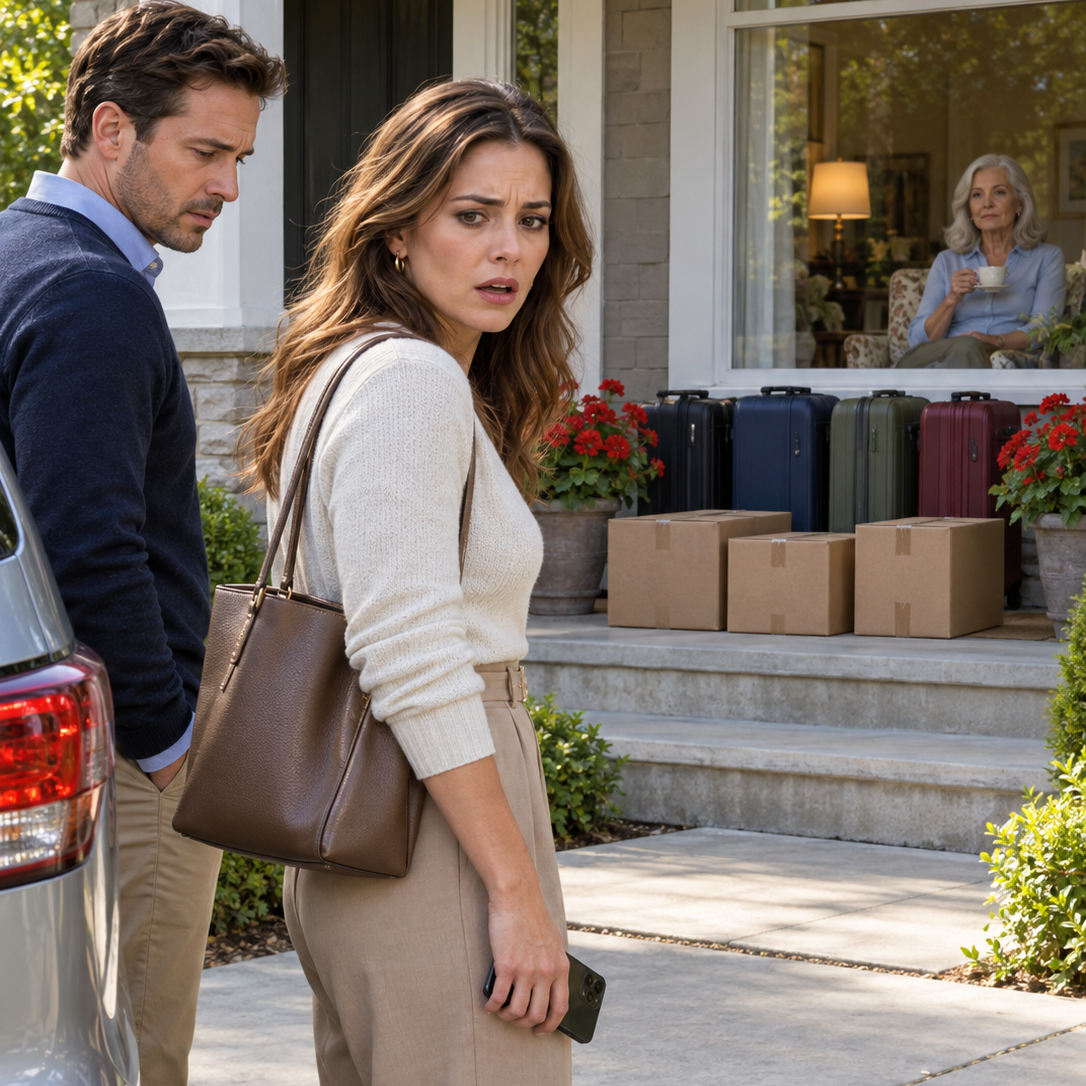
I opened the front door.
The morning air was cool.
My geraniums sat on either side
of the porch.
I arranged the luggage neatly
beside them.
Four suitcases.
Three boxes.
Nothing blocking the walkway.
Nothing damaged.
Nothing missing.
Then I stepped back inside.
Locked the door.
And checked the time.
10:42.
Eighteen minutes before Sarah’s deadline.
I went upstairs once more.
Opened my bedroom.
Nothing had moved.
My dresser remained against the wall.
My bed remained made.
My late husband’s chair remained
beside the window.
Exactly where everything belonged.
I smiled.
Then returned downstairs.
At 10:55, I was sitting
in my favorite chair
near the front window
when a silver SUV turned
into the driveway.
Right on schedule.
I watched it approach.
Sarah was in the passenger seat,
laughing into her phone.
David parked.
Sarah opened her door.
One heel touched the driveway.
Then the other.
She was still laughing
when she turned toward the house.
And saw the porch.
Four suitcases.
Three boxes.
Every possession they’d brought
into my home sitting neatly
beside my geraniums.
Her laughter stopped.
She slowly lowered the phone.
And stared.
”
David hadn’t noticed yet.
He was reaching into the back seat,
pulling out a shopping bag.
Then Sarah said his name.
Quietly, at first.
“David.”
Something in her voice
made him straighten.
He followed her gaze.
The bag slipped against his knee.
For several seconds,
neither of them moved.
Then Sarah walked toward the porch.
Her heels struck the concrete
with brisk, furious clicks.
She tried the door.
Once.
Then again, harder.
“Kimberly.”
I set my tea down.
“Open this door.”
I stood slowly,
feeling the morning’s lifting
in the muscles across my back.
That was when I realized
my hands were trembling.
Not enough for anyone else
to see.
Enough for me.
I rested them against my skirt
before opening the door.
I left the screen between us.
Sarah pointed toward the luggage.
“What is this?”
“Your belongings.”
“I can see that.”
“Then we agree.”
David came up behind her.
His face had gone pale.
“Mom, what are you doing?”
“What I should have done
when you first asked
for my bedroom.”
Sarah let out a disbelieving laugh.
“You’re throwing us out?”
“I’m ending this arrangement.”
“Because of a room?”
“Because you told me
I no longer had the right
to decide where I slept.”
She crossed her arms.
“You’re being dramatic.”
I looked past her
at my son.
“Do you agree with that?”
David shifted the shopping bag
from one hand to the other.
“Can we talk inside?”
“We can talk here.”
“Mom, the neighbors.”
Across the street,
Mrs. Alvarez was watering her hydrangeas.
She had been watering
the same hydrangea for several minutes.
I didn’t look toward her again.
“The neighbors didn’t ask
for my bedroom.”
Sarah stepped closer to the screen.
“You have four bedrooms.
There is no reason
for you to need the biggest one.”
“I don’t need to prove
how much space I deserve
in my own house.”
“You’re one person.”
“Yes.”
The answer seemed to irritate her
more than an argument would have.
David finally put the bag down.
“Where are we supposed to go?”
“Somewhere you arrange.”
“We gave up our apartment.”
“You told me
your rent was increasing.”
“It was.”
“And you decided
to leave it.”
“To save money.”
I nodded.
“That was the plan.”
He looked at the suitcases
as though they belonged
to strangers.
“We can’t get another place today.”
“Then find somewhere temporary.”
Sarah turned toward him.
“Tell her about the movers.”
He closed his eyes briefly.
I heard an engine
before he could answer.
A white moving truck
turned onto our street
and stopped behind their SUV.
Of course it did.
Eleven o’clock.
Sarah’s deadline had arrived
with a hydraulic lift
and two men in work shirts.
The driver climbed out,
looked at the house number,
then at the luggage.
His expression changed
in the small, professional way
of someone recognizing
a problem outside his job description.
“Porter delivery?”
Sarah immediately turned toward him.
“Yes. Upstairs, front bedroom.”
“No,” I said.
The driver paused.
Sarah looked back at me.
“Don’t start embarrassing us.”
“I own this house.
No furniture is coming inside.”
The second mover remained
beside the truck.
The driver looked at David.
“Sir?”
David’s jaw tightened.
For a moment,
I honestly believed
he might contradict me.
Then he looked away.
“She owns the house.”
The driver nodded once.
“Then we can’t unload here.”
Sarah pulled her phone out.
“We have a confirmed booking.”
“For delivery,” he said.
“We still need permission
to enter the property.”
She stared at him.
As though everyone had suddenly
stopped understanding an obvious rule.
Her wishes came first.
The rest of us
were supposed to move accordingly.
“What are our options?” David asked.
The driver explained storage,
another delivery address,
and the additional charges.
I listened without interrupting.
Not because I enjoyed
watching them discover costs.
Because none of those costs
belonged to me.
Then the driver checked his paperwork.
“Are we canceling
the removal portion too?”
Something cold moved
through my stomach.
“What removal portion?”
He glanced at Sarah.
“Existing bedroom set.
Dresser, bed frame, mattress.
One upholstered chair.”
I kept my hand
on the doorframe.
The wood felt smooth
beneath my palm.
“My furniture?”
David looked at his wife.
Sarah lifted her chin.
“We needed room.”
“Where was it going?”
She didn’t answer.
The driver looked down
at the sheet again.
“Donation drop-off, according to this.”
My husband’s chair.
The oak dresser
we had saved for
through two winters of overtime.
My bed.
Not moved across the hall.
Taken away.
I looked at David.
“Did you know?”
He opened his mouth.
Nothing came out.
“David.”
“She said we could
get you something smaller.”
I felt my pulse
in my throat.
“You knew.”
“I thought we would talk
before anything actually—”
“You left.”
He stopped.
“You left me here
with an eleven o’clock deadline.”
Behind him,
the mover quietly folded his paperwork.
“I’ll give you folks a minute.”
He walked back toward the truck.
Sarah’s cheeks had flushed.
“You’re making furniture
more important than your family.”
“No.”
My voice surprised me.
Not loud.
Not shaking anymore.
“You decided my things
could leave without my permission.
You decided I could follow them
into whatever space remained.
That is why this ends.”
David finally met my eyes.
For the first time that morning,
he seemed to understand
there was something larger here
than a bedroom.
It didn’t make him brave.
“Can we at least stay
until the weekend?”
I thought about that.
Really thought.
There had been years
when my answer would have been yes
before the question finished.
Years when disappointment
in my son’s face
felt like an emergency.
But I could already imagine
the weekend arriving.
The explanation.
The delay.
The accusation that I was unreasonable
for expecting a promise
to mean anything.
“No.”
Sarah stared at me.
Then she reached into her purse
and took out the spare key
I had given David.
She held it up.
“We have a key.”
I looked at my son.
“Was that your plan?”
His eyes went to the key,
then to the packed luggage.
“Sarah.”
“What?”
“Give it back.”
“You cannot be serious.”
“Give her the key.”
For the first time,
her confidence faltered.
Not because he had raised his voice.
He hadn’t.
Because he had finally said
something she didn’t want.
She dropped it onto the porch table.
The little brass sound
seemed louder than the moving truck.
David picked up the shopping bag.
Then he bent
for the first suitcase.
“Where are you going?” she demanded.
“To call the storage place.”
“David.”
He kept walking.
Sarah stood there
for another few seconds.
“You’ll regret this.”
I looked at her,
at the woman
I had welcomed into my kitchen
and imagined sharing holidays with.
“I regret this morning already.”
Something moved across her face.
It was gone
before I could name it.
Then she took two suitcases
and pulled them down the steps.
I didn’t watch them load
every box.
I closed the front door
before they finished.
That was the hardest part.
Not packing.
Not saying no.
Closing the door
while my son stood outside.
I leaned against it
and waited for relief.
Instead,
I cried.
Quietly at first,
then with the painful breathlessness
of something held back too long.
I cried for the little boy
who used to bring me
dandelions with muddy roots.
For the teenager
who once drove home
in the middle of a party
because I’d sounded tired.
For the man
who had stood in my kitchen
and watched me become inconvenient.
I cried because I loved him.
And because loving him
had not protected either of us
from what he had become.
Eventually, the truck left.
Then the SUV.
I heard the street settle
back into its ordinary sounds.
A dog barking.
A lawn mower.
Someone closing a car door.
My house smelled faintly
of tea and Sarah’s perfume.
I went upstairs.
Sat in my husband’s chair.
And cried again.
By late afternoon,
I had stopped shaking.
That didn’t mean
I had stopped doubting myself.
Doubt arrived in practical clothing.
Maybe I should have waited.
Maybe a conversation
would have worked.
Maybe I had humiliated them.
Maybe a mother
was supposed to absorb
one more unkindness
and call it patience.
I knew those thoughts.
They had kept me awake
through smaller incidents
I had excused for years.
Sarah changing my restaurant reservation
because she preferred somewhere expensive.
David asking me
to cover the difference.
Christmas moved without consulting me.
A birthday lunch canceled
after I had already baked the cake.
None of those moments
had seemed worth a confrontation.
Together,
they had taught my son
I would stay agreeable
even when I was hurt.
My phone rang.
My sister, Elaine.
I nearly didn’t answer.
Then I remembered
I didn’t have to perform
being fine.
“Hello?”
“Are you all right?”
I closed my eyes.
“What did you hear?”
“That you had some kind
of breakdown over a closet.”
I let out one exhausted laugh.
“Did David call you?”
“Sarah sent a message
to the family group.”
I had muted that group
months earlier.
Too many advertisements,
too many forwarded videos,
too much conversation
that somehow never included
asking how anyone actually was.
“What did she say?”
Elaine hesitated.
“Kim.”
“Tell me.”
“She says you put them
on the street
because you couldn’t handle
another woman making the house comfortable.”
I looked toward the window.
A small bird landed
on the fence
and immediately flew away.
“I see.”
“David hasn’t said anything.”
That hurt more.
Of course it did.
Elaine waited.
I told her everything.
Not quickly.
Not neatly.
Sometimes I had to stop
because saying it aloud
made it worse.
When I described
the furniture donation,
she went very quiet.
Then she said,
“Do you want me to come?”
“Yes.”
The answer escaped
before pride could interfere.
She arrived forty minutes later
with soup,
bread,
and a bag of oranges.
She didn’t make
a triumphant speech.
She didn’t tell me
what she’d always thought
of Sarah.
She put the soup
on the stove.
Then she wrapped her arms
around me.
I had been so determined
to stay upright
that the kindness nearly undid me.
We ate at the kitchen table.
My kitchen table.
Elaine noticed me
looking around.
“What?”
“I keep expecting someone
to tell me I’m overreacting.”
She buttered a piece of bread.
“You can be upset
and still be right.”
“I put his things outside.”
“You packed them carefully
and waited here.”
“I locked the door.”
“Yes.”
The simplicity steadied me.
After dinner,
I checked the family messages.
Sarah had written
three paragraphs.
There were no movers
in her version.
No donation pickup.
No deadline.
Just a lonely older woman
who resented her son’s marriage.
Several relatives had sent
question marks.
One cousin had written,
“Family should help family.”
I began typing
a long explanation.
Then stopped.
I deleted half of it.
What remained was brief.
“I offered the guest room
without rent.
They arranged to remove my furniture
and take my bedroom
without my permission.
I ended the arrangement today.
Their belongings were returned undamaged.
I won’t discuss this further
in the group.”
I read it twice.
Then sent it.
Elaine handed me an orange.
“Now put the phone down.”
For once,
I listened.
The next morning,
I called a locksmith.
I didn’t think David
would break into my home.
I also no longer wanted
the security of my house
to depend on assumptions.
There were spare keys
from years of family visits.
I had lost track
of who held them.
That alone was reason enough.
The locksmith changed the locks,
tested both doors,
and handed me the new keys.
One went on my ring.
One went to Elaine.
The rest stayed
in my desk.
I also called an attorney
a friend had recommended.
Not to punish anyone.
To understand what I should do
if they came back
claiming something I hadn’t anticipated.
I described the three days,
the luggage,
the returned key,
and the furniture order.
She asked careful questions.
Then she suggested
I preserve the messages
and write down the timeline.
“If they dispute the arrangement,
call before taking another step.”
So I wrote everything down.
My hand ached
by the end.
There was something sobering
about seeing a painful morning
reduced to dates and facts.
I had needed that too.
Because memory softens things
when we miss someone.
It takes a clear sentence
and replaces it with
perhaps he didn’t mean it.
My notes remembered
what had actually happened.
David called that afternoon.
I let it ring twice
before answering.
“Mom.”
“Hello, David.”
He sounded tired.
“We’re at a hotel.”
“All right.”
“It’s expensive.”
I looked at the grocery list
beside my phone.
“Yes, hotels usually are.”
A pause.
“Sarah thinks you owe us
for the storage.”
“No.”
“The movers charged twice.”
“I didn’t order them.”
He exhaled hard.
“I’m trying to fix this.”
“What are you trying to fix?”
“Our situation.”
I waited.
He seemed irritated
by the silence.
“What do you want me to say?”
“The truth would be a start.”
“I already know
yesterday got out of hand.”
“Things didn’t get out of hand.
You and your wife
made a plan.”
He said nothing.
“You watched her tell me
to leave my room.
Then you told me
to show respect.”
“I didn’t mean it like that.”
“How did you mean it?”
He couldn’t answer.
I could hear traffic
on his end.
Somewhere nearby,
a shopping cart rattled.
Ordinary life continuing
around an extraordinary disappointment.
Finally, he said,
“I shouldn’t have said that.”
“No, you shouldn’t.”
“I said I’m sorry.”
“You said you shouldn’t have said it.
Those aren’t the same thing.”
“Mom.”
The old warning
lived inside that word.
Don’t make this difficult.
Don’t require more.
Don’t force me
to feel uncomfortable.
I recognized it now.
“You don’t have to find
the perfect words today.
But I won’t help you
pretend this was a misunderstanding.”
His voice hardened.
“So we’re just on our own?”
“You are adults.”
“I thought family mattered to you.”
It landed.
He knew it would.
I pressed my fingers
against the table.
“It matters enough
that I won’t keep doing this.”
He ended the call
without saying goodbye.
I sat very still.
Then I crossed toothpaste
off the grocery list.
I didn’t need any.
It was such a small act,
so absurdly ordinary,
that I almost laughed.
The world had not ended.
I still needed milk.
I still needed to eat.
That evening,
Mrs. Alvarez knocked.
She held a covered dish.
“I made too much.”
She lived alone.
Her casserole was large enough
for six.
“Come in,” I said.
She looked toward the stairs
but asked nothing.
We ate together.
Talked about her daughter’s new job,
the road construction,
and whether the bakery
had changed its cinnamon rolls.
At the door,
she touched my arm.
“For what it’s worth,
I heard enough.”
I swallowed.
“I wish you hadn’t.”
“I wish you hadn’t
needed to say it.”
Then she went home,
leaving me with leftovers
and the strange relief
of not having to defend myself.
The family group settled
within two days.
An aunt called
to apologize for assuming.
The cousin who mentioned family
never offered David a room.
I noticed.
I said nothing.
Elaine told me
Sarah had asked her too.
“For how long?” I asked.
“She didn’t say.”
“What did you say?”
“That our guest room
isn’t available.”
Elaine’s husband used it
for his model trains.
I smiled for the first time
without forcing it.
A week passed.
I washed the guest linens.
Found one of David’s cufflinks
under the dresser.
A small silver square.
I held it
longer than necessary.
Then I put it
in an envelope.
There were no secret documents
hidden in their luggage.
No shocking letter
explaining everything.
Only the ordinary evidence
of two people
who had expected me
to make their lives easier.
That was painful enough.
On the eighth day,
David sent a text.
“Can I get my cufflink?
I think I left it.”
I wrote back.
“I found it.
You can collect it Saturday
at two.”
He arrived alone.
I opened the door.
He had shaved badly.
A thin line of dried blood
marked his jaw.
I stepped aside.
“You can come in.”
He looked surprised.
I didn’t explain
that a visit
and an invitation to live
were different things.
He needed to learn
some distinctions himself.
We sat at the kitchen table.
The envelope lay between us.
He didn’t pick it up.
“Sarah isn’t coming.”
“I noticed.”
“She says you hate her.”
“I don’t hate her.”
“She thinks you’ve always
wanted me to yourself.”
I looked at my son.
“Did you believe that
before last week?”
He stared at the envelope.
“No.”
“Do you believe it now?”
“No.”
“Then don’t bring it here
as though it might be true.”
His shoulders lowered.
For a while,
he looked very young.
That was dangerous for me.
The urge to comfort him
rose before the memory
of what he’d done.
I kept my hands
around my cup.
“We found a furnished rental,” he said.
“Month to month.”
“That’s good.”
“It’s small.”
I waited.
He rubbed his forehead.
“I know.”
“What do you know?”
“That small isn’t an emergency.”
I let the words settle.
It was the first thing
he had said
that sounded like understanding.
Then he added,
“The deposit wiped out
most of what we had.”
There it was.
The old doorway.
I could walk through it
with my checkbook
and spare him
the full weight
of his choices.
“How are you managing?”
“I sold my gaming setup.”
“That must have helped.”
He glanced up.
“You’re not going to say
I shouldn’t have needed it?”
“No.”
“I thought you might.”
“You know what you can afford
better than I do.”
He looked puzzled.
I wondered how often
my help had sounded
like a claim of authority.
How often I had rescued him,
then worried aloud
about choices he made afterward.
There were things
I needed to examine too.
But those things
didn’t make his behavior mine.
“Mom, can I ask you something?”
“Yes.”
“Did you really mean forever?”
“I never said forever.”
“You said it was over.”
“The living arrangement is over.”
He swallowed.
“So we can still—”
“Have a relationship?”
He nodded.
“I hope so.”
His eyes filled.
It would have been easy
to end the conversation there.
A hug.
A promise.
An agreement
that everyone had been stressed.
Instead, I asked
the question I had carried
for eight days.
“Why didn’t you stop her?”
He wiped his mouth
with the back of his hand.
“I thought you’d let us.”
That answer hurt
more than an excuse.
He seemed to realize it.
“I don’t mean
I thought it was okay.”
“You thought I wouldn’t refuse.”
He nodded slowly.
“Why?”
“Because you usually don’t.”
The refrigerator hummed.
Outside, a delivery van
passed the window.
I sat with that.
Then I said,
“That’s something I have
to take responsibility for.”
He looked relieved too quickly.
“But your choice
is still your responsibility.”
“I know.”
“I’m not sure you do yet.”
He leaned back.
For a moment,
defensiveness returned.
Then he looked toward the stairs.
“She said you were
only using half the room.”
“And what did you say?”
“That we should ask.”
“But you didn’t.”
“No.”
“Why?”
“Because she said
you’d make her feel unwelcome.”
I looked down at my tea.
“So you made me
feel unwelcome instead.”
His face changed.
Not dramatically.
It simply lost
the last place
where he had been hiding.
“Yes.”
There was no satisfaction
in hearing it.
Only grief,
finally being named correctly.
“I thought,” he said slowly,
“you’d be upset for a day.
Then you’d help us move things.
Then you’d make dinner.”
I couldn’t speak
for several seconds.
He stared at his hands.
“I knew you’d be hurt.
I did it anyway.”
That was the first apology
before the apology.
The part that mattered.
When he finally said,
“I’m sorry, Mom,”
he didn’t add
that he was stressed.
He didn’t mention the hotel.
He didn’t tell me
Sarah had started it.
I believed him.
Believing him
didn’t make everything disappear.
“I love you,” I said.
“But I cannot live
as the easiest person
for you to disappoint.”
He nodded.
Tears slipped down his face.
I let him wipe them himself.
We talked for another hour.
Not about moving back.
About small things
that had grown large
because neither of us
had named them.
The canceled birthday.
The borrowed money.
The way he called
when he needed an answer
and hurried off
when I needed company.
He admitted he had begun
thinking of my help
as part of his budget.
I admitted I had sometimes
offered money
when what I wanted
was time with him.
It was embarrassing.
Both truths were.
But embarrassment felt cleaner
than resentment.
When he left,
he took the cufflink.
At the door,
he looked back.
“Can I call next week?”
“Yes.”
“Just to call.”
“I would like that.”
After he drove away,
I sat in the kitchen
and let myself feel
something short of forgiveness
and warmer than anger.
A beginning.
Two weeks later,
Sarah wrote to me.
A long message.
She was sorry
I had felt disrespected.
She was sorry
the situation had escalated.
She hoped I understood
how difficult things were
for young couples.
I read it
at the dining table.
Then set the phone down
and went outside
to deadhead the geraniums.
I didn’t owe
every message
an immediate reply.
That was another new lesson.
By evening,
I knew what to say.
“I am willing to talk.
I need you to acknowledge
what you chose to do,
including arranging my furniture’s removal.
I won’t debate whether
I was allowed to refuse.”
Her answer came quickly.
“Fine. When?”
I nearly canceled.
Instead, I offered
a Saturday afternoon
at a café downtown.
Some conversations belonged
away from the room
someone had tried to take.
David came with her.
I hadn’t asked him to.
I hadn’t forbidden it either.
Sarah looked polished.
Cream sweater.
Gold earrings.
Hair smooth against her shoulders.
But she kept turning
her ring around her finger.
I ordered tea.
They ordered coffee.
For a while,
the three of us watched
a server wipe
the neighboring table.
Then Sarah spoke.
“I should have asked.”
“Yes.”
“I thought it made sense.”
I waited.
She looked at David.
He didn’t rescue her.
She looked back at me.
“The room was bigger.
You didn’t need an office.
I did.”
“You were welcome
to ask about an office.”
“You would have said no.”
“Maybe.”
She blinked.
I continued.
“You were also welcome
to hear no.”
Her mouth tightened.
“I didn’t think
you’d put us out.”
“I know.”
That seemed to disturb her
more than anger.
She looked down.
“My mother always gives in
after she complains.”
I knew her mother
only through holiday gatherings.
A quiet woman
who washed dishes
before anyone asked.
I had wondered
why Sarah spoke for her
so often.
“I’m not your mother,” I said.
“I know that now.”
“Does your mother
get to say no?”
Sarah’s eyes came up.
For a moment,
I thought she would leave.
Instead, she looked
at the small spoon
beside her cup.
“I don’t know.”
It was the first honest answer
she had given me.
She took a breath.
“I wanted our life
to look better than it was.”
Neither of us spoke.
“The apartment wasn’t just expensive.
We weren’t saving anything.
Every month,
we said the next month
would be different.”
David nodded.
“We both did that.”
She pressed her lips together.
“Your house felt like
we could finally get ahead.”
“And my bedroom?”
Her eyes shone.
“Like we hadn’t gone backward.”
I understood then
without agreeing.
She had wanted
the big room,
the closet,
the desk by the window,
because accepting a guest room
meant admitting she was a guest.
Accepting help
had felt like failure.
So she had tried
to turn help
into something she controlled.
“You don’t get to make
your embarrassment my punishment,” I said.
She flinched.
“No.”
“And his part matters too.”
I looked at David.
He nodded.
“I let it happen.”
Sarah’s voice became smaller.
“I shouldn’t have ordered the movers
to take your things.”
“No.”
“I knew you’d be upset.”
“Then why do it?”
She breathed out shakily.
“Because I thought
once it was done,
you wouldn’t make us undo it.”
There it was again.
The same calculation.
Two adults
counting on my reluctance
to create a scene.
I felt tired.
Not old.
Tired.
“You both made plans
around how much hurt
you thought I’d accept.”
David looked down.
Sarah wiped beneath one eye.
“Yes,” she whispered.
The café carried on around us.
Cups clinked.
A child asked for a muffin.
Someone laughed near the counter.
I was grateful
for that ordinary noise.
It kept the conversation
from becoming a performance
with a dramatic ending.
“I am sorry,” Sarah said.
“For telling you to leave
your own room.
For arranging the removal.
For what I said
to your family afterward.”
I watched her.
She continued.
“I’ll correct that message.”
“You should.”
“I will.”
I nodded.
Not forgiveness.
Not yet.
An acknowledgment
that she had finally
put her hands
on her own part.
We finished our drinks.
No one hugged.
At the door,
Sarah asked,
“Does this mean
we can come for dinner?”
“Eventually,” I said.
“I need some time.”
She looked disappointed.
Then she said,
“All right.”
I wondered
whether she heard
the echo.
That evening,
she sent a message
to the family group.
Shorter than the first.
She said she and David
had tried to take my room.
That they had arranged
to remove my furniture
without asking.
That I had returned
their belongings carefully.
That the decision
to leave had followed
their behavior.
She didn’t call me confused.
She didn’t mention loneliness.
David added his own message.
“I was part of this.
Mom did nothing
to deserve how we treated her.”
I read both
more than once.
Then I muted
the group again.
Some corrections mattered
without requiring an audience
for what came afterward.
Spring turned toward summer.
I began sleeping better.
At first,
that made me sad.
I didn’t like discovering
how much tension
I had carried
in anticipation of my son’s calls.
Then I began
to enjoy the quiet
without interpreting it
as evidence
that no one loved me.
I joined a painting class
at the community center.
My first watercolor
looked like a wet cabbage
pretending to be a tree.
The instructor studied it
with admirable seriousness.
“You’re using plenty of water.”
Elaine laughed so hard
when I told her
that I had to sit down.
I went back
the next week.
And the next.
I wasn’t good.
That was unexpectedly pleasant.
There was nothing
to manage for anyone.
No standard
I had to maintain
to prove my usefulness.
Only paper,
color,
and the chance
to learn something badly
before learning it better.
David called on Wednesdays.
At first,
our conversations were awkward.
He asked too many questions,
like a man following instructions.
Had I eaten?
Was the house all right?
Did I need anything repaired?
One evening,
I stopped him.
“You don’t have to
earn your way through this call.”
He went quiet.
“I don’t know
what normal sounds like now.”
“Tell me about your day.”
“It was boring.”
“Mine too.”
He laughed.
A real laugh.
Then he told me
about a coworker
who had heated fish
in the break room.
I told him
about my cabbage tree.
For twenty minutes,
we were mother and son
without an invoice
hidden inside the conversation.
I cried after that call.
Differently this time.
In July,
I invited them for dinner.
Not a holiday.
Not a celebration.
A Sunday,
with roast chicken
and a salad.
Sarah arrived carrying bread.
David held a carton
of strawberries.
They stopped on the porch
until I opened the door.
Such a small thing.
Still,
I noticed.
“Come in.”
Sarah looked toward the kitchen.
“Would you like me
to put this somewhere?”
“On the counter, please.”
She did.
No rearranging.
No commentary
about the cabinets.
No suggestion
that I should replace
the old chairs.
We ate.
Talked about the weather,
their work,
my painting class.
The conversation stumbled
in places.
I let it.
A repaired relationship
didn’t need to pretend
it had never broken.
After dinner,
David started washing dishes.
Sarah dried.
I sat at the table,
feeling strange
about not standing immediately.
Then I stayed seated.
At one point,
David looked toward the hallway.
“You changed the guest room.”
“Yes.”
The door stood open.
A folding worktable
sat beneath the window.
Paintbrushes dried in a jar.
A small bookshelf
held watercolor paper
and library books.
The bed remained.
I still liked having guests.
But the room
had begun belonging
to my daily life too.
“Looks nice,” he said.
“Thank you.”
Sarah studied
a painting on the wall.
A bowl of oranges.
Lopsided,
but recognizable.
“You painted that?”
“I did.”
She moved closer.
“The light is pretty.”
It was such
a simple observation
that I almost distrusted it.
Then I let myself
accept the compliment.
“Thank you.”
They left before dark.
No requests.
No suggestion
that the evening
had purchased anything.
When I closed the door,
the house felt peaceful.
Not empty.
Peaceful.
The difference
was becoming easier to recognize.
In August,
David asked whether I wanted
my old garden bench repaired.
One leg had loosened
the previous winter.
He had noticed it
during dinner.
I said yes.
We agreed on Saturday.
He arrived at nine
with tools,
sanded the damaged wood,
and asked before choosing
a replacement board.
I brought lemonade outside.
He looked at the glass,
then at me.
“You don’t have to wait on me.”
“I know.
I wanted lemonade too.”
He smiled.
We sat beneath the maple
while the glue set.
For a while,
neither of us spoke.
Then he said,
“I started seeing someone.”
I turned.
“A counselor,” he added quickly.
“Oh.”
He laughed once,
a little embarrassed.
“Sarah and I both did.
Separately, at first.”
I waited.
“I keep thinking
being supportive means
keeping everyone from getting upset.”
“That sounds exhausting.”
“It is.”
He rolled the glass
between his palms.
“But I wasn’t really doing that.
I was choosing
who I thought
would forgive me easiest.”
I looked at him.
He stared at the yard.
“You.”
“Yes,” I said.
He nodded.
No argument.
No collapse.
Just the work
of hearing something true.
“I can’t promise
I’ll never be stupid again.”
“I would be suspicious
if you did.”
He smiled faintly.
“I can promise
you won’t have to
make me say
what happened that morning.”
I let that settle.
Then I said,
“Your father used to think
an apology needed
to solve everything immediately.”
David looked over.
“He did?”
“Oh, yes.”
I smiled at the memory.
“He would stand
in the doorway,
looking so hopeful
that I would forgive him
just to make him leave.”
David laughed.
“Sounds familiar.”
“One day,
I told him
I could accept his apology
and still be upset.”
“What did he say?”
“He asked how long.”
We both laughed then.
The sound surprised me.
Not because it was joyful.
Because it hurt
and comforted at once,
the way memories sometimes do
when they finally have room
to breathe.
“Was he a good husband?”
David asked quietly.
I thought before answering.
“Yes.
And he learned.”
My son nodded.
I hoped he understood
why I had chosen
both parts.
September brought rain.
The geraniums grew tired.
I trimmed them back,
carried some pots inside,
and began thinking
about the upstairs rooms.
Not because anyone asked.
Because the house
was mine to reconsider.
The fourth bedroom
had become a collection
of things I might need someday.
Old lamps.
Extra blankets.
A broken printer
no one had repaired.
I spent a week
sorting through it.
Kept what I wanted.
Donated what I didn’t.
My decisions.
My pace.
In the back of the closet,
I found a cardboard carton
marked in my husband’s handwriting.
“Bedroom project.”
I sat on the floor
before opening it.
Inside were brass handles,
fabric samples,
and a small notebook.
For a moment,
I could hear him
calling from the hardware aisle,
asking whether brushed brass
was apparently different
from ordinary brass.
He had planned
to fix my dresser.
The drawers stuck
during damp weather.
We had meant
to reupholster his chair too.
Then appointments had come.
Tests.
The hospital.
All the small projects
had stopped
before either of us understood
we were running out of time.
I opened the notebook.
Measurements.
Prices.
A little sketch
of the bedroom window.
Then,
on the next page,
a list.
“Kim’s worktable.
Better lamp.
Shelves for paints.
Ask about classes.”
I pressed my hand
against the paper.
Years earlier,
before illness,
I had mentioned
wanting to paint again.
Not seriously.
Just once,
while we were washing dishes.
I had loved it
when I was young.
Then work,
children,
bills,
and everybody else’s needs
had filled the years.
I barely remembered
telling him.
He had remembered.
I turned the page.
There was one more note,
written at an angle
beneath a price calculation.
“Tell her the room
doesn’t have to stay the same.”
I sat there
for a long time.
I had spent months
defending my right
to keep things
where they belonged.
Now I was looking
at the handwriting
of the man I missed,
giving me permission
I had never actually needed.
I wasn’t protecting him
by keeping a chair
unrepaired.
I wasn’t keeping love alive
by preserving every scratch
exactly as it had been.
What Sarah had tried to take
was my choice.
What I did next
could be something else entirely.
I called an upholsterer
the following morning.
Chose a soft green fabric.
Nothing like the old brown.
Then I hired someone
to repair the dresser drawers.
For three days,
the space beside the window
stood empty.
I expected it
to feel unbearable.
Instead,
morning light fell
across the bare floor.
I could see
the little square mark
where one chair leg
had worn the finish.
I touched it once.
Then went downstairs
to paint.
When the chair came back,
I loved it.
That startled me.
I sat in it
with a book
and didn’t feel
as though I had
betrayed anyone.
I sent David a photograph.
“Had your dad’s chair redone.”
He called within minutes.
“You changed it.”
“I did.”
“Are you okay?”
“Yes.”
He paused.
Then his voice softened.
“It looks comfortable.”
“It is.”
“Dad would have complained
about the bill.”
“For at least a week.”
We laughed.
Then I told him
about the notebook.
He listened
without interrupting.
At the end,
he was quiet.
“I thought,” he said,
“you stayed in that room
because you couldn’t move on.”
I looked at the green fabric
beneath my hand.
“I stayed because I liked it.
And because some days
I missed him.
Both were allowed.”
“I know that now.”
I believed
he was beginning to.
October arrived
with cooler evenings.
David and Sarah signed a lease
on a modest apartment
they could afford
without anyone else’s contribution.
Two bedrooms.
No walk-in closet.
A little balcony
overlooking a parking lot.
They invited me
to see it.
I brought a plant,
not an envelope.
David opened the door.
Sarah stood beside
a narrow dining table.
Their furniture fit awkwardly.
The second bedroom
held her desk
and a clothes rack.
She gave me
a nervous smile.
“The office is small.”
I waited.
“But it works.”
“I’m glad.”
She showed me
the shelves
she had installed herself.
One leaned slightly.
I didn’t point it out.
In the kitchen,
David made coffee
while Sarah unpacked
a bakery box.
There were three plates
on the table.
I noticed that too.
Before I left,
Sarah walked me
to the balcony.
Traffic whispered below us.
“I called the donation place,” she said.
I looked at her.
“After everything.
To cancel the pickup record.
They said
nothing had been collected.”
“No.”
She folded her arms
against the cool air.
“I kept thinking
about that chair.”
I waited.
“I knew it was his.
I still put it
on the list.”
Her eyes filled.
“I wanted you to know
I understand that part now.”
I watched a man
cross the parking lot
carrying grocery bags.
Then I said,
“I had it reupholstered.”
She turned toward me.
“David showed me.”
“It’s green.”
“It looks beautiful.”
“I love it.”
She nodded,
tears slipping down
before she brushed them away.
“I took that choice
away from you.”
“You tried.”
“Yes,” she whispered.
“I tried.”
For the first time,
I felt the anger
in that particular place
begin to loosen.
Not because
she had cried.
Because she had stopped
trying to make her actions
sound smaller.
“I won’t forget it,” I said.
“I know.”
“But I don’t want
to keep living
inside that morning either.”
She looked at me.
“I’d like that.”
“We’ll see
what we build from here.”
She nodded.
It was enough
for that day.
Thanksgiving approached.
For years,
I had cooked everything.
Bought everything.
Timed my morning
around everyone else’s arrival.
That year,
I sent a message.
“Dinner at three.
I’m making turkey and potatoes.
Please bring the rest.”
Elaine volunteered dessert.
David offered vegetables.
Sarah asked about stuffing.
I sent her
my husband’s recipe.
She wrote back
with two questions.
Then a third.
I answered all three.
No resentment.
No test
she was supposed to pass.
Just a recipe,
shared because she asked.
On Thanksgiving morning,
I woke before sunrise.
For a moment,
the house was dark
and so quiet
I could hear
the heating pipes settle.
I lay in my bed,
under the quilt
I had chosen years earlier,
and listened.
No footsteps
moving through my hallway.
No borrowed authority
waiting downstairs.
No need
to prepare myself
for the cost
of being generous.
I got up
when I wanted.
Made coffee.
Opened the curtains.
The chair by the window
caught the first pale light.
Green,
soft,
beautifully mine.
By three,
the table was full.
Not crowded.
Full.
Elaine and her husband.
Mrs. Alvarez,
whose daughter was traveling.
David and Sarah.
Me.
There were serving bowls
that didn’t match.
Too many spoons.
One candle
that kept leaning
until someone folded paper
beneath the holder.
Sarah’s stuffing
was slightly overbaked.
She looked stricken
when she tasted it.
David reached for another spoonful.
“I like the crispy parts.”
“So did your father,” I said.
She looked up.
I passed her the gravy.
The conversation moved on.
That was a kindness too.
Letting an imperfect dish
remain an imperfect dish.
Not a verdict
on the person
who had made it.
After dinner,
Elaine’s husband
insisted on washing.
David dried.
Mrs. Alvarez wrapped leftovers
with military precision.
Sarah cleared plates.
I sat at the table
with my sister
and watched evening gather
against the windows.
Elaine leaned toward me.
“How are you?”
I knew
what she was asking.
Not whether the turkey
had turned out.
Not whether my back hurt.
How was I,
inside the life
I had nearly surrendered
to avoid making anyone uncomfortable?
I thought about it.
Then answered honestly.
“Better.”
She squeezed my hand.
Later,
when the kitchen was clean,
David stood beside the stairs.
He looked at me
with an expression
I couldn’t quite read.
“Can I see Dad’s notebook?”
I nodded.
We went upstairs.
Sarah stayed below,
talking with Elaine.
I took the notebook
from my dresser.
David sat
on the edge of the bed
and turned the pages carefully.
He smiled
at the measurements.
The hardware calculations.
The sketch
of the window.
When he reached
the notes about painting,
he stopped.
His thumb rested
beside his father’s handwriting.
“I miss him,” he said.
“So do I.”
He looked toward the chair.
“I think
I made you responsible
for that too.”
I sat beside him.
“What do you mean?”
“Keeping everything familiar.
Being here.
Always answering.
I could come home
and pretend
nothing had really changed.”
I watched him
close the notebook.
“Then I got angry
when you had needs
that didn’t fit.”
He breathed slowly.
“That doesn’t excuse anything.”
“No,” I said.
“It doesn’t.”
“I know.”
For a while,
we sat together
in the room
he had tried to take.
No one needed
to say that aloud.
It was there
in his careful hands,
in the space
he left between us,
in the way
he asked before putting
the notebook down.
Finally,
he turned to me.
“You deserved better
than I gave you.”
My eyes filled.
“Yes,” I said.
“I did.”
He nodded.
“I want you
to have better now.”
I looked at my son,
at the lines
beginning beside his eyes,
at the boy
who was gone
and the man
still learning
how to stand upright
inside his own choices.
“Then keep showing up
the way you have been.”
“I will.”
I didn’t ask
for a larger promise.
I didn’t need
him to become perfect.
I needed
his next choice
to be his own,
and kinder.
When we went downstairs,
Sarah was putting on her coat.
She hugged Elaine.
Thanked Mrs. Alvarez
for the leftovers.
Then turned toward me.
“Thank you for having us.”
“You’re welcome.”
She hesitated.
“Would a hug be all right?”
I stepped forward.
It was brief.
A little awkward.
Real enough.
David hugged me next.
Not the distracted squeeze
he used to give
while reaching for his keys.
He held on
for a moment.
Then let go.
After everyone left,
I walked through the house
turning off lights.
The guest room
held my painting table.
The fourth bedroom
was clean and unfinished,
waiting for whatever purpose
I might eventually choose.
There was no urgency
to fill every space.
No need
to turn every empty room
into proof
that I was lonely.
Downstairs,
one geranium
still held a stubborn bloom.
I carried it
closer to the window.
Then I went upstairs
with a cup of tea.
My oak dresser
stood against the wall.
Its repaired drawers
opened without sticking.
The bed was made
with clean sheets.
Beside the window,
the green chair waited.
I sat down.
For years,
I had mistaken
being needed
for being safe.
I had thought
a good mother
kept finding room.
For luggage.
For excuses.
For other people’s plans.
Even when making room
meant disappearing
from her own life.
I didn’t think that anymore.
My son had a home.
I had mine.
Between them,
there was a road
we could travel
by invitation,
with affection,
and return from
before love became obligation.
I took out
my husband’s notebook
one last time.
Read the list.
The worktable was downstairs.
The lamp
was already ordered.
My brushes stood
in a jar
beside a painting
I hadn’t finished.
I picked up a pencil.
Beneath his notes,
in my own handwriting,
I added one word.
“Done.”
Then I closed the book
and set it beside me.
Outside,
the last car
turned off our street.
The house settled.
I drank my tea
while it was warm.
And when I was tired,
I went to bed
in the room
I had chosen,
beneath the roof
I had helped build,
with no deadline waiting
in the morning.