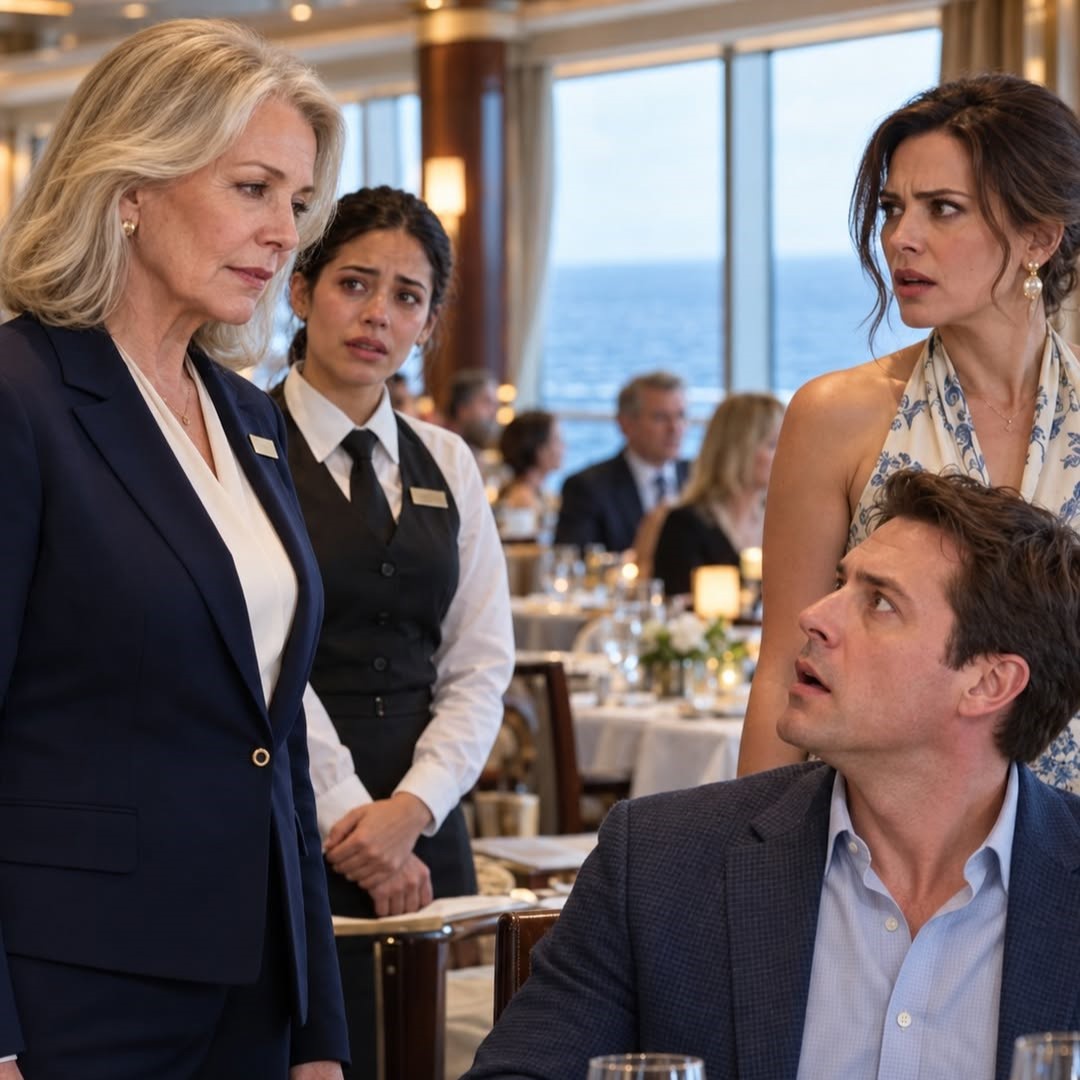
PART 2: THE NAME BENEATH THE BADGE
“Yes, David.”
The dining room seemed to tilt
around the sound of his name.
His chair scraped backward.
Lilia looked between us,
her expression tightening into something
I recognized before she spoke.
Calculation.
“You knew,” she said.
I kept my hands still.
“Knew what?”
“That we were coming.”
“Yes.”
“And you let us embarrass ourselves?”
Behind her, Carmen stood holding
a water pitcher against her apron.
Her fingers trembled.
I turned toward her.
“Please ask Elena to join us.
Then take your break.”
Lilia snapped her fingers.
“She hasn’t finished serving us.”
“She has finished this conversation.”
My voice carried farther
than I intended.
At the nearest table,
a man lowered his fork.
I stepped aside,
giving Carmen a clear path.
She looked at me once,
then walked toward the service doors.
David was still staring.
His gaze moved from my face
to the name on my badge.
“Morrison?”
“A professional name,” I said.
“My legal name remains Patterson.
We can discuss that privately.”
“Privately?” Lilia repeated.
“You humiliate us in public,
then ask for privacy?”
“I asked you to stop
humiliating a member of our staff.”
David stood.
“Mom, how did this happen?”
“For now, you’ll finish lunch.
This evening, we can talk.”
He reached toward my wrist.
I stepped back.
The movement was small.
His face changed when he noticed.
“I wasn’t going to hurt you.”
I looked directly at him.
“You understand why I moved.”
He lowered his hand.
For the first time,
he did not have
an answer ready.
Elena arrived beside us,
composed in her charcoal uniform.
“Mrs. Patterson?”
“Please take over this table.”
Lilia gave a short laugh.
“Mrs. Patterson. There it is.
So the whole thing was fake.”
Elena glanced at me.
I felt the old instinct stir.
Explain quickly.
Make everyone comfortable.
Keep the peace
before someone became angry.
Instead, I straightened my badge.
“Nothing about Carmen’s employment is fake.
Nothing about her right
to respectful treatment is negotiable.”
Then I left them standing
beside their untouched lunch.
I reached the staff corridor
before my knees began shaking.
The carpet ended at a threshold.
Beyond it, the floor was practical,
gray, easy to clean.
Somehow that helped.
I pressed my palm
against the cool wall.
For three days,
I had watched my son
look through me.
I had told myself
I was gathering courage.
Perhaps part of me
had been conducting a cruel experiment.
Would he recognize my voice?
My hands?
The way I tilted my head
when someone needed help?
He had recognized the service first.
The woman came later.
“Marlene?”
James stood at the corridor’s end.
He took one look
at my face.
“Office?”
I nodded.
He walked beside me
without touching my elbow
or telling me to breathe.
Inside, he closed the door.
“Do you want them restricted
from approaching you?”
“No. Not yet.”
“All right.”
I sat.
Outside the window,
the sea moved in long,
dark blue folds.
“I upgraded them,” I said.
“I know.”
“I wanted them to see
something they couldn’t dismiss.”
James waited.
“Instead, I gave them
three days of better service.”
“You can change your mind
about how this ends.”
I looked down at my hands.
“I don’t want their holiday
to become my revenge.”
“Then it won’t.”
The simplicity of that answer
nearly undid me.
A knock sounded.
Carmen stood in the doorway,
her eyes red but dry.
“I’m sorry,” she began.
“No.”
The word escaped sharply.
I softened my voice.
“Please don’t apologize
for being spoken to that way.”
“She wanted the dressing separate.
I brought a replacement.
Then she said I rolled
my eyes at her.”
“Did you?”
Carmen hesitated.
“I looked at the ceiling.
Only for a second.”
Despite everything,
a small laugh left me.
“Then we’ll survive
a second of ceiling inspection.”
Her mouth trembled.
“She said she knew
someone important.”
“So do you,” James said.
Carmen looked between us.
I leaned forward.
“If another guest treats you badly,
report it. Whoever they are.”
After she left,
James set a glass
of water beside me.
“You should eat something.”
“In a minute.”
“Now, preferably.”
I looked up.
He smiled faintly.
“You’ve been feeding other people
since you were seventeen.
Allow a sandwich.”
That evening,
David arrived without Lilia.
He stopped inside my office
as if the room itself
had accused him of something.
The desk.
The framed training certificate.
The photograph of my first
guest services team.
My name on the door.
“Is this really your office?”
“Yes.”
He sat without being invited,
then immediately stood again.
“I don’t understand.”
“Which part?”
“All of it.”
I let him find
somewhere to begin.
Finally, he pointed toward the window.
“You’re working on a ship?”
“I work across several operations.
This voyage includes a staff review.”
“And the owner just gave
you a job?”
“He offered me training.
I earned the position.”
David rubbed his forehead.
“You were a waitress.”
“For thirty-eight years.”
“I didn’t mean—”
“You meant exactly that.
You just expected me
to agree with you.”
He sat again.
“How much are they paying you?”
I felt something settle inside me.
There it was.
Not where had I slept.
Not whether my cheek healed.
Not why I had flinched.
“How I’m paid
isn’t your business.”
“I’m your son.”
“Yes.”
The silence that followed
was the longest silence
we had ever shared.
He looked toward the door.
“Lilia says you set us up.”
“I gave you a suite.
That was a mistake.
I won’t charge you for it.”
“What mistake?”
“Thinking generosity might make you
curious about the person offering it.”
His jaw tightened.
“You’re making this sound terrible.”
“It was terrible.”
“We had an argument.”
“She struck me.”
He stared at the carpet.
“And you told me
to leave the house.”
“I was angry.”
“I slept in my car.”
His head rose.
For one second,
he looked like my son again.
The little boy
who once brought me
a chipped cup of water
when I had the flu.
“Why didn’t you call?”
I let the question remain
between us until he heard it.
Then he looked away.
“We thought you went
to a friend’s place.”
“You didn’t ask.”
Outside, an announcement drifted faintly
through the corridor speakers.
Evening entertainment.
A piano performance.
Other people continuing
their ordinary lives.
“I’m sorry you had
a difficult few nights,” he said.
I closed my eyes briefly.
Not sorry I left.
Not sorry I abandoned you.
Sorry the weather had been unpleasant
during the event he caused.
When I opened my eyes,
he was examining my desk again.
“What does twenty-five percent mean?”
I looked at him.
“Who told you that?”
“Your company profile.
Lilia looked it up.”
Of course she had.
“The guest services subsidiary,” I said.
“Not a quarter of twelve ships.
My investment and earned equity
are governed by a contract.”
“So you do have money.”
“I have work.”
“You could help us.”
“No.”
The answer surprised us both
with its lack of strain.
He leaned forward.
“Mom, listen. Things are bad.
The cruise was already booked.
There were penalties.
We couldn’t just cancel everything.”
“So you came.”
“We needed a break.”
“So did I.”
His face hardened.
“You always do this.”
“What?”
“Make me feel guilty
for having a life.”
I stood.
“This conversation is over.”
He rose slowly.
For a moment,
I thought he might apologize properly.
Instead, he said,
“Lilia wants to know
if the onboard charges are covered.”
“Only the suite upgrade.
Your purchases remain your responsibility.”
He swallowed.
“How much?”
“You can request your statement
from the guest accounts desk.”
After he left,
I sat in the quiet
and cried without covering my mouth.
Not for long.
But without apologizing
to the empty room.
The following morning,
our accounts manager, Priya,
asked to see me.
She closed the office door.
“We have a payment problem
with your relatives’ reservation.”
I felt the old shame rise,
hot and immediate.
“Treat it like any reservation.”
“That’s why I’m here.”
She placed a printed report
face down on the desk.
“Their onboard authorization failed.
During the review,
we found a separate discrepancy
in their original booking.”
“What kind?”
“The payment card used
for the deposit belongs to you.”
I shook my head.
“I didn’t book this.”
“The cardholder name is yours.
The contact email isn’t.”
My fingers went cold.
I had replaced my everyday card
after leaving the house.
But there had been another account.
An emergency card,
kept inside a blue envelope
with my insurance paperwork.
Unused for years.
I turned the report over.
The final four digits
were horribly familiar.
“How much?”
“The deposit was twelve thousand.
The remaining fare was paid
with two different cards.”
Twelve thousand dollars.
The number sat on the page,
quiet and complete.
Priya spoke carefully.
“This doesn’t prove who entered it.
You should contact your bank.
We’ll preserve our booking records.”
I reached for my phone.
Before I could unlock it,
my office extension rang.
Guest accounts.
Lilia was at the desk.
She wanted the spending restriction removed.
She had also requested
that the disputed deposit
be refunded to her personal account.
“She says you authorized everything,”
the clerk told me.
“She says your son
has permission to sign for you.”
I looked at the blue water
beyond my window.
Then I looked back
at the twelve-thousand-dollar charge.
“Don’t process anything,” I said.
“I’m coming down.”
Outside my office,
David was waiting.
He saw the report in my hand.
His shoulders dropped.
“Mom,” he whispered,
“please let me explain
before you call the bank.”
PART 3: THE SIGNATURE IN THE DARK
“Did you use my card?”
David glanced toward the corridor.
“Can we go somewhere private?”
“We are somewhere private.”
A steward pushed a linen cart
past the far entrance.
David waited until he disappeared.
“It wasn’t supposed to happen
like this.”
“That isn’t an answer.”
He rubbed his mouth.
I remembered wiping that mouth
with a damp napkin
before his first school photograph.
The memory came uninvited.
So did the tenderness.
Neither changed the question.
“Did you use my card?”
“Yes.”
The word left him reluctantly.
Not because it was difficult
to understand.
Because saying it removed
his last place to hide.
“How did you get it?”
“The envelope in your room.”
“You went through my papers.”
“You weren’t using it.”
I stared at him.
He heard himself.
“I mean, we were going
to pay it back.”
“When?”
“After my bonus.”
“Which bonus?”
His face closed.
I stepped past him.
He followed me toward guest accounts.
“Please don’t do this here.”
I stopped.
“You chose here
when you brought that card.”
At the desk,
Lilia stood with both palms
flat on the counter.
A small velvet shopping bag
hung from her wrist.
“This is outrageous,” she said.
“We were told everything was handled.”
Priya stood behind the clerk.
“Your suite upgrade was complimentary.
Your additional purchases are separate.”
Lilia saw me.
“Finally.”
She lifted the shopping bag.
“Tell them we’re approved.
They’ve embarrassed me in the boutique.”
“Your spending authorization failed.”
“Because the bank is being ridiculous.”
“Which bank?”
She looked toward David.
That glance answered more
than either of them intended.
I asked Priya
for a private meeting room.
James did not join us.
I had asked him
to remain outside the family conversation.
Priya stayed because this concerned
a disputed company payment.
Security waited in the corridor,
available without putting on a show.
Lilia sat first.
She crossed one leg,
then uncrossed it.
“This has gone far enough.”
I placed the report
on the table.
“Did you know this card
belonged to me?”
She barely looked down.
“David said it was available.”
“Did you know?”
“Yes, Marlene.
We’re family.”
I turned toward my son.
“Did I authorize you?”
He stared at the report.
“No.”
Lilia’s chair creaked.
“Don’t say it like that.”
“How should he say it?”
“Like someone who understands
what you owe your family.”
The room went very quiet.
I remembered all the years
I had mistaken that sentence
for a duty.
School clothes.
A used car.
Rent during his first job.
A wedding contribution
I could barely afford.
The small, ordinary pleasures
I postponed until postponement
became a way of living.
“I owe neither of you
permission to take from me.”
Lilia laughed once.
It sounded strained.
“You’re suddenly very impressive
with your captain protecting you.”
“He didn’t take my card.”
She leaned forward.
“What exactly did you give him
for this little arrangement?”
David moved.
“Lilia.”
But the warning was too late.
For years,
I had answered cruelty
by proving my goodness.
This time,
I let the insult sit
where she had placed it.
“My relationship with James
doesn’t excuse your behavior.”
Then I looked at David.
“I’m contacting my bank.
You can tell them the truth
when they ask you.”
He reached for the report.
Priya moved it back
without raising her voice.
“That stays with our records.”
Lilia stood abruptly.
“Then cancel the cruise.”
“We’re already on it,” David said.
“Cancel the charges.”
“That isn’t how this works.”
She swung toward me.
“You gave us the suite.
You welcomed us.
Now you’re acting like
we stole something.”
I held her gaze.
“You did.”
David’s face crumpled.
It was not the expression
I had imagined in my anger.
There was no satisfaction in it.
Only a tired, terrible recognition.
Priya ended the meeting.
Their reservation would be handled
under ordinary payment procedures.
No special penalties.
No invented fees.
No announcement over the loudspeakers.
I would not turn
other employees into weapons.
But I would not ask them
to absorb my family’s debt.
In my office,
I called the bank.
The representative asked clear questions.
Had I permitted the purchase?
No.
Had I shared the card voluntarily?
No.
Did I recognize the person
who might have used it?
“Yes,” I said.
“My son.”
Saying that hurt differently
than hearing him admit it.
It made the theft real
outside the family.
Outside the room
where everything became an argument
about my tone.
The representative explained
that an investigation could follow.
I asked questions.
I wrote down the answers.
Then I completed the report.
Afterward,
I sat holding my pen
long after the call ended.
James knocked.
“Tea?”
I nodded.
He set the cup down
and took the visitor’s chair.
“I reported him.”
“I know that was hard.”
“I keep seeing him at seven.”
James folded his hands.
“What was he like?”
“Afraid of thunderstorms.
Pretended he wasn’t.”
I looked toward the window.
“He used to drag his blanket
into the hallway.
Said he was checking on me.”
James smiled sadly.
For a moment,
I could almost hear
those small bare feet.
Then I remembered
the kitchen.
The card sliding across a counter.
The phrase about squeezing
every cent from me.
Both versions were my son.
Loving one did not require
financing the other.
“I don’t want you
to solve this,” I told James.
“I won’t.”
“Not with money.
Not by calling someone.”
“All right.”
“And I need to understand
every part of my contract again.
With my own lawyer.”
His expression changed,
but not into offense.
“Good.”
“I should have done that earlier.”
“You had independent advice.”
“I had a consultation.
I was frightened of looking foolish.
I didn’t ask everything.”
“Then ask everything now.”
That afternoon,
I called the attorney
who had reviewed my investment.
We went through the documents
slowly.
The holding company owned the ships.
Our subsidiary managed guest services
under contracts with fleet operators.
My fifty thousand had bought
a defined interest in that subsidiary.
Additional equity depended on work,
performance, and time.
My title carried responsibilities.
My shares carried risks.
There was no floating kingdom
that had become mine
because an old sweetheart smiled.
There was a business
I needed to understand.
By the end of the call,
my headache had eased.
Competence felt less dazzling
than rescue.
It also felt safer.
The next morning,
Carmen found me
reviewing passenger feedback.
“I heard you were leaving
at the next port,” she said.
“Who told you that?”
“Mrs. Patterson.”
For a moment,
I thought she meant me.
Then I understood.
Lilia.
“She told the dining team
you weren’t feeling well.
That your family was taking over.”
My stomach tightened.
“What else?”
Carmen hesitated.
“Something about confusion.
And an old romance.”
I put down my pen.
Outside, passengers laughed
near the elevators.
A child dragged a stuffed dolphin
along the carpet.
The normality sharpened everything.
“Thank you for telling me.”
“Are you all right?”
“I will be.”
Before I could stand,
my phone vibrated.
A message from David.
Please meet us before docking.
We need to protect you.
I read it twice.
Then I forwarded it
to my attorney.
She called immediately.
“Do you have any existing
power of attorney?”
“No.”
“Ever signed one?”
“I signed an emergency contact form
when I moved into their house.”
“Anything else?”
My memory opened reluctantly.
David at the kitchen table.
A packet of papers.
Home insurance, he had said.
Something about occupants
and emergency arrangements.
I had read the first pages.
He had turned to a signature tab.
My hand began to shake.
“I’m not sure.”
“Ask for the document.
Don’t sign anything new.”
At four,
David and Lilia came
to the conference room.
I had asked Elena
to remain nearby.
A company meeting room
was no place
for another family ambush.
Lilia carried a cream folder.
David looked as though
he had not slept.
She placed the folder
between us.
“We’ve spoken with someone.”
“Who?”
“A professional.”
“Name?”
She ignored the question.
“We know this is overwhelming.
The job. The money.
This man from your past.”
“My past is not
a medical condition.”
David winced.
“Mom, please.”
Lilia opened the folder.
Inside was a printed form.
She turned it toward me.
“This allows David
to help manage things
until you settle down.”
I did not touch it.
Across the top,
in heavy black letters,
were words I had never agreed
to place above my name.
Durable Power of Attorney.
Below them,
a signature already occupied
the line marked principal.
My signature.
Or something shaped like it.
“That isn’t mine,” I said.
David looked at the paper.
Lilia spoke too quickly.
“You signed it months ago.”
“No.”
“You don’t remember.”
I looked at my son.
His eyes were wet.
“Tell me what this is.”
He opened his mouth,
then closed it.
Lilia slid another page forward.
“This is the copy
we sent your bank.”
The room seemed to lose
every trace of air.
My bank.
My savings.
The account holding the money
I had kept back
after investing in the business.
“When?” I asked.
Lilia lifted her chin.
“Yesterday.”
I reached for my phone.
She put her hand
over the folder.
“There’s no need to panic.”
But David was already standing.
“No,” he said.
His voice shook.
Lilia turned toward him.
“Sit down.”
He pulled his phone
from his pocket.
Then he looked at me
with an expression
I had never seen before.
Not fear of losing my money.
Fear of finally losing me.
“She didn’t sign it,” he said.
“I watched Lilia write it.”
PART 4: A DOOR OF MY OWN
“Give me the folder.”
My voice sounded strange
in the still room.
Lilia pulled it closer.
“David is upset.”
“Put it down.”
Elena appeared in the doorway.
She had heard enough
to know something had changed.
“Do you need assistance?”
“Yes,” I said.
“Please ask security to join us.”
Lilia rose.
“This is a family matter.”
“The document concerns my bank account.
I’m keeping a copy.”
“You can’t hold us here.”
“I haven’t asked anyone
to hold you.”
David reached across the table
and slid the folder toward me.
Lilia grabbed his wrist.
He pulled free.
That small movement
felt louder than shouting.
I photographed each page,
then sent the images
to my attorney.
My fingers fumbled once.
I steadied them
against the edge of the table.
“Mom,” David said.
“Later.”
He nodded.
For once,
he accepted the word.
The security supervisor arrived.
I explained what had happened
without embellishment.
He documented the incident.
The folder remained on the table
while we contacted counsel
and the appropriate shore authorities.
No one seized Lilia
or performed some dramatic arrest.
She sat stiffly,
watching me call the bank
she had expected to control.
A specialist joined the call.
I answered questions.
I established my identity.
I disputed the document
and requested restrictions
on third-party access.
The copy had been received.
It had not been accepted.
No transfer had gone through.
I bent forward,
one hand over my eyes.
For several seconds,
I could not speak.
Across the table,
David began crying.
I did not comfort him.
That was perhaps
the hardest thing I did.
The bank required more steps.
My attorney arranged them.
There would be statements,
copies, identification checks.
There would be consequences
that could not be softened
by calling the incident
a misunderstanding.
When the call ended,
Lilia looked at me.
“You’re really doing this.”
“Yes.”
“You’ll destroy your own son.”
David wiped his face.
“She didn’t do this.”
Lilia stared at him.
“You used the card too.”
“I know.”
“You wanted the cruise.”
“I know.”
“You told me
she always gives in.”
He closed his eyes.
That confession reached me
more deeply than his tears.
Not because it was surprising.
Because I had never heard
the rule spoken aloud.
She always gives in.
An entire relationship
reduced to a prediction.
David opened his eyes.
“I did say that.”
I sat back.
For the first time,
he was telling the truth
without asking me
to make it painless.
When we reached port,
arrangements moved ashore.
I gave my statement.
David gave his.
Lilia spoke through an attorney.
The cruise continued
without a public spectacle.
Their holiday ended early,
through the ordinary process
for an unresolved payment problem
and a serious onboard dispute.
Their luggage left
on a wheeled porter’s cart.
I watched from a window
above the terminal.
David paused beside the taxi rank.
He looked toward the ship.
He could not see me
behind the tinted glass.
For a moment,
his hand lifted.
Then it fell.
I stepped away
before the taxi departed.
That evening,
I could not eat dinner.
The victory I had imagined
during those first angry nights
had never arrived.
There was no sweetness
in the sight of my son
carrying his own consequences.
There was relief.
There was grief.
There was a great,
unfamiliar stretch of space
where my fear had lived.
James found me
on the sheltered promenade.
He stayed a little distance away.
“Company?”
“Yes.”
We stood looking
at the darkening shoreline.
“I thought doing the right thing
would feel cleaner,” I said.
He leaned against the rail.
“Sometimes it just feels done.”
A gull wheeled overhead.
Far below,
someone laughed on the pier.
“I still love him.”
“Of course.”
“I don’t want him back
the way he was.”
James nodded.
The wind lifted my hair.
I let it.
For years,
I had smoothed every stray strand
before opening a door.
That evening,
there was no one
I needed to look smaller for.
The investigation took months.
Real life offered no instant verdict,
no courtroom speech
that repaired everything by lunchtime.
There were appointments
in plain offices.
Calls returned late.
Questions I had already answered
asked by someone new.
My attorney helped me
separate what I knew
from what I feared.
The card records supported
the unauthorized purchase.
The messages David provided
documented the false form.
One exchange stayed with me.
He had warned Lilia
that I might refuse.
She had answered
that my signature was simple.
Then he had stopped objecting.
That silence had consequences too.
David admitted his role
in the card misuse.
He cooperated with investigators.
His cooperation mattered.
It did not erase
what he had done.
The final agreements required restitution.
David received probation
and conditions he could not ignore.
Lilia’s case involved
the forged document
as well as the payment scheme.
Her resolution carried supervised probation,
restitution, and community service.
Neither outcome gave me back
the woman I had been
before that night.
But both put the truth
somewhere it could not be shouted away.
The bank resolved my claim
after its investigation.
The company reconciled the disputed booking
through the appropriate channels.
I paid for my own attorney.
I kept every invoice.
Justice, I discovered,
also involved folders.
And patience.
And remembering to eat
before a difficult appointment.
My report about the slap
became part of the record.
I supplied the photograph
I had taken that night
without knowing why.
My cheek, swollen beneath
the parking lot lights.
I remembered sitting
in the driver’s seat,
holding the phone too close,
ashamed of documenting
something I had not caused.
The advocate who reviewed it
turned the screen gently toward me.
“You deserved help then.”
I stared at the image.
“I thought I was being dramatic.”
“You were hurt.”
For some reason,
those three words
broke through more completely
than any legal finding.
I cried in her office.
She passed me tissues
and waited.
I began counseling afterward.
At first,
I spoke mostly about David.
His childhood.
His disappointments.
How hard he had worked.
How easily Lilia became angry.
My counselor listened,
then asked a question
that stayed with me.
“What happened to you
while you were explaining him?”
I had no answer
that first afternoon.
Over time,
I found one.
I had disappeared
inside the explanations.
Not all at once.
A grocery bill here.
A swallowed objection there.
An apology offered
before I knew my offense.
By the time I slept
in the Honda,
I had almost accepted
that taking up space
required permission.
Learning otherwise
was slow, embarrassing work.
I practiced saying no
in ordinary places.
No, that appointment time
did not work for me.
No, I could not cover
an additional shift.
No, I did not want
to discuss my son today.
The sky did not fall.
Some people even said,
“All right.”
That astonished me
more than the title
on my office door.
I found an apartment
above a small bakery
three blocks from the harbor.
It had narrow windows,
uneven kitchen tiles,
and a bedroom
that caught the morning light.
The landlord asked
whether I wanted
a second name on the lease.
“No,” I said.
“Just mine.”
I bought a blue sofa
because I liked it.
Not because it hid stains.
Not because someone else
had a coupon.
Because I liked it.
On moving day,
James carried a lamp upstairs.
Carmen brought bread.
Elena arrived with a toolbox
and immediately criticized
the curtain brackets.
“They’ll fall out,” she said.
“Probably during something important.”
She fixed them
while standing on a chair
she had inspected first.
We ate takeout
from cardboard containers.
No one asked
what I could afford
to give them next.
After everyone left,
I stood in my kitchen
and listened.
A refrigerator humming.
Traffic at the corner.
Someone laughing downstairs.
My own keys
rested beside the sink.
I picked them up,
then set them down again.
Such a small thing.
A key that opened
a place where I belonged.
I slept until morning.
At work,
there were mistakes.
I approved a staffing plan
that left one dining room short.
I misunderstood a supplier’s deadline.
During a budget meeting,
I confused two reporting periods
and wanted the floor
to swallow me.
Priya slid the correct sheet
across the table.
“Easy fix,” she said.
And it was.
No one called me useless.
No one suggested
I repay the company
for having trusted me.
I learned.
By winter,
our new service training program
was running across three ships.
Carmen joined its first mentoring group.
She was good at it.
Better than she expected.
During one workshop,
she explained how to recognize
when a guest complaint
had become personal abuse.
Her voice remained steady.
Afterward, she approached me.
“I nearly quit that week.”
“I know.”
“No. Before the salad.
I’d already written the email.”
I looked at her.
“What changed?”
“You moved.”
I frowned.
She smiled.
“You stepped between us.
Then you made space
for me to leave.”
I remembered the pitcher
against her apron.
How frightened she had looked.
“I spent years thinking
good service meant taking everything,”
she said.
“So did I.”
She touched my arm,
then returned to her trainees.
I watched her go
with an unexpected ache.
Something I had suffered
had become useful
without needing to become
something I was grateful for.
David sent his first letter
three months after the cruise.
My attorney forwarded it
after I agreed to receive it.
I left the envelope
on my kitchen table
through breakfast.
Then lunch.
At dusk,
I opened it.
He did not begin
with a request.
He wrote that he
and Lilia had separated.
Their house was being sold
to address debts
they could no longer hide.
He had moved
into a small rented room.
He was making restitution payments.
Then came a sentence
I read several times.
I liked what your silence bought me.
Underneath it:
I called that keeping the peace.
I put the letter down.
The bakery had closed.
The street outside
was damp with rain.
When I picked it up again,
his handwriting had become smaller.
He described the night I left.
He had heard my car start.
He had watched the headlights
cross the living room wall.
He had known
I had nowhere arranged.
And he had stayed seated.
There it was.
The thing I had waited
for someone to acknowledge.
He had known.
I cried over that page
until the ink blurred
at the edge.
Then I folded it carefully.
I did not call him.
A truthful letter
was a beginning.
It was not a bridge
I had to cross immediately.
I wrote back
two weeks later.
I told him
I had received his apology.
I told him
I was willing to exchange letters.
No visits yet.
No financial requests.
No messages through James,
my colleagues, or my neighbors.
If he wanted
a relationship with me,
he would have to know me
without access to my wallet.
He answered:
I understand.
For six months,
he behaved as though he did.
His payments arrived
through the agreed process.
His letters became less polished
and more specific.
He wrote about cooking rice badly.
About taking the bus
when his car needed repairs.
About a counseling session
where he became angry
and stayed anyway.
Once,
he wrote that he
had blamed Lilia for everything.
Then he crossed out
an entire paragraph.
Below the heavy black lines,
he wrote:
That made me feel better.
It wasn’t the truth.
I kept that letter too.
The final surprise arrived
on a quiet Tuesday
in the form of a voicemail.
A woman named Ruth
asked whether I was
Marlene from the old Harbor Diner.
Her voice was familiar
beneath the years.
She had supervised the morning shift
when David was small.
I called her back.
We talked about aching knees,
former customers,
and the terrible coffee
we used to defend.
Then she said,
“James told me
your training program is doing well.”
I stopped stirring my tea.
“You spoke to James?”
“He called for a reference.
Before your investment went through.”
I remembered signing permission
for employment checks.
I had assumed
they were formalities.
“He called you?”
“And Anita.
And Mr. Bell’s daughter.
You remember him?
He always needed
someone to read the menu.”
I did.
His hands had shaken too badly
to hold it.
Ruth’s voice softened.
“I told James about the freezer failure.
And the inspection.
And how you kept everybody paid
when the owner was hospitalized.”
“I only organized the schedules.”
“You organized everything.”
I sat down.
Outside my window,
a delivery truck rattled past.
Ruth continued.
“He asked whether
you could manage difficult people.
I told him
you’d been managing them
for longer than he’d owned ships.”
After we hung up,
I remained at the table.
Then I called James.
“You checked my references.”
“Yes.”
“You never told me
what they said.”
“You never asked.”
I looked at the certificate
hanging beside my kitchen shelf.
“All this time,
part of me thought
you gave me a life
because you remembered loving me.”
His answer came slowly.
“I remembered you.
Then I learned
who you had become.”
I pressed my hand
against my mouth.
“You could have told me.”
“I thought the work told you.
I see now
I should have said it too.”
There was no hidden fortune.
No secret inheritance
waiting to explain my rescue.
People had seen me
doing ordinary things
with care.
And those things counted.
For years,
I had mistaken survival skills
for evidence
that I had achieved nothing.
Now they were
the foundation of my work.
That evening,
I took my old diner apron
from the bottom
of a moving box.
I washed it.
Pressed it.
Hung it inside
my bedroom closet.
Not where guests could admire it.
Where I could see it
while choosing what to wear.
James and I began dating
properly that spring.
Dinner after work.
Long walks when our schedules matched.
An argument about his habit
of answering emails at the table.
An apology from him
without a speech
about everything he provided.
We kept separate homes.
Separate accounts.
Written agreements
for the business we shared.
Sometimes romance looked like
an old song
playing in his kitchen.
Sometimes it looked like
him asking before making plans.
Both mattered.
He once asked
whether I would ever
use Morrison legally.
We were sitting
on my blue sofa.
“Perhaps,” I said.
“But I’m keeping Patterson
on my office door.”
He smiled.
“I like that name.”
“So do I.”
Near the first anniversary
of my departure,
I agreed to meet David
at a café.
Public place.
One hour.
My own transportation.
I arrived early
and chose a seat
beside the window.
He came without flowers,
without a gift,
without Lilia.
He looked thinner.
Older in a way
his birthday could not explain.
“Hi, Mom.”
“Hello, David.”
He sat.
For several minutes,
we discussed his work
and the weather.
Then he put both hands
flat on the table.
“I want to apologize
for something specific.”
I waited.
“When you asked me
to help you,
I treated you
like an expense.”
His voice caught.
“And when you stopped paying,
I treated you
like an enemy.”
Outside,
a woman folded an umbrella.
Water dripped across the pavement.
“I made you afraid of me.”
I looked at the hands
on the tabletop.
The same hands
I had once held
while crossing streets.
“Yes,” I said.
He nodded,
accepting the word
without bargaining with it.
“I can’t undo that.”
“No.”
“I’m working on becoming someone
you don’t have to fear.”
I took a slow breath.
“That will take time.”
“I know.”
We finished our coffee.
He paid for his own.
I paid for mine.
At the door,
he stopped.
“Can I hug you?”
For a moment,
the question itself
nearly broke my heart.
“Yes.”
The embrace was brief.
I did not feel healed
when it ended.
I felt present.
That was enough
for a first meeting.
We met again
the following month.
Then again.
Sometimes he disappointed me.
Once, he began defending himself,
caught the words,
and started over.
I learned
that I could love
the effort
without pretending
the damage had vanished.
Lilia never apologized.
Through counsel,
she requested that certain statements
be described more gently.
I declined.
After the legal matters concluded,
our remaining contact ended.
I stopped waiting
for remorse from someone
who considered accountability
an insult.
Her absence grew ordinary.
That, too,
was a kind of peace.
On a bright Sunday
a year after the harbor,
I hosted lunch.
Nothing grand.
Roast chicken.
Potatoes with too much rosemary.
A lemon cake
that leaned slightly left.
Carmen arrived with flowers.
Elena inspected my new dining chairs
and approved them.
Priya brought a salad
with the dressing separate,
which made Carmen laugh
until she had to sit down.
James opened the windows.
David arrived last,
carrying bread he had baked.
The loaf was misshapen.
He looked embarrassed.
“It tastes better than it looks.”
“We’ll investigate,” Priya said.
Everyone moved aside
to make room.
No one performed forgiveness
for an audience.
No one announced
that the past was over.
We simply ate.
David asked Carmen
about her training work.
Then he listened
to the answer.
When plates began to empty,
he stood.
“I’ll wash.”
“I have a dishwasher,” I said.
“Then I’ll learn
where you keep things.”
I watched him
carry the plates carefully.
Later,
after the others had gone,
he dried the last glass
while I wrapped leftover cake.
He looked around the kitchen.
“You seem happy here.”
“I am.”
He nodded.
“I’m glad.”
There was sadness in his voice,
but he did not ask
to be rescued from it.
I handed him
a slice of cake.
“Take this home.”
He hesitated.
“Are you sure?”
“Yes, David.
I offered.”
Something changed in his expression.
A small understanding.
A gift was something
another person chose to give.
He took the container.
“Thank you, Mom.”
After he left,
James helped me
carry two cups of tea
onto the little balcony.
The harbor lay
beyond the rooftops.
A ship moved slowly
toward open water,
its windows catching
the last light.
James settled beside me.
“Tired?”
“A little.”
“Good afternoon?”
I thought of Carmen laughing.
Elena tightening a loose screw
without being asked.
Priya taking extra potatoes.
My son asking permission
before opening a cupboard.
“Yes,” I said.
“A good afternoon.”
Below us,
the bakery owner
pulled down the striped awning.
Somewhere nearby,
a radio played softly.
I wrapped both hands
around my warm cup.
There were bills waiting inside.
Work in the morning.
A difficult staffing decision
I still needed to make.
An unfinished letter
to my son.
None of it frightened me
the way uncertainty once had.
I had a home
I could return to.
Work I understood.
People who could hear no
and stay kind.
When the evening cooled,
James asked whether
I wanted to go inside.
“In a minute.”
He settled back.
I watched the ship
clear the harbor mouth.
Then I rose,
carried my cup inside,
and left the balcony door open
to the gentle air.