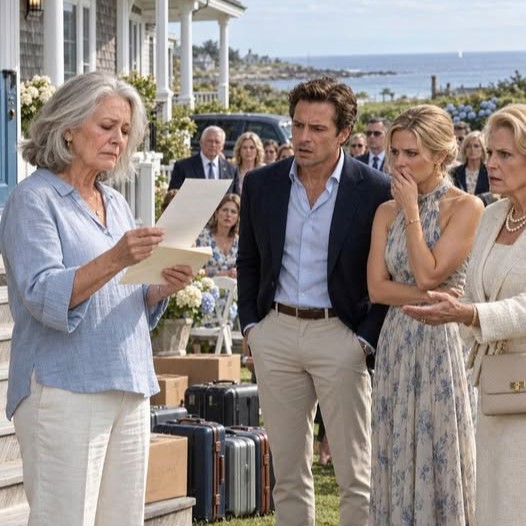
PART 2: THE LAST PAGE
The signature line was empty.
Beneath it, a second space
waited for a notary’s seal.
That space was empty, too.
For a moment, nobody moved.
The ocean kept breaking beyond the dunes,
indifferent to the expensive shoes
sinking into my sandy lawn.
Cullen stared at the paper.
Then he looked at me.
“You took out the real one.”
His accusation came so quickly
that I almost missed
what it revealed.
Not confusion.
Not surprise.
He had already decided
which version of reality
I was supposed to accept.
“No,” I said.
“This is the document you found.”
Laurelai made a small, impatient sound.
“Surely we don’t need
a public reading of family paperwork.”
“You arranged the audience,” I answered.
“I arranged nothing.”
Her mouth closed.
Beside the driveway, Miles
removed his sunglasses.
He was looking at Cullen
with an expression I recognized.
A man discovering
that an ordinary question
had opened something dangerous.
I turned the document around.
Across its upper margin,
in pale gray letters,
was a single word.
DRAFT.
Cullen stepped toward the porch.
“You said Dad wanted this.”
“I said your father loved you.”
“That’s the same thing.”
“No, sweetheart.”
My voice nearly broke.
“It isn’t.”
A woman near the folding chairs
lowered the champagne flute
someone had handed her.
Another guest quietly stopped recording.
I appreciated that more
than she could have known.
My attorney, Ruth Mercer,
stepped through the open doorway
and came to stand beside me.
She carried a thin leather folder.
Until then, most guests
had not noticed her.
Cullen certainly had.
His eyes flickered toward her,
then back to the envelope.
“Why is she here?”
“Because you mentioned a deed.”
Ruth spoke without raising her voice.
“And because your mother asked me
to explain the document accurately.”
Laurelai folded her arms.
“We were told this was settled.”
“It was contemplated,” Ruth answered.
“It was never executed or delivered.”
She paused.
“The property remains solely
in your mother’s name.”
Blythe stood beside the black car,
one hand resting on its roof.
Her wedding ring caught the sunlight.
She had not said anything yet.
Now she looked at Cullen.
“You told me she signed.”
He did not turn around.
“Mom, let’s go inside.”
I had wanted those words
from him for twelve days.
An invitation to speak privately.
A moment without performance.
But now I understood
that privacy could serve two purposes.
It could protect a relationship.
Or conceal what someone
had done to it.
“We can discuss our feelings privately,”
I told him.
“The ownership question stays here.”
Miles moved closer.
“What exactly did you show me?”
Cullen’s shoulders stiffened.
“A copy.”
“Of what?”
“The paperwork.”
Ruth extended her hand.
“Do you have it, Mr. Harrow?”
Miles hesitated.
Then he took out his phone.
Laurelai touched his wrist.
“Miles.”
He pulled away.
I watched that small movement
with a strange, exhausted fascination.
All morning, she had directed people
as if the lawn
were a stage she owned.
Now somebody had missed his cue.
Miles opened an email.
He handed the phone to Ruth.
She read without changing expression.
Then she enlarged something
with two fingers.
“Would you forward this
to the address on my card?”
Cullen climbed the first porch step.
“Don’t do that.”
Ruth looked up.
“Please remain where you are.”
“This is my family.”
“Yes,” she said.
“That is precisely why
we need to be careful.”
Blythe finally left the car.
“What did you send my father?”
Cullen exhaled hard.
“An early version.
There was a misunderstanding.”
Miles was still studying him.
“There’s a signature on mine.”
The lawn went utterly still.
I heard the wind
rattle a loose chair leg.
I felt Ruth’s shoulder
shift beside mine.
Not toward Cullen.
Toward me.
My hand tightened around the envelope.
“I haven’t signed anything.”
Miles looked at my face.
Whatever he saw there
made his own expression change.
“I believe you,” he said.
Those three words frightened me
more than another accusation
would have done.
Because belief meant
there was something real
to be frightened of.
Cullen shook his head.
“This is ridiculous.”
Ruth returned Miles’s phone.
“Please preserve the original email
and its attachment.”
Laurelai laughed once.
A brittle, unpleasant sound.
“Are we seriously accusing
the groom of a crime
at his own welcome party?”
Nobody answered her.
Because it was not
his welcome party anymore.
It was my front lawn.
My porch.
My blue door.
And for the first time
since the car arrived,
everyone seemed to remember that.
I looked at Cullen.
“Did you open my envelope?”
He rubbed his jaw.
“You leave things everywhere.”
“Did you open it?”
“I needed to know
what was happening with the house.”
“You could have asked.”
“You never give a straight answer.”
I thought about the years
I had answered his calls
before the second ring.
The checks I had written
without making him explain twice.
The dinners kept warm.
The spare room kept ready.
Perhaps he had mistaken
a lifetime of yes
for the absence of a person
who could say no.
“I was planning a gift,” I said.
“I wasn’t surrendering my right
to decide whether to give it.”
His face darkened.
“You’re punishing me
because you weren’t at the wedding.”
“No.”
The word came out quietly.
“I’m responding to what happened
before I knew about the wedding.”
I lifted my free hand
toward the house behind me.
“My robe was in a closet.
Your wife’s was in my bedroom.
Your father’s photograph
was facedown in a drawer.”
Blythe’s eyes dropped.
Cullen stared at the porch boards.
“The frame didn’t match,”
Blythe said at last.
It was such a small sentence.
Such a terrible little explanation.
I nodded slowly.
“Neither did I, apparently.”
Her eyes filled.
I did not enjoy seeing that.
There are people who imagine
that finding your strength
means losing your tenderness.
Mine was still there.
It was simply no longer
being allowed to make decisions
on everyone else’s behalf.
Ruth touched my elbow.
“Elaine.”
My name steadied me.
Not Mom.
Not widow.
Not a problem to be managed.
Elaine.
A woman standing at her own door.
I folded the draft.
Then I put it away.
“This gathering is over.”
Laurelai stepped forward.
“You cannot send everyone away
with an accusation hanging over them.”
“There is no accusation against them.”
I looked across the lawn.
“I’m sorry you were misled.
You’re welcome to take
whatever refreshments you brought.
But there will be no ceremony.”
A man near the gate
set down his glass.
Then he picked up
two folding chairs.
That was how it ended.
Not with applause.
Not with a grand speech.
With a stranger deciding
that enough had happened
to an old woman
on a Thursday afternoon.
Others began helping him.
The rows disappeared.
The champagne went into coolers.
Someone murmured an apology
as she passed the porch.
Someone else squeezed my hand.
Blythe stayed beside the steps.
“I was told you were ill.”
“I know.”
“Cullen said crowds confused you.”
I looked at my son.
He was watching the driveway.
Not me.
“She asked why you weren’t coming,”
he said.
“I needed an explanation.”
“And that was the one
you chose.”
He said nothing.
Miles stood apart,
reading the email again.
Laurelai went to him,
speaking in an urgent whisper.
He did not look up.
Ruth asked Cullen and Blythe
to arrange a collection time
for the rest of their belongings.
The suitcases were on the lawn
because they had brought them
without asking.
After my first photograph,
I had moved everything
into the locked carriage shed,
away from weather and curious hands.
That morning, I had brought
the luggage back outside.
I had not damaged anything.
I had not opened anything.
I had simply stopped
providing a home
they had already announced as theirs.
“You’re really doing this?”
Cullen asked.
“I’m really asking you
to live somewhere else.”
“We gave up our apartment.”
“You made that decision.”
“Where are we supposed to go?”
For seventy-one years,
I had believed certain questions
were automatically mine to answer.
That afternoon, I discovered
I could feel his distress
without taking ownership of it.
“I don’t know,” I said.
He stared at me
as though I had spoken
in a language
he had never heard before.
Blythe took her suitcase.
After a moment,
he took the other three.
Neither thanked the people
who helped load the boxes.
When the black car left,
Laurelai followed in her own vehicle.
Miles remained.
He stood beside his sedan,
holding his phone
with both hands.
“I need to apologize,” he said.
“You should speak to Ruth.”
“I will.
But first, I need you
to hear this from me.”
The last guest’s car
turned out of the lane.
At last, the beach
sounded like the beach again.
Miles swallowed.
“I advanced Cullen money.”
Ruth’s expression sharpened.
“How much?”
“Eighty-five thousand dollars.”
I sat down.
Not because I was faint.
Because my knees had suddenly remembered
every year they had carried me.
Miles kept talking.
“The wedding.
Some existing obligations.
He said the house transfer
was part of his inheritance.
That you preferred to do it
while you were alive.”
“Was the loan secured?”
Ruth asked.
“He said we’d formalize security
after the transfer was recorded.”
“And did you?”
“No.
I kept asking for confirmation.”
His eyes met mine.
“That’s why I called.”
I looked toward the dunes.
Nile and I had rebuilt
the porch railing twice.
Once after a storm.
Once because we had learned
the first design was foolish.
We had made mistakes.
Expensive ones, sometimes.
But we had never
called somebody else’s home
our collateral.
Miles’s voice grew rough.
“I wanted my daughter
to start her marriage comfortably.
I let what I wanted
stand in for what I knew.”
That was the first honest explanation
I had heard all afternoon.
It did not excuse him.
It made him recognizable.
Ruth asked for every message,
every attachment,
every transfer receipt.
Miles agreed.
Then he left.
I remained on the porch
until the light thinned.
My coffee was cold.
Inside, Nile’s photograph
stood on the mantel again.
I had returned it there
the same afternoon
I changed the locks.
Ruth waited while I went
to stand in front of it.
“He would be ashamed,” I whispered.
“Of Cullen?”
I touched the frame.
“Of what I almost allowed.”
Ruth was quiet
for a long moment.
“Loving your son
wasn’t a mistake, Elaine.”
“No.
But perhaps I stopped noticing
where love ended
and permission began.”
We ate toast in the kitchen
because neither of us
had remembered lunch.
At seven, Miles’s forwarded email arrived.
Ruth opened the attachment
on her laptop.
I saw my name
beneath a signature
that resembled mine.
Resembled.
Like a stranger wearing
a familiar coat.
The notary block carried
a seal and a date.
June eighteenth.
I had spent June eighteenth
at my sister’s house,
recovering from cataract surgery.
Ruth wrote that down.
Then another email arrived.
A second attachment.
A message from Miles:
He sent this when I asked
why you weren’t handling it yourself.
Ruth opened the file.
Her face changed.
“What is it?”
She did not answer immediately.
Then she turned the screen.
At the top of the page
were the words
DURABLE POWER OF ATTORNEY.
Below them was my name.
Below that, Cullen’s.
And beside a signature
I had never written,
someone had given my son
authority over nearly everything I owned.
PART 3: WHAT HE COUNTED ON
I reached for the screen
as if the paper inside it
might burn my house down.
Ruth caught my hand gently.
“We preserve it first.”
“He can’t do that.”
“A document making a claim
doesn’t make the claim true.”
“But he has it.”
“Yes.”
She did not soften that.
I needed her steadiness
more than I needed comfort.
We saved the emails.
We preserved the attachments.
Ruth made a list
on the back of an envelope.
My bank.
My financial adviser.
My regular attorney’s file.
The county property records.
The notary named on both documents.
One step.
Then another.
That was how we crossed
the first terrible hour.
Not by deciding
what my son had become.
By protecting what was mine
while we found out.
Ruth stayed until my neighbor,
June Bell, came over
with soup and overnight things.
June had lived beside us
for twenty-three years.
She had watched Nile
teach Cullen to mend a screen.
She had held my coat
at Nile’s graveside.
She did not ask
whether I was embarrassed.
She put the soup
on the stove.
Then she said,
“Which room am I taking?”
For the first time that day,
I nearly cried.
“The one facing the water.”
“Good.
I’ve earned the view.”
We sat at the kitchen table
under the yellow pendant light.
My phone kept lighting up.
Cullen.
Laurelai.
Cullen again.
Then a message from Blythe.
I didn’t know about that document.
I stared at it.
June stirred her soup.
“You don’t have to answer tonight.”
“What if she didn’t?”
“Then tomorrow will still be tomorrow.”
I turned the phone over.
That night, I slept
in the bedroom they had chosen.
I wore my own robe.
Such a small thing.
Such an enormous one.
At nine the next morning,
I went to my bank.
Ruth met me there.
We carried identification,
copies of the disputed documents,
and the sickening knowledge
that family could turn
ordinary precautions into grief.
The manager knew me.
She had sent flowers
when Nile died.
After reviewing my accounts,
she asked us to wait.
When she returned,
her expression had changed.
“A request came through Tuesday.”
My hands went cold.
“What request?”
“To add your son
as an authorized representative.”
“Was it approved?”
“No.
We needed direct verification
and additional documentation.”
She looked at me carefully.
“The caller said you
were becoming difficult to reach.”
I thought of every time
I had answered Cullen
while my dinner cooled.
“He knows my number.”
“We didn’t accept
the number he supplied
as a substitute for yours.”
I closed my eyes.
Across the table,
Ruth began taking notes.
There had been no transfer.
No new account access.
No money missing.
Relief did not feel
the way I expected.
It felt like discovering
a train had passed
inches from your body
while you were sleeping.
We updated security procedures.
We documented my objection.
Then we went
to Ruth’s office.
By afternoon, she had confirmed
that the house remained mine.
No deed conveying it
had been recorded.
No lien from Miles
appeared against the property.
The papers had convinced people.
So far, they had not
changed the public record.
That distinction mattered.
It did not make
what happened smaller.
We made a report
and provided the evidence.
An investigator would review it.
There would be questions.
There would be waiting.
There would be no instant courtroom,
no handcuffs appearing
because a mother finally said enough.
I was grateful for that.
And furious about it.
Both feelings fit
inside me at once.
On Saturday, Cullen came
to my year-round house.
He had not been invited.
I watched him through
the glass beside the door.
His hair was uncombed.
He carried no flowers.
No envelope.
No apology.
Just the expectation
that I would let him in.
I opened the inner door
but kept the storm door latched.
“You need to leave.”
“Mom, please.
Five minutes.”
“Speak to Ruth.”
“You called the police on me.”
“I reported documents
with my name on them.”
“You know what this could do?”
“Yes.”
“My job.
My marriage.”
I held the doorframe
until a splinter pressed my palm.
“Did you think about those things
when you used my name?”
He looked away.
A car passed slowly
at the end of the street.
He waited until it disappeared.
Then he lowered his voice.
“I was going to fix it.”
“What needed fixing?”
“The timing.”
I almost laughed.
Not because anything was funny.
Because my heart
could not bear the distance
between his answer
and the truth.
“The signature wasn’t a timing problem.”
He rubbed both hands
over his face.
“Miles wouldn’t release the rest
without something in writing.”
“The rest of what?”
“The money.”
“And my account?”
He went very still.
“What?”
“The bank called me.
About your request.”
For the first time,
he looked frightened
without looking angry first.
“I needed a bridge.”
“A bridge to where?”
“Until everything settled.”
“Everything meaning my house.”
He said nothing.
I thought of the little boy
who used to ask permission
before taking change
from the dish by the telephone.
I had been so proud
of his honesty.
Perhaps memory becomes dangerous
when we use it
to contradict the person
standing in front of us.
“You can still stop this,” he said.
“No.
I can stop cooperating.
That’s different.”
“You’d rather ruin your son?”
My throat tightened.
“I would rather have a son
who doesn’t require my ruin
to feel loved.”
His face folded.
Only for a moment.
Then he hardened again.
“Dad would never have done this.”
The words struck
exactly where he intended.
For years, Nile’s name
had been our shared shelter.
Now Cullen had dragged it
into the street
and held it like a weapon.
I unlatched nothing.
“Your father isn’t here
to tell you what he thinks.”
“He left that note.”
“Yes.”
“He wanted me taken care of.”
“He wanted you loved.”
Cullen leaned toward the glass.
“What’s the difference?”
I looked at him
for a long, unbearable moment.
“Apparently, we have work
to do on that.”
Then I closed the door.
I sat on the floor
because the chair
was too far away.
June found me there
twenty minutes later.
She did not tell me
I had done the right thing.
She sat down beside me.
Sometimes certainty is too heavy
to offer a grieving mother.
Company is lighter.
We stayed there
until I could stand.
The notary’s name belonged
to a real woman
in another county.
She had not witnessed me
sign either document.
Through proper requests,
the investigator obtained information
that raised further questions
about the seal and entries.
Ruth warned me
against filling those gaps
with imagination.
“Evidence first,” she said.
“Even when you’re certain.”
I learned to hate
how sensible that was.
Blythe asked to meet
the following Wednesday.
Ruth offered her conference room.
Blythe arrived without her mother.
Her wedding ring was still on.
Her nails were unpainted.
She carried a paper bag
with something square inside.
Before sitting, she set it
on the table between us.
Nile’s brass tide clock.
I had not yet noticed
it was missing.
It had stood
beside his photograph.
“I packed it,” she said.
“I thought we could sell it.
The mechanism doesn’t work.”
“It works.”
She blinked.
“You have to set it
for the local tide.”
Her eyes filled.
“I didn’t know.”
I looked at the bag.
“No.
You didn’t.”
She sat very carefully,
like somebody entering
a room after an accident.
“I knew you hadn’t been consulted
about some of the boxes.”
I waited.
“Cullen said you were sentimental.
That moving things beforehand
would make it easier.”
“Easier for whom?”
She stared at her hands.
“Us.”
That answer cost her something.
I could see it.
It was also the first thing
she had said
that I could begin to trust.
“What about the wedding?”
Her breath trembled.
“I knew you weren’t sick
the way he described.”
“How?”
“You left him a voicemail
about meeting for lunch.
He played part of it.”
The room seemed to shrink.
“What did he say?”
“That you’d make a scene
if you knew.”
I looked down at my hands.
Hands that had sewn
a loose button on his jacket
before his first interview.
Hands that had held
his father’s wedding ring
after the hospital returned it.
Hands apparently capable
of embarrassing a room
by belonging to me.
“And you believed him.”
“I wanted to.”
There it was again.
The honest explanation
that did not excuse anything.
Blythe wiped her face.
“My mother said
we shouldn’t let guilt
dictate our wedding.”
“Your wedding was yours.”
I made myself look at her.
“You could invite whomever you wanted.
But you let people believe
I was loved and included
while you kept me outside.”
She nodded.
“Yes.”
Neither of us spoke
for a while.
Then she pushed her phone forward.
“There’s something else.”
I did not touch it.
“Ruth should see it first.”
Ruth took the phone.
A message thread.
Dates from June.
Cullen telling Blythe
that the transfer was nearly finished.
Blythe asking whether
I should be present
when they announced it.
Cullen answering that
my presence would complicate things.
Then another exchange.
This one from August.
Blythe had asked
why my signature looked different.
Ruth looked up.
Blythe’s face had gone white.
“I accepted his explanation.”
“What was it?”
I asked.
“That your hand shook.”
My hand rested flat
on the conference table.
Perfectly still.
Blythe stared at it.
I did not move it
to make her feel better.
Afterward, she agreed
to preserve her messages
and speak with the investigator.
Her cooperation did not erase
her own choices.
But it kept her
from making another one
in the wrong direction.
Weeks passed.
The beach grass browned.
The town took down
its summer parking signs.
My son stopped calling daily.
Then he stopped calling altogether.
The silence hurt.
I had asked for boundaries.
I had not understood
how much empty space
they could leave behind.
One afternoon, I opened
the drawer containing Nile’s note.
It was written
on a hardware receipt.
Of course it was.
Nile could locate a lost bolt
after fifteen years,
but never proper stationery.
The note was not a will.
Ruth had made that clear
when I first showed her.
It was something
he had written during treatment,
after we discussed
what might happen later.
I had read one sentence
so many times
that it had become a command.
If you ever give Cullen the point,
give him the blue key.
I had built an entire future
around those words.
The wedding gift.
The draft.
The idea that generosity
could keep all three of us
together somehow.
That afternoon,
I unfolded the receipt completely.
But before I could read further,
my phone rang.
Miles.
“Can you come to Ruth’s office?”
His voice sounded older.
“What happened?”
“I found something.”
“Another document?”
“No.”
He took a breath.
“A recording.”
The next morning,
Miles sat across from me
with his phone
on the conference table.
Laurelai’s voice filled the room.
“Her things can go into storage.
Once they’re inside,
she won’t throw them out.”
Then Cullen spoke.
Calmly.
Almost wearily.
“She’ll come around.
She always does.”
I stopped breathing.
The recording continued.
Miles had asked
whether I knew
about the loan.
Cullen had said yes.
Miles had asked
why I had not called him.
Laurelai answered before Cullen could.
“Because Elaine doesn’t like discussing money.
Let the children handle it.”
Ruth stopped the playback.
“Why was this recorded?”
Miles looked down.
“He sent it as a voice message.
They were together.
I saved it with the loan file.”
“Why are we hearing it now?”
“Because I didn’t search everything
the first time you asked.”
His eyes lifted to mine.
“Because part of me
still wanted there to be
an explanation I could live with.”
The door opened behind him.
Cullen stood in the reception area,
his lawyer beside him.
Ruth had scheduled
a separate meeting after ours.
He saw his father-in-law.
Then the phone.
Then my face.
“What did you give her?”
Miles rose.
“The truth.”
Cullen’s lawyer touched his sleeve.
“Don’t speak.”
But Cullen was already looking
straight at me.
“You don’t understand.
I was protecting you.”
My heart thudded once.
“From what?”
He spread his hands,
as if the answer
should have been obvious.
“From being alone
in a house that big.”
Ruth stood.
“We’re ending this conversation.”
But Miles had reached
for his own folder.
“There’s one thing
I haven’t told the investigator yet.”
Cullen’s face drained.
Miles took out a printed email.
“The first time
I questioned the signature,
you asked me to keep quiet.”
Laurelai appeared in the doorway
behind Cullen.
“Miles, stop.”
He did not look at her.
“And I did.”
His voice broke.
“I told the bank
the gift had been confirmed.”
Laurelai gripped the doorframe.
“You’ll destroy all of us.”
Miles looked at my son,
then at his wife.
Then he placed the email
in front of Ruth.
“Then they need
my statement, too.”
PART 4: THE HOUSE THAT STAYED MINE
“Then he’ll have to explain it,”
I said.
My voice did not rise.
That surprised Vanessa
more than shouting would have.
Dana asked her attorney
to preserve the original message
and provide it through
the appropriate channels.
Vanessa nodded.
For a moment,
she seemed to expect something else.
Absolution, perhaps.
The comfort women give each other
when a man has behaved badly.
But she had carried
a lamp through my doorway.
She had helped prepare the lease.
She had arranged to remove
the desk my father built.
Being deceived about some things
did not erase the things
she had chosen to know.
“I’m sorry,” she whispered.
I looked at the carton.
“My father made that desk
when I finished nursing school.”
She lowered her eyes.
“He saved scraps
from three different jobs.
He couldn’t afford new walnut.”
Nobody spoke.
“He sanded it after dinner
for almost two months.”
My throat tightened.
“I don’t need you
to understand its value now.
I needed you to ask
before deciding it was yours.”
Vanessa began crying.
I let her.
Dana ended my portion
of the meeting shortly afterward.
Outside,
the air smelled of rain.
I stood on the sidewalk
with my mug in its carton
and felt unexpectedly tired.
Not defeated.
Just tired of carrying
other people’s explanations.
Dana stood beside me.
“Are you all right to drive?”
“Yes.”
Then I reconsidered.
“Could I sit inside
for a few minutes first?”
“Of course.”
It was such a small exchange.
But I remembered it later.
The question.
The answer.
The freedom to change
what I had said.
No punishment attached.
The evidence about my furniture
went to the investigator.
The proposed buyer confirmed
the scheduled collection
and supplied Mark’s messages.
The sale never happened.
A canceled appointment became
one more piece of a plan
he could no longer describe
as a misunderstanding.
Weeks passed.
My life did not pause
to wait for consequences.
I went to work.
Bought groceries.
Learned which kitchen drawer stuck
when the weather turned damp.
Some nights,
I checked the cameras too often.
Other nights,
I woke convinced
I had heard the side door.
Rachel answered late calls
without making me explain
why I needed her voice.
Eventually,
I found a counselor.
During our first appointment,
I described the moving truck.
Then the lease.
Then Emily.
When I finished,
the counselor asked
what frightened me most.
I thought the answer
would be losing my house.
Instead, I heard myself say,
“How quickly I wondered
whether I was being unreasonable.”
She nodded gently.
“Even with the recording?”
“Even with the recording.”
We spent several sessions
on that sentence.
On the habit of doubting
what I could plainly see.
On all the years
I had mistaken surrender
for keeping a family together.
I had left the marriage.
Some of its rules
were still living inside me.
Removing them took longer
than changing a lock.
Emily gave her statement.
She provided her phone
for the requested examination
and acknowledged what she had done.
She did not pretend
she had witnessed my signature.
She did not describe
my house as family property.
For the first time,
she told the whole story
without adding an excuse
after every difficult fact.
Mark called her afterward.
She told me about it
during a meeting with Dana.
“He said I betrayed him.”
I watched her twist
a tissue around one finger.
“What did you say?”
“That he asked me
to betray you first.”
Her voice broke.
“And I did.”
I looked away
because the truth still hurt.
But it hurt differently
when she stopped hiding it.
“I don’t want you
to hate your father,” I said.
Emily shook her head.
“I know.”
“I want you to stop
handing him other people’s boundaries.”
She nodded.
“I’m trying.”
That was all
I could ask for honestly.
Not a perfect daughter.
Not an instant repair.
Evidence.
Time.
Different choices repeated
until they began to mean something.
Mark received his consequences
months after the truck arrived.
The process was neither swift
nor as dramatic
as he had always imagined justice.
There were scheduled appearances.
Continuances.
Paperwork.
Lawyers speaking in measured voices
while I sat with
my hands clenched beneath the table.
The charges ultimately pursued
concerned the false document
and his attempt to use it.
He eventually entered a plea
to a forgery-related offense.
The resulting sentence included probation,
financial restitution,
and conditions restricting contact with me.
I did not celebrate
when Dana explained the outcome.
I asked her
to repeat the contact conditions.
Then I wrote them down.
Vanessa’s involvement was addressed separately.
She admitted her role,
cooperated with the investigation,
and accepted the resulting agreement.
She paid the portion
assigned to her.
She and Mark separated
before the case was over.
I learned that through attorneys.
I did not ask
where either of them went.
Their next address
was finally none of my business.
The restitution covered documented losses.
The locksmith.
The damaged paint.
The security work.
Other costs we could establish.
It did not put a price
on waking at three
to stare at a silent hallway.
It did not need to.
For once,
I understood that something
could be incomplete compensation
and still be meaningful accountability.
Dana also resolved
the property claims in writing.
Mark acknowledged that the lease
was not validly authorized by me.
He relinquished any claim
to possession under it.
I kept the final documents
in a folder inside
my father’s walnut desk.
Not because I expected
to read them every morning.
Because I wanted
to know where they were.
At the final court appearance,
Mark saw me near the corridor doors.
His lawyer had stepped away.
For a second,
he looked like the man
I had married long ago.
Older.
Tired.
Almost uncertain.
Then he opened his mouth.
“You really let it go this far.”
The familiar shape returned.
My fault.
My decision.
My failure to rescue him
from what he had done.
Dana moved toward us.
I lifted one hand slightly.
“I let the truth go
as far as it needed.”
His jaw tightened.
“We had twenty-seven years.”
“Yes,” I said.
“We did.”
I did not list
the holidays I had organized.
The shifts I had worked.
The apologies I had made
for arguments he started.
Those years were real.
They were also finished.
I walked out with Dana
before he could turn them
into another debt.
Outside,
Rachel waited beside her car.
She had driven up
without telling me
because she thought I might
want company afterward.
“Lunch?” she asked.
I looked at the bright sky.
“Yes.”
We ate sandwiches
in a little restaurant
with uneven wooden floors.
Halfway through,
I started laughing.
Rachel lowered her glass.
“What?”
“I thought I’d feel victorious.”
“What do you feel?”
“Hungry.”
She smiled.
“Good.”
We ordered pie.
The hardest conversation with Emily
came after the legal matter ended.
Without hearings ahead,
without documents to gather,
we finally had nothing
between us but ourselves.
She came on a Sunday afternoon.
She rang the bell.
I noticed.
I suspected I always would.
We sat on the porch
with coffee between us.
The flower beds had begun
to show their first spring growth.
“I have something,” she said.
My body tightened
before I could stop it.
Emily noticed.
Her eyes dropped.
“It’s a letter.
You don’t have to read it now.”
She placed an envelope
on the little table.
“I’m not asking
to get my key back.”
I looked at her.
“I’m not ready for that.”
“I know.”
A breeze moved
through the bare branches.
Emily rubbed her palms
against her jeans.
“There’s something I didn’t tell you.”
I set down my cup.
Not another secret.
Please.
She swallowed.
“Dad tried to get me
to leave things out
when I gave my statement.”
“What things?”
“The email about the address.
The part where I knew
you wouldn’t agree.”
I waited.
“He said if I helped him,
he’d make sure I received
something when the house sold.”
For a moment,
even the street seemed quiet.
“When the house sold?”
Emily nodded,
tears gathering beneath her eyes.
“He said you couldn’t afford
to fight forever.
That you’d eventually sell
and give him something
to make him go away.”
I stared past her
at the street.
There it was.
The final shape of it.
He had not needed
to own my house.
He had only needed
to make owning it unbearable.
Then he could offer
to solve the problem
he had created.
“How did you answer him?”
“I saved the message.
I sent it to the investigator.”
“When?”
“The same day.”
“Why didn’t you tell me?”
“I was ashamed
that he thought I’d say yes.”
I studied her face.
“And would you have?”
She shook her head.
“No.”
Not hurried.
Not defensive.
Just no.
“I already saw what happened
the first time I helped him.”
A car passed slowly.
Somewhere down the block,
a child called for a bicycle pump.
I let those ordinary sounds
come back into the silence.
“Thank you for telling the truth.”
Emily started crying.
“I should have done it
before any of this.”
“Yes.”
She nodded,
accepting the word.
“I’m sorry, Mom.”
This apology was different.
It had no explanation
tied to its ankle.
No request following it.
No frightened glance
toward what I might give back.
“I believe you,” I said.
Then, because she deserved honesty,
“I’m still hurt.”
“I know.”
“We’ll have to go slowly.”
“I can do slowly.”
I reached across the table.
She looked at my hand
before taking it,
as though asking permission
without making me answer aloud.
We sat that way
until our coffee went cold.
Her letter stayed unopened
until after she left.
Inside,
she had written down
what she had done.
Not what Mark
had persuaded her to feel.
What she had chosen.
She named the listing.
The closing date.
The code.
The signature she had not witnessed.
Then she wrote
one sentence I read
more than once.
I treated your forgiveness
like something I could promise him.
I folded the letter carefully.
For years,
I had been the safe parent.
The one who would understand.
The one who could be disappointed
without becoming dangerous.
Somewhere along the way,
my daughter had mistaken
that safety for permission
to hurt me last.
Now she understood the difference.
It did not repair everything.
It made repair possible.
Summer arrived quietly.
My neighbor, Mrs. Alvarez,
brought cuttings from her garden.
She was the woman
whose little dog had inspected
my flower beds that first week.
One evening,
she stood beside my porch
holding a pot of purple flowers.
“I wanted to tell you something.”
My stomach tightened automatically.
She noticed and smiled gently.
“Something good.”
I exhaled.
“The officers asked me
about that moving truck.
I told them
you’d only just arrived.”
“Thank you.”
“I almost came over
when I first saw it.
Then I thought
perhaps you had company.”
She looked toward my side door.
“I wish I’d asked.”
“You couldn’t have known.”
“No,” she said.
“But now I know you.”
She handed me the flowers.
“If something looks wrong,
I’ll ask.”
That promise felt better
than someone assuring me
nothing would happen again.
Neither of us
could promise that.
We could promise to notice.
By August,
I had stopped checking
the camera every night.
By September,
I sometimes left my phone
in the kitchen
while I read outside.
The first time I noticed,
I almost went back for it.
Then I stayed
where I was.
The sky darkened slowly.
A cricket started beneath the steps.
My book rested open
against my knee.
Nothing needed answering.
Rachel came for Thanksgiving.
Emily asked whether she could come,
and I said yes.
She arrived carrying dessert
and a grocery bag
filled with things
she had offered to bring.
She waited on the porch
until I opened the door.
“You can knock again
if I don’t hear you,” I said.
She smiled a little.
“I know.”
Rachel cooked beside me,
bumping my shoulder
whenever she needed the drawer.
Emily set the table.
Nobody assigned me
the uncomfortable chair.
Nobody told me
I was lucky to be included
in the home I paid for.
At dinner,
Rachel lifted her glass.
“To a good year ahead.”
We drank to that.
Later,
while Rachel washed dishes,
Emily found me
beside my father’s desk.
She ran her fingertips
lightly along its edge.
“I remember sitting under this
when you studied.”
“You used to steal my highlighters.”
“I was decorating.”
I laughed.
The sound came easily.
That surprised us both.
Emily looked down,
smiling through sudden tears.
“I missed that.”
“So did I.”
She hugged me carefully.
I hugged her back.
The door remained mine.
The choice remained mine.
So did the embrace.
After they went to bed,
I walked through the house
turning off lamps.
My reading chair stood
where I wanted it.
My mother’s photograph faced the room.
The quilt lay folded
across the foot of my bed.
In the kitchen,
I washed my blue mug
and set it beside the kettle.
For a moment,
I remembered Vanessa holding it
on that gray Saturday morning.
Then another memory rose
beside that one.
Rachel giving it to me.
Emily laughing over dinner.
Mrs. Alvarez arriving with flowers.
The mug had held
more than one morning.
So would I.
At the side entrance,
I checked the lock once.
Only once.
Then I switched off the light
and went to bed.
The house settled around me,
warm and ordinary,
with people I loved sleeping nearby
because I had invited them.
I lay beneath my quilt
and listened to the quiet.
There was nothing
I needed to surrender
to keep it.