“After my husband passed away,
I kept the $28 million inheritance
and the penthouse in New York City hidden.
That same week, my daughter-in-law shouted,
“Now that he’s gone, just cry,
pack your things,
and go live on the streets.”
I simply answered, “Okay.”
Three months later,
a notice was delivered to their house.
Five days after we buried my husband,
the house still smelled of sympathy flowers
and warmed-over casseroles.
The March cold in White Plains
clung to the windows,
and every room on Maple Avenue
felt too quiet in the way
a home does when the person
who filled it is suddenly gone.
I had spent forty years in that house.
I had polished those floors,
sewn those curtains,
and stood at that same kitchen counter
at 4:30 every morning
while the coffee brewed before my shift
at Saint Vincent’s Hospital.
By the time we returned from the cemetery,
my daughter-in-law was already moving
through the living room
like she had been waiting for that moment.
She did not lower her voice.
She did not even pretend to be kind
for one more day.
She looked at me,
still wearing the black dress from the funeral,
and said,
“Now that he’s gone,
cry it out, pack your things,
and go live on the streets.”
My son stood behind her
and said nothing.
That was the part I remembered most.
Not the cruelty in her voice.
Not the yellow sticky notes
she had already begun placing on furniture
that had belonged to me for decades.
Not even the way our wedding photo
had been removed from the mantel
and leaned against the wall
like it no longer belonged in the room.
It was my son’s silence.
I thought about all the years
that had led to that moment.
The double shifts.
The holidays missed at the hospital.
The money quietly stretched and saved
and handed over whenever he fell short.
The small humiliations I had explained away
because he was my only child
and I kept telling myself
that family has seasons,
that grief makes people strange,
that decency eventually returns
if you give it enough time.
So I said the one word
neither of them expected.
“Okay.”
No tears.
No scene.
No begging to stay in the house
I had helped build.
I simply slipped my hand
into the pocket of my coat
and wrapped my fingers around
the small brass key
my husband had pressed into my palm
three weeks before he died.
“Keep this safe,”
he had whispered in the hospital.
“And don’t tell anyone.”
At the time,
I thought it was the medication talking.
By that afternoon,
standing in my bedroom
with a stack of legal papers
laid neatly across my bedspread,
I understood he had been trying
to tell me something
I had failed to hear in time.
The papers were ready for my signature.
A voluntary transfer.
The house, the property,
everything pushed neatly toward my son
while I was still wearing mourning black.
So I packed one small suitcase.
Two sweaters.
My nursing shoes.
My Bible.
My mother’s quilt.
The framed photo from my wedding day.
In the kitchen,
I left the signed papers on the table,
picked up my old purse,
and checked for three things:
my wallet,
my flip phone,
and that brass key.
That night,
I sat alone in a cheap motel
off Route 119,
staring at a lamp with a cracked shade
and a vending machine dinner
I could not make myself touch.
Somewhere between the sound of traffic outside
and the hum of the ice machine
down the hall,
I remembered the business card
my husband had slipped into my purse
months earlier.
An estate lawyer.
A Manhattan address.
47th Street.
I called.
The man answered
as though he had been waiting for me.
The next morning,
before sunrise,
I took the bus into Manhattan
carrying everything I still owned
in one suitcase and one purse.
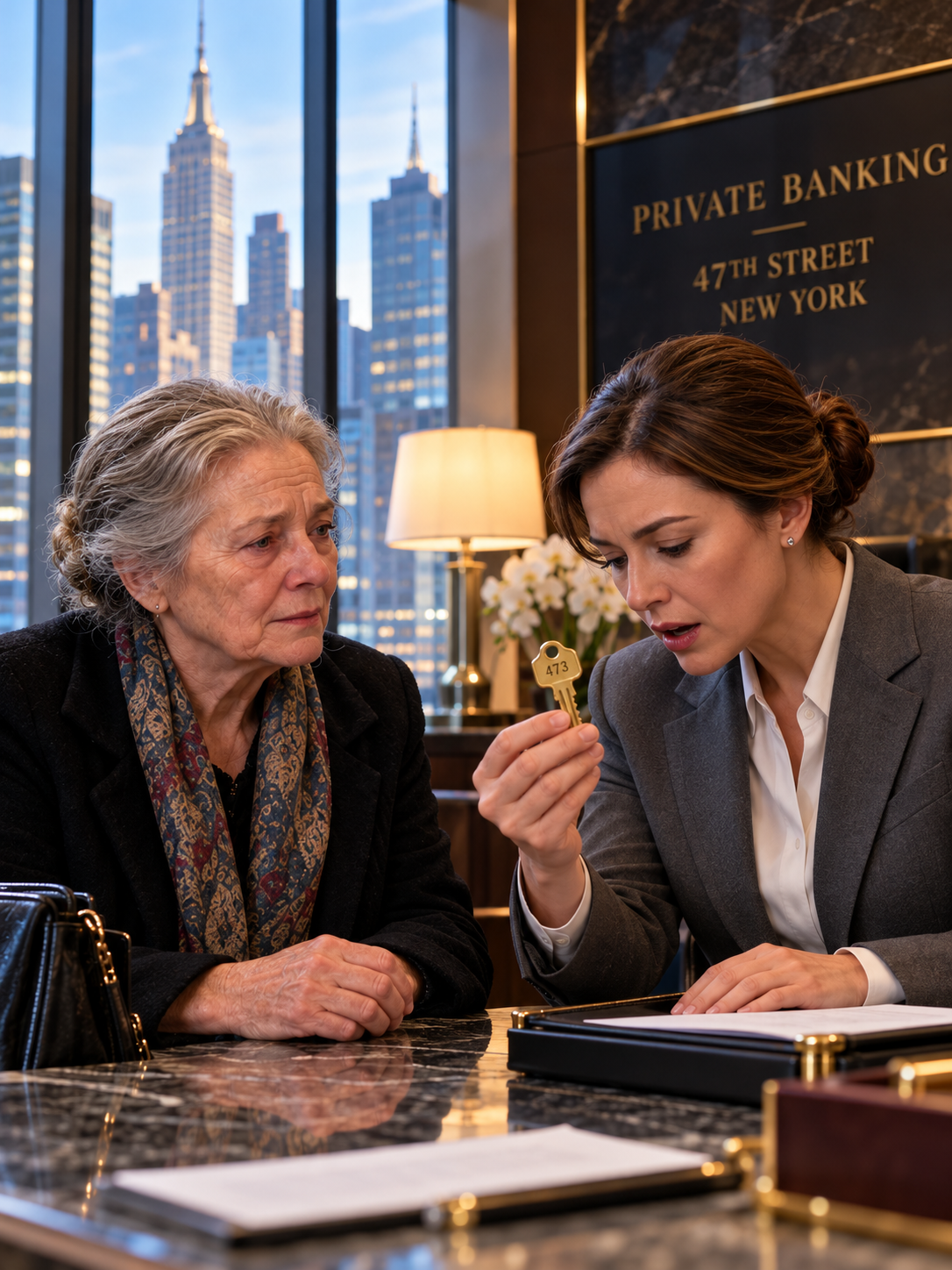
At 9:07 the next morning,
inside a quiet bank on 47th Street,
a woman in a gray suit
took the brass key from my hand,
looked at the number stamped into it,
and stopped calling me ma’am.
She picked up the phone,
said four words in a lower voice,
and everything about the room changed.
“Mrs. Brooks is here.”
I heard her clearly.
Then she put down the receiver
and looked at me differently.
Not with pity.
Not with the embarrassed politeness
people reserve for elderly women
carrying worn suitcases into expensive buildings.
With recognition.
“My name is Priya Patel,” she said.
“Please come with me.”
I followed her through a glass doorway
into a private conference room.
There was a polished walnut table,
six leather chairs,
and a silver pitcher of water.
She pulled out a chair.
“Would you like some tea?”
“No, thank you.”
I kept my suitcase beside my feet.
She glanced at it.
Then she looked away.
“Mr. Whitaker will be joining us.”
“Who is he?”
“Your husband’s estate attorney.”
I felt my stomach tighten.
“My husband is dead.”
Her expression softened.
“I know, Mrs. Brooks.”
For several seconds,
neither of us spoke.
Then she placed a folder before me.
My husband’s name appeared
on the first page.
Edward James Brooks.
The letters blurred.
I had spent forty-three years
being married to that man.
I knew the sound of his footsteps.
I knew how he folded his newspaper.
I knew he hated cold coffee
and always pretended
he had forgotten our anniversary
before producing some little surprise.
But I had never seen
this folder before.
A man entered the room.
He was perhaps sixty,
with silver hair,
wire-rimmed glasses,
and a dark blue suit.
“Eleanor,” he said gently.
“I’m Samuel Whitaker.”
He extended his hand.
I shook it.
“Your husband spoke about you often.”
I stared at him.
“Then you knew him better than I did.”
He hesitated.
I had not meant to sound bitter.
But the bitterness was there.
He sat across from me.
“Edward asked me to explain everything.”
“Then explain.”
Mr. Whitaker opened the folder.
“First, I need you to understand something.”
He leaned forward.
“You are not homeless.”
I looked down at my shoes.
The soles were wearing thin.
My nursing shoes
had carried me through thousands of hospital corridors.
Now they rested
beneath a table worth more
than the furniture in my motel room.
“I slept beside a vending machine,” I whispered.
“I understand.”
“No,” I answered.
“I don’t believe you do.”
He accepted that without argument.
Then he turned a page.
“Your husband established a trust.”
He showed me the document.
“You are its sole current beneficiary.”
I blinked.
“What kind of trust?”
“One containing considerable assets.”
“How considerable?”
He turned the folder toward me.
I saw several columns of numbers.
Investment accounts.
Government securities.
Business holdings.
Cash reserves.
I studied the final figure.
Then I studied it again.
Twenty-eight million dollars.
At first,
I thought there was a printing mistake.
I reached for my glasses.
My hands were trembling.
“That cannot be right.”
“It is correct.”
“Twenty-eight thousand?”
“Twenty-eight million.”
My mouth went dry.
I looked toward Mrs. Patel.
She nodded.
I turned back to the lawyer.
“Edward worked in medical supply distribution.”
“Yes.”
“He drove a twelve-year-old Buick.”
“I know.”
“He repaired our washing machine with wire.”
Mr. Whitaker smiled sadly.
“That sounds like him.”
I pushed the folder away.
“Then somebody has made a terrible mistake.”
Nobody answered immediately.
Finally, Mr. Whitaker said,
“Your husband owned part of that business.”
“He told me that.”
“A substantial part.”
He explained slowly.
Edward had helped build
a small regional medical distribution company
almost thirty years earlier.
His original partner handled sales.
Edward managed warehouses,
contracts,
and supplier relationships.
For years,
they reinvested nearly everything.
The business expanded.
Then expanded again.
When a national company acquired it,
Edward received a significant payment.
He continued receiving distributions
from investments made afterward.
The money had grown quietly.
Carefully.
Patiently.
Just like the man himself.
I remembered evenings
when Edward sat at our kitchen table
with invoices spread around him.
I remembered asking
whether the business was doing well.
He always gave the same answer.
“Well enough to keep us comfortable.”
I covered my mouth.
He had not lied completely.
But he had hidden an entire life
behind those ordinary words.
“Why didn’t he tell me?”
Mr. Whitaker looked uncomfortable.
“He planned to.”
“When?”
He glanced at the papers.
“Before his illness became serious.”
My eyes filled.
“He had two years.”
“I know.”
“He watched me worry about grocery prices.”
The lawyer lowered his eyes.
“He watched me cut coupons.”
My voice broke.
“He watched me take extra hospital shifts.”
Mr. Whitaker spoke quietly.
“Edward knew you were angry about that.”
“How could he know?”
“Because he was angry with himself.”
He opened another envelope.
But he did not hand it over.
“Before you read this,
there is something else.”
I laughed bitterly.
“Of course there is.”
He looked directly at me.
“The trust also owns a Manhattan penthouse.”
I stared.
“A what?”
“A residential apartment.”
“Where?”
“East Forty-seventh Street.”
I looked toward the window.
The morning sunlight
was beginning to strike the neighboring buildings.
“How large?”
“Three bedrooms,
a private terrace,
and an office.”
I shook my head slowly.
“Edward hated elevators.”
Mr. Whitaker almost smiled.
“He apparently made an exception.”
I pressed my palms against the table.
All those years.
All those sacrifices.
All those mornings at 4:30.
The money should have made me happy.
Instead,
I wanted my husband alive
so I could ask him
why he had kept me outside
such an important part of our marriage.
I wanted one more argument.
One more conversation.
One more ordinary Tuesday.
Instead,
I had twenty-eight million dollars
and a room full of strangers.
Mrs. Patel placed a tissue box nearby.
I did not reach for it.
“Does my son know?”
Mr. Whitaker shook his head.
“Not about these assets.”
“Does Claire?”
“No.”
Claire.
My daughter-in-law.
I could still hear her voice.
Go live on the streets.
The words had followed me
from Maple Avenue
to the motel
to that beautiful bank.
“What about my house?”
Mr. Whitaker opened another folder.
“The property on Maple Avenue?”
“Yes.”
He studied me carefully.
“Tell me exactly what happened.”
So I told him.
Everything.
The funeral.
The sticky notes.
The wedding photograph.
The transfer papers.
Claire’s voice.
Michael’s silence.
And the single suitcase
I carried out of my own bedroom.
Mr. Whitaker listened without interrupting.
When I finished,
he asked one question.
“Did anyone notarize those papers?”
“No.”
“Did anyone explain their legal effect?”
“No.”
“Were you given time to review them?”
I shook my head.
He leaned back.
“Then we have several issues to address.”
“What do you mean?”
“The papers you signed
did not complete a property transfer.”
I stared at him.
“Michael and Claire believe otherwise.”
“They may believe whatever they wish.”
He tapped the folder.
“Belief does not establish ownership.”
Then he showed me the deed.
The original house deed.
My name appeared beside Edward’s.
Joint ownership with survivorship rights.
When Edward died,
ownership passed entirely to me.
There was no automatic share
for Michael to inherit.
And no authority
for Claire to decide where I lived.
I stared at the document.
Forty years.
I had spent forty years
calling that place our home.
Now somebody had to show me paperwork
proving I belonged there.
“Can they sell it?”
“Not lawfully without your authorization.”
“Can they change the locks?”
“They cannot lawfully dispossess you.”
“Can they take my furniture?”
“We will address that immediately.”
He closed the folder.
“Eleanor, listen carefully.”
I looked up.
“You have options.”
Options.
Such a small word.
Yet I had forgotten what it felt like
to possess even one.
For the first time
since Edward’s funeral,
I straightened my shoulders.
“What do you recommend?”
“First, we protect your property.”
He counted on his fingers.
“Then we review those transfer papers.”
“Then?”
“We investigate the financial records.”
“Why?”
His expression changed.
“Because Edward anticipated a problem.”
Something cold moved through me.
“What kind of problem?”
He hesitated.
“Possible misuse of financial authority.”
I shook my head.
“I don’t understand.”
“Michael held a limited power of attorney
during part of Edward’s illness.”
“Yes.”
“He helped pay medical bills.”
“That was the arrangement.”
Mr. Whitaker nodded.
“But several transactions require explanation.”
My heart began pounding.
“How many?”
“We are still reviewing them.”
“Samuel.”
It was the first time
I had used his first name.
He understood my tone.
“There may have been unauthorized withdrawals.”
I closed my eyes.
My son.
My only child.
The boy I had carried
through the emergency room
when he broke his arm at nine.
The young man
who cried against my shoulder
when his first serious girlfriend left him.
The father
who held his newborn daughter
like she was made of glass.
I wanted the lawyer to be wrong.
I wanted everything to be wrong.
But then I remembered
the yellow sticky notes.
The prepared transfer papers.
And Michael standing silently
while his wife told me
to sleep on the streets.
“Find out,” I said.
Mr. Whitaker nodded.
“We will.”
Then he slid a business card
across the table.
“Until this is resolved,
please let my office handle communications.”
“With Michael?”
“With anyone discussing the property.”
I picked up the card.
“And where am I supposed to stay?”
Mrs. Patel looked toward the lawyer.
He smiled faintly.
“I believe your husband anticipated that question.”
An hour later,
I stood outside a residential building
where a uniformed doorman
opened the entrance for me.
My suitcase rolled badly
over the polished marble floor.
One wheel kept catching.
I apologized for the noise.
The doorman shook his head.
“No need, Mrs. Brooks.”
He was a broad-shouldered man
with a warm voice
and a small scar beside his eyebrow.
“My name is Anthony.”
He smiled.
“Mr. Brooks spoke very highly of you.”
I stared at him.
“You knew my husband?”
“Yes, ma’am.”
“How often did he come here?”
“Not very often during his illness.”
Anthony hesitated.
“But he always asked
whether everything was ready for you.”
My throat tightened.
“Ready for me?”
He nodded.
I looked toward the elevators.
Suddenly,
I was frightened.
Not of the building.
Not of the money.
Of opening another door
into a marriage
I thought I had understood.
Anthony accompanied me upstairs.
The elevator opened
into a quiet private hallway.
He handed me a slim leather case.
“Your keys, Mrs. Brooks.”
I opened it.
There were two silver keys
and a small security card.
The brass key
still rested inside my coat pocket.
I held both sets
for a long moment.
One had opened a bank box.
The other opened a new life.
Neither could bring Edward back.
The penthouse door swung inward.
Sunlight poured across pale wooden floors.
Beyond enormous windows,
Manhattan stretched into the distance.
Buildings.
Rooftops.
A narrow glittering view of the river.
The apartment was beautiful.
Not flashy.
Not filled with gold furniture
or enormous chandeliers.
It was quiet.
Cream walls.
Warm lamps.
Bookshelves.
A blue sofa.
Fresh flowers on the dining table.
And beside one window
stood a rocking chair.
I stopped breathing.
It was the same kind
my mother had owned.
Edward knew I loved those chairs.
He knew I preferred
a comfortable place to sit
over the finest furniture money could buy.
I walked toward it.
On the seat
lay a folded blue blanket.
A handwritten card rested on top.
The handwriting was unmistakable.
My husband’s.
Eleanor,
I hope you like the view.
That was all.
Five ordinary words.
I sat down
and began to cry.
Not gracefully.
Not quietly.
I cried until my chest hurt.
For Edward.
For our life.
For the secrets.
For the house.
For the humiliation.
For the little boy Michael had once been.
And for the old woman
who had spent the previous night
wondering whether she could afford
another week in a motel.
When I finally stopped,
the afternoon light had shifted.
I found the kitchen.
There were clean dishes.
A stocked pantry.
A kettle.
Coffee.
Real coffee.
Not a vending machine.
I filled the kettle.
Then I caught myself
reaching for a second cup.
The habit was so powerful
that my hand
had already opened the cupboard.
I stood there
holding two mugs.
One blue.
One white.
I put the white one back.
That hurt more than the bank balance.
That evening,
I ate toast at the kitchen counter.
My phone rang eleven times.
Michael.
Then Claire.
Then Michael again.
I watched their names appear.
I did not answer.
At 8:16,
a message arrived.
Mom, where are you?
At 8:23,
another appeared.
Claire says you took important papers.
At 8:41,
he wrote again.
We need to finish the house transfer.
I stared at those words.
Not one question about my health.
Not one apology.
Not one acknowledgment
that I had buried his father
less than two weeks earlier.
Just paperwork.
I turned off the phone.
For the first time in decades,
I slept without setting an alarm.
The next morning,
I woke at 4:30 anyway.
Old habits survive
long after their purpose disappears.
I made coffee.
Then I walked through the apartment.
The bedrooms were immaculate.
One room contained books.
Another held a desk
facing the city.
Inside the third,
I found a small sewing cabinet.
My hand stopped on its wooden lid.
I recognized it immediately.
It belonged to my mother.
After she died,
Edward had promised to repair it.
Then it disappeared.
He told me
the wood was too damaged.
I had believed him.
Now it stood before me,
beautifully restored.
I opened the top drawer.
Inside were my mother’s silver thimble,
a packet of needles,
and a photograph of her
sitting at the kitchen table
when I was seventeen.
Behind the photograph
was another note.
You always said
you wished you had more time.
I hope you make some.
I sat on the floor.
I did not know
whether to smile or become angry.
Edward had loved me deeply.
That much was obvious.
But love did not erase
the pain of being excluded.
I wished he had understood
that I wanted partnership,
not surprises.
I wanted him beside me
when we made decisions.
Not arranging them secretly
after he was gone.
For several mornings,
I moved through the apartment
like a visitor in somebody else’s dream.
I learned the names
of the building staff.
Anthony remembered my coffee preference
after hearing it once.
A housekeeper named Mrs. Chen
came twice a week.
I asked her
not to call me madam.
She smiled.
“Then you must call me Lin.”
We became friends
over the practical business
of polishing a wooden table.
I discovered a nearby grocery store.
I bought apples.
Oatmeal.
Eggs.
A small bouquet of yellow tulips.
The cashier asked
whether I needed help carrying everything.
I told him I was fine.
Then I walked home
holding two paper bags
and feeling strangely proud.
Money had not changed
the ordinary things I enjoyed.
It had only changed
how frightened I needed to be.
On the sixth morning,
Mr. Whitaker called.
“We found something.”
I sat down.
“Tell me.”
“Several withdrawals occurred
during Edward’s final months.”
“How much?”
“We have identified nearly
one hundred and forty-six thousand dollars.”
My fingers tightened around the phone.
“Michael?”
“The funds went into accounts
connected to his business.”
I knew the business.
Michael owned a small renovation company.
He had struggled for years.
Edward and I had helped repeatedly.
A truck payment.
An insurance premium.
Payroll one month.
Rent another.
Always something urgent.
Always one more emergency.
“Could Edward have authorized it?”
“Some earlier transfers were documented loans.”
“And the rest?”
“We have no supporting authorization.”
I swallowed.
“What happened after Edward died?”
There was a pause.
“Another seventy-four thousand dollars
was withdrawn from a household account.”
I stared at the wall.
“After he died?”
“Yes.”
“How?”
“Apparently using credentials
and authority that were no longer valid.”
I closed my eyes.
My son knew
how to arrange his father’s funeral.
He had barely helped.
He knew
how to comfort his mother.
He had refused.
But he somehow found time
to move seventy-four thousand dollars
while we were mourning.
“Are you certain?”
“We are confirming every record.”
I leaned against the chair.
“What happens now?”
“We ask for an accounting.”
“And if they refuse?”
“Then we pursue formal remedies.”
I looked through the window.
Below me,
people hurried toward work.
They were carrying lunches,
holding coffee cups,
talking into phones.
Ordinary people
living ordinary mornings.
I wanted to be one of them.
Instead,
I was a widow
with a fortune I had never expected
and a son
I could no longer recognize.
“Samuel?”
“Yes?”
“Please don’t tell them about the inheritance.”
“I will protect your confidentiality.”
“I want to know the truth first.”
He understood.
“So do I.”
Two weeks later,
I met my oldest friend
at a diner near Grand Central.
Rosa Alvarez
had worked beside me
at Saint Vincent’s for twenty-seven years.
She had seen me
deliver difficult news to families,
comfort frightened patients,
and stand through fourteen-hour shifts.
But when she saw me
sitting alone in a booth,
she stopped walking.
“Eleanor?”
I stood.
She rushed toward me.
Her arms closed around my shoulders.
“Oh, sweetheart.”
That was all she said.
And somehow,
it was enough.
We sat down.
She ordered coffee.
I ordered tea.
Then I told her everything.
Not the exact amount
of Edward’s estate.
Not at first.
I simply told her
that he had left me secure.
And that Michael
had driven me from home.
Rosa listened.
Her face grew hard.
“Your son let Claire say that?”
“Yes.”
“And he said nothing?”
“Nothing.”
She stirred her coffee
although she had added no sugar.
“Eleanor, do you remember
what you told me
when Carlos lost his job?”
I shook my head.
“You said helping someone
doesn’t require letting them hurt you.”
I looked away.
“That sounds like something I would say.”
“You gave me very good advice.”
She reached across the table.
“Now listen to it.”
I smiled weakly.
Rosa squeezed my hand.
“You can love Michael
without giving him permission
to destroy your life.”
I stared at our joined hands.
My fingers looked older
than I remembered.
Thin skin.
Blue veins.
A small scar
from a needle accident decades earlier.
I had spent my life
caring for other people.
I knew how to protect patients.
How to recognize neglect.
How to document abuse.
How to call for help.
But when the abuse came
from my own family,
I had tried to explain it away.
Rosa saw the realization
move across my face.
“Being his mother
doesn’t make you his property.”
I began to cry.
She passed me a napkin.
Then another.
The waitress brought more tea
without asking questions.
After a while,
Rosa smiled.
“So where are you staying?”
I hesitated.
“Manhattan.”
“In a hotel?”
“No.”
“An apartment?”
“Yes.”
“Is it safe?”
I laughed.
For the first time
since Edward’s funeral,
I laughed so hard
that I had to cover my mouth.
Rosa looked bewildered.
“What?”
“It has a doorman.”
She blinked.
“A doorman?”
“And a view of the river.”
Rosa leaned back.
“Eleanor Brooks.”
I shook my head.
“There’s more.”
By the time I finished,
her coffee had gone cold.
She stared at me.
Then she whispered,
“Twenty-eight million?”
I nodded.
She looked toward the ceiling.
“Edward, you impossible man.”
We both began laughing.
Then we both began crying.
Because the truth was complicated.
Edward had protected me.
But he had also kept secrets.
My son had hurt me.
But I still loved him.
And money,
no matter how much,
could not make any of that simple.
Before we left,
Rosa took my hand again.
“Promise me something.”
“What?”
“Don’t spend your remaining years
proving anything to Claire.”
I looked at her.
“Then what should I do?”
“Live.”
One word.
So much harder than revenge.
April arrived slowly.
The trees along Maple Avenue
began showing tiny green leaves.
I knew because
Rosa drove past the house
one afternoon
and sent me a photograph.
My home looked unchanged.
The white porch.
The red brick steps.
The lilac bushes
Edward planted beside the driveway.
But two unfamiliar cars
were parked beneath the maple tree.
Rosa added a message.
Looks like they’re having company.
I studied the photograph.
My son had been entertaining guests
inside the house
where his father’s ashes
had barely settled into the earth.
I wondered whether
our wedding picture
was still leaning against the wall.
That evening,
my granddaughter called.
Her name was Lucy.
She had just turned sixteen.
She was Michael and Claire’s only child.
Lucy had inherited Edward’s gray eyes
and my unfortunate tendency
to worry too much.
When her name appeared,
my heart nearly stopped.
“Grandma?”
Her voice was barely audible.
“Lucy, sweetheart.”
“Are you okay?”
“Yes, darling.”
She inhaled sharply.
“Mom said you left
because you were angry at us.”
I closed my eyes.
“At you?”
“She said you didn’t want
to be part of our family anymore.”
My chest tightened.
“Oh, Lucy.”
“I tried calling your old number.”
“I know.”
“Dad said you were ignoring everyone.”
I took a slow breath.
“Listen carefully, sweetheart.”
“Okay.”
“I have never stopped loving you.”
She began crying.
I heard the sound
of a door closing somewhere.
“Are you really homeless?”
I gripped the phone.
“No.”
“Mom said you might be.”
“I have a safe place to live.”
“Can I see you?”
I hesitated.
Not because I did not want to.
But because I knew
how easily Claire
could turn the meeting
into another accusation.
“Of course you can.”
“Really?”
“Yes.”
I heard her sniff.
“Could we meet somewhere public?”
“Where would you like?”
“The library near my school.”
I smiled through tears.
“Saturday?”
“Yes.”
“Bring your favorite book.”
She gave a small laugh.
“You always say that.”
“Some things never change.”
Before hanging up,
Lucy whispered something
that stayed with me for days.
“Grandma?”
“Yes, sweetheart?”
“I knew you wouldn’t just leave me.”
That Saturday,
I arrived at the library early.
I wore my blue cardigan,
dark trousers,
and the silver earrings
Edward gave me for our thirtieth anniversary.
I bought two hot chocolates
from the café next door.
Lucy arrived
wearing her school jacket
and carrying a backpack
almost as large as she was.
When she saw me,
she began running.
I barely had time
to set down the drinks
before she wrapped her arms around me.
She held on.
So did I.
For several minutes,
neither of us spoke.
Then she stepped back
and studied my face.
“You look different.”
“Do I?”
“You look tired.”
I smiled sadly.
“Grief does that.”
She nodded.
“I miss Grandpa.”
“So do I.”
We sat beside a window.
She showed me her latest drawings.
A city skyline.
A crooked old house.
A portrait of Edward
sitting in his favorite chair.
The portrait undid me.
She had drawn every detail.
His glasses.
His tired smile.
The way his right hand
rested on the chair arm.
I touched the page.
“This is beautiful.”
Lucy looked down.
“I made it for his birthday.”
“He would have loved it.”
“I wanted to leave it
in his room.”
She swallowed.
“Mom moved everything.”
I looked up.
“What do you mean?”
“She said we needed space.”
“Where are his things?”
“Some are in boxes.”
I felt my stomach turn.
“Which boxes?”
“In the garage.”
Lucy looked frightened.
“Grandma, please don’t get angry.”
I reached for her hand.
“I am not angry with you.”
“She said old furniture was worthless.”
I looked through the window.
For a moment,
I could almost see Claire
walking from room to room,
deciding what to discard.
A chair.
A photograph.
A lifetime.
“Lucy, listen.”
She looked at me.
“Your grandfather loved that house.”
“I know.”
“He also loved you.”
Tears filled her eyes.
“And nothing anyone moves
can change that.”
She nodded.
Then she reached into her backpack.
“I brought something.”
It was a photograph.
Edward and I
standing beneath the maple tree
on our fortieth anniversary.
Lucy had taken it.
We were laughing.
Edward’s arm rested around my waist.
I remembered the exact moment.
He had whispered
that my cake tasted better
than the restaurant’s expensive dessert.
I smiled.
“Where did you find this?”
“In the drawer by Grandpa’s bed.”
She hesitated.
“Mom was throwing things away.”
I pressed the photograph to my chest.
“Thank you.”
Lucy watched me carefully.
Then she asked,
“Are you and Dad fighting?”
I considered the question.
Children deserve honesty.
But they do not deserve
to carry adult conflicts.
“Your father and I
have serious things to discuss.”
“About the house?”
“Yes.”
“Mom says you promised it to them.”
I shook my head.
“I have made no such promise.”
Lucy stared at me.
“Then why did she say that?”
“I don’t know.”
She looked down at her hands.
I leaned closer.
“You do not need to choose sides.”
“But they keep asking questions.”
“About me?”
She nodded.
“They want to know where you live.”
I kept my voice gentle.
“You can tell them I’m safe.”
“That’s all?”
“For now.”
She breathed out slowly.
Then she reached for her hot chocolate.
We spent the next hour
talking about ordinary things.
Her school play.
A difficult mathematics test.
A boy named Noah
who kept borrowing her pencils.
The world felt normal again.
Before leaving,
she hugged me fiercely.
“Will you come to my graduation?”
“Try keeping me away.”
She smiled.
Then she grew serious.
“Grandma?”
“Yes?”
“I think Grandpa knew something.”
My heartbeat quickened.
“What do you mean?”
She looked toward the library entrance.
“Before he got really sick,
I heard him arguing with Dad.”
I held still.
“About what?”
“Money.”
She swallowed.
“Grandpa said Dad was taking advantage.”
I said nothing.
“And Dad said everything
would belong to him someday anyway.”
A familiar ache
spread through my chest.
“What did Grandpa say?”
Lucy looked directly at me.
“He said you were still alive.”
Then she added,
“He said that was something
Dad had better remember.”
That night,
I sat in Edward’s rocking chair
and listened to rain
strike the penthouse windows.
My husband had known.
Perhaps not everything.
Perhaps not the exact words
Claire would use after his funeral.
But he had known enough.
I took out my flip phone.
For the first time,
I listened to the voicemails
Michael had left.
There were twenty-three.
The first sounded irritated.
“Mom, call me.”
The fourth sounded impatient.
“We need those papers finalized.”
The seventh mentioned a realtor.
The eleventh complained
that I was being dramatic.
By the sixteenth,
his tone had changed.
“Mom, the lawyer contacted us.”
Another pause.
“I don’t understand what’s happening.”
The twentieth sounded frightened.
“Claire says we should get our own attorney.”
Then the last message.
“Mom, please.”
His voice cracked.
“Can we talk?”
I played that one twice.
Then I set the phone down.
I wanted to call him.
I wanted to say
that everything would be all right.
That his father would forgive him.
That I would fix whatever went wrong.
I had spent forty years
making that kind of call.
This time,
I picked up the telephone
and called Samuel Whitaker instead.
“Samuel, I want to speak with Michael.”
“I understand.”
“But not alone.”
“That is wise.”
“And I want the financial records first.”
There was a brief silence.
“Eleanor, the audit uncovered another document.”
My heart sank.
“What document?”
“An attempted deed acknowledgment.”
I frowned.
“The papers I signed?”
“Related to them.”
He explained
that someone had tried
to obtain notarization afterward.
The paperwork contained
inconsistent dates and signatures.
A notary’s supposed acknowledgment
had raised serious questions.
The county office
had not accepted the submission.
I felt suddenly cold.
“Who submitted it?”
“We are tracing that now.”
“Was my name on it?”
“Yes.”
“Was Edward’s?”
Mr. Whitaker hesitated.
“Yes.”
I stared at the rain.
“Edward was dead.”
“I know.”
The room seemed to tilt.
Somebody had tried
to use my husband’s name
after he was buried.
I thought about Claire
labeling our furniture.
I thought about Michael
standing silently behind her.
And I understood
that what happened after the funeral
had not been a sudden argument.
It had been prepared.
By the beginning of May,
the lawyers had gathered enough evidence
to reconstruct the financial damage.
Michael’s business
had been losing money
for almost two years.
He had borrowed from Edward.
Then borrowed again.
Some loans were documented.
Others were not.
When Edward became seriously ill,
Michael gained access
to a household account
for medical and family expenses.
He used part of that access
to cover business debts.
Then his company lost
a major commercial contract.
Payroll fell behind.
Creditors began calling.
Claire had continued spending
as if nothing had changed.
New furniture.
Weekend trips.
An expensive vehicle lease.
Private tutoring for Lucy.
The bank statements told a story
far less glamorous
than the photographs Claire posted online.
Their financial life
was held together
by money that did not belong to them.
And when Edward died,
they saw the house
as their last remaining escape.
I sat across from Samuel
while he explained the findings.
The records were arranged
in neat chronological order.
Every transfer.
Every authorization.
Every unexplained withdrawal.
“Michael is responsible for these transfers,”
Samuel said.
I studied one particular transaction.
Forty-two thousand dollars.
Three days after Edward died.
The day we chose his burial clothes.
I remembered Michael
standing beside the bedroom closet
while I held Edward’s gray suit.
He had put his hand
on my shoulder.
“Whatever you want, Mom.”
He had sounded so gentle.
The transfer occurred
that same afternoon.
I looked away.
“What happens if he cannot repay?”
“We can pursue a civil claim.”
“And the unauthorized transactions?”
“Financial institutions and authorities
may investigate possible offenses.”
I swallowed.
“Would he go to prison?”
Samuel chose his words carefully.
“That would depend
on the evidence and legal proceedings.”
My eyes filled.
“I don’t want my son destroyed.”
“I know.”
“But I cannot let him steal.”
“That is the difficult part.”
I stared at the papers.
For years,
I had believed forgiveness
meant removing consequences.
If Michael missed a payment,
I paid it.
If Claire insulted me,
I stayed quiet.
If Edward worried,
I told him not to argue.
I called it keeping the peace.
But there had never been peace.
Only postponed consequences.
“Samuel,” I said quietly.
“Yes?”
“I want the law followed.”
He nodded.
“And I want Lucy protected.”
“We can establish independent safeguards
for anything you choose to provide her.”
I took a deep breath.
“Then let’s begin.”
Michael finally agreed
to meet me in early May.
Samuel arranged the meeting
at his Manhattan office.
I arrived ten minutes early.
Michael arrived twenty minutes late.
He looked older.
His hair was uncombed.
Dark circles shadowed his eyes.
He wore the same blue jacket
he had worn at Edward’s funeral.
When he entered,
he stopped in the doorway.
“Mom.”
I looked at him.
“Michael.”
He glanced at Samuel.
“Do we really need him here?”
“Yes.”
He frowned.
“I’m your son.”
“I know exactly who you are.”
The words surprised us both.
He sat down slowly.
For several moments,
neither of us spoke.
Then Michael leaned forward.
“Claire says you’re trying
to take our house.”
I stared at him.
“Your house?”
He rubbed his forehead.
“You know what I mean.”
“No, Michael.”
My voice remained calm.
“Tell me what you mean.”
He shifted uncomfortably.
“Dad always said
the house would be mine someday.”
“Someday,” I repeated.
He looked up.
“That’s what he said.”
“And when did he say
I would have to die?”
Michael’s face changed.
“Mom, don’t.”
“When did he say
you could throw me out?”
“That’s not what happened.”
I felt something settle inside me.
Not anger.
Clarity.
“Then tell me what happened.”
He opened his mouth.
Closed it.
Then looked away.
“Claire was upset.”
“About what?”
“Dad dying.”
“Your wife told me
to live on the streets.”
“She was under pressure.”
I leaned forward.
“Michael.”
He finally met my eyes.
“Was I not under pressure?”
He swallowed.
“Mom—”
“I had just buried your father.”
His jaw tightened.
“I was frightened.”
I pressed my hand
against the polished table.
“I had nowhere to sleep.”
He looked down.
“I didn’t think you’d actually leave.”
There it was.
The first honest thing
he had said.
“You thought I’d beg.”
He shook his head.
“That’s not fair.”
“You thought I’d sign
whatever Claire put in front of me.”
His eyes flashed.
“We were trying to protect the house.”
“From whom?”
He said nothing.
“From me?”
Silence.
I looked at my son.
My beautiful boy.
My greatest joy.
A man now nearly forty-five
who could not meet his mother’s eyes.
“Michael, where did the money go?”
His face drained.
“What money?”
Samuel opened the audit file.
Michael glanced at it.
Then stared at me.
“You hired people to investigate me?”
“Yes.”
“I’m your son!”
I nodded slowly.
“And Edward was your father.”
His breathing grew uneven.
“You don’t understand.”
“Then explain.”
He leaned back.
“The company was collapsing.”
“I know.”
“I was going to lose everything.”
“You should have told us.”
“Dad would have said no.”
I felt tears rise.
“So you took it anyway?”
He covered his face.
For a long time,
he did not answer.
Then he whispered,
“I thought I could replace it.”
I closed my eyes.
The sentence sounded painfully familiar.
Every unpaid loan.
Every urgent request.
Every promise made
with complete confidence
and forgotten by the following month.
“What about the withdrawals
after your father died?”
He looked at Samuel.
Then back at me.
“I was desperate.”
“Did Claire know?”
He hesitated.
“Michael.”
“Yes.”
The room went quiet.
I breathed slowly.
“And the transfer papers?”
He began shaking his head.
“Claire arranged those.”
“Did you know?”
“Not all of it.”
“Did you know she wanted my signature?”
“Yes.”
“Did you know she planned
to make me leave?”
His eyes filled.
I waited.
Finally, he whispered,
“Yes.”
I looked at the ceiling.
There are moments
when the truth hurts less
than the years spent avoiding it.
This was not one of them.
“Why?”
The word came out broken.
Michael stared at the table.
“Because we needed the house.”
I waited.
He began crying.
“Because I was scared.”
I shook my head.
“I was scared too.”
He looked at me helplessly.
“But you had choices.”
His face crumpled.
“You never gave me one.”
When Michael left,
I remained in the conference room.
Samuel offered me water.
I shook my head.
The building was quiet.
I could hear someone typing
in an office beyond the wall.
I watched the second hand
move around the clock.
For nearly forty-five years,
being Michael’s mother
had defined so much of my life.
His illnesses.
His birthdays.
His school concerts.
His first job.
His marriage.
His daughter’s birth.
I had measured years
by what he needed from me.
And somewhere along the way,
he had stopped seeing me
as a person.
I became the woman
who would always pay.
Always forgive.
Always rearrange her life.
Always understand.
Samuel sat across from me.
“You did well.”
I laughed without humor.
“I feel terrible.”
“That doesn’t mean you did wrong.”
I wiped my eyes.
“I still love him.”
“Of course you do.”
“I want him to be happy.”
“I know.”
“But I cannot keep living
as the price of his happiness.”
Samuel nodded.
“That is a reasonable boundary.”
I stood.
Then I asked a question
that surprised even me.
“Can I get my wedding photograph back?”
Samuel smiled gently.
“Yes, Eleanor.”
“And my mother’s dining table?”
“Yes.”
“And Edward’s rocking chair?”
He nodded.
“We’ll arrange a documented inventory
and a lawful process
for recovering your property.”
I gripped my purse.
“Good.”
For the first time,
I did not want
to win an argument.
I wanted my life back.
Three months after Edward’s death,
a formal notice arrived
at the house on Maple Avenue.
It was delivered
on a bright June morning.
Claire signed for it herself.
The envelope contained
a notice terminating permission
to occupy the property,
with the required legal process
and a stated date for surrender.
It also demanded
that my personal belongings
remain undisturbed.
The papers explained
that I was the lawful owner.
That the attempted transfer
had not conveyed title.
That unauthorized financial activity
was under investigation.
And that any disagreement
would be handled
through the proper courts.
I was not present
when Claire opened the envelope.
But Lucy called me that afternoon.
“Grandma?”
“Yes, sweetheart?”
“Mom’s really angry.”
I closed my eyes.
“I’m sorry you have to hear that.”
“She threw an envelope.”
I held the phone tighter.
“Are you safe?”
“Yes.”
“Where’s your father?”
“He’s talking to someone downstairs.”
Lucy hesitated.
“Mom says you’re kicking us out.”
I took a breath.
“Your parents have to arrange
another place to live.”
“Why?”
“Because this house belongs to me.”
There was a pause.
“Didn’t Dad know that?”
“I believe he does now.”
She was silent.
Then she whispered,
“Are you doing this because
you don’t love us anymore?”
I felt my heart break.
“No, Lucy.”
I kept my voice steady.
“I am doing this
because loving someone
does not mean surrendering your home.”
She sniffed.
“Will we be okay?”
I looked toward the city.
“I will make sure
you are not abandoned.”
Then I added carefully,
“But your parents must make
their own responsible decisions.”
She breathed out.
“Okay.”
Before we hung up,
she said something
I did not expect.
“Grandpa would be proud of you.”
I couldn’t answer immediately.
Because for the first time,
I wondered whether
he would have been.
Three days later,
Claire called from Michael’s phone.
I almost let it ring.
But something in me
wanted to hear her voice
without allowing it to frighten me.
I answered.
“Eleanor!”
She sounded furious.
“What is this ridiculous notice?”
“Good afternoon, Claire.”
“Don’t good-afternoon me.”
I waited.
“You can’t throw us out!”
“I have retained an attorney.”
“You are being vindictive!”
I glanced at Edward’s photograph.
“Did you receive the notice?”
“Of course we received it!”
“Then please direct questions
to Samuel Whitaker.”
Her breathing grew sharp.
“Who is paying this lawyer?”
“I am.”
“With what money?”
I said nothing.
She laughed.
“Oh, please.”
“You’re living in some cheap apartment
and pretending you have legal power.”
I looked around the penthouse.
Sunlight fell across
the dining room floor.
A bowl of fresh peaches
stood beside the window.
Beyond it,
the city glittered.
“I have the documents, Claire.”
“You don’t understand how ownership works.”
“I understand more than I did.”
She lowered her voice.
“Listen carefully.”
I recognized that tone.
The same tone
she had used after the funeral.
“You have no one else.”
I held still.
“Michael is your only son.”
“I know.”
“Lucy is your only grandchild.”
“I know that too.”
“If you do this,
you’ll lose your family.”
For a moment,
the threat landed exactly
where she intended.
Then I thought about Rosa.
About Lucy.
About Edward’s rocking chair.
And about the woman
who had eaten dinner
from a vending machine
because she believed
she had nowhere else to go.
I spoke quietly.
“Claire, family isn’t something
you get to hold hostage.”
She laughed bitterly.
“You think you can survive alone?”
I looked out the window.
“Yes.”
The word felt familiar.
Like another answer
I had given her months earlier.
Except this time,
there was no surrender in it.
Claire shouted something else.
I ended the call.
Then I placed the phone down
and made myself tea.
My hands were steady.
The following week,
I returned to Maple Avenue.
Not alone.
Samuel accompanied me.
So did a professional inventory specialist
and a representative
who documented the visit.
The visit had been arranged
with written notice and consent.
We were there
to identify my belongings,
not to force anyone out.
I wore a plain blue dress
and comfortable walking shoes.
The same kind
I had always worn.
I considered buying something expensive
for the occasion.
Then decided against it.
I did not need clothing
to prove who I was.
When the car stopped
outside the house,
my heart began pounding.
The lilacs were blooming.
Edward planted them
the year Michael turned seven.
They had grown taller
than the porch railing.
I touched a blossom
before walking to the door.
Michael opened it.
He looked exhausted.
“Mom.”
“Hello, Michael.”
His gaze moved
toward the people behind me.
“Are all of them necessary?”
“Yes.”
He stepped aside.
I entered the house
where I had raised my family.
The smell was different.
Artificial vanilla.
Fresh paint.
An unfamiliar perfume.
My mother’s rug was gone.
The curtains had been replaced.
The hallway photographs
had disappeared.
And above the fireplace,
where our wedding portrait once stood,
hung an enormous abstract painting.
Claire came downstairs.
She wore white trousers
and a silk blouse.
Her hair was perfectly arranged.
But her face changed
when she saw me.
“Unbelievable.”
I ignored her.
My eyes were fixed
on the fireplace mantel.
“Where is my wedding photograph?”
Claire folded her arms.
“We put the old things away.”
“Where?”
“In storage.”
“What storage?”
She looked at Michael.
He said nothing.
I turned toward my son.
“Michael?”
He swallowed.
“The garage.”
I nodded.
“Let’s start there.”
Claire stepped into my path.
“You are not rummaging
through our belongings.”
Samuel moved forward.
“This visit was agreed upon.”
Claire’s cheeks flushed.
“I’m speaking to my mother-in-law.”
Samuel remained calm.
“And I am representing her legal interests.”
She looked at me.
“Is this really necessary?”
I answered quietly.
“Three months ago,
you told me to live on the streets.”
Her mouth tightened.
“You were being difficult.”
“I was grieving.”
She looked away.
“You’re twisting everything.”
I stepped closer.
“No, Claire.”
My voice did not rise.
“I am remembering it accurately.”
For once,
she had no immediate answer.
We walked into the garage.
Cardboard boxes lined one wall.
Several pieces of furniture
were covered with blankets.
A wooden cabinet
stood beside a stack of paint cans.
Edward’s rocking chair.
I walked toward it.
One of the arms was scratched.
The cushion had been removed.
But it was still there.
I touched the polished wood.
I remembered Edward
sitting in that chair
on Sunday afternoons.
Reading.
Dozing.
Calling me over
whenever the crossword became difficult.
I swallowed hard.
“Please include this.”
The inventory specialist nodded.
I opened a nearby box.
Inside were photographs.
Old letters.
Christmas ornaments.
Edward’s military service certificate
from his younger years.
And our wedding portrait.
The frame had cracked.
A yellow sticky note
was attached to the glass.
DONATE.
I stared at the word.
Forty-three years of marriage.
A thousand shared mornings.
An entire life.
Reduced to one label.
I peeled it off slowly.
Claire watched from the doorway.
“Oh, stop being dramatic.”
I looked at her.
“Did you do this?”
She shrugged.
“We were clearing space.”
“Did you know what this photograph meant?”
“It’s just a picture.”
I turned it toward her.
Edward was twenty-six.
I was twenty-four.
We stood outside a little church
beneath a cloudless summer sky.
I wore my mother’s pearl necklace.
Edward wore a rented suit.
We had sixty dollars
left in our checking account.
And we were happier
than anyone in that room
could possibly understand.
“This is my wedding day.”
Claire rolled her eyes.
I looked toward Michael.
He was staring at the floor.
“Do you remember your father
telling you about this picture?”
Michael nodded.
“He said it was
his favorite day.”
I waited.
He looked at the yellow note
in my hand.
His face changed.
“Claire,” he whispered.
She turned.
“What?”
“Why did you put that on there?”
She looked irritated.
“Michael, don’t start.”
“Why?”
“Because we didn’t need
all that old junk!”
The words rang through the garage.
Michael looked at her.
Then at me.
For the first time
since Edward’s funeral,
I saw my son
truly understand something.
Not the documents.
Not the money.
Not the legal consequences.
The cruelty.
He walked toward me.
“Mom, I’m sorry.”
I wanted to believe him.
I wanted to drop everything
and hold him.
But apologies
had always come easily
after the damage was done.
So I answered carefully.
“Thank you for saying that.”
Then I handed the photograph
to the inventory specialist.
“Please make sure
this comes home with me.”
We spent nearly three hours
documenting my belongings.
Some items were missing.
My mother’s dining table
had been placed in a storage facility.
Several antique lamps
had been sold.
Edward’s watch was gone.
Claire claimed
she did not know where it was.
Michael eventually admitted
they had pawned it.
I closed my eyes.
The watch was not valuable.
At least,
not in the way banks measured value.
Edward bought it
with his first supervisor’s paycheck.
He wore it
for thirty-seven years.
When the strap broke,
I repaired it myself.
The idea of strangers
handling that watch
hurt more than I expected.
Samuel made a note.
I asked Michael
whether he knew the pawnshop.
He nodded.
“Then please give Samuel the details.”
“I’ll get it back, Mom.”
I looked at him.
“I hope you do.”
Claire scoffed.
“You’re making a spectacle over a watch.”
I turned toward her.
“Some things have value
because of who touched them.”
She rolled her eyes.
I continued.
“And some people never learn that.”
Michael looked away.
Claire’s face hardened.
“You think you’re better than us?”
“No.”
I studied her.
“I think I deserve
to be treated with dignity.”
She laughed.
“Dignity doesn’t pay the mortgage.”
I looked at my son.
“Neither does stealing.”
The garage went silent.
Claire stared at Samuel.
“Are you going to let her accuse us?”
Samuel opened his notebook.
“The financial claims are already documented.”
For the first time,
I saw genuine fear
in Claire’s expression.
She looked at Michael.
“What did you tell them?”
He said nothing.
“What did you tell them, Michael?”
He rubbed his forehead.
“The truth.”
Claire stepped backward.
Her voice became sharp.
“You idiot.”
I watched my son flinch.
And something about that movement
told me more
than their words ever had.
Their marriage was not merely unhappy.
It was built upon fear.
Debt.
Resentment.
And a shared belief
that somebody else
would eventually rescue them.
For years,
that somebody had been me.
Not anymore.
Before leaving,
I walked into the kitchen.
The room had changed.
New cabinet handles.
Gray paint.
A refrigerator covered
with unfamiliar magnets.
But the old kitchen clock remained.
It still ticked
above the doorway.
I stood beneath it
and remembered countless mornings.
Edward standing barefoot
beside the coffee machine.
Michael rushing downstairs
because he had missed the bus.
Lucy learning to bake cookies
with flour on her cheeks.
My mother sitting at the table
during her final Christmas.
I had thought
the house itself held those memories.
Now I understood
they lived inside me.
The kitchen did not have
to remain unchanged
for my life to have mattered.
Michael entered quietly.
“Mom?”
I turned.
He stood beside the door.
“Claire’s upstairs.”
I waited.
He swallowed.
“I need to ask you something.”
“Go ahead.”
“Where have you been living?”
“Somewhere safe.”
“Is it expensive?”
I looked at him carefully.
“Why?”
He seemed embarrassed.
“I was worried.”
I nodded.
“That is kind of you.”
His face tightened.
“You don’t believe me.”
“I believe you’re worried.”
“But?”
“I don’t know
what you’re worried about.”
He leaned against the counter.
“I know I messed up.”
“Yes.”
“I know Dad would be ashamed.”
I looked toward the window.
“Your father loved you.”
Michael’s eyes filled.
“He always did.”
“But loving you
didn’t make him blind.”
Michael wiped his face.
“I didn’t think
it would turn into this.”
I studied him.
“What did you think would happen?”
He stared at the floor.
“I thought you’d move out.”
“And then?”
“We’d sell the house.”
“And where would I live?”
He looked helpless.
“We would find somewhere.”
“Who would?”
He did not answer.
“How much money
did you plan to give me?”
He shifted.
“Mom—”
“How much?”
He swallowed.
“Whatever was left.”
I felt something inside me
become very still.
Whatever was left.
After their debts.
After their plans.
After their future had been secured.
My life would have been
whatever remained.
I thought about all the times
I had given Michael
the larger piece of cake.
The better winter coat.
The last twenty dollars
from my purse.
Motherhood had taught me generosity.
But somewhere,
I had taught my son
that my needs
were always the leftovers.
I stepped toward him.
“Michael, I love you.”
He began crying.
“But I will never again
live on what you decide
I am allowed to keep.”
He covered his mouth.
I took my purse.
Then I walked toward the front door.
At the threshold,
I turned around.
“One more thing.”
He looked up.
“Please don’t involve Lucy
in your arguments with me.”
He nodded.
“She deserves a childhood,
not an inheritance dispute.”
“I know.”
“Then act like it.”
I stepped onto the porch.
The lilacs smelled exactly
as they had every spring.
I closed the door gently.
I did not slam it.
I did not need to.
The legal process took longer
than Claire had expected.
Her first lawyer
sent a threatening letter.
Then requested additional time.
Then withdrew
after reviewing the property records.
Another lawyer appeared.
The arguments changed.
First,
Claire claimed Edward promised them the house.
Then she claimed
I had voluntarily transferred ownership.
Then she suggested
I was confused after my husband’s death.
That accusation hurt.
For thirty-five years,
I had made decisions
in hospital rooms
where seconds mattered.
I had handled emergencies
while exhausted physicians
asked for my judgment.
I had learned
to recognize danger
before patients could explain it.
And now a woman
who had never once
asked about my health
wanted strangers to believe
I could not understand
my own legal documents.
Samuel arranged
an independent professional assessment
and gathered corroborating records.
I attended every appointment.
I answered every question.
I provided dates.
Names.
Events.
And the exact circumstances
under which I had signed
those papers.
The evidence did not support
Claire’s allegations.
Her attempt to portray me
as incapable of managing my affairs
lost its force.
But I did not celebrate.
It was painful
to defend my competence
against my own family.
One afternoon,
after another meeting,
I sat beside Samuel
and looked at my hands.
“Do people often do this?”
He understood.
“Financial exploitation within families
is more common than many imagine.”
I shook my head.
“I never thought it would happen to me.”
“Most people don’t.”
I looked toward the door.
“Do they usually lose everything?”
“Some lose far too much.”
“And the ones who don’t?”
He paused.
“They often have someone
who helps them recognize their rights.”
I thought of Rosa.
Of Lucy.
Of the brass key.
And of Edward,
who had tried
in his imperfect way
to protect me.
Then I asked,
“What happens to people
who don’t have a lawyer?”
Samuel looked at me.
“That is a very important question.”
I carried it home.
In July,
Michael’s company finally closed.
There was no dramatic announcement.
No television cameras.
No public confrontation.
Just unpaid invoices,
a locked office,
and several workers
who needed their final wages.
Samuel’s office
helped identify the financial obligations.
Michael had to face creditors
he had spent months avoiding.
For the first time,
I did not step in
to pay everything.
I wanted to.
Especially when I learned
that two of his employees
had young children.
But Rosa challenged me.
“If you pay Michael’s debts again,
what changes?”
I stared at her.
“Those workers did nothing wrong.”
“Then help them without rescuing him.”
I thought about that.
It was a distinction
I had never allowed myself to make.
Helping an innocent person
was not the same
as shielding someone from consequences.
With legal guidance,
I provided emergency assistance
through an independent local organization
supporting workers affected by business closures.
The organization decided eligibility.
Michael never controlled the funds.
The employees received practical help.
And my son
remained responsible for his obligations.
It was the first time
I had used my new financial freedom
without feeling trapped
by somebody else’s crisis.
A few days later,
Rosa came to the penthouse.
She stood beside the window
and watched boats
move along the distant river.
“Eleanor.”
I looked at her.
“Yes?”
“This place is ridiculous.”
I laughed.
“I know.”
She wandered into the kitchen.
“Your refrigerator is larger
than my first apartment.”
“I know that too.”
She turned toward me.
“Are you happy here?”
The question surprised me.
I looked around.
The apartment was beautiful.
Safe.
Quiet.
Full of sunlight.
But happiness
was more complicated.
“I think I’m learning how.”
Rosa nodded.
“Good.”
Then she opened her handbag
and produced a small notebook.
“Now I need your advice.”
I smiled.
“About what?”
“Maria.”
Maria was Rosa’s granddaughter.
She wanted to study nursing.
Her grades were excellent.
Her family couldn’t afford
the full cost of her education.
Rosa had been trying
to find scholarships.
I listened carefully.
Then I asked,
“How many students are there
like Maria?”
Rosa laughed sadly.
“More than you can imagine.”
I remembered all the young nurses
who had worked beside me.
Some raised children alone.
Some cared for elderly parents.
Some slept in their cars
between shifts
because their rent had increased.
Others abandoned their training
because one unexpected bill
could ruin everything.
I looked at Rosa.
“Would you help me
find out what they need?”
She frowned.
“What are you thinking?”
I looked toward Edward’s photograph.
“Something useful.”
By August,
the first outline of a charitable program
lay across my dining room table.
Samuel recommended specialists
in nonprofit governance,
financial planning,
and charitable administration.
I insisted on transparency.
Independent oversight.
Clear eligibility requirements.
No private favors.
No hidden agreements.
I had learned
what happened when money
moved without accountability.
The program would support
nursing students
and healthcare workers
facing genuine financial emergencies.
Scholarships.
Temporary housing assistance.
Professional training.
Emergency transportation.
Support after family crises.
I did not want
a grand building with my name
written across the entrance.
I wanted practical help.
The kind I remembered needing
when Michael was small
and Edward’s business
was still struggling.
Rosa helped gather recommendations
from experienced nurses.
A retired hospital administrator
joined our advisory group.
A community attorney
reviewed procedures.
We talked with workers
who understood the problems directly.
For weeks,
I felt a kind of energy
I had not known
since leaving the hospital.
I had something to build.
Something that did not depend
on Claire’s anger
or Michael’s apologies.
Something Edward’s money
could make possible,
but only my own experience
could properly shape.
One afternoon,
Samuel asked
what we should call it.
I looked at the application papers.
For a moment,
I thought about Edward.
Then I remembered Rosa’s advice.
Live.
I smiled.
“The Night Shift Fund.”
Samuel raised an eyebrow.
“Why that name?”
“Because some of us
spent our best years
keeping the lights on
while everyone else slept.”
Rosa squeezed my shoulder.
I continued.
“And because nobody
should have to choose
between caring for others
and keeping a roof overhead.”
We agreed
to begin with a modest pilot program.
The larger endowment
would be developed carefully,
with proper legal and financial safeguards.
I did not want
to spend money recklessly
simply because there was so much.
Edward had spent a lifetime
building financial security.
I intended to turn it
into something lasting.
But there was another decision
I still had to make.
The house on Maple Avenue.
Claire and Michael
did not leave immediately.
The deadlines passed.
Their lawyers requested extensions.
Negotiations continued.
Ultimately,
the matter proceeded
through the appropriate court process.
I refused to change locks.
I refused to threaten utilities.
I refused to send people
to frighten them.
I remembered what it felt like
to be told
I had no place to sleep.
I would not use
that fear as a weapon.
But I also refused
to withdraw my claim.
My lawyer sought
a lawful resolution,
including possession
and restitution for documented losses.
By autumn,
the court had addressed
the dispute over occupancy.
Michael and Claire
were required to make arrangements
to leave the property
under the applicable orders.
The court proceedings
also exposed important evidence
about the attempted transfer.
The questionable acknowledgment
was not merely a clerical mistake.
Records tied its preparation
to communications involving Claire.
A signature had been represented
as Edward’s authorization
on a date
when he could not possibly
have signed it.
The issue was referred
for further investigation.
Claire denied wrongdoing.
Then changed her explanation.
Then blamed a document service.
Then blamed Michael.
I listened to the developments
without speaking publicly.
I had no desire
to turn my husband’s memory
into a spectacle.
But I would not
bury the truth
to protect somebody’s reputation.
One evening,
Samuel called with an update.
“Eleanor, the evidence is strong.”
I sat in Edward’s rocking chair.
“What does that mean?”
“It means there are serious consequences
they can no longer simply dismiss.”
I stared at the brass key
resting on my side table.
“Do I have to decide
what happens to them?”
“Not every consequence is your decision.”
I breathed out.
“That helps.”
He paused.
“Are you still willing
to testify if necessary?”
I looked at Edward’s photograph.
“Yes.”
My answer came without hesitation.
Not because I hated Claire.
Not because I wanted Michael punished.
But because I finally understood
that telling the truth
was not an act of revenge.
The day they moved out,
I did not go to watch.
I spent the morning
with Lucy instead.
We visited a small museum.
Then ate lunch
at a café near the park.
She ordered pasta.
I ordered soup.
We talked about school.
She had joined the debate team.
She wanted to study psychology.
And she had recently learned
that Noah,
the boy who borrowed her pencils,
actually owned several pencils
but liked talking to her.
I laughed.
“Your grandfather would’ve enjoyed that.”
Lucy smiled.
“He would’ve teased me.”
“Mercilessly.”
She looked out the window.
Then her expression changed.
“Grandma?”
“Yes?”
“Mom and Dad are separating.”
I set down my spoon.
“I’m sorry.”
She shrugged.
Then her eyes filled.
“They argue all the time.”
I reached for her hand.
“Have they told you
what arrangements they’re making?”
She nodded.
“Dad’s getting an apartment.”
“And your mother?”
“She’ll stay with Aunt Denise
for a little while.”
I squeezed her fingers.
“Do you feel safe
with both of them?”
“Yes.”
She hesitated.
“I just hate how everybody’s angry.”
I understood.
“It’s exhausting, isn’t it?”
She nodded.
I looked at her carefully.
“Lucy, adults sometimes make choices
that hurt the people around them.”
She listened.
“But their mistakes
are not yours to repair.”
A tear rolled down her cheek.
“You didn’t make this happen.”
She whispered,
“Mom says you did.”
I felt the familiar sting.
But I kept my voice calm.
“Your parents made decisions
long before I sent that notice.”
Lucy stared at our hands.
“You don’t hate Mom?”
I considered the question.
“I am deeply hurt
by what your mother did.”
“But do you hate her?”
I shook my head.
“No.”
“Why not?”
“Because hate would keep me
inside that terrible afternoon forever.”
Lucy began crying.
I moved beside her
and held her close.
“You are allowed to love
both your parents.”
She gripped my cardigan.
“And you are allowed
to love me too.”
Her shoulders shook.
“I do.”
“I know, sweetheart.”
We sat together
until her breathing became steady.
Then she looked up.
“Grandma?”
“Yes?”
“Can I still come over
for Christmas cookies?”
I smiled.
“I already bought the cinnamon.”
After the house became vacant,
I went back alone.
Samuel had arranged
for the property to be secured
and its condition documented.
The air smelled stale.
Dust covered several windowsills.
The rooms were almost empty.
Michael and Claire
had taken their furniture.
My dining table
had been returned from storage.
Edward’s rocking chair
stood in the living room.
Our wedding portrait
rested safely on the mantel.
I walked slowly
through every room.
The house felt smaller
than I remembered.
Perhaps it always had been.
Or perhaps grief
had changed my sense of space.
In Michael’s childhood bedroom,
I found a loose baseball
beneath the radiator.
The faded red stitching
was beginning to fray.
I picked it up.
For a moment,
I saw my little boy
running across the backyard.
He was eight.
His sneakers were muddy.
Edward was calling,
“Keep your eye on the ball!”
Michael laughed
whenever he missed.
He had such an easy laugh.
I sat on the bare floor
holding that baseball
and cried for the child
who no longer existed.
I cried for myself too.
For all the years
I had confused sacrifice
with a guarantee of love.
And I cried for Edward,
who would never see
what our family had become.
After a while,
I heard the front door open.
“Mom?”
Michael.
I wiped my face.
He appeared in the doorway.
He looked startled
to see me on the floor.
“What are you doing?”
I held up the baseball.
“Remember this?”
He stared.
Then nodded slowly.
“My first Little League season.”
“You broke the kitchen window.”
He gave a faint smile.
“Dad said the ball
had excellent aim.”
I laughed through tears.
Michael sat down
several feet away.
Neither of us spoke.
For a long time,
we looked at the empty room.
Then he whispered,
“I ruined everything.”
I stared at the baseball.
“You caused serious harm.”
He nodded.
“I know.”
“And Claire did too.”
He covered his face.
“I kept telling myself
we would fix it later.”
I looked toward him.
“Later is where
you put problems
when you don’t want
to face them today.”
He nodded again.
“I was ashamed.”
I waited.
“I’d lost the business.”
His voice trembled.
“I couldn’t pay the bills.”
“Then you should have told us.”
“I couldn’t stand
being a failure.”
I watched him carefully.
“Michael, a failing business
doesn’t make you a failure.”
His eyes filled.
“But stealing from your father
and abandoning your mother
are choices you must answer for.”
He lowered his head.
“I know.”
This time,
I believed he understood
what the words meant.
Not completely.
Not yet.
But enough to begin.
“I’ve accepted a job,” he said.
I looked at him.
“Doing what?”
“Equipment maintenance.”
“Where?”
“A medical supply warehouse.”
I almost smiled.
Like his father.
Michael noticed.
“It’s not much.”
“Honest work matters.”
He nodded.
“I’m starting over.”
I studied his face.
“Good.”
He swallowed.
“Will you ever forgive me?”
I looked down at the baseball.
Such a familiar question.
And such a dangerous one.
Because he wanted an answer
that would erase his shame.
But forgiveness
could not be another rescue.
“I hope I can,” I said.
His eyes filled.
“But rebuilding trust takes time.”
“I know.”
“And I need to see change,
not just hear promises.”
He nodded.
“I’ll do whatever it takes.”
I looked at him steadily.
“Then start by doing
what is right
when nobody is watching.”
He began crying.
This time,
I did not rush
to stop his tears.
I sat beside him.
Not fixing.
Not promising.
Just remaining present.
Eventually,
he leaned his head
against my shoulder.
For one brief moment,
he felt like my little boy again.
But when he lifted his head,
I saw a grown man
who had finally begun
to understand responsibility.
And that mattered more.
Winter arrived
with the first serious snowfall
in late November.
By then,
Michael and Claire
were living separately.
Their divorce proceedings
had become another difficult process
that Lucy was learning to endure.
The financial investigation continued.
Michael formally acknowledged
the unauthorized transfers
and agreed to a restitution arrangement
under legal supervision.
He sold his remaining business equipment.
He gave up his expensive truck.
He moved into a small apartment
in Yonkers.
He took extra shifts.
And every month,
he made a payment
toward what he owed.
The amount seemed small
against the original loss.
But I noticed something different.
For the first time,
he was paying
without asking me
to solve the rest.
Claire’s legal situation
was more complicated.
The evidence concerning
the attempted document fraud
resulted in formal proceedings.
She eventually accepted responsibility
for her role
through a negotiated resolution.
The consequences included
court-imposed conditions,
financial obligations,
and restrictions
that she deeply resented.
I did not attend
every hearing.
I did not need to.
Samuel kept me informed.
I cooperated
when the authorities required it.
Then I returned
to living my own life.
One afternoon,
Claire requested a meeting
through her attorney.
I considered refusing.
Then decided
there were things
I wanted to say.
We met in a conference room
with appropriate representatives present.
Claire looked different.
No expensive silk blouse.
No perfectly styled hair.
She wore a plain gray sweater.
Her face was pale.
For several seconds,
she studied me.
Then she said,
“I suppose you’re satisfied.”
I looked at her calmly.
“No.”
She frowned.
“You got the house.”
“Yes.”
“You got your money.”
“Some of it has been recovered.”
“You destroyed my marriage.”
I shook my head.
“Your marriage was not mine to destroy.”
Her eyes narrowed.
“You always hated me.”
“That isn’t true.”
“Then why did you do this?”
I studied her face.
I had known Claire
for nearly twenty years.
I remembered the young woman
Michael first brought home.
She was nervous.
Eager to impress.
She wore a yellow dress
and brought flowers.
I had liked her.
I had hoped
we would become close.
Somewhere along the years,
our relationship had hardened
into demands and resentments.
But I did not believe
she had begun life
as the cruel woman
who stood before me.
“Claire,” I said quietly,
“do you remember our first Thanksgiving?”
She looked startled.
“What?”
“You brought pumpkin pie.”
She blinked.
“It collapsed in the car.”
I smiled faintly.
“We ate it anyway.”
Claire looked away.
“You said it was delicious.”
“It was.”
For a moment,
her expression softened.
Then it hardened again.
“What does that have to do
with any of this?”
“Because I want you to know
I did not spend twenty years
waiting to hurt you.”
She stared at me.
“I wanted you to be happy.”
Her lips trembled.
“But you decided
my happiness no longer mattered.”
She looked down.
“I was scared.”
“So was I.”
“We were losing everything.”
“I know.”
“Michael kept promising he’d fix it.”
I nodded.
“And I was angry.”
She pressed her lips together.
“I thought the house
was supposed to be ours.”
I took a slow breath.
“Then you should have asked.”
She shook her head.
“You would’ve said no.”
“Perhaps.”
“Then what choice did we have?”
I looked at her steadily.
“You had the choice
not to throw out
a grieving seventy-year-old woman.”
Her face changed.
I continued.
“You had the choice
not to prepare documents
you knew were misleading.”
Her eyes filled.
“You had the choice
not to treat my husband’s life
like unwanted furniture.”
For the first time,
Claire did not interrupt.
I leaned forward.
“I don’t need you to like me.”
She stared at the table.
“I don’t need you
to approve of my decisions.”
Her shoulders began trembling.
“But I needed you
to remember I was human.”
A long silence followed.
Finally,
Claire whispered,
“I was awful to you.”
I felt my eyes sting.
“Yes.”
She began crying.
“I don’t know
how I became that person.”
I looked at her.
“I hope you find out.”
She covered her face.
“I’m sorry.”
I believed
that she was sorry
for more than the legal consequences.
But I also knew
an apology could not restore
everything she had damaged.
“Thank you,” I said.
She looked up hopefully.
“Can we start over?”
I considered the question.
Then answered gently.
“We can be civil
for Lucy’s sake.”
Her face fell.
“But I need distance.”
She nodded slowly.
For the first time,
she did not argue.
As I stood to leave,
Claire whispered,
“I didn’t know
Edward left you anything.”
I paused.
She looked confused.
“How have you paid
for all these lawyers?”
I held her gaze.
“My husband made sure
I would be all right.”
She waited.
I offered no explanation.
Some truths
were no longer hers to demand.
Christmas came
with snow on the terrace.
Lucy stayed with me
for part of the holiday.
We baked cookies.
We watched an old movie.
We wrapped gifts
for children receiving assistance
through a local community program.
She decorated a small tree
beside the penthouse window.
At the top,
she placed a handmade paper star
Edward had helped her create
when she was seven.
It was crooked.
The glitter had faded.
One corner was bent.
Lucy looked embarrassed.
“It’s kind of ugly.”
I smiled.
“It’s perfect.”
She stood on a chair
and positioned it carefully.
Then she stepped down.
“Grandpa would’ve liked this place.”
I looked around.
“I think so.”
She smiled.
“Especially that chair.”
I followed her gaze
to the rocking chair
near the window.
Edward’s old chair
had joined the one
he bought for the penthouse.
They stood side by side.
Two ordinary wooden chairs
in an extraordinary apartment.
Somehow,
they made it feel like home.
On Christmas Eve,
Michael came for dinner.
It was his first visit.
I had invited him
after months of consistent effort.
He arrived early.
He wore a clean shirt
and carried a small package.
“I didn’t know what to bring.”
I smiled.
“You didn’t need anything.”
He looked nervous.
“It’s not expensive.”
“Michael.”
He stopped.
“Come inside.”
He entered slowly.
The view stopped him.
He stood near the windows
without speaking.
Finally,
he turned toward me.
“Mom.”
“Yes?”
“Is this yours?”
I nodded.
He looked around again.
“All of it?”
“Yes.”
His mouth opened.
Then closed.
I watched him process
what he was seeing.
He looked toward
the painting above the fireplace.
Toward the dining table.
Toward the terrace.
Then back at me.
“Where did this come from?”
I took a slow breath.
“Your father.”
He stared.
“Dad?”
I nodded.
He sat down heavily.
For several seconds,
he could not speak.
Then he whispered,
“How?”
I told him.
Not every financial detail.
Not every account.
But the truth.
Edward’s business.
The sale.
The trust.
The penthouse.
The financial security
he had arranged for me.
Michael listened
with growing disbelief.
When I finished,
he covered his face.
“Oh, God.”
I sat across from him.
He looked up.
“Dad had all that money?”
“Yes.”
“And he never told me?”
“No.”
Michael stared at the floor.
“Why?”
I thought carefully.
“I cannot speak for everything
your father believed.”
He waited.
“But he worried
that money had become
the center of our family.”
Michael’s eyes filled.
“He was right.”
I said nothing.
He looked around again.
Then began shaking his head.
“Claire thought you were broke.”
“I know.”
“So did I.”
“Yes.”
His face twisted.
“We threw you out
when you had all this?”
I watched him.
Then I said something
I had wanted to say
for months.
“Michael, listen to yourself.”
He looked at me.
“Would throwing me out
have been acceptable
if I really had nothing?”
He froze.
The question hung between us.
I did not soften it.
I did not rescue him
from the answer.
Finally,
he lowered his eyes.
“No.”
His voice broke.
“No, Mom.”
Tears rolled down his cheeks.
“It would’ve been worse.”
I nodded.
“Yes.”
He covered his mouth.
“I am so ashamed.”
I reached across the table
and touched his hand.
“I know.”
He looked toward the window.
Then back at me.
“I don’t deserve any of this.”
I followed his gaze.
The apartment.
The furniture.
The beautiful Christmas tree.
“You deserve the opportunity
to become a better man.”
He began crying again.
“But nobody is entitled
to another person’s possessions.”
He nodded.
I continued gently.
“Your father left me choices.”
Michael looked at me.
“And I am choosing
to live with dignity.”
For a long time,
we sat in silence.
Then he picked up
the small package
he had brought.
“I made this for you.”
I opened it.
Inside was a wooden picture frame.
Simple.
Carefully sanded.
Finished with dark walnut stain.
I recognized the workmanship.
Edward had taught Michael
how to work with wood
when he was a teenager.
On the back,
Michael had burned two initials.
E and E.
Eleanor and Edward.
I touched them.
My eyes filled.
“It’s beautiful.”
He swallowed.
“I couldn’t afford to buy much.”
I looked at him.
“Michael, this is enough.”
And for the first time
in many years,
I meant those words
without any hidden disappointment.
After dinner,
Lucy asked
whether we could take a family photograph.
We stood beside the Christmas tree.
Michael on one side.
Lucy in the middle.
Me on the other.
Lin offered to take the picture.
We smiled.
Not perfectly.
Not without sadness.
But honestly.
When Lucy checked the photograph,
she laughed.
“Grandma, your eyes are closed.”
I shook my head.
“Take another.”
Michael grinned faintly.
“Just like Dad.”
We all went quiet.
Then Lucy smiled.
“He always blinked.”
I laughed.
“He certainly did.”
Michael looked at me.
“Remember the beach vacation?”
I nodded.
“Every picture had his eyes closed.”
Lucy began laughing.
Michael did too.
And suddenly,
the room was filled
with something
I had not heard
since Edward died.
Family laughter.
Not the cruel laughter
Claire had offered
when she imagined me homeless.
Not laughter
at someone else’s pain.
But the kind
that comes from remembering love.
We took another picture.
This time,
my eyes were open.
The following spring,
the Night Shift Fund
awarded its first scholarships.
We held a small ceremony
in a community conference room.
There were no celebrities.
No extravagant decorations.
No expensive publicity campaign.
Just students,
healthcare workers,
families,
and people who understood
what one unexpected expense
could do to a household.
Maria received one of the scholarships
through the independent selection process.
Rosa cried
before Maria even reached the microphone.
I sat beside her.
“Stop that,” I whispered.
“You’re starting too.”
She laughed through tears.
Maria spoke about her mother,
who worked overnight cleaning offices.
She spoke about studying
at the kitchen table
while her younger brothers slept.
She spoke about wanting
to become a nurse
because a hospital nurse
once held her hand
when she was frightened.
Then she looked toward me.
“Someone helped me
before I had anything to give back.”
My eyes filled.
“I hope I can do that
for somebody else.”
The room applauded.
I thought about my younger self.
Standing at Saint Vincent’s.
Exhausted.
Worried about bills.
Saving every extra dollar
for Michael’s future.
I wished I could tell her
that all those years
had mattered.
That her work
had not disappeared
beneath the needs of everyone else.
That one day,
she would help young women
who reminded her of herself.
After the ceremony,
a nurse approached me.
She was perhaps thirty.
Her eyes were red.
She held a small envelope.
“Mrs. Brooks?”
“Yes?”
“My name is Hannah.”
I smiled.
“It’s lovely to meet you.”
She looked embarrassed.
“I received emergency assistance
from the fund last month.”
I nodded.
“I hope it helped.”
Her lips trembled.
“My landlord was going to evict us.”
I felt my chest tighten.
“Us?”
“My daughter and me.”
She swallowed.
“I fell behind after surgery.”
I listened.
“The grant helped me catch up.”
Her voice broke.
“My little girl got to stay
in her own room.”
I closed my eyes.
For a moment,
I was back in the motel.
Holding my purse.
Wondering where I would sleep.
Hannah reached for my hand.
“I don’t know
how to thank you.”
I looked at her.
“Keep going.”
She smiled through tears.
“And when you can,
help somebody else.”
She nodded.
“I will.”
As she walked away,
Rosa came beside me.
“You know what Edward would say?”
I wiped my cheeks.
“What?”
“He’d say you finally stopped
saving all your money.”
I laughed.
“He was the one
hiding twenty-eight million dollars.”
Rosa grinned.
“Marriage is complicated.”
I looked toward the students.
“Yes.”
Then I smiled.
“But so is happiness.”
By summer,
the house on Maple Avenue
had become another decision
I could no longer postpone.
I had kept it empty
through the winter.
The gardens had overgrown.
The rooms smelled of closed windows.
Every visit
brought memories.
Some beautiful.
Some painful.
I began to understand
that reclaiming something
did not mean
I had to keep it forever.
One morning,
I drove to White Plains
with Rosa.
We sat on the porch
drinking lemonade.
The maple tree
cast familiar shadows
across the front steps.
Rosa looked toward the yard.
“Are you going to sell?”
“I think so.”
“Does it hurt?”
“Yes.”
She nodded.
“Then take your time.”
I watched a bird
land on the railing.
“I thought coming back here
would make everything right.”
“And?”
I smiled sadly.
“Everything that mattered
came back with me.”
Rosa looked toward the house.
“Edward?”
“Yes.”
“Your memories?”
“Yes.”
“And your furniture?”
I laughed.
“Most of it.”
She squeezed my hand.
“Then perhaps
you don’t need the walls.”
I looked at the lilacs.
Edward had planted them
with his own hands.
I remembered holding the saplings
while he filled the holes.
Michael was seven.
He kept asking
whether they would grow taller
than the house.
I smiled.
“Maybe you’re right.”
We sat quietly
until the lemonade grew warm.
Then I made a decision.
I would sell the house.
Not to developers.
Not to someone
who wanted to tear it down.
I would look for a family
who would love it.
And I would use the proceeds
to strengthen the fund’s
long-term housing assistance program.
I didn’t need
the money from the sale.
But I wanted the house
to continue doing
what Edward and I
had once hoped it would.
Provide safety.
Provide shelter.
Give people somewhere
to come home.
The buyers arrived in September.
Their names were Hannah and David Ellis.
Hannah was a nurse.
David taught science
at a public middle school.
They had a toddler
and another baby on the way.
When Hannah stepped
into the kitchen,
she stopped immediately.
“Oh, David.”
He looked around.
“What?”
“Look at the light.”
Morning sunshine
filled the room
through the east-facing windows.
She smiled.
“I could drink coffee here
before my shifts.”
I felt my throat tighten.
For forty years,
I had done exactly that.
David walked into the backyard.
Their little boy
followed him onto the grass.
The child pointed upward.
“Big tree!”
I laughed.
“Yes, sweetheart.”
“It is a very big tree.”
Hannah turned toward me.
“How long did you live here?”
“Forty years.”
Her expression softened.
“That must be hard to leave.”
I nodded.
“It is.”
She looked around again.
“Why are you selling?”
I considered the question.
Then answered simply.
“Because it’s time
for someone else
to make beautiful memories here.”
Her eyes filled.
She looked toward David.
He nodded.
They made an offer
through their agent.
It was fair.
Their financing was sound.
And I accepted.
I did not give them
a secret fortune.
I did not play games
with the price.
I wanted a proper transaction,
a responsible purchase,
and a clean beginning
for everyone involved.
On closing day,
I handed Hannah the keys.
She held them carefully.
“Thank you, Mrs. Brooks.”
I smiled.
“Please call me Eleanor.”
She looked down
at the old brass-colored house key.
“We’ll take good care of it.”
I believed her.
Then I said something
I had not expected.
“There’s one thing
I hope you’ll keep.”
Hannah looked up.
“What?”
“The lilac bushes.”
She smiled.
“Of course.”
“My husband planted them.”
Her eyes softened.
“Then they’ll stay.”
I hugged her.
And just like that,
the house belonged
to another family.
I walked down the steps.
I did not look back immediately.
I waited until
I reached the sidewalk.
Then I turned around.
The white porch.
The maple tree.
The kitchen window.
The home
where my marriage had begun
and my family had grown.
It had held my happiest years.
And my most painful day.
I whispered,
“Goodbye, Edward.”
A breeze moved through the leaves.
For one impossible second,
I imagined his voice.
“Don’t forget your coat, Ellie.”
I smiled through tears.
Then I went home.
There were still difficult days.
I want to be clear about that.
Money did not cure grief.
Legal victories
did not restore trust overnight.
An apology
did not erase a betrayal.
And the love between a mother
and her grown son
remained more complicated
than either of us wished.
Michael continued working.
He kept up
with his restitution obligations.
He attended counseling.
He learned to budget.
He stopped asking me
to solve every difficulty.
When his car needed repairs,
he saved for them.
When his rent increased,
he found a cheaper apartment.
When work became difficult,
he called to talk,
not to ask for money.
It was strange
how much those ordinary choices mattered.
Sometimes,
we met for coffee.
Sometimes,
we walked in the park.
Sometimes,
we spoke about Edward.
And sometimes,
Michael apologized again.
Not dramatically.
Not expecting immediate forgiveness.
Just quietly.
Like a man
learning to live
with the consequences of his actions.
One afternoon,
we sat beside the Hudson River.
The weather was warm.
A few boats
moved across the water.
Michael watched them silently.
Then he said,
“Mom, I’ve been thinking.”
I smiled faintly.
“That sounds dangerous.”
He laughed.
Then grew serious.
“I used to think
Dad respected me less
because I wasn’t successful.”
I looked at him.
“He respected honest effort.”
Michael nodded.
“I know that now.”
He rubbed his palms together.
“I kept trying
to look successful
instead of becoming responsible.”
I waited.
“Claire and I
were always competing
with people who had more.”
He looked toward the river.
“Better cars.”
“Bigger houses.”
“More vacations.”
“Everything had to look perfect.”
He swallowed.
“And we were miserable.”
I watched a bird
skim the water.
“People can live very comfortably
and still feel poor
if nothing is ever enough.”
Michael looked at me.
“You really don’t care
about fancy things, do you?”
I smiled.
“I like comfortable shoes.”
He laughed.
“And good coffee.”
“Very much.”
He shook his head.
“All that money.”
Then he grew quiet.
“And Dad still drove that Buick.”
I smiled sadly.
“He loved that car.”
Michael looked at me.
“Mom?”
“Yes?”
“Are you going to leave
all the money to Lucy?”
I studied him.
There it was.
The question
that once would have frightened me.
But Michael’s expression
held curiosity rather than entitlement.
“I have made
a careful estate plan.”
He nodded.
“Lucy will have support
for education and her future,
with independent protections.”
He looked relieved.
“But most of my charitable commitments
will support people
who need a chance.”
Michael stared at the water.
After a moment,
he nodded.
“I think that’s good.”
I watched him carefully.
He did not ask
what he would receive.
He did not complain.
He simply sat beside me.
Then he said,
“I hope I can become
someone Dad would’ve been proud of.”
I reached for his hand.
“Your father would want you
to keep trying.”
His eyes filled.
“And so do I.”
The final surprise
came on a rainy afternoon
nearly eighteen months
after Edward’s death.
I was sorting papers
in the penthouse study.
Samuel had delivered
a small archive box
containing personal documents
from Edward’s estate.
Most were ordinary.
Old business letters.
Insurance records.
Photographs.
Receipts.
A faded notebook
containing Edward’s handwriting.
I smiled
when I opened it.
He had written down
the dates of our anniversaries.
Every single one.
Beside some years,
he listed gifts.
1979\.
Blue scarf.
1984\.
Weekend in Vermont.
1996\.
Silver earrings.
2008\.
New sewing machine.
Then I reached the final pages.
There was an envelope
addressed to me.
My name appeared
in Edward’s careful handwriting.
Eleanor.
For when you are ready.
I held it
for a long moment.
The rain tapped softly
against the window.
I sat in his rocking chair.
Then I opened it.
Inside were three things.
An old bank deposit slip.
A photograph.
And a letter.
The deposit slip
was dated forty-one years earlier.
I recognized it immediately.
It came from
the account we used
when we first bought
the house on Maple Avenue.
The deposit amount
was three thousand six hundred dollars.
My nursing overtime savings.
I remembered that year.
Michael was small.
Edward’s business was uncertain.
We had almost lost
our chance to buy the house.
I worked extra shifts
until the down payment was complete.
Edward had cried
when the bank approved our mortgage.
I touched the paper.
Then unfolded the photograph.
It showed me
standing in our first kitchen,
wearing a blue nursing uniform
and holding baby Michael.
I looked exhausted.
My hair was untidy.
There were dark circles
beneath my eyes.
But I was smiling.
Edward had written
on the back.
The strongest person I ever knew.
I pressed the photograph
against my chest.
Then I unfolded the letter.
My hands began shaking.
My dearest Ellie,
If you are reading this,
I am no longer there
to make your coffee.
I hate that thought.
More than anything,
I hate imagining you alone.
I know I should have told you
about the money sooner.
I was wrong
to keep such an important secret.
You deserved to know.
You deserved to make decisions
beside me,
not discover everything afterward.
I hope someday
you can forgive me
for confusing protection
with keeping things to myself.
I stopped reading.
Tears blurred the page.
He had known.
He had understood
the very thing
I wished I could tell him.
I wiped my eyes
and continued.
Do you remember
when we bought our first house?
I told everyone
I had finally provided
a home for my family.
But that was never
the whole truth.
You provided it too.
You worked through exhaustion.
You gave up sleep.
You carried our family
through every difficult season.
When my business began succeeding,
I kept thinking
that one day
I would repay your sacrifices.
But I understand now
that love is not a debt
a husband can settle
with a bank account.
You never needed millions.
You needed me
to stand beside you.
And I hope,
despite my mistakes,
that you knew I did.
I read those words twice.
Then a third time.
The rain grew heavier.
Outside,
Manhattan disappeared
behind a curtain of gray.
I continued.
I have worried about Michael.
I love our son.
But I have watched him
become too comfortable
taking what others give.
I have tried
to speak with him.
I have tried
to help him understand.
Perhaps I helped too much.
Perhaps we both did.
I don’t know
what choices he will make
after I am gone.
But I know this.
You must never spend
the rest of your life
paying for his mistakes.
Not with money.
Not with your health.
And certainly not
with your dignity.
I covered my mouth.
Edward had written
what I had needed
to hear that afternoon
on Maple Avenue.
I kept reading.
If the day comes
when you must choose
between being loved
and being used,
please remember
that those are not
the same thing.
I want Michael to be good.
I want him to grow.
I want him to find peace.
But I want you
to have peace too.
And Ellie,
there is one more thing.
Don’t let our house
become a prison
just because it once
held our happiest memories.
A home is not
the walls around you.
It is the life
you are free to live
inside them.
You gave me
forty-three beautiful years.
You made every ordinary day
worth remembering.
Now I want you
to have mornings
that belong only to you.
Buy flowers.
Take walks.
Visit places
we never had time to see.
Use your mother’s sewing cabinet.
Make friends.
Help people if you wish.
But please,
do something
simply because it makes you happy.
And when you are ready,
sit beside the window
with a good cup of coffee.
Watch the city wake up.
Think of me kindly.
Then keep living.
All my love,
Edward.
I lowered the letter.
For a long time,
I could not move.
I had spent months
trying to understand
why he had kept everything hidden.
Now I knew
he had understood his mistake.
That did not erase
the years of secrecy.
But it gave me something
I had not expected.
An apology.
A final conversation.
An acknowledgment
that I had been
more than the woman
who kept our household running.
I had been his partner.
I placed the letter
beside our wedding photograph.
Then I sat quietly
until the rain stopped.
That evening,
I called Michael.
“Mom?”
“Hello, sweetheart.”
“Everything okay?”
“Yes.”
I looked at Edward’s handwriting.
“I found a letter from your father.”
He went silent.
“Really?”
“Yes.”
“What did he say?”
I smiled through tears.
“He said he loved us.”
Michael breathed out.
Then he whispered,
“I miss him.”
“So do I.”
I glanced toward the photograph.
“And he wanted us
to become better people.”
Michael was quiet.
Then he said,
“I’m trying, Mom.”
I closed my eyes.
“I know you are.”
For the first time,
those words brought me peace.
The next few months
held ordinary happiness.
Not the sort
people photograph for magazines.
Not yachts.
Not extravagant parties.
Not expensive jewelry.
Ordinary happiness.
I began painting again.
At first,
my hands felt clumsy.
I had not held
a watercolor brush
in nearly thirty years.
But Lin encouraged me.
She set up
a small table beside the window.
Rosa brought old art books.
Lucy joined me on weekends.
We painted flowers.
Buildings.
Clouds.
And one particularly terrible portrait
of Anthony,
who laughed so hard
he asked to keep it.
I took a train
to visit an old friend
in Massachusetts.
I spent an afternoon
walking through a botanical garden.
I returned to Vermont
and found the little inn
where Edward and I
had stayed decades earlier.
I sat beside the fireplace
with a book.
I ordered dessert
without looking at the price.
Then I laughed at myself
for noticing.
The Night Shift Fund grew carefully.
More scholarships were awarded.
More healthcare workers
received emergency assistance.
We established independent oversight
and published clear reports.
I insisted
that every dollar
have a purpose.
I knew
what it meant
to count pennies.
I would not waste millions
just because they were available.
Lucy began applying to colleges.
Michael maintained steady employment.
His relationship with Claire
became more respectful
as they learned
to parent separately.
Claire fulfilled
the conditions of her legal resolution.
She remained distant from me.
That was acceptable.
We greeted each other politely
at Lucy’s school events.
We did not pretend
that nothing had happened.
But we did not
force Lucy to choose
between loving her mother
and loving her grandmother.
That was its own kind of peace.
One afternoon,
Claire approached me
after Lucy’s school concert.
She looked nervous.
“Eleanor?”
I turned.
“Yes?”
She hesitated.
“I heard about your nursing fund.”
I nodded.
“Yes.”
“Lucy told me.”
I waited.
Claire looked down.
“It sounds like good work.”
“Thank you.”
She shifted her purse.
Then she looked at me.
“I wanted to say something.”
I stood quietly.
“I know I can’t change
what I did.”
Her voice trembled.
“But I hope someday
you can think of me
without remembering only that day.”
I considered her words.
Then answered gently.
“I remember many things, Claire.”
Her eyes filled.
“Some were good.”
She nodded.
“And I hope
you create more good memories
for Lucy.”
A tear rolled down her cheek.
“I will try.”
I believed she meant it.
We did not embrace.
We did not become close friends.
But when we walked away,
there was no bitterness
in my heart.
Only distance.
And the possibility
of better choices ahead.
On the second anniversary
of Edward’s death,
I visited his grave.
It was a clear March morning.
The air was cold,
but sunlight warmed
the cemetery’s stone paths.
I carried yellow tulips.
Edward had always preferred them
to expensive roses.
I knelt beside his headstone.
For several minutes,
I said nothing.
Then I began talking
as though he were
sitting across the kitchen table.
“Your son has a good job.”
I smiled faintly.
“He’s finally learning
to take care of himself.”
A breeze moved
through the bare branches.
“Lucy wants to study psychology.”
I laughed softly.
“She has a boyfriend now.”
I imagined Edward’s expression.
“You would interrogate that poor boy.”
I touched the headstone.
“The fund is doing well.”
My voice trembled.
“We helped forty-seven healthcare workers
last year.”
I swallowed.
“Forty-seven families, Edward.”
Tears filled my eyes.
“Can you imagine?”
I set the tulips down.
“And I sold the house.”
I waited.
As though he might answer.
Then I smiled.
“I think you would understand.”
My fingers rested
on the cool stone.
“I was angry with you.”
The confession surprised me.
“About the secrets.”
I took a breath.
“I still wish
you had told me.”
A tear fell.
“But I know
you were trying to protect me.”
I looked toward the sky.
“And I forgive you.”
The words left me
more gently than expected.
Not because
everything had been perfect.
But because our marriage
had been real.
Imperfect.
Sometimes frustrating.
Sometimes beautiful beyond explanation.
And full of love
that neither of us
had always known
how to express.
I leaned forward
and touched the stone.
“Thank you for loving me.”
Then I stood.
As I walked away,
I felt something shift.
For two years,
I had carried grief
like a weight
I was afraid to put down.
But grief
was not the only way
to honor someone.
Living could honor them too.
That summer,
Lucy graduated from high school.
The ceremony took place
on a bright Saturday afternoon.
I sat in the audience
beside Michael.
Claire sat on his other side.
We were not
the family we once imagined.
But we were there.
Together.
For Lucy.
When her name was called,
I stood so quickly
that Michael caught my elbow.
“Careful, Mom.”
I laughed.
“You should see me
when the coffee runs out.”
He grinned.
Lucy crossed the stage
wearing a blue graduation gown.
She accepted her diploma.
Then searched the audience.
When she spotted us,
she waved.
I waved back.
So did Michael.
So did Claire.
And for one beautiful moment,
all the anger
and legal documents
and terrible memories
seemed very far away.
Afterward,
we gathered beneath a tree
for photographs.
Lucy hugged me.
“I did it, Grandma!”
“You certainly did.”
She grinned.
“Grandpa would’ve cried.”
I laughed.
“He would’ve cried first.”
Michael smiled.
“He definitely would have.”
Claire nodded.
“He would’ve been proud.”
I looked at her.
For a moment,
we shared something
neither of us needed
to argue about.
Edward loved Lucy.
And Lucy was becoming
a thoughtful young woman.
That mattered more
than any argument
we had once fought.
Michael took a photograph
of Lucy and me.
Then he handed back my phone.
“Mom?”
“Yes?”
“Can I ask you something?”
“Of course.”
He looked nervous.
“Would you like
to have dinner with us Sunday?”
I glanced at Claire.
She seemed equally surprised.
Michael continued.
“Nothing fancy.”
“Just a little restaurant.”
“Lucy wants to celebrate again.”
I smiled.
“I’d like that.”
He looked relieved.
Then I added,
“But I am paying
for my own dinner.”
Michael laughed.
“Actually, Mom.”
He reached into his wallet.
“I was planning to treat you.”
I stared at him.
He smiled shyly.
“I’ve been saving.”
I felt tears rise.
For years,
my son had measured love
by what he could receive.
Now he wanted
to give something back.
Not because he expected millions.
Not because he wanted a house.
But because he had worked
and saved
and wanted to share.
I touched his cheek.
“Then I would be honored.”
That Sunday,
we ate at a small Italian restaurant
in White Plains.
Nothing luxurious.
Red-checkered tablecloths.
Warm bread.
A waiter
who called everyone sweetheart.
Lucy ordered pasta.
Claire chose fish.
Michael ordered chicken parmesan.
I had soup
and a little salad.
We laughed
over old family stories.
We talked about Lucy’s college plans.
We discussed a movie
Michael wanted to see.
Nobody mentioned inheritance.
Nobody asked for money.
Nobody argued about property.
When the bill arrived,
Michael picked it up.
I watched him
take out his debit card.
He checked the total.
Then paid.
Such a small moment.
Such a profound difference.
Outside,
the evening air was warm.
Lucy hugged us goodbye.
Claire offered a quiet smile.
Michael walked me to my car.
We stood beside it
for a moment.
Then he said,
“Mom?”
“Yes?”
“Thank you for coming.”
I smiled.
“Thank you for inviting me.”
He hesitated.
“I know things
will never be exactly the same.”
I looked at him.
“No.”
His eyes filled.
“But that doesn’t mean
they can’t become good.”
He swallowed.
“Do you really believe that?”
I reached for his hand.
“I do.”
He hugged me.
Not desperately.
Not asking for anything.
Just holding me.
And for the first time
since the funeral,
I allowed myself
to lean into my son’s embrace
without fear
of what he might demand afterward.
When he stepped back,
his eyes were wet.
“I love you, Mom.”
I smiled through tears.
“I love you too, Michael.”
And this time,
nothing else needed saying.
One year later,
the Night Shift Fund
announced a permanent endowment.
Its trustees had established
a sustainable grant program
with careful investment oversight.
The first recipients
were progressing through school.
Some had already graduated.
Others were returning to work
after family emergencies.
The organization had helped
people avoid eviction,
complete professional training,
and care for children
while rebuilding their lives.
During the annual gathering,
I stood before a small audience
and held a photograph.
It showed Edward and me
outside our first home.
The house on Maple Avenue.
The photograph had faded.
My dress looked terribly old-fashioned.
Edward’s tie was crooked.
But we were smiling.
I held it up.
“When my husband and I
bought our first house,
we had very little money.”
The room grew quiet.
“We had a young son.”
“We had bills.”
“We had dreams.”
I smiled.
“And we had each other.”
I lowered the photograph.
“Years later,
my husband became financially successful.”
I paused.
“But I learned something important
after he passed away.”
I looked across the audience.
“Money can provide security.”
“It can pay for shelter.”
“It can open doors.”
“But money cannot teach someone
how to love.”
I took a breath.
“And it cannot make someone
worthy of respect.”
A few people nodded.
“Every person here
deserves dignity.”
I thought of the motel.
The broken lamp.
The cold vending machine dinner.
“Not because of their bank account.”
“Not because of their job title.”
“Not because of what they own.”
I looked toward Rosa,
who was sitting in the front row.
“But because they are human.”
My voice trembled.
“I hope this fund
will always remember that.”
The room applauded.
I stepped away
from the microphone.
Rosa stood
and embraced me.
“You did it,” she whispered.
I looked around
at the young nurses,
the families,
the scholarship recipients,
and the workers
who had found help
when they needed it most.
Then I smiled.
“No.”
I squeezed her hand.
“We did.”
That evening,
I returned to the penthouse
just before sunset.
Anthony greeted me downstairs.
“Good evening, Mrs. Brooks.”
“Good evening, Anthony.”
“How was the event?”
“Wonderful.”
He smiled.
“Mr. Brooks would’ve been proud.”
I looked at him.
“Thank you.”
The elevator doors opened.
I stepped inside.
As it rose,
I thought about the first time
I had entered that building.
A suitcase.
An old purse.
A woman
who believed she had lost everything.
I remembered Anthony
taking my bag.
The beautiful apartment.
Edward’s note.
The first cup of coffee
I had made alone.
I remembered how frightened
I had been
of every unfamiliar sound.
Now the building felt like home.
Upstairs,
Lin had left fresh tulips
on the dining table.
A small note rested beside them.
Congratulations, Eleanor.
I smiled.
Then I walked
toward the terrace.
The sky was turning pink.
The river shimmered
between the buildings.
Far below,
cars moved through Manhattan
like tiny beads of light.
I sat in Edward’s rocking chair.
Beside it
stood my mother’s restored sewing cabinet.
Above the fireplace
hung our wedding portrait.
The frame Michael made
held the photograph
of Lucy’s graduation.
And on the windowsill,
in a small glass box,
rested the brass key
Edward had pressed into my palm
three weeks before he died.
I looked at it
for a long time.
Such a small object.
Such a heavy responsibility.
That key
had not simply opened
a bank deposit box.
It had forced me
to open my eyes.
To see my family
as they really were.
To understand that love
without boundaries
could become surrender.
And to realize
that my remaining years
belonged to me.
My phone chimed.
A message from Lucy.
Grandma, are we still painting Saturday?
I smiled.
Of course, sweetheart.
Another message appeared.
Dad says he’s bringing cinnamon rolls.
I laughed.
Tell him to bring extra.
A moment later,
Michael sent a message.
Love you, Mom.
I stared at the words.
Then typed back.
Love you too.
I put the phone down.
There had been a time
when those words
were followed by requests.
By emergencies.
By guilt.
By the expectation
that I would give up
whatever I had
to prove I meant them.
Now they were simply words.
And they were enough.
The city lights came on.
One by one.
I leaned back
and closed my eyes.
For a moment,
I imagined Edward beside me.
Not as a ghost.
Not as a miracle.
Just a memory
of the man
who used to sit
across from me
at our kitchen table.
I could almost hear him.
“Ellie, did you remember to eat?”
I smiled.
“Yes, Edward.”
The breeze moved gently
through the terrace flowers.
“I remembered.”
The next morning,
I woke at 4:30.
Of course I did.
Some habits
are built into the heart.
I walked into the kitchen
wearing my old blue robe.
The apartment was quiet.
I filled the coffee machine.
Measured the grounds.
Poured the water.
Then stood by the window
while the first pale light
appeared over Manhattan.
I remembered the morning
after Edward’s funeral.
Claire’s angry face.
Michael’s silence.
The yellow sticky notes.
My small suitcase.
The motel.
The vending machine.
The fear.
I remembered
the woman I had been
when I whispered,
“Okay.”
She had thought
she was surrendering.
But she was really
walking toward the first decision
she had made
entirely for herself
in a very long time.
I poured my coffee.
Just one cup.
I carried it
to the rocking chair.
Outside,
the city was waking.
People hurried
toward trains and offices.
Some were heading home
from overnight hospital shifts.
Some were starting
the longest days of their lives.
Some were frightened.
Some were hopeful.
Some had no idea
how much their lives
could change
before sunset.
I watched them
with a tenderness
I had not felt
for a long time.
My husband had left me
twenty-eight million dollars
and a penthouse
high above New York City.
But the greatest gift
was not the fortune.
It was the chance
to understand
that my life
still had meaning
after loss.
That I could be generous
without being used.
That I could forgive
without forgetting.
That I could love my son
without sacrificing myself.
And that a woman
who had spent decades
caring for everyone else
was still allowed
to care for herself.
I took a sip of coffee.
It was warm.
Strong.
Exactly how I liked it.
On the table beside me
sat Edward’s final letter.
I touched the paper gently.
Then I looked
at our wedding photograph.
“We made it, darling,” I whispered.
Outside,
the sun rose
over the waking city.
My phone remained silent.
No demands.
No threats.
No frantic calls
asking me to rescue someone.
There was only
the soft hum of morning,
the scent of fresh coffee,
and the quiet certainty
that I was safe.
I thought about the house
I had once been forced to leave.
Then I looked around
the home I had chosen.
And I smiled.
Because at seventy-one,
after a lifetime
of giving everyone else
a place to belong,
I had finally discovered
something wonderfully simple.
I belonged to myself.
And this time,
no one could tell me
to pack my things
and disappear.
I was already home.