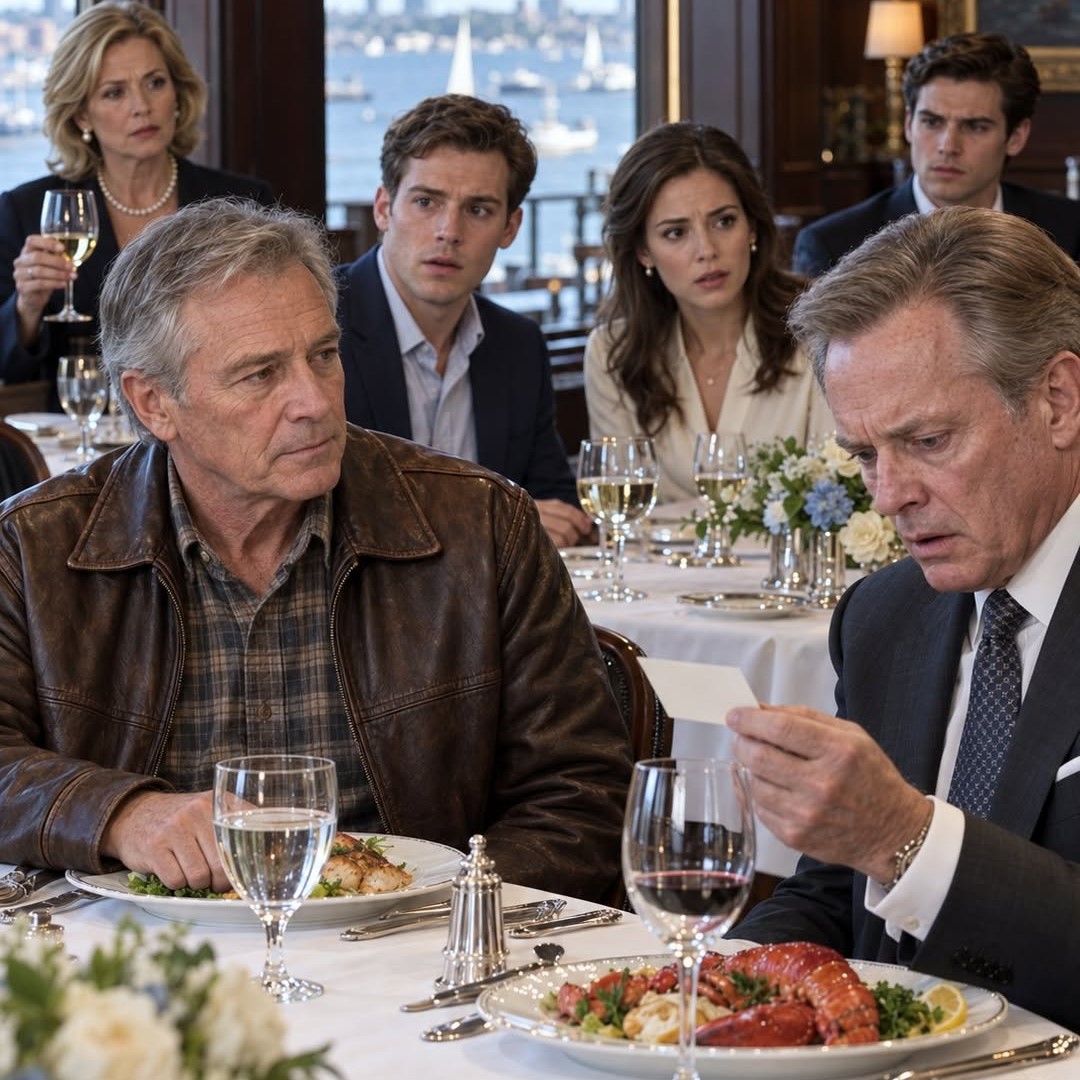
“I never told my son
that my investments brought in
$120,000 a month. When his wealthy
girlfriend’s parents invited me to their
exclusive country club, I showed up
looking like a man who barely
had any money. I wanted to
find out what kind of people
they really were. They treated me
like I was beneath them, never suspecting
I was the investor who held
their financial future in his hands.
“”No disrespect, Tom, but Michael isn’t
in a position to give our daughter
the lifestyle she’s accustomed to.””
Richard Bradford delivered those words
in a perfectly calm voice.
Somehow, that made the insult
sting even more.
Across the private dining area,
I watched my son’s expression tighten.
Jessica reached beneath the white tablecloth
for his hand, but her mother
caught the movement and raised an eyebrow.
I put my fork down.
The Brookshire Country Club offered
a sweeping view of Boston Harbor.
Everything around us gleamed with polished silver
and dark mahogany, and the guests
were the sort of people
who never bothered checking prices before ordering.
I’d come wearing faded jeans,
worn work boots, a flannel shirt
that cost six dollars, and the same
leather jacket I’d owned since 1995.
Twenty years ago, I’d been
a member of this very club.
I remembered the harbor scenery,
the private wine cellar,
and the aging portrait hanging
above the fireplace.
After Sarah passed away,
I’d canceled my membership.
Without her, none of those things
meant anything.
Nobody sitting at that table
knew my history with the place.
During the entire drive over,
Michael had kept both hands tight
around the steering wheel.
He’d been preparing excuses for my appearance
long before anyone had made
a single comment.
When the valet spotted my dented Honda,
Christopher let out a quiet laugh.
Richard acted as though
he hadn’t heard it.
Patricia missed nothing.
Neither did I.
For thirty-five years, I’d dealt with businessmen
who used expensive suits
to conceal their fear.
I’d learned to recognize genuine confidence
and distinguish it from someone
putting on an act.
Richard was putting on an act.
What I hadn’t figured out yet
was the reason.
From the moment I arrived,
the Bradford family had been
sizing me up.
Patricia examined my outfit.
Christopher found my car amusing.
And Richard looked at Michael
as though my son were seeking approval
for a bank loan rather than permission
to marry Jessica.
“”You’re living in South Boston?””
Patricia had asked.
“”That’s right.””
“”Are you renting?””
“”I own my place.””
Richard offered a courteous smile.
“”Well, real estate values might give you
a little profit someday.””
I chose not to respond.
As far as they knew,
I was a retired financial employee
surviving on a fairly small pension.
Michael believed that, too.
He had no idea my investments
earned approximately $120,000 every month.
I’d deliberately kept that information from him.
Eight years earlier, after his mother died,
Michael had gone through the worst period
of his life.
He dropped out of graduate school,
accumulated credit-card debt, and repeatedly called me
whenever he couldn’t manage another payment.
At twenty-three, he filed for bankruptcy.
But he eventually found his way back.
He took two jobs,
enrolled in school again,
completed his architecture degree, and learned
to handle his responsibilities without expecting
someone else to bail him out.
I kept my financial success private
because I wanted Michael to understand
that he could make it
on his own.
Now he was twenty-eight,
seated beside the woman he wanted
to marry, while her relatives discussed him
as though he were a dangerous
financial liability.
Jessica was the one member
of the Bradford family who had
greeted me warmly.
She’d gotten to her feet,
embraced me, and met my eyes
without hesitation.
Her parents had looked straight
at my boots.
When the waiter came back,
Richard requested lobster.
Patricia selected Wagyu beef.
Christopher barely glanced at the menu
before placing his order.
“”I’ll take the chicken breast,””
I told the waiter. “”Nothing fancy.
And just water, please.””
The family exchanged looks.
Michael’s ears grew red.
I continued eating.
Their interrogation was disguised
as polite dinner conversation.
Where had I gone to college?
A state university.
What vehicle did I own?
A 2008 Honda Civic.
Was I currently a member
of any private club?
No longer.
With every answer, Christopher looked increasingly entertained.
Jessica attempted to change the subject
by bringing up Michael’s newest architectural project.
Richard interrupted her.
“”Marriage takes preparation,”” he said.
“”And raising children takes money.””
“”I was just promoted,”” Michael replied.
“”Well, that’s promising,”” Patricia said.
She sounded like an adult politely praising
a child’s artwork.
Underneath the table, Michael’s hands tightened.
Richard settled farther back
into his expensive suit.
“”Jessica grew up with certain expectations.
Traveling. A good education. Financial stability.
We need to be certain she won’t
end up struggling.””
“”Dad,”” Jessica said sharply.
“”I’m looking out for you.””
“”No,”” she replied. “”You’re humiliating Michael.””
Richard paid no attention.
Instead, he turned toward me.
“”Surely you understand.
You’re a father yourself.””
“”Oh, I understand perfectly.””
Everyone at the table went quiet.
“”You want reassurance that Michael can
support your daughter,”” I said.
“”That’s a reasonable concern.””
“”And you’ve spent this entire meal
trying to determine whether my family
is socially and financially acceptable to yours.””
Patricia stopped with her wineglass suspended
halfway to her lips.
Christopher’s grin disappeared.
Richard began folding his napkin,
moving his fingers with deliberate care.
“”I wouldn’t put it quite that way.””
“”Then how would you put it?””
He cleared his throat.
“”Principles are important.
Family background is important.
Financial means are important.””
“”Social standing,”” I said.
“”Yes.””
“”And you’ve decided we don’t have any.””
Michael lowered his gaze
to his dinner plate.
Jessica looked furious.
“”Mr. Warren,”” she said,
“”I’m really sorry.””
“”You don’t owe me an apology.””
I faced Richard again.
He apparently believed the matter was settled.
In his mind, a man dressed
in shabby clothes would quietly accept
the insult because he ought
to be thankful for the privilege
of dining there.
But I had another question.
“”How are things going with
Riverside Development?””
Richard’s face shifted almost imperceptibly.
I noticed.
“”Excuse me?””
“”Your Cambridge real estate holdings.
Twenty million dollars in renovation expenses.
Financing delays. It’s been a rough quarter.””
Christopher turned abruptly toward his father.
Patricia placed her wineglass
on the table.
Richard’s butter knife went motionless.
“”How do you know anything about Riverside?””
I didn’t answer him.
“”And what about Hartford?
That acquisition fell apart after
your bridge financing was withdrawn.
That must have put considerable strain
on your business.””
His posture changed.
The assurance he’d displayed throughout lunch
was suddenly gone.
Michael stared at me like I’d begun
speaking a language he’d never heard before.
Richard leaned toward me.
“”Who are you, exactly?””
I reached into the old leather jacket
they’d been judging since I arrived.
My hand found my wallet.
Inside was a business card
I’d kept for years,
although I hardly ever needed
to hand it to anyone.
Every Bradford at the table watched me.
Jessica glanced between her father and me.
Michael didn’t move.
I took out the card,
placed it facedown on the spotless
white tablecloth, and held it
beneath one finger.
“”You wanted to know what kind
of financial resources our family has,””
I said. “”You wanted to determine
whether my son deserves
to marry your daughter.””
Nobody spoke.
“”Then we should have
a conversation about money.””
I pushed the card across the table.
It came to rest beside
Richard’s untouched glass of wine.
He looked at the card.
Then he looked back at me.
“”Turn it over.””
For the first time since lunch began,
Richard did exactly what I asked.
He picked up the card
and flipped it.
His gaze traveled across the top line.
Then his face went completely pale.
“Thomas Warren,” he whispered.
Below my name were three words.
Warren Harbor Capital.
And beneath those, in smaller print:
Founder and Managing Partner.
Richard read them twice.
Christopher leaned closer.
“What is it?”
His father didn’t answer.
Outside the windows, a ferry moved
slowly across the harbor,
leaving a white seam behind it.
I could hear silverware touching china
at another table.
Such an ordinary sound.
I would remember it afterward.
“Your firm,” Richard said,
“is reviewing our recapitalization.”
“Yes.”
“The Harbor committee meets Tuesday.”
“I know when my committee meets.”
Patricia looked between us.
“Richard, explain.”
He put the card down carefully,
as though its corners were sharp.
“Warren Harbor is the lead investor.”
“Prospective lead investor,” I corrected.
“Nothing has been approved.”
Michael turned toward me.
“Dad?”
There was no pride in his voice.
No relief.
Only confusion.
I had imagined this revelation
more times than I wanted to admit.
In every version,
my son finally understood
what I’d built.
I hadn’t imagined him looking
as though I’d become a stranger.
“How much?” Richard asked quietly.
I kept my attention on Michael.
“We’ll talk privately.”
Richard misunderstood.
He straightened his cuffs.
“Of course. Naturally.
This isn’t the appropriate setting.”
“It was appropriate five minutes ago.”
His hands stopped.
“When you believed we had nothing,
you were comfortable discussing our finances.”
“Tom, there’s been a misunderstanding.”
“No.”
The word settled between us.
“You understood my clothes.
You misunderstood what they entitled
you to do.”
Christopher stared at the card.
Patricia’s face had gone rigid.
Richard tried another smile.
It looked painful.
“Surely you recognize a father’s concern.”
Jessica moved her chair back.
“No, Dad.
Don’t hide behind me.”
He turned toward her.
“Jessica.”
“You didn’t ask about our plans.
You didn’t ask what I earn.
You didn’t ask whether we’re happy.”
“We’re concerned about your future.”
“Then why are you relieved
because his father has money?”
For a moment,
Richard had no answer.
Jessica stood.
Michael rose beside her,
but she touched his arm.
“Wait.”
She looked at me.
“Does this change how you see him?”
“No.”
“Good. It doesn’t change
how I see him either.”
I nodded.
But Michael wasn’t looking at her.
He was looking at me.
“You let me apologize
for your car.”
I felt something turn
beneath my ribs.
“In the parking lot,” he continued.
“I said you were doing your best.
You let me say that.”
“I am doing my best.”
“You know what I mean.”
I did.
Richard lifted one hand.
“Perhaps we should all take
a moment to settle down.”
Michael turned toward him.
“You’ve had the whole meal
to say something decent.”
His voice wasn’t loud.
That made everyone listen.
“I’ve heard enough about my salary.
Enough about my neighborhood.
Enough about what Jessica deserves.”
Patricia drew breath.
Michael continued before she spoke.
“She deserves someone who listens
when she tells them she’s happy.”
Jessica’s eyes filled.
“And she gets to decide
whether that’s me.”
For the first time that afternoon,
my son looked entirely like himself.
Not the frightened boy
who’d lost his mother.
Not the young man
asking whether I could cover
another overdue bill.
A man standing beside the woman
he had chosen.
Richard glanced toward nearby diners.
“Keep your voice down.”
“It is down.”
I almost smiled.
Almost.
Then Michael faced me again.
“And you.”
The words hurt more
because I deserved them.
“If you knew who they were,
why did you bring me here
without telling me?”
“I didn’t know what they’d do.”
“But you suspected.”
“Yes.”
“You came to test them.”
I looked at the tablecloth.
At my untouched water.
At the card I’d imagined
would settle everything.
“Yes.”
Jessica took Michael’s hand openly.
Nobody stopped her this time.
Richard leaned forward.
“Whatever happened here,
the Riverside transaction should remain separate.”
I looked up.
“It will.”
His shoulders loosened.
Then I finished.
“Which means I won’t approve it
to make this family dinner easier.”
He went still.
“And I won’t reject it
because you insulted my boots.”
For the first time,
he seemed unable to decide
whether I’d threatened him
or offered him mercy.
Neither was what I intended.
“I’ll disclose the family connection.
I’ll step away from the decision.
The committee will review your numbers.”
“Tom, we need certainty.”
“Then give them accurate information.”
Something flickered across Christopher’s face.
Richard noticed it too.
That interested me.
But I didn’t pursue it.
Not there.
Not with my son standing
beside a chair he’d endured
for too long.
I signaled our waiter.
“Please bring a separate check
for my lunch.”
Richard reacted immediately.
“You’re my guest.”
“Then you should have treated me
like one.”
I paid for the chicken,
the water,
and a generous tip
for a young man
who’d spent the last hour
pretending not to hear us.
As I stood,
Patricia said my name.
“Tom.”
I waited.
She glanced at the card.
Then back at my jacket.
“We didn’t realize.”
“I know.”
There was nothing else
I could add to that.
At the entrance,
an older man in a dark suit
stepped away from the reception desk.
“Mr. Warren?”
I recognized him slowly.
“Daniel?”
His smile softened.
“It’s been a long time.”
He’d been an assistant dining manager
when Sarah and I came here.
Now a small silver badge
identified him as the general manager.
He offered his hand.
I shook it.
“How have you been?”
“Well enough.”
His eyes moved toward Michael.
“And this must be your son.”
Michael nodded,
still visibly shaken.
Daniel smiled at him.
“Your mother used to show us
your school drawings.”
Michael’s face changed.
“She did?”
“Every visit.
She carried them in a folder.”
I remembered the folder.
Blue cardboard.
Bent corners.
Sarah had refused to replace it.
Daniel looked back at me.
“I’m glad to see you again.”
I thanked him.
We walked outside
into a wind cold enough
to clear a man’s head,
though it did nothing
for the weight in my chest.
Jessica’s coat fluttered around her knees.
Michael handed the valet his ticket.
Nobody spoke until the Honda arrived.
Then Jessica said,
“I’ll get a car.”
Michael looked at her.
“You don’t have to.”
“I know.”
She kissed his cheek.
“You and your dad need to talk.”
I opened my mouth.
She gave me a tired,
unmistakably honest look.
“Please don’t make him tell you
that everything is fine.”
“I won’t.”
She hugged me anyway.
That nearly undid me.
On the drive home,
Michael kept both hands
on the steering wheel again.
This time,
I knew I was the reason.
We crossed the bridge
without a word.
At a red light,
he finally spoke.
“Was Mom rich too?”
The question was so unexpected
I answered too quickly.
“We were comfortable.”
He looked at me.
“Don’t do that.”
The light changed.
I waited until he turned
onto a quieter street.
“She owned part of the firm.
We built it together.”
“Together how?”
“She kept our books at first.
Then she handled research.
Later, she managed the business.”
“You said she helped
with paperwork.”
“Yes.”
“That wasn’t the same thing.”
“No.”
A bus passed us,
its windows bright with strangers.
Michael stared straight ahead.
“What else don’t I know?”
Too much,
I realized.
Not because I’d hidden everything deliberately.
Some things I’d simply allowed
to disappear behind easier explanations.
The way silence grows
when nobody challenges it.
“I’ll tell you everything.”
“That’s a large promise.”
“I know.”
He parked outside my house.
The engine ticked as it cooled.
Neither of us moved.
“How much money do you make?”
“The distributions vary.
Around a hundred twenty thousand monthly.”
He closed his eyes.
I waited.
Not for anger.
For whatever came before it.
“When I was working nights,” he said,
“you knew?”
“Yes.”
“When I sold Mom’s camera?”
My breath stopped.
“I didn’t know you sold it.”
“The old Nikon.
I got four hundred dollars.”
He gave a short laugh
that contained no humor.
“I told myself she would’ve wanted
me to finish school.”
“She would have.”
“You could’ve helped.”
“Yes.”
He turned toward me.
“Then why didn’t you?”
For years,
I’d had an answer ready.
Discipline.
Independence.
The dignity of earning
what nobody could take away.
Sitting beside him,
those words sounded thin.
“I was frightened,” I said.
“Of what?”
“Losing you differently.”
He waited.
“After your mother died,
you kept asking for money.
Every call became an emergency.
I couldn’t tell whether helping
was keeping you alive
or helping you disappear.”
“You could’ve asked.”
“I tried.”
“You lectured.”
That was true too.
“You were grieving,” I said.
“So was I.
I turned everything into a lesson
because numbers were easier
than what was happening to us.”
His eyes shone.
“I thought you were barely managing.”
“I know.”
“No, Dad.
I bought groceries for you
when I could.
I skipped things
because I thought you needed them.”
“I kept every—”
I stopped.
He looked at me sharply.
“Every what?”
I swallowed.
“Every amount you gave me.
In an account.”
His face hardened.
“You made that a lesson too?”
“I thought I’d give it back
when you bought a home.”
“I wasn’t making deposits.
I was taking care of you.”
The shame of that reached
somewhere pride had never touched.
“I understand.”
“I don’t think you did.”
“No,” I said.
“I didn’t.”
He turned away.
For a while,
we watched the bare branches
moving over my front steps.
Then he said,
“I’m proud I finished school.”
“You should be.”
“But you don’t get to say
I needed all that pain
to become someone worth respecting.”
My throat tightened.
“You were worth respecting
before any of it.”
“Then I needed to hear that.”
I put my hand
on the dashboard,
an awkward, useless movement.
“I should have said it.”
He wiped his face
with the heel of his hand.
I didn’t reach for him.
I wanted to.
But wanting comfort from him
was part of what
I needed to stop doing.
“I owe you an apology,” I said.
“A real one.
Not an explanation dressed up
to sound like one.”
He listened.
“I kept the truth from you.
I decided what you could handle.
Today, I let you walk
into a situation I’d prepared for
while you had no idea.”
A tear slid down his cheek.
“I thought I was protecting
what you’d earned.”
“You made me feel foolish.”
“I know.”
“And poor.”
The word stayed between us.
Not because there was shame
in having little.
Because I’d allowed him
to believe our lives depended
on a story I’d invented.
“I’m sorry, Michael.”
He nodded once.
Then he got out.
“I need a few days.”
“All right.”
He handed me my keys.
“I’ll take the train.”
“You can keep the car.”
“I want to walk.”
I let him.
From the sidewalk,
he looked back.
“Don’t send me money.”
“I won’t.”
“And don’t call Jessica
to explain yourself.”
“I won’t do that either.”
He walked toward the corner.
I stood beside the Honda
until he disappeared.
Then I went inside
and sat at the kitchen table
where Sarah used to drink tea.
The house made its familiar sounds.
A pipe knocked.
The refrigerator hummed.
Somewhere upstairs,
a floorboard settled.
For the first time in years,
my quiet house felt
less like a refuge
than a place where
I’d been avoiding a conversation.
On Monday morning,
I called our chief investment officer,
Elena Ruiz.
“I need to disclose a conflict.”
She listened without interrupting.
When I finished,
she asked one question.
“Did you promise him anything?”
“No.”
“Did he ask you to?”
“Not directly.”
“He will.”
“I know.”
She paused.
“Are you all right?”
That nearly surprised a laugh
out of me.
“Apparently, I’m an excellent investor
and an uneven father.”
“Those aren’t unusual companions.”
I told her to document everything.
No private calls with Richard.
No side conversations.
No suggestions from me
about approval or rejection.
“And Tom?”
“Yes?”
“Don’t read the committee packet
then pretend you stepped away.”
She knew me too well.
“I won’t.”
Richard called seven times that day.
I answered the first.
He began with an apology.
It was polished.
He regretted the tone.
He valued our children.
He hoped an uncomfortable social encounter
wouldn’t cloud sound commercial judgment.
I let him finish.
Then I said,
“Elena is handling your application.”
“Surely we can speak
as future family.”
“Our children decide
whether we become family.”
“Of course.”
“And family isn’t a financing mechanism.”
His breathing changed.
“I’m asking for fairness.”
“You’re being offered it.”
He never once asked
how Michael was doing.
After we hung up,
I put my phone
in another room.
On Wednesday,
Jessica came to my door.
She carried no flowers,
no carefully chosen peace offering.
Only a paper bag
with two sandwiches.
“I’m not here as a messenger.”
I stepped aside.
“Come in.”
We sat in the kitchen.
She looked around quietly.
At Sarah’s yellow bowl.
At the chipped window latch.
At a life whose ordinary surfaces
had become suspect to my son.
“Is this really how you live?”
“Yes.”
“Good.”
I raised an eyebrow.
“Michael wondered whether this house
was part of the act.”
The words landed hard.
“It isn’t.”
“I told him that.”
“You couldn’t know.”
She unwrapped her sandwich.
“The dish towel has a hole.
Nobody stages that well.”
I smiled despite myself.
Then she set the sandwich down.
“My father wants me
to talk to you.”
“About Riverside?”
“Yes.”
“What did you tell him?”
“That I wasn’t an introduction
he could invoice.”
I looked at her
for a long moment.
She wasn’t triumphant.
She looked exhausted.
“Are you all right?”
“No.”
I appreciated the answer.
“He’s scared,” she said.
“I can hear it now.
Everything he said about Michael
was something he couldn’t bear
to admit about himself.”
“That may be true.”
“It doesn’t excuse it.”
“No.”
She folded her hands.
“He’s always done this.
Made every fear sound
like a standard other people
failed to meet.”
“Have you told him that?”
“Yesterday.”
“How did it go?”
“He said Michael was turning me
against my family.”
She stared at the table.
“I said I’d had these thoughts
long before I met Michael.
He just didn’t like
hearing them out loud.”
Outside,
a delivery truck stopped.
The driver carried a package
to my neighbor’s door.
Life continued with an indifference
I found oddly comforting.
“I love your son,” Jessica said.
“Not because he survived something
and made a useful story
out of it.”
I lowered my eyes.
“I understand.”
“I love him because
he notices when people are tired.
Because he remembers what matters.
Because he asks me questions
and listens to the answers.”
She looked toward Sarah’s photograph.
“He told me his mother
was good at that.”
“She was.”
“Then maybe you can both
learn it again.”
Before leaving,
Jessica asked if she could
take Michael a photograph.
“Something of her
he hasn’t seen.”
I went upstairs.
In Sarah’s desk,
beneath old insurance papers,
I found a shoebox
I’d avoided for years.
Inside were pictures,
ticket stubs,
a birthday candle
wrapped in tissue.
And a small brass key
taped to an envelope.
I knew the key immediately.
The cabinet in my study.
The one holding our older records.
On the envelope,
Sarah had written four words.
Tom, when you’re ready.
I sat down on the bed.
For eight years,
I’d thought I knew
every message she’d left.
Her illness had been brief.
There hadn’t been time
for elaborate arrangements.
But there had been afternoons
when I’d been at the office,
insisting I could finish
one more thing.
Jessica waited downstairs.
I opened the envelope.
Inside was a photograph
of Michael at seventeen,
standing beside a cardboard model
of a little brick library.
Sarah had written on the back.
He says the windows are wrong.
I think he’s afraid
someone will love it.
Tell him to keep building.
Underneath was a folded page.
Not a farewell letter.
A list.
Account numbers.
Renewal dates.
The name of our accountant.
Practical things,
in her sloping handwriting.
Then, at the bottom:
And Tom, listen to him
before you solve him.
I read that sentence
until the words blurred.
When I came downstairs,
Jessica stood without speaking.
I gave her the photograph.
“The writing on the back
is for him.”
She looked at my face.
“Are you sure?”
“Yes.”
I kept the other page.
That instruction belonged to me.
Two evenings later,
Michael called.
“Can I come over?”
“Anytime.”
“I don’t want
another big revelation.”
“Neither do I.”
He arrived carrying an old
plastic grocery bag.
Inside were containers
of lentil soup.
“Jessica made too much.”
I doubted that,
but I thanked him.
We ate without discussing money.
He told me about a site visit.
A contractor had discovered
a structural problem behind a wall.
“What did you do?”
“I asked the engineer
to come look.”
I nearly offered advice.
Caught myself.
“And?”
“We changed the design.”
“Was that difficult?”
He looked at me.
“A little.”
I nodded.
He went on talking.
After dinner,
he took out the photograph.
“Mom hated this model.”
“No, she didn’t.”
“She said the roof leaked.”
“It was cardboard, Michael.”
“That was her joke.”
I remembered.
So did he.
For the first time
since the club,
we laughed together.
Then the laughter thinned.
“I miss her,” he said.
“I do too.”
“I thought if I stopped
talking about her,
you’d stop looking so sad.”
I stared at him.
“I thought talking about her
made things worse for you.”
He shook his head slowly.
Eight years.
Two men being considerate
in precisely the wrong way.
I covered my face.
Michael’s chair scraped.
Then his arms were around me.
I held him
with a desperation
that had nothing to do
with making him forgive me.
We stayed like that
until we could breathe
without trying to hide it.
Later,
I opened the cabinet.
He sat beside me
while I showed him
what his mother had helped build.
Not everything at once.
Not a performance.
Partnership documents.
An early photograph
of six people
in a borrowed office.
Sarah’s notes in the margins
of a proposal we’d rejected.
“Why this one?” he asked.
“She thought the project
would displace too many tenants.”
“Was she right?”
“Yes.”
“Did you listen?”
“Eventually.”
He smiled faintly.
“Sounds familiar.”
I accepted that.
We discussed the account
holding the money he’d given me.
I told him the balance.
He was quiet.
Then he said,
“Use some for your roof.”
“The roof is fine.”
“It leaks near the chimney.”
“I put a bucket there.”
He looked at me
until I laughed.
“All right.”
“And the rest,” he said,
“let me think.”
I closed the folder.
“Take your time.”
For once,
I meant it without
a lesson attached.
The Riverside review lasted
three difficult weeks.
I learned the outcome
when everyone else did.
Elena called on a Thursday.
“The committee declined
the proposal as submitted.”
I stood by the window.
“Because?”
“Projected rents were overstated.
Construction costs were understated.
Several related-party payments
weren’t adequately disclosed.”
I watched a child
pull a scooter
up the opposite sidewalk.
“Fraud?”
“We aren’t making that determination.
We’ve requested corrected records.
Independent counsel is reviewing
our exposure to the materials.”
“Understood.”
“There’s a viable property underneath it.
But the current structure isn’t viable.”
“What happens now?”
“That depends on
what Richard is willing to lose.”
It was the right answer.
It was also the answer
Richard had spent years
paying other people
to avoid saying.
He arrived at my house
the following afternoon.
No appointment.
No driver.
His suit was the same quality,
but he’d forgotten
to arrange his expression.
I met him on the porch.
“You’ve made your point.”
I kept my hand
on the doorframe.
“I didn’t make that decision.”
“Your people did.”
“Based on your records.”
His mouth tightened.
“There are employees.
Contractors.
Families.”
“Yes.”
“You’d put them at risk
over a lunch?”
“No.
You put them at risk
before I ordered chicken.”
He stepped back
as though I’d struck him.
For a moment,
I saw the man
beneath the expensive certainty.
Tired.
Cornered.
Used to mistaking control
for safety.
Then anger covered him again.
“You enjoyed humiliating me.”
I considered lying.
It would’ve been easy.
The righteous man
at his modest front door.
The arrogant man
finally receiving consequences.
But Michael had spent enough years
inside stories I preferred
to the truth.
“For a moment,” I said,
“I enjoyed turning that card over.”
Richard stared at me.
“I wanted you to feel
what you were doing
to my son.”
“Well, congratulations.”
“It didn’t help him.”
The wind lifted
the edge of his coat.
“But your business problems
aren’t punishment for that moment.
They existed before
you knew my name.”
He looked past me,
into the narrow hallway.
“What would you do?”
“Tell the truth
while you still have choices.”
“And lose everything?”
“Find out what everything means.”
He laughed bitterly.
“You can afford philosophy.”
“Yes,” I said.
“I can.
That’s why I won’t pretend
this is easy.”
He had no response.
“Ask Elena about
a sale process,” I continued.
“An independent one.
Bring complete records.
Accept that you may lose control.”
He looked down.
For the first time,
he seemed older than
the man at lunch.
“Jessica won’t take my calls.”
“Then stop making every call
about what you need.”
He left without shaking my hand.
I watched him walk
to his car.
I felt no satisfaction.
That surprised me less
than it once would have.
Over the next month,
the Bradfords’ life
became smaller in public
and more complicated in private.
The country club membership went first.
Then a vacation property
they rarely visited.
Richard stepped down
from managing Riverside.
An outside firm took over
the sale of its viable assets.
He lost most
of his equity.
A separate buyer funded
completion of the Cambridge work,
under a revised plan
with verified costs.
Some employees kept their jobs.
Others received severance
from the sale proceeds.
A few subcontractors accepted less
than they’d been owed.
There was damage
no apology could reverse.
I refused to call
any of that victory.
Christopher called me
during the restructuring.
I almost let it ring.
Then I answered.
“I need to tell you something.”
I waited.
“I worked on the projections.”
“How?”
“I changed assumptions
after the analyst objected.”
“Did you tell the reviewers?”
“Yes.”
“Everything?”
A pause.
“Not yet.”
“Then this isn’t the call
you need to finish.”
He breathed shakily.
“I was trying to make
the numbers work.”
“Numbers don’t work better
because you frighten them.”
“I know that now.”
“Tell the people
who need to know.”
“I will.”
Before he hung up,
he said,
“I also owe you an apology.”
“For what?”
“Your car.
Your clothes.
All of it.”
“Apologize to Michael too.”
“I did.
He didn’t answer.”
“Give him time.”
He did.
That was the first
useful thing Christopher did
without expecting immediate credit.
Patricia’s apology arrived differently.
She asked Jessica
whether she could visit
our Sunday dinner.
Jessica asked Michael.
Michael asked me.
Nobody was summoned.
Nobody was told
what a family required.
We agreed on six o’clock.
Patricia arrived carrying
a plain glass dish
with an apple cake inside.
She wore a coat
I’d seen before,
and looked embarrassed
when I noticed the cake.
“My mother made this.”
“That’s kind of her.”
Patricia shook her head.
“Her recipe.
She died twelve years ago.”
“Oh.
I’m sorry.”
“I stopped making it
because Richard thought it looked rustic.”
She gave a small,
unsteady smile.
“It’s cake.
I don’t know why
I let that matter.”
At the table,
she didn’t begin
with excuses.
“Michael, I was cruel.”
He set down his fork.
“I disguised it as concern.
I wanted to impress
people who weren’t even there.”
Jessica watched her mother carefully.
Patricia turned toward me.
“And I would’ve left
that lunch pleased with myself
if you hadn’t had that card.”
Nobody spoke.
“I keep thinking about that.”
“So do I,” I said.
She nodded,
accepting the answer.
“I don’t expect forgiveness tonight.”
“Good,” Michael said.
Patricia flinched.
Then she nodded again.
“Good.”
Dinner continued awkwardly.
Which was better,
I discovered,
than dinner proceeding smoothly
because everyone was lying.
Patricia asked about Michael’s work.
When he answered,
she listened.
When Jessica spoke
about her own plans,
Patricia didn’t interrupt.
At the door,
she offered to help wash dishes.
I handed her a towel.
We stood together
beside the sink,
a chipped plate between us.
“My father drove a delivery truck,”
she said suddenly.
“I used to help him
wash it on Sundays.”
I looked at her.
“Jessica doesn’t know.”
“Why not?”
Patricia rubbed the plate dry.
“I thought I’d come too far
to mention where I started.”
The water ran warm
over my hands.
“Maybe tell her.”
She folded the towel.
“I think I will.”
Spring arrived slowly that year.
Snow lingered in shaded places.
The harbor turned silver,
then blue.
Michael and I began meeting
with a counselor twice a month.
The first appointment was uncomfortable.
The second was worse.
By the third,
I stopped treating every silence
as something I should repair.
He told me things
I hadn’t known
about those years after Sarah died.
How often he’d slept
with the television on.
How ashamed he’d been
of needing anyone.
How my brisk advice
had sounded like disappointment,
even when I’d intended hope.
I told him
about the nights I’d sat
outside his apartment,
unable to decide
whether knocking would help.
“You were there?”
“Sometimes.”
“Why didn’t you knock?”
“I didn’t know what to say.”
He looked at me
for a long time.
“You could’ve started with hello.”
It was a small sentence.
It changed more
than any financial disclosure
ever could.
In April,
he asked Jessica to marry him.
On a public pier.
No photographers.
No elaborate setup.
Just the harbor,
the ring he’d saved for,
and a woman who said yes
before he’d finished asking.
They told me afterward
over takeout in my kitchen.
Jessica held out her hand.
I admired the ring.
Michael watched my face.
“What?”
“Nothing.”
“You’re thinking something.”
I smiled.
“That your mother would’ve cried.”
Jessica began crying first.
Then Michael.
I made a poor effort
to remain useful
by finding napkins.
They wanted a small wedding.
A garden ceremony.
Dinner afterward.
Richard offered to pay.
So did I.
Jessica looked at both offers
and made the same decision.
“We’ll set the budget.
If you want to contribute,
we’ll tell you
what we can accept.”
Michael glanced at me.
I nodded.
They accepted help
with the meal
and paid for
the rest themselves.
Not because hardship
proved their love.
Because they wanted
the day to belong
to their choices.
I understood the difference now.
Richard requested a meeting
with Michael before the wedding.
Michael agreed,
on the condition
that Jessica could come.
They met in a coffee shop.
I wasn’t there.
I learned about it later,
when Michael came
to help repair my porch.
Richard had apologized.
Badly at first.
Then better,
after Jessica stopped him
from describing his intentions.
“He finally said
he’d been measuring me
against a life
he couldn’t afford himself.”
I held a board steady.
“What did you say?”
“That I wasn’t applying
to become him.”
I nodded.
“Then what?”
“He asked whether
there was anything he could do.”
“Was there?”
Michael drove a screw
into the new wood.
“I told him to show up
without trying to run things.”
“Reasonable.”
“He didn’t like it.”
“Did he agree?”
“Yes.”
Michael checked the board
with the flat of his hand.
“I’m not ready
to call him Dad.”
“You don’t have to.”
“I know.”
He looked at me.
“I actually know that now.”
The wedding was in June.
A neighborhood garden
behind a small community center.
The chairs didn’t match perfectly.
One tablecloth was shorter
than all the others.
A gust of wind
knocked over the seating chart
twice before anyone arrived.
It was beautiful.
I wore a dark suit.
Not because I’d changed
my view of clothes.
Because my son had asked
for one photograph
without the leather jacket.
He’d grinned when he said it.
I would’ve worn
a sailor’s uniform
if he’d asked kindly enough.
Before the ceremony,
he found me
behind the community center.
He held a small parcel.
“I have something for you.”
“Michael.”
“Don’t make that face.
It isn’t expensive.”
Inside was a camera.
Sarah’s Nikon.
The strap was faded.
One corner bore
a familiar scratch.
I couldn’t speak.
“How?”
“The shop kept sales records.
I asked last month.”
He watched me
turn it over.
“The buyer lived
two towns away.
He hadn’t used it much.”
“You bought it back?”
Michael nodded.
“With some of
the money in that account.”
I closed my eyes.
For years,
I’d imagined giving him
that account as proof
of my foresight.
He’d used it
to return something
I hadn’t known
I’d lost.
“I thought you might
take pictures today,” he said.
My hands shook.
“There’ll be a photographer.”
“Then yours can be
the ones nobody poses for.”
I pulled him close.
He laughed against my shoulder.
“Careful with the suit.”
I held him harder.
The ceremony began
ten minutes late.
A little girl
forgot where to carry
the basket of petals.
An elderly aunt
answered her telephone
during the opening music.
Nobody minded for long.
Jessica came down the path
beside her father.
Richard wore a plain gray suit.
No grand expression.
No performance of ownership.
At the front,
he kissed her cheek
and stepped back.
Exactly as she’d asked.
Michael looked at Jessica
with such open wonder
that I lifted the camera
and nearly forgot
to press the shutter.
Then I caught it.
That face.
That moment.
My son,
with nothing left
to prove at the table.
During dinner,
Christopher approached me.
He’d taken a salaried position
with a smaller company.
No executive title.
No family office.
He told me
he was learning estimating
from a man
who checked every figure twice.
“Sounds useful,” I said.
“It is.”
He looked toward Michael.
“We talked last week.”
“Good.”
“He said forgiveness
wasn’t a group assignment.”
I smiled.
“That sounds like him.”
Christopher nodded.
“I deserved that.”
“Probably.”
He laughed,
then grew serious.
“I wanted you to know
I’m not asking for work.”
“All right.”
“Or an introduction.”
“Christopher.”
“Yes?”
“Tell me whether you like
what you’re doing.”
He considered that
as though nobody
had asked him before.
“Some days.”
“That’s a start.”
Across the garden,
Patricia danced with her daughter.
Her shoes sat
beneath her chair.
Richard stood beside me
for a while
without speaking.
Finally he said,
“I sold the boat.”
I watched the dancers.
“I heard.”
“I thought I’d miss it
more than I do.”
“What do you miss?”
He took time
with the answer.
“Being certain
I was right.”
“That can be expensive.”
He looked at me.
“I imagine you’d know.”
I smiled.
“Yes.”
We stood quietly.
Then he said,
“I owe you an apology
that doesn’t include
the word business.”
I lowered the camera.
“You do.”
“I was ashamed
of what was happening.
I made your son
carry some of it.”
His eyes stayed
on the garden.
“He didn’t deserve that.
Neither did you.”
“No.”
“I won’t ask you
to forget it.”
“Good.”
He nodded.
After a while,
I handed him
a paper cup of coffee.
We drank it
standing beside a folding table.
It was the first
honest conversation
we’d ever had.
Later,
when the music softened,
Michael took the microphone.
I braced myself
for a speech.
Instead,
he looked around
at the little garden.
“Thank you for coming.”
A few people cheered.
“Jessica and I
have a lot to learn.”
He glanced at her.
“She says mostly me.”
Laughter moved through the tables.
“But we’re learning
that love doesn’t mean
deciding everything for someone.”
His eyes found mine.
“It means asking.
And staying long enough
to hear the answer.”
I looked down
at the camera.
My vision had blurred again.
Beside me,
Patricia reached quietly
for a napkin.
That autumn,
Michael and Jessica
moved into a small house
with uneven floors
and good morning light.
They could afford the payments
on their own salaries.
I reviewed nothing
unless they asked.
When they did ask,
I answered the question
they’d actually given me.
It was harder
than it sounds.
They painted the kitchen green.
Jessica hated it
after the first wall.
Michael suggested waiting
until the paint dried.
She hated it then too.
They repainted it cream
and laughed about the cost.
I brought sandwiches
and held the ladder.
Nobody discussed what
the afternoon was teaching them.
It was simply an afternoon.
That was enough.
A year after the wedding,
they asked me
to come over early
for Sunday dinner.
There was a small box
beside my plate.
Inside lay
a pair of yellow socks.
For a moment,
I thought I’d misunderstood.
Then Jessica smiled.
Michael’s hand trembled
against hers.
I sat down hard.
“Oh,” I said.
It was all
I could manage.
They laughed.
Then I cried.
Then they cried too,
and dinner went cold
while we stood
in their little kitchen
holding one another.
There were appointments afterward.
Plans.
Worries they chose
to share with me.
I offered help,
and learned to hear
both yes and no
without taking either personally.
When their daughter arrived,
they named her Lucy Sarah.
I met her
on a rain-washed morning,
wrapped in a blanket
too large for her.
Michael placed her
in my arms.
Her fingers opened
against my thumb.
“You all right?” he asked.
I nodded.
Then shook my head.
Then laughed.
“Apparently not.”
Jessica smiled
from the hospital bed.
“That’s the correct response.”
I looked at
my granddaughter’s tiny face.
No earnings.
No accomplishments.
Nothing she could offer
except the fact
that she had arrived.
And already,
there was no question
of what she deserved.
I wished I could tell
the younger version
of myself that.
The man who’d confused
preparing a child
with withholding certainty.
The man who’d believed
love needed a strategy
to prevent it
from becoming weakness.
But he was gone
only in the way
all our old selves go.
Still part of me.
No longer in charge.
Years later,
Lucy would ask
about the leather jacket.
By then,
the lining had torn,
and one pocket
sagged at the seam.
She’d slide her hands
into the sleeves
and announce
that she looked enormous.
“You do,” I’d tell her.
“Were you always this old?”
“Older, some days.”
She’d consider that,
then ask for toast.
The jacket stayed
on the hook
beside my front door.
So did Michael’s spare key.
I repaired the roof.
I kept the Honda
until the mechanic
gently explained
that affection wasn’t
a replacement for brakes.
When I bought another car,
Michael came with me.
We argued about nothing important.
He preferred silver.
I preferred blue.
I bought blue.
He drove us home.
Sometimes,
we still disagreed
about the years
we couldn’t repair.
An apology hadn’t
erased them.
A wedding hadn’t
rewritten them.
But disagreement stopped meaning
we might lose each other.
We could stay
at the same table
and tell the truth.
That was new.
That was worth keeping.
On the first warm Sunday
after Lucy turned two,
everyone came to my house.
Jessica brought bread.
Michael brought a salad
he’d forgotten to dress.
Patricia carried her mother’s cake.
Christopher arrived late,
apologizing with groceries
for the following week.
Richard came early
and asked whether
I needed anything moved.
I pointed toward
the chairs in the garage.
He carried them out
without offering instructions.
Lucy ran through the garden
in yellow boots,
stopping every few steps
to inspect something
the adults had missed.
An ant.
A stone.
A fallen blossom.
I took Sarah’s camera
from its case.
Michael watched me
adjust the strap.
“Still works?”
“Perfectly.”
He smiled.
At the table,
nobody asked
what anyone earned.
Jessica described a difficult
week at work.
Patricia listened
without turning it
into advice.
Christopher admitted
he’d made a mistake
on an estimate
and caught it
before anyone ordered materials.
Richard asked
how he’d found it.
A real question.
No hidden examination.
I caught myself
watching them too closely,
searching for proof
that everything had changed.
Then Lucy tugged
at my sleeve.
“Grandpa.
Sit here.”
She pointed
to the chair beside hers.
I put the camera down.
There were dishes
waiting in the kitchen.
Unanswered messages.
Numbers that would rise
and fall by morning.
For once,
none of them
needed me first.
I sat.
Lucy pushed a crooked
piece of bread
onto my plate.
“For you.”
“Thank you.”
She leaned against my arm
and went back
to studying her cake.
Across the table,
Michael was laughing
at something Jessica said.
Evening light touched
the side of his face.
I could see Sarah
in him clearly then.
Not as a wound.
As something living.
Something she’d given us
that grief had never
managed to take.
The garden grew quieter.
Someone poured more coffee.
A boat horn sounded
far beyond the houses.
Lucy laid her small hand
over mine.
I turned my palm upward
and held it gently,
with nowhere else
I needed to be.