The Child at the Altar Changed Everything. But the Truth She Carried Was Even More Dangerous.
The object in the little girl’s palm was not a weapon, not a note, not some childish trinket stolen for attention.
It was a photograph.
Old. Bent at the corners. Smudged as if it had been carried too long by hands too small for the burden. Ethan took it before security could reach her, almost by instinct, and the second his eyes fell on it, the blood drained from his face.
The chapel blurred.
Because the man in the photo was him.
Not a stranger who merely resembled him. Not a trick of angles or light.
Him.
He looked younger, thinner, rougher around the edges—but unmistakably him. Standing in front of a small yellow house he had never seen before, one hand holding the strap of a duffel bag, the other resting awkwardly on the shoulder of a woman whose face had been scratched out so violently the paper had nearly torn.
And beside them stood the little girl.
Only younger.
Only cleaner.
Only smiling.
A murmur swept through the guests like wind through dry leaves. Olivia’s perfect posture tightened by a fraction. It was such a tiny movement that no one else would have seen it, but Ethan saw it. For the first time all day, Olivia looked surprised.
“Where did you get this?” he asked, his voice low and unsteady.
The little girl looked up at him with eyes far too old for her face. “You gave it to my mama,” she said.
A hundred people were watching. The stained-glass saints above seemed to lean closer. Even the officiant had stepped back as though he had wandered into a storm without noticing the clouds.
“That’s impossible,” Olivia said smoothly, turning to the guests with a controlled little laugh. “Someone is clearly manipulating this child.”
But the girl flinched at the sound of Olivia’s voice.
Not dramatically.
Not theatrically.
Just the small, involuntary recoil of someone who had learned fear the hard way.
And Ethan felt it like a blade between his ribs.
“What’s your name?” he asked her.
She swallowed. “Mia.”
The name hit him strangely—not as recognition, but as a pressure behind the eyes, a sensation like standing too close to a memory that would not open. His fingers tightened around the photograph. Something on the back scratched against his thumb. He turned it over.
There, in faded ink, was his handwriting.
When the time is right, find me. I’ll fix it. —E
For one long, terrible second, Ethan forgot how to breathe.
“No,” Olivia said sharply, and now the room heard it—the change in her voice, the polished charm cracking at the edges. “This is absurd.”
Ethan lifted his eyes to her. “You knew.”
It was not a question.
Olivia’s face softened again, but too quickly, too perfectly. “Ethan, please. You’re overwhelmed. Anyone could forge a note.”
Mia shook her head, sudden desperation filling her voice. “She came to our house. She said if Mama ever tried to find you, bad things would happen. Mama cried after she left. Then Mama disappeared.”
The words dropped into the chapel like stones into black water.
Guests stared openly now. Some had phones in their hands. Others were too stunned even to whisper. Ethan could hear his own heartbeat. Mama disappeared.
He knelt in front of Mia despite the thousand-dollar suit, the altar, the entire ruined spectacle of his wedding. “When?” he asked.
“A long time ago.” Her lip trembled. “Before she went away, she told me to find you if the lady in white ever smiled at you.”
Ethan looked at Olivia again.
And suddenly he remembered.
Not the whole thing. Not enough. But fragments—broken glass glinting in darkness.
A town he had lived in for six months while building his first company from almost nothing. A rented yellow house. A woman with kind, tired eyes. Rain knocking at thin windows. A promise made at a kitchen table while the world outside seemed determined to collapse.
He stood slowly.
Olivia’s expression turned tender, almost pitying. “Ethan,” she said, stepping closer, “you were sick back then. Burned out. Half-delirious from stress. You barely knew where you were most days. Someone is using that vulnerable period against you.”
The explanation was elegant.
Reasonable.
It would have worked on almost anyone in the room.
But Ethan noticed something he would once have missed: Olivia never asked what Mia’s mother’s name was.
Not once.
As if she already knew.
“Security,” Olivia said without taking her eyes off Ethan, “please remove them.”
Them.
Not her.
Ethan turned so fast the command sliced through the air before security could move. “No one touches this child.”
The authority in his voice stopped everyone cold.
Olivia’s smile vanished completely.
For the first time, the woman standing before him did not look poised or luminous or graceful. She looked furious—not with the chaos, but with losing control of it.
“You’re making a mistake,” she said quietly.
A sound came from the back of the chapel.
One of the doors had opened.
A woman stood there, framed by gray daylight and cold wind. Her coat was too thin. Her face was pale and drawn. One side of it was marked by a faint scar near the temple. She looked like someone who had crossed a thousand miles powered only by fear.
Mia turned.
“Mommy.”
The word shattered the room.
Mia tore from Ethan and ran. The woman dropped to her knees and caught her with both arms, holding her so tightly it looked less like an embrace than rescue. Guests rose halfway from their seats. Someone gasped Olivia’s name aloud, as if that alone might explain anything.
The woman stood with Mia clinging to her hand and looked straight at Ethan.
Her eyes filled.
“You really don’t remember me, do you?”
He didn’t answer because he couldn’t.
She took one shaking breath. “My name is Nora.”
And this time, the memory came not as a fragment but as impact.
Nora laughing in a grocery store aisle because the power had gone out and they were choosing dinner by flashlight.
Nora asleep on his shoulder while he worked through the night.
Nora crying after a phone call she never explained.
Nora saying, If anything happens, don’t trust anyone who arrives with easy answers.
His knees nearly gave under him.
Olivia moved first. “This is harassment,” she snapped. “I want them both out now.”
“No,” Nora said, and though her voice was quiet, it carried. “What you want is what you’ve always wanted. His money. His name. His life.”
Olivia let out a thin, disbelieving laugh. “You sound insane.”
“Maybe.” Nora’s chin lifted. “But not wrong.”
Ethan’s mind raced. “Tell me what happened.”
Nora looked at him for a long moment, and pain softened her anger. “You vanished first,” she said. “One day you were there, promising you’d come back from the city after your investor meeting. Then your number stopped working. Your apartment was empty. Everyone said you left. A week later, she came.”
She pointed at Olivia.
“Not as Olivia. Different hair. Different name. Same eyes.” Nora’s hand trembled, but she kept speaking. “She said you had chosen a new life and I needed to do the same. She offered money. I refused. Then she threatened Mia.”
The chapel had gone so silent the candles seemed loud.
“I tried to find you anyway,” Nora continued. “Then I got into a car accident on the way to meet someone who claimed they knew where you were. When I woke up, half my memory was gone and Mia was in foster placement until I recovered. By the time I found the photograph again, you were already… this.”
She looked around at the cathedral, the flowers, the towering wealth of him.
Olivia crossed her arms. “A tragic story. Conveniently impossible to verify.”
Nora reached into her coat pocket. “I brought proof.”
This time the room seemed to lean forward as one body.
She handed Ethan a slim metal flash drive.
Olivia lunged.
It happened so fast that a few guests screamed. But Ethan caught Olivia’s wrist before she could grab it. Her nails dug into his skin. Her eyes met his, and what he saw there turned his stomach.
Not panic.
Not fear.
Hatred.
Pure and ancient.
“Let go,” he said.
She smiled then—a small, terrible smile stripped of all sweetness. “You really want to do this here?”
“Yes,” he said.
Someone from the front row—Daniel, Ethan’s oldest friend and a federal prosecutor who had come as best man—stepped forward. “I have a laptop.”
Within moments, the absurdity of the scene became total: the groom in front of the altar, the bride pale as carved stone, guests crowding near, and Daniel opening a laptop on a flower-covered signing table meant for marriage certificates.
Ethan inserted the drive.
There were only three files.
A video.
A folder of documents.
An audio recording.
The video played first.
It showed Olivia in a hotel lobby two years earlier, speaking to a man Ethan recognized with a jolt: Victor Hale, a fixer whose name had once surfaced during a corporate espionage case Ethan’s firm quietly settled. The footage had no sound, but it did not need it. Victor handed Olivia a folder. Olivia opened it. Inside was Ethan’s face on a printed profile.
The second file contained bank transfers from shell accounts linked to an offshore trust Olivia controlled. Payments to Victor. Payments to a private investigator. Payments to a medical records broker. Payments to someone listed only as Caretaker.
The audio file was the worst.
Static crackled. Then Olivia’s voice came through, cool and unmistakable.
“He remembers too much when he’s with her.”
A man asked, “Then why not end it?”
“Because broken men are suspicious,” Olivia said. “Successful men with curated pain are admired. I need him grateful, not grieving.”
Ethan stared at the screen as if it might explode and undo itself.
Nora closed her eyes.
Daniel looked sick.
And the guests—friends, investors, journalists, family—stood in horrified witness as Olivia Parker-that-never-was became someone else entirely.
Still, unbelievably, she did not crumble.
She straightened.
Then she laughed.
Not loudly. Not wildly. Just once, as though everyone else had finally caught up to a private joke she had been carrying for years.
“You want the truth?” she asked.
No one answered.
She looked at Ethan, and now her composure was almost elegant again—not the elegance of innocence, but of a blade finally unsheathed.
“I didn’t choose you because of your money,” she said. “That came later. I chose you because you were easy to rebuild.”
Ethan felt every eye turn to him.
Olivia took a slow step closer. “You think success was all grit and sacrifice? Some of it was. But not the doors that opened at exactly the right moment. Not the rivals who withdrew. Not the scandal that disappeared. Not the investor who doubled his offer after that dinner you never attended.” Her smile sharpened. “I arranged the path. I removed obstacles. I made you into the man everyone worships.”
“That’s insane,” Ethan said.
“Is it?” She tilted her head. “Ask yourself why you can’t remember entire months of your own life. Ask why every time you got close to the past, some emergency dragged you away. Ask why you started waking at three seventeen every morning for years with the same terror and no source.”
His stomach dropped. Three seventeen. Every night. For years.
Olivia’s gaze flicked to Nora. “She was not the problem. She was the proof you had once made choices outside my design.”
Nora pulled Mia closer.
Daniel quietly stepped between Olivia and Ethan.
But Olivia wasn’t finished. “Go ahead,” she said. “Call the police. Destroy me. Publish the recording. It will ruin a great many things.” Her eyes glittered. “But you still won’t know the part that matters.”
Ethan’s voice came out harsher than he intended. “What part?”
For the first time since Mia appeared, Olivia looked almost pleased.
“The part where you asked me to do it.”
The words struck the room dead.
No one moved.
Even Nora’s grip on Mia loosened with shock.
Olivia reached into the bodice of her wedding gown and drew out a folded piece of paper sealed in clear plastic. Daniel moved as if to stop her, but Ethan held out a hand.
She gave the paper to him.
His fingers felt numb opening it.
Inside was a contract.
Dated eight years earlier.
Signed by Ethan Parker.
Not forged—signed. He knew his own signature too well.
The document was written in sparse legal language, but one paragraph was circled in red:
In the event that personal attachments compromise strategic growth, Contractor is authorized to intervene by any non-lethal means necessary to preserve trajectory, memory discretion permitted at client request.
At the bottom, below his signature, were six words in handwriting he recognized as his own.
No matter what I say later.
The world tilted.
Nora stared at him as though he had transformed into a stranger in front of her.
Mia looked from one adult to another, confused and frightened.
Olivia’s voice softened into something almost intimate. “You came to me before you were famous. You said love made you weak. You said you were one chance away from becoming who you were meant to be, and nothing—no woman, no child, no guilt—could be allowed to derail it.” She watched the horror spread across his face. “You weren’t my victim, Ethan. You were my first believer.”
He wanted to deny it.
He wanted to say she was lying, that this was one more manipulation.
But beneath the shock, beneath the revulsion, beneath the collapse of everything solid, there stirred a memory so faint and so devastating that it nearly broke him: himself in a dim office, exhausted and hungry and desperate enough to mistake ambition for destiny, listening to a woman in shadows promise that greatness required sacrifice.
And agreeing.
Not because he was forced.
Because he wanted it.
Nora stepped back as if the distance might protect Mia from what Ethan had been.
Pain crossed Ethan’s face so nakedly that several guests turned away.
“I didn’t know,” he whispered.
Olivia’s eyes gleamed. “You forgot. There’s a difference.”
Sirens wailed faintly outside at last—someone had finally called them.
Daniel took the contract from Ethan with rigid care. “This changes nothing,” he said to Olivia. “Conspiracy, coercion, fraud—”
“It changes everything,” Olivia replied. “Because now he has to decide which truth destroys him less: that I built his empire, or that he hired the architect.”
Officers were entering the chapel. Guests parted in stunned silence. A thousand flowers perfumed a room that now smelled only of panic.
Ethan looked at Nora.
At Mia.
At the altar where a future had been waiting twenty minutes ago.
Then at the contract in Daniel’s hands.
And for the first time in his life, success felt small—cheap as ash.
Nora turned away, gathering Mia into her arms.
But before the police could reach Olivia, before Daniel could speak again, before Ethan could even think to stop her, Olivia leaned close enough that only he heard the words she whispered:
“That isn’t the original contract. The real one has your second signature—written after Mia was born.”
Then she smiled for the cameras just as the officers took her wrists.
Ethan went cold.
Because if she was telling the truth, then the worst thing in the room was not Olivia.
It was the version of him he still could not remember.
And as Nora carried Mia toward the doors, Ethan saw the little girl glance back at him—not with trust, not with fear, but with a question no child should ever have to ask:
Were you coming to save us… or finish what you started?
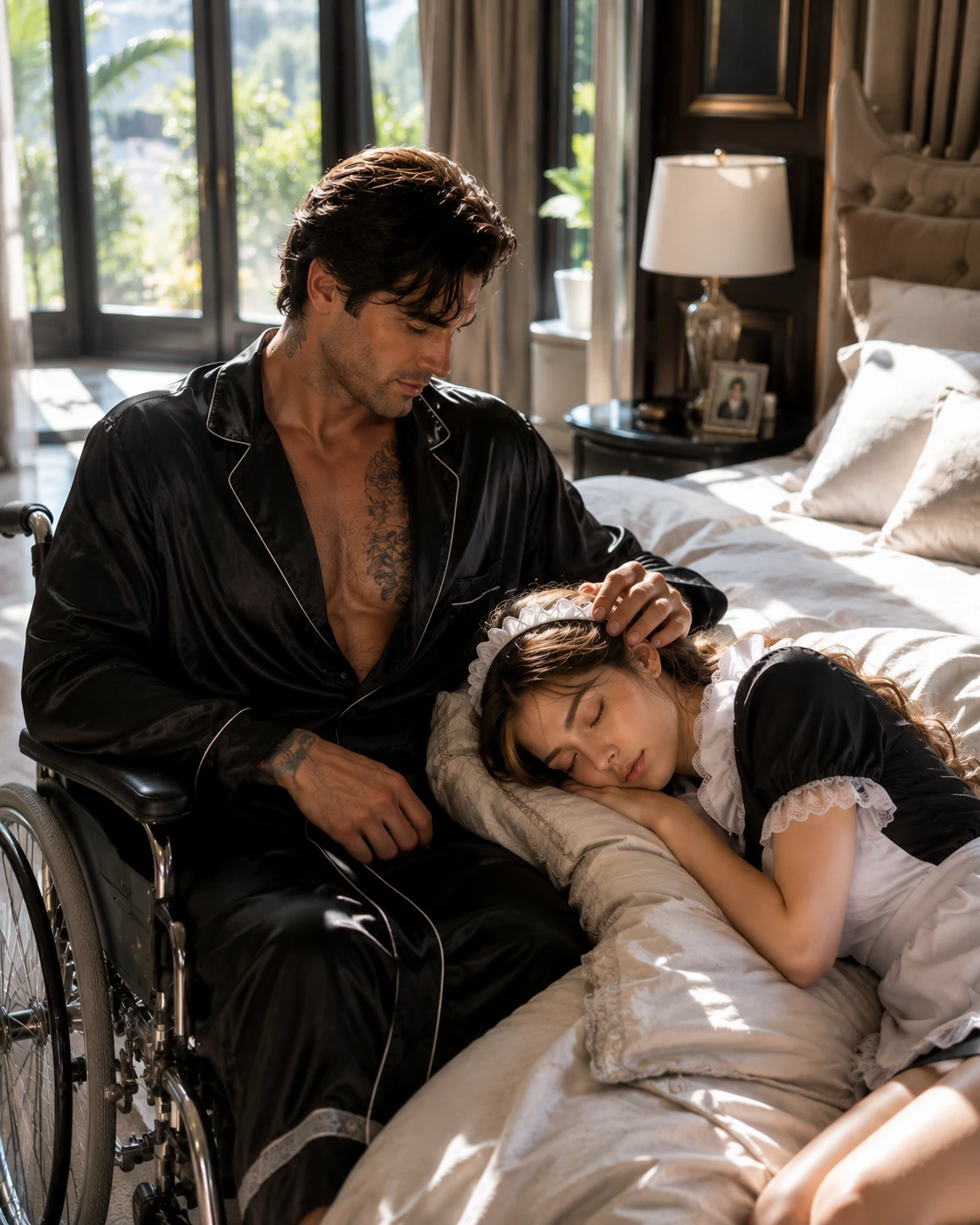
PART 3 Two years after a sniper’s bullet stole the use of my legs, everyone inside my estate had learned to fear me—nurses quit, therapists fled, and even armed men lowered their eyes when I entered a room. 3009
PART 3
The Woman Who Had Taught Me to Stand
I didn’t sleep.
Neither did Emma.
At four in the morning, we were still sitting in my study with the photograph between us.
The strange thing about memory is that it doesn’t always return as a story.
Sometimes it returns as fragments.
A smell.
A voice.
A room.
I remembered lemon furniture polish.
Rain against tall windows.
A woman standing over seventeen-year-old me while I complained that my ankle hurt.
Marianne Carter had not been my nurse.
Not officially.
My mother had hired her after surgery because I had refused to cooperate with the home therapist.
Apparently some things in a person changed less than he wanted to believe.
“She made terrible tea,” I said.
Emma looked up.
“What?”
“Your mother. She put too much milk in everything.”
Emma’s face slowly changed.
“She still does that.”
I laughed softly.
“She used to make me walk from the sunroom to the kitchen.”
“You had a broken ankle.”
“Reconstructed ankle. Car crash.”
“I never knew.”
“It wasn’t important.”
Emma looked pointedly at the wheelchair.
“I think maybe it is now.”
She was right.
Again.
I hated how frequently that happened.
I picked up the photograph.
“I was seventeen and furious because I’d missed the baseball season.”
“You played baseball?”
“Badly.”
“I don’t believe that.”
“I was excellent.”
“That’s more believable.”
I continued.
“Doctors said I’d recover completely, but I wasn’t patient. Your mother came three afternoons a week.”
Emma stared at the picture.
“She never talked about this.”
“She probably worked for dozens of families.”
“No.”
Her answer was immediate.
“My mother remembered people.”
The past tense hung between us.
Remembered.
That was the cruelty of her illness.
Every answer we wanted might still exist inside Marianne somewhere.
But memory had become a locked house with doors opening and closing unpredictably.
“Would seeing me upset her?” I asked.
Emma looked surprised.
“You want to see her?”
“If you want me to.”
She studied my face.
“Why?”
“Because she mattered to my mother.”
“And to you?”
I looked at the photograph again.
“I think more than I remembered.”
Emma nodded slowly.
“Then we can ask her.”
Two days later, I went to Lakeview Gardens.
I nearly changed my mind three times.
Not because I feared Marianne.
Because I hated facilities.
Hospitals.
Rehabilitation centers.
Anything with automatic doors and disinfectant.
Places where strangers asked whether I needed help.
Emma must have noticed.
She stood beside the van after Luke lowered the ramp.
“You don’t have to come.”
“I know.”
“We can leave.”
“I know.”
“You’re gripping the armrest hard enough to crack it.”
I looked at my hand and released it.
“Do you always narrate other people’s weaknesses?”
“Only yours.”
Luke coughed to hide laughter.
“Go away,” I told him.
He saluted and drove off.
Emma led me inside.
Lakeview Gardens was warmer than I expected.
Sunlight filled the common room.
Someone had placed fresh flowers near the windows.
An older man sat completing a puzzle with an aide.
Two women watched a cooking show.
Nothing about the place felt tragic.
That surprised me.
Marianne sat near a window knitting something blue.
She was fifty-eight but looked older.
Not fragile.
Just distant.
Emma approached first.
“Mom?”
Marianne looked up.
For a second, nothing happened.
Then she smiled.
“Emmy.”
Emma’s entire face softened.
“Hi, Mom.”
“You’re late for school.”
Emma paused.
“It’s Saturday.”
“Oh.”
Marianne accepted that.
Then she saw me.
Her knitting stopped.
I waited.
Marianne’s eyes narrowed.
“Daniel Moretti?”
My chest tightened.
Emma looked at me.
I couldn’t speak for a second.
“Yes, ma’am.”
Marianne stared at the wheelchair.
Her expression changed.
Not pity.
Recognition.
“Oh, Danny.”
Nobody had called me that in her voice in eighteen years.
She reached out.
Then stopped.
“May I?”
I nodded.
She touched my hand.
“What happened?”
“I got hurt.”
“You always did have poor judgment.”
Emma laughed unexpectedly.
I looked at her mother.
“You remember me?”
“Of course.”
Then Marianne frowned.
“Why are you seventeen?”
Emma’s smile faltered.
Marianne looked toward the window.
The door had closed again.
A moment later she returned to her knitting.
Emma sat beside her.
“We found a picture of you at the Moretti house.”
Marianne nodded vaguely.
“Lucia.”
My mother’s name.
I swallowed.
“You remember Lucia?”
Marianne smiled.
“Beautiful woman. Terrible gardener.”
Emma looked at me.
I almost laughed.
That was exactly right.
My mother had managed to kill a cactus.
“Mom,” Emma said carefully, “Lucia wrote something about you helping Danny.”
Marianne continued knitting.
“He didn’t like being helped.”
Emma’s eyebrows rose.
“No.”
I glared at her.
Marianne smiled faintly.
“He thought anger was strength.”
The words landed quietly.
Harder than shouting would have.
Emma’s eyes moved toward me.
“What did you tell him?”
Marianne’s hands slowed.
“That strength was getting up again.”
My throat tightened.
“But I can’t.”
She looked directly at me.
For one clear, startling moment, her eyes were completely present.
“Who said anything about walking?”
The room went still.
Marianne looked at my wheelchair.
Then back at me.
“Getting up isn’t always standing.”
I couldn’t answer.
A minute later, she asked Emma whether we wanted tea.
The moment was gone.
But the words remained.
I called Dr. Shaw the next morning.
He arrived at eleven.
I disliked him immediately.
He was cheerful.
“Mr. Moretti.”
“Danny.”
He smiled.
“Danny.”
He did not comment on the change.
Good.
We spent forty minutes discussing reality.
Not miracles.
Not inspirational speeches.
Reality.
My spinal injury was incomplete in some regions and complete in others.
The likelihood of meaningful independent walking remained extremely low.
Therapy would not change that.
What therapy might improve was everything I had ignored because it wasn’t walking.
Transfers.
Shoulder strength.
Circulation.
Pain management.
Endurance.
Sleep.
Independence.
“How quickly?” I asked.
Dr. Shaw shrugged.
“Depends.”
“On what?”
“Whether you throw anything at me.”
I looked toward Luke.
He had obviously been talking.
Emma, standing near the doorway with my schedule, covered a smile.
“I hate everyone in this house.”
“Excellent,” Dr. Shaw said. “Anger has energy. We’ll use it.”
My first session lasted twenty-three minutes.
I hated all twenty-three.
The second lasted thirty.
By the fourth week, I could transfer from the wheelchair to the therapy bench with minimal assistance.
That should not have mattered.
It mattered enormously.
One afternoon, after completing a transfer without anyone touching me, I sat breathing hard.
Dr. Shaw nodded.
“Again.”
I stared at him.
“You could say congratulations.”
“I could.”
“You’re choosing not to?”
“Yes.”
I smiled.
“Again.”
Emma watched from the doorway.
I pretended not to notice.
Life did not become beautiful because I started therapy.
I still woke angry.
Phantom pain still arrived without invitation.
I still had days when everything felt unfair.
The difference was that the bad days stopped being the only days.
Emma stopped working at the diner.
Not because I paid her debts.
She would never have accepted that.
Instead, after three months as my assistant, Mrs. Alvarez encouraged her to apply for an administrative position managing household staffing and vendor contracts across my legitimate properties.
Emma applied.
Human resources interviewed her without me present.
She got the job.
She negotiated again.
Of course she did.
“You’re terrifying,” I told her.
“You taught me.”
“That is slander.”
She smiled.
Something had changed between us too.
I noticed it in quiet ways.
The way she brought two coffees without asking.
The way I recognized her footsteps.
The way she stopped treating my wheelchair as either invisible or tragic.
One night, she found me outside on the terrace after everyone else had gone.
Chicago spread beneath us.
Lights.
Glass towers.
Traffic moving far below.
“Cold?” she asked.
“No.”
She wrapped a blanket around my shoulders anyway.
“I said no.”
“I heard you.”
“Then why?”
“Because you’re shivering.”
I looked up at her.
“Bossy.”
“Recovering tyrant.”
I laughed.
She leaned against the railing.
After a while, she said, “Mom remembered your mother today.”
“What did she say?”
“That Lucia used to hide chocolate in the laundry room because your father was dieting.”
“That sounds accurate.”
“She also said something strange.”
“What?”
“She said Lucia had left a box.”
I turned.
“A box?”
“She couldn’t remember where.”
“What kind?”
“She kept saying, ‘for the boys when they become men.’”
My stomach tightened.
“Boys.”
“You and Luke?”
“Probably.”
Emma looked at me.
“Was Luke raised with you?”
“Almost.”
His father worked security for mine. After Luke’s mother died, he spent more time at our house than his own.
“He was my brother in every way except paperwork.”
Emma considered that.
“Could the box still be at the old estate?”
“The house was sold twelve years ago.”
“Then probably not.”
I stared at the city.
Unless my mother hadn’t left it at the house.
Luke knew immediately.
I could tell from his face.
We were in my study the next morning.
“A box?” he repeated.
“Yes.”
“No idea.”
He was lying.
Luke was a terrible liar with people who knew him.
“Where is it?”
“I don’t know.”
“You know something.”
He stood.
“Danny.”
“What?”
“Leave it alone.”
That made me furious.
Not because of the box.
Because two years of isolation had made everyone around me accustomed to deciding what I could handle.
“I am done with people protecting me from my own life.”
Luke’s face tightened.
“This isn’t about your injury.”
“Then tell me.”
He walked to the window.
For a long time, he said nothing.
“My father gave me something after your mother died.”
“What?”
“A safe-deposit key.”
I stared.
“He said Lucia told him not to open the box until you were ready.”
“And when exactly was I going to be ready?”
Luke turned.
“When you wanted a future.”
The anger left me.
“What does that mean?”
“You didn’t want one, Danny.”
I looked away.
He continued quietly.
“After the shooting, you wouldn’t talk about anything beyond the next meeting. The next problem. The next person who disappointed you.”
His voice softened.
“I watched you turn this house into a bunker.”
I stared at my hands.
“So everyone decided to wait.”
“No. Your mother decided.”
“She’s been dead twelve years.”
“Yes.”
“Which makes this exceptionally irritating.”
Luke laughed.
That saved us.
“Where’s the key?”
“In my apartment.”
The box was held in a private bank vault downtown.
It took lawyers, signatures, and three days to access.
Emma did not come.
I asked if she wanted to.
She shook her head.
“Whatever your mother left belongs to you and Luke.”
That boundary mattered.
Luke and I entered together.
The box contained two folders and a letter.
No cash.
No jewels.
No hidden criminal ledger.
My mother would have laughed at our expectations.
The first folder contained deeds.
Not to buildings.
To a piece of land on the Wisconsin shore of Lake Michigan.
Forty acres.
A modest farmhouse.
Luke whistled.
“She owned this?”
“Apparently.”
The second folder contained incorporation papers for something called Lucia House Foundation.
I frowned.
Luke opened the letter.
It was addressed to both of us.
My mother’s words were simple.
Daniel and Luke,
If you are reading this, I hope you have finally become old enough to understand that power is only useful if it builds something that survives you.
The land is yours together.
I bought it because both of you were raised around men who believed leaving money behind was the same thing as leaving a legacy.
It isn’t.
Build something useful.
I don’t care what.
A school.
A retreat.
A place for families who need a week without being afraid of bills.
Just don’t turn it into another monument to yourselves.
And Daniel—one day something will happen that your anger cannot fix.
When that day comes, remember Marianne.
She understood that dignity sometimes begins with accepting help.
Love,
Mom
I read the final paragraph three times.
Luke sat quietly beside me.
Finally he said, “She knew you.”
“Apparently better than I did.”
That evening, I showed Emma the papers.
Not because she had a claim to them.
Because her mother was part of why they mattered.
She read slowly.
Then looked up.
“What are you going to build?”
“I don’t know.”
“You always know.”
“That’s the problem.”
She smiled.
“You could ask people.”
“I have people.”
“No. You have employees.”
That annoyed me because it was true.
“So what would you build?”
She thought.
“My mother used to say families caring for someone sick rarely get to rest.”
I listened.
“Maybe somewhere caregivers could stay for a few days. Accessible rooms. Medical support nearby. No hospital feeling.”
Luke, who had been pretending not to listen, turned.
Emma continued.
“A place where someone with Alzheimer’s could spend a safe weekend with trained staff while their daughter sleeps eight hours without feeling guilty.”
Her voice had gone quiet.
I looked at her.
“That sounds useful.”
“It would be expensive.”
I almost smiled.
“For once, that’s not the limiting factor.”
She laughed.
Luke leaned forward.
“We could combine that with accessible rehabilitation retreats.”
Emma nodded.
“For people adjusting after injuries.”
The three of us looked at one another.
And there it was.
Not redemption.
Not some grand transformation.
An idea.
A beginning.
Six months later, construction started.
We called it Lucia House.
Not Moretti House.
Not Daniel Moretti Rehabilitation Center.
My mother would have haunted me for that.
Emma’s mother had a clear day when we brought her the architectural drawings.
Marianne studied them carefully.
Then looked at me.
“You listened.”
“I eventually do.”
“Slow learner.”
Emma laughed.
I smiled.
“Yes, ma’am.”
Marianne reached for Emma’s hand.
“You did good, Emmy.”
Emma looked down quickly.
I knew she was trying not to cry.
Marianne touched her cheek.
“You always were my brave girl.”
For that afternoon, memory gave her daughter back almost everything.
Not permanently.
We knew better than to ask for that.
But enough.
Sometimes enough is a miracle all by itself.
The following spring, my legitimate companies had become the center of my working life.
The underground operations were smaller.
Then smaller again.
I sold businesses that could be sold.
Closed others.
Moved people into legal employment when possible.
Luke handled the difficult conversations.
Nobody celebrated.
There was no dramatic announcement.
I simply became tired of owning a world that required me to remain the worst version of myself.
One night, Emma brought me a contract.
Then didn’t leave.
“What?”
She sat opposite me.
“I got another job offer.”
My stomach tightened unexpectedly.
“Where?”
“Lakeview Gardens.”
I stared.
“They want me to help coordinate family services.”
“That makes sense.”
“It’s less money.”
“I can increase—”
She held up a finger.
“Don’t.”
I stopped.
“I think I want it.”
Then something surprising happened.
I realized I wanted her to take it.
Not because I wanted her gone.
Because she wanted a life that belonged to her.
“When do you start?”
Her expression softened.
“Three weeks.”
I nodded.
“Then you should take it.”
“You’re not going to make this difficult?”
“I make everything difficult.”
“True.”
“But not this.”
She smiled.
“Thank you.”
Emma stood.
At the door, she stopped.
“Danny?”
“Yes?”
“I’m still coming to Lucia House meetings.”
“Obviously.”
“And Mrs. Alvarez says you still need someone to prevent your calendar from becoming criminal.”
“Also obviously.”
She smiled again.
Then left.
I sat alone in the study.
Strangely, I wasn’t afraid.
Because losing control was beginning to feel different from losing people.
Sometimes letting someone choose their own road was how you kept them in your life honestly.
Three weeks later, Emma left my employment.
And for the first time, I realized that whatever existed between us could finally become a choice neither money nor obligation had created.
The thought terrified me far more than any armed man ever had.
THE END