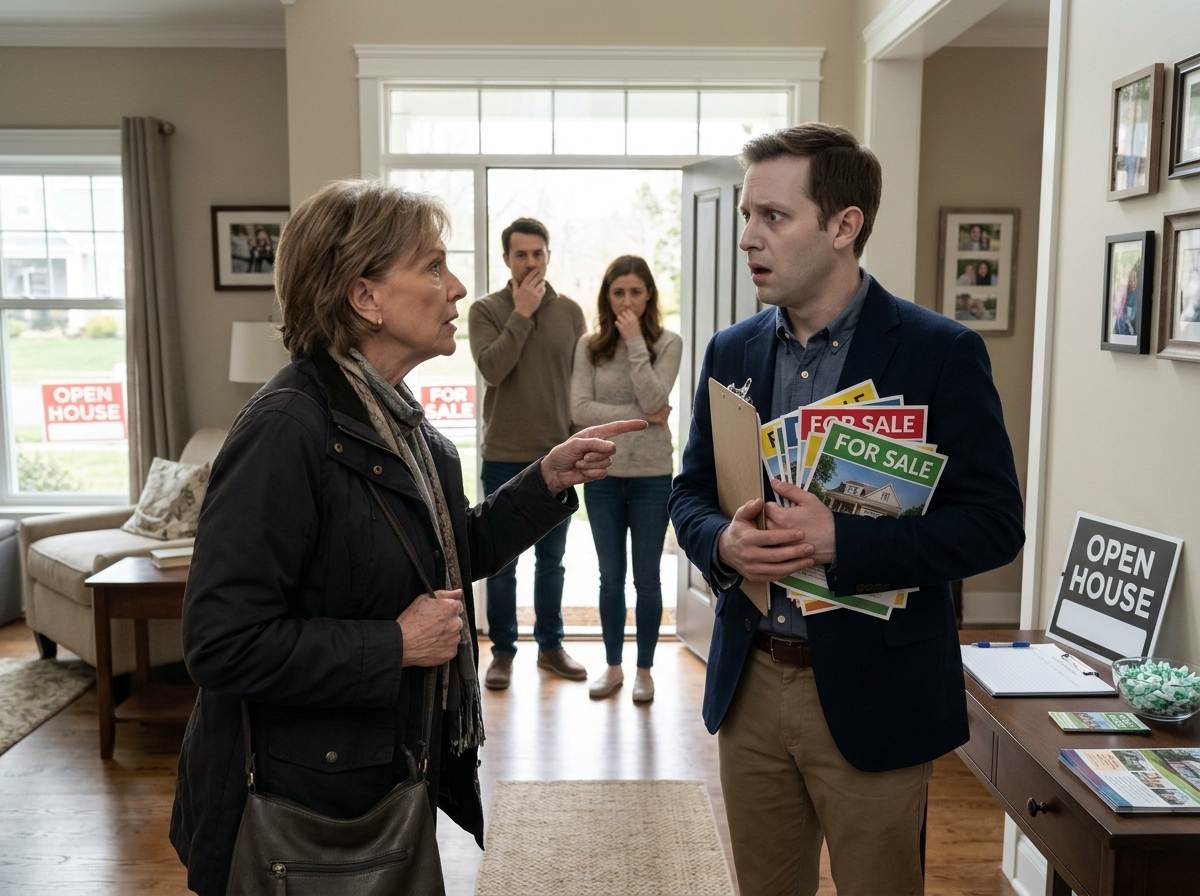
My children listed my house for sale while I was visiting my sister, and held an open house with a realtor and a cheese platter.
I came home to strangers walking through my bedroom.
My son said, “Mom, it’s done. We accepted an offer this morning.”
I set down my suitcase and asked one question.
“Did anyone check who holds the mortgage?”
My husband, Frank, died in 2021.
We had lived peacefully in the house on Birch Lane for forty-three years.
I knew exactly which floorboard creaked outside the bathroom. I knew which window stuck tightly in July and which kitchen cabinet needed a little lift before it would close properly. I knew the precise spot in the garden where the afternoon sun always reached the roses.
I had planted every single rosebush myself.
Frank built the wooden fence around them with his own hands. He had painted the porch twice, repaired the roof three times, and spent an entire summer building the fireplace that now stood in our living room.
That house wasn’t simply a property.
It was where we brought our children home from the hospital. It was where Paul learned to ride a bicycle in the driveway. It was where Denise had her first birthday party, where Frank proposed to me again on our twentieth anniversary, and where we buried our beloved old dog beneath the maple tree.
It was where we had built our entire life.
After Frank died, the house became quieter.
Too quiet, sometimes.
But I wasn’t unhappy there.
I had my garden. I had my neighbors. I had my weekly coffee with two women from church. I had my sister, Carol, who called me almost every evening.
And I had my children.
Or at least, I thought I did.
My son, Paul, and my daughter, Denise, had become increasingly concerned about me after their father’s funeral.
At first, I appreciated it.
They called more often. They brought groceries. Paul offered to inspect the roof. Denise suggested hiring someone to clean the gutters.
But slowly, their concern began to change.
They stopped asking what I wanted and started explaining what I needed.
They stopped saying, “Mom, are you happy?”
They started saying, “Mom, you really shouldn’t be doing this at your age.”
If I mentioned that I had spent the afternoon trimming the roses, Denise would shake her head.
“If you fall, who is going to find you?”
If I told Paul that I planned to drive to the grocery store, he would insist on taking me.
“Those roads are getting dangerous, Mom.”
If I mentioned that the upstairs bathroom needed repainting, they would exchange a look.
“Why spend money fixing things you don’t need anymore?”
I noticed the pattern.
They never said the house was worth six hundred thousand dollars.
They simply called it too big.
They never said they wanted the property.
They simply said they were worried about my future.
And every conversation eventually ended with the same suggestion.
“Mom, you should consider independent living.”
They had already chosen the place.
Meadowbrook.
It was a beautiful retirement community about twenty minutes from Birch Lane. It had a heated swimming pool, a restaurant, a fitness room, organized activities, and a lovely landscaped courtyard.
Denise showed me photographs on her phone.
“Look at this, Mom. They have a library.”
“I have a library,” I replied, pointing toward the bookshelves in our living room.
“They have a dining room where you don’t have to cook.”
“I like cooking.”
“They have people your own age.”
“I have friends.”
“Mom, you’re making this difficult.”
I didn’t answer.
I knew that tone.
It was the tone Denise used whenever I refused to agree with something she had already decided.
Paul was more subtle.
He would sit at my kitchen table and speak in a reasonable voice.
“Think about the maintenance, Mom. The taxes. The insurance. The roof. The plumbing. You can’t keep doing everything yourself.”
“I haven’t asked you to do everything.”
“That’s not the point.”
“Then what is the point?”
He would look toward the window.
“Nothing. We’re just thinking ahead.”
I should have recognized that they weren’t thinking about my future.
They were thinking about the house.
But I didn’t want to believe that.
They were my children.
I had spent my entire life believing that love meant giving people the benefit of the doubt.
Unfortunately, sometimes people use that kindness as an opportunity.
And I was about to discover just how far my children had gone.
The Trip That Changed Everything
In October, I decided to visit Carol in Tucson.
She had been asking me for months.
“You need a change of scenery,” she told me over the phone. “Come out here for two weeks. We’ll sit in the sunshine, eat too much, and complain about our husbands.”
“Your husband is still alive.”
“Exactly. I have more material.”
I laughed.
For the first time in a long while, I felt excited about something.
Paul offered to drive me to the airport.
He arrived early that morning carrying my suitcase.
“Two whole weeks, Mom. You’re going to have a wonderful time.”
“That’s the plan.”
He placed the suitcase in the trunk and checked the back seat.
“Do you have your medication?”
“Yes.”
“Your phone charger?”
“Yes.”
“Your travel documents?”
“Paul, I’ve been traveling since before you learned to tie your shoes.”
He laughed.
“Just checking.”
At the airport, he hugged me.
Then he said something I would remember for the rest of my life.
“Don’t worry about anything at home, Mom. We’ve got it.”
I thought he meant the garden.
Maybe the mail.
Perhaps the leaking gutter I had mentioned a week earlier.
“Thank you, sweetheart.”
He kissed my cheek.
“Enjoy yourself.”
I walked into the terminal without a second thought.
During the first few days in Tucson, Carol and I did everything we had planned.
We visited a botanical garden, ate lunch at a little restaurant overlooking the mountains, and spent hours talking about our childhood.
I told her about the roses.
She told me about a neighbor who had accidentally painted his front door purple.
We laughed until our stomachs hurt.
But something strange happened during the second week.
I called Paul to ask whether the mail had been collected.
He didn’t answer.
I called Denise.
She answered immediately.
“Hi, Mom!”
“Is everything all right at home?”
“Of course. Why?”
“Paul hasn’t returned my call.”
“Oh, he’s busy. Don’t worry.”
“What is he doing?”
There was a pause.
“Just helping with a few things.”
“What things?”
“House stuff, Mom. Nothing you need to worry about.”
I looked at Carol.
She raised an eyebrow.
“Denise,” I said, “what exactly are you doing with my house?”
“Nothing! We’re just making sure everything is taken care of.”
Her voice was cheerful.
Too cheerful.
I decided not to push.
I was visiting my sister. I didn’t want to spend the entire vacation arguing with my children.
I returned to the sunshine and the conversation.
But two days later, I received a notification on my phone.
It was an email from a neighborhood property alert service.
A new listing had appeared on Birch Lane.
I opened it.
At first, I thought I had clicked the wrong address.
Then I saw the photograph.
My house.
My front porch.
My roses.
A bright red-and-white sign stood in the yard.
FOR SALE — OPEN HOUSE SATURDAY.
The asking price was $629,000.
I stared at the screen.
Then I zoomed in.
The listing description read:
Beautiful, well-maintained family home. Four bedrooms, three bathrooms, mature landscaping, spacious backyard, and excellent potential for modern renovation. Owner relocating to a more suitable living arrangement.
Owner relocating.
I read those words several times.
I had never agreed to relocate.
I had never agreed to sell.
I had never even spoken to a realtor.
My hands began to shake.
I called Paul.
No answer.
I called Denise.
She declined the call.
I tried again.
This time, she sent a text.
Mom, we’re handling everything. We’ll explain when you get home. Please enjoy your trip.
I read the message twice.
Then I showed it to Carol.
She put down her coffee.
“Are you telling me your children listed your house without asking you?”
“That’s what it looks like.”
“Then get on the phone with an attorney.”
“I don’t want to overreact.”
Carol looked at me for several seconds.
“Sweetheart, somebody has put a price tag on your bedroom while you’re sitting here drinking coffee with me. I don’t think you’re the one overreacting.”
She was right.
But I still wanted to believe there was some explanation.
I called my attorney’s office.
Helen Brooks had handled Frank’s estate. I explained what I had discovered.
She asked me one question.
“Did you sign anything authorizing the sale?”
“No.”
“Did you give either child financial power of attorney?”
“I gave them medical power of attorney after I fell in 2022.”
“Do you have a copy?”
“Yes.”
“Bring it to me when you return. In the meantime, don’t sign anything and don’t authorize anyone to act on your behalf.”
I thanked her.
Then I sat quietly beside Carol.
For the first time in forty-three years, I was afraid to go home.
The Open House
My flight landed on Saturday morning.
I could have called Paul and demanded an explanation.
I could have called Denise and told her to stop everything.
Instead, I decided to see what was happening for myself.
I rented a car and drove home.
The closer I got to Birch Lane, the tighter my stomach became.
When I turned onto our street, I saw several unfamiliar vehicles.
A white SUV.
A black sedan.
A silver pickup truck.
And then I saw the sign.
It was planted directly beside the rosebushes.
A massive red-and-white real estate sign.
My stomach dropped.
The front door was wide open.
A group of strangers stood on my porch.
One woman held a paper cup of coffee.
A man was looking through the front window.
I parked at the curb and stepped out.
My suitcase felt heavier than it had at the airport.
I walked up the path.
Nobody stopped me.
Nobody asked who I was.
Inside, the house smelled like fresh coffee, furniture polish, and something sweet.
There was a cheese platter on my dining table.
My dining table.
A professional-looking woman in a navy blazer stood beside it, handing brochures to a couple.
“Notice the original hardwood floors,” she was saying. “And the ceiling height is excellent.”
A young man was standing near the living room wall, tapping it with his knuckles.
“Is this load-bearing?”
I looked toward the hallway.
Someone was opening my bedroom closet.
I could hear the sliding door.
A woman’s voice followed.
“The master bedroom is bigger than I expected.”
I stood completely still.
For a full minute, nobody noticed me.
Then Paul emerged from the kitchen carrying a glass of red wine.
He looked at me.
His smile disappeared.
“Mom.”
I looked at him.
“Paul.”
He glanced at my suitcase.
“You’re early.”
“Why is there a stranger in my bedroom?”
He took a breath.
“Mom, let’s not do this here.”
Denise appeared behind him.
She wore a cream-colored sweater and the expression she always used when she believed she was being reasonable.
“Mom, let’s go talk quietly in the kitchen.”
“We can talk right here.”
The young couple stopped examining the wall.
The realtor lowered her brochures.
Paul set his wine glass on the mantel.
“Okay. Mom. It’s officially done.”
I stared at him.
“What is done?”
“We listed the house two weeks ago. We received six offers. We accepted one early this morning.”
My mouth went dry.
“You accepted an offer on my house?”
“Our house, Mom. It’s a family asset.”
I looked at Denise.
She nodded as if this were the most obvious thing in the world.
“We found you a wonderful place at Meadowbrook. You’ll have everything you need.”
“I don’t want Meadowbrook.”
“Mom, just listen.”
“I am listening. I’m trying to understand why there are strangers in my bedroom.”
Paul became irritated.
“Because we have a buyer. We needed to make the house available for viewing.”
“You needed to make my house available?”
“Yes.”
“Without telling me?”
He sighed.
“Mom, you gave us power of attorney.”
I slowly placed my suitcase on the floor.
“Which power of attorney?”
He frowned.
“What do you mean?”
“The one I signed in the hospital?”
“Yes.”
“The one for medical decisions?”
Denise gave an impatient little laugh.
“Mom, don’t get caught up in technicalities.”
I turned toward her.
“Technicalities?”
She folded her arms.
“We’re trying to make things easier for you.”
I looked around.
At the strangers.
At the brochures.
At the cheese platter.
At the realtor who was now standing very still.
Then I asked one question.
“Did absolutely anyone check who holds the mortgage?”
Paul frowned.
“There’s no mortgage. Dad paid the house off in 2009.”
“You’ve seen the old papers.”
Denise laughed.
“What are you talking about?”
“In 2022, after your father died, I took out a new mortgage on this house.”
Paul’s expression changed.
“Why?”
“That’s between me and the lender.”
“How much?”
“Four hundred and twenty thousand dollars.”
Denise grabbed the edge of the dining table.
“Mom!”
I continued.
“And here’s the part you’ll want to sit down for. The lender isn’t a bank.”
Paul looked toward the realtor.
“Then who is it?”
I turned toward the young couple.
“You’ll want to hear this too, because the people who legally hold the note on this house are standing in this room.”
The young woman stepped forward.
“My name is Laura Reed.”
Her husband followed.
“Michael Reed.”
I smiled.
“These are the people who loaned me the money.”
Paul stared.
Denise’s face went completely white.
And the realtor slowly put down the brochures.
The People My Children Had Never Bothered to Know
Michael and Laura weren’t strangers to me.
They had been friends of Frank and mine for nearly a decade.
We first met them through our church.
Michael had worked in construction for years. Laura was a nurse. They had two children and a modest house on the other side of town.
Then Michael had a terrible accident at a construction site.
He spent months recovering.
His insurance company disputed part of his claim, and the family began falling behind on their mortgage.
Frank and I helped them.
We paid for some immediate expenses and arranged a temporary loan so they could avoid losing their home.
They eventually recovered financially and repaid us.
But the experience changed them.
They began investing in property and helping people who needed private financing.
After Frank died, I found myself facing a mountain of expenses.
There were medical bills, estate costs, property taxes, and repairs that couldn’t wait.
I could have sold the house.
But I didn’t want to.
I could have asked Paul and Denise for help.
But I didn’t want to turn my children into the people responsible for my financial decisions.
Instead, I contacted Michael and Laura.
We arranged a private mortgage secured against the property.
The original loan was $420,000.
I used the money carefully.
A portion paid the remaining medical and estate expenses.
Another portion renovated the old cottage behind the garage.
The rest became the starting capital for a small property management business I established with Carol.
It was a business I had researched for months.
I had spent years managing our own rental property before Frank became ill. I understood maintenance, tenant agreements, insurance, and property expenses.
Carol had experience with bookkeeping.
Together, we built something small but successful.
The company eventually managed several furnished rental properties.
It wasn’t a fortune.
But it was profitable.
And, more importantly, it gave me something to wake up for every morning.
I had a reason to work.
A reason to learn.
A reason to plan.
I wasn’t simply waiting for old age to happen.
When I finished explaining, Paul shook his head.
“You borrowed four hundred and twenty thousand dollars from them?”
“Yes.”
“Against this house?”
“Yes.”
“Without telling us?”
I looked directly at him.
“Why would I need to tell you?”
He opened his mouth.
Then closed it.
Michael placed a document on the dining table.
“This is the recorded mortgage. The current outstanding balance is $386,000.”
The realtor picked it up.
She examined the recording information and looked increasingly uncomfortable.
“Mr. Thompson,” she said, “did you disclose this mortgage when you submitted the property information?”
Paul didn’t answer.
Denise stepped forward.
“We didn’t know about it.”
The realtor looked at me.
“Mrs. Thompson, are you the legal owner?”
“Yes.”
“Did you authorize this listing?”
“No.”
“Did you sign the listing agreement?”
“No.”
“Did you authorize your children to accept an offer?”
“No.”
The realtor closed her folder.
“Then we have a serious problem.”
Paul immediately became defensive.
“Wait. We have an accepted offer. The buyer can pay the mortgage at closing.”
Michael shook his head.
“That isn’t the only problem.”
Paul turned toward him.
“What do you mean?”
“Your mother is the property owner. The mortgage is secured against her property. You cannot simply arrange a sale because you believe you have permission.”
The realtor nodded.
“I’ll need to contact my managing broker and legal department. The open house is over.”
Paul looked furious.
“You’re going to cancel everything?”
The realtor gave him a hard look.
“I am not going to continue marketing a property when the legal owner says she never authorized the sale.”
She began collecting the brochures.
The young couple quietly moved away from the wall.
Laura approached me.
“Are you all right?”
I nodded.
“Now I am.”
What Was Really Behind the Sale
After the realtor left, Paul and Denise remained.
I asked Michael and Laura to stay.
They agreed.
I wanted witnesses.
Paul sat down.
“Mom, this is getting blown completely out of proportion.”
“Is it?”
“We thought we were doing what was best.”
“Then explain the offer.”
He rubbed his forehead.
“The buyer offered $610,000.”
“How much?”
“Six hundred and ten thousand.”
“And what were you planning to do with the money?”
“Pay off the mortgage, cover the selling costs, and put the remaining amount toward your new residence.”
I stared at him.
“How much were you planning to put toward Meadowbrook?”
Denise answered.
“Enough for a comfortable arrangement.”
“How much?”
She looked at Paul.
He said nothing.
I repeated the question.
“How much of my money were you planning to put toward my new residence?”
Paul finally spoke.
“That would depend on the final costs.”
I nodded.
“So you arranged to sell my house, accepted an offer, and chose where I would live, but you never worked out exactly how much money I would receive?”
“We were going to figure that out.”
“After the sale?”
“Yes.”
I looked at Denise.
“Did you already choose my apartment?”
She nodded reluctantly.
“We found a two-bedroom unit.”
“Two bedrooms?”
“Yes.”
“Why?”
“One for you and one for guests.”
I looked at her.
“That’s generous.”
She frowned.
“What?”
“Nothing. I just find it interesting that you were willing to spend my money on a two-bedroom apartment without asking whether I wanted to move.”
Paul leaned forward.
“Mom, you need to understand that the house is worth a lot of money. It doesn’t make sense to keep it.”
“To whom?”
“To you!”
“Why?”
“Because you’re alone!”
The words came out louder than he intended.
Silence followed.
I looked at him.
“Your father is gone, Paul. I know that. I wake up in this house every morning without him. I sit at the table where he used to drink his coffee. I walk past his empty chair. I know exactly what it means to be alone.”
My voice began to shake.
“But I am not helpless.”
Paul looked away.
“I never said you were.”
“You didn’t have to. You behaved as though I was.”
Denise began crying.
“Mom, we just didn’t want you to get hurt.”
I looked at her.
“Then why did you hurt me?”
She covered her face.
For several seconds, nobody spoke.
Then Michael cleared his throat.
“There’s something else you should probably know.”
I turned toward him.
He looked uncomfortable.
“We received a call about two weeks ago.”
“From whom?”
“Your son.”
Paul sat up sharply.
“Michael.”
Michael continued.
“He asked whether we would consider releasing the mortgage early if the house sold.”
I turned toward Paul.
“You called them?”
He nodded.
“I was trying to understand the financial situation.”
Michael looked at him.
“You didn’t ask about the financial situation. You asked whether we would release the mortgage for less than the outstanding balance.”
Denise looked confused.
“What does that mean?”
Michael answered.
“He suggested we accept $250,000 at closing as full settlement.”
I stared at my son.
“Two hundred and fifty thousand?”
Paul’s face reddened.
“It was just a proposal.”
“The outstanding balance is $386,000.”
“I thought they might negotiate.”
Michael shook his head.
“We never agreed to that.”
I looked at Paul.
“Why would you offer someone else’s money to settle my debt?”
He didn’t answer.
And that was when I began to understand that the situation was worse than I had initially thought.
My children hadn’t simply decided to sell my house.
They had already begun negotiating with the people who held my mortgage.
Without me.
The Paperwork That Exposed Everything
On Monday morning, I met with Helen Brooks.
I brought every document I could find.
The original medical power of attorney.
The mortgage agreement.
The property records.
The listing information.
The offer summary.
And the messages Denise had sent me while I was in Tucson.
Helen read everything carefully.
Then she removed her glasses.
“Your children had no authority to sell the property under this medical power of attorney.”
“That’s what I thought.”
“It only allows them to make certain medical decisions if you are unable to do so. It does not authorize them to sell real estate or manage your finances.”
“Could they have misunderstood?”
Helen looked at me.
“Perhaps. But their misunderstanding does not automatically give them legal authority.”
She made several copies.
“We need to notify the brokerage in writing that you never authorized the listing. We should also document the attempted transaction and contact the buyer’s representative.”
“Can the buyer force me to sell?”
“That will depend on the specific documents and applicable law, but based on what you’ve shown me, your children do not appear to have had authority to enter into a binding sale on your behalf. We’ll take the appropriate steps to protect your ownership.”
I nodded.
Then Helen asked another question.
“Do you trust Paul and Denise with your financial decisions?”
I sat quietly.
I thought about the hospital.
The fall.
The clipboard.
The way Paul had told me not to worry.
The way Denise had smiled and said everything was for my own good.
“No,” I answered.
Helen nodded.
“Then we should review your estate plan and your powers of attorney.”
I agreed.
We prepared a new financial power of attorney with clear limits and safeguards.
I also appointed Carol as my primary medical decision-maker.
Paul and Denise could remain emergency contacts, but they would no longer have authority to make decisions on my behalf.
Helen reviewed my will, my property records, and the business documents.
She also recommended that I establish a clear process for future decisions involving my property.
I wanted everything documented.
No more assumptions.
No more vague conversations.
No more signatures on hospital clipboards without a proper explanation.
Before I left, Helen handed me a business card.
“One more thing.”
“What?”
“If either child contacts a realtor, lender, or buyer again claiming to represent you, I want you to notify me immediately.”
I slipped the card into my handbag.
“I will.”
As I walked out of her office, I felt something I hadn’t felt in a long time.
Relief.
Not because the problem was over.
Because I finally had a plan.
The Buyer Came Back
Three days later, Helen received a call from the buyer’s attorney.
The couple, whose names were Michael and Laura Reed’s friends? No. The prospective buyers were a different couple: James and Olivia Parker.
They had made the offer after seeing the listing online.
They had already arranged inspections and started discussing financing.
They were understandably upset.
They had been told the property was being sold by the owner’s authorized representatives.
They had no idea I hadn’t agreed.
Helen arranged a meeting.
I attended with her.
James and Olivia were polite, but clearly frustrated.
Olivia spoke first.
“We’re sorry this happened. We genuinely thought everything was legitimate.”
“I understand,” I said.
“We’ve been looking for a house for almost a year. When we saw this one, we fell in love with it.”
I looked at her.
“I can understand why. It’s a lovely house.”
James leaned forward.
“We were told the owner was moving into assisted living and that her children were handling the sale.”
I nodded.
“That was not true.”
Olivia looked down.
“We’re very sorry.”
I believed her.
They weren’t the people who had betrayed me.
They were simply caught in the middle.
Helen explained the ownership situation and the mortgage.
James asked whether there was any possibility I would reconsider selling.
I looked at the couple.
They seemed sincere.
But I thought of Frank.
I thought of the roses.
I thought of the years I had spent building a life inside those walls.
“No,” I said gently. “I’m not ready to sell.”
Olivia nodded.
“I understand.”
Before leaving, she surprised me.
“Your house is beautiful. I hope you get to enjoy it for many more years.”
I smiled.
“Thank you.”
That afternoon, the offer was formally withdrawn.
The brokerage removed the listing.
And the house was mine again.
It had never legally stopped being mine.
But this time, I understood how important it was to protect that fact.
The Family Meeting
I called Paul and Denise the following Sunday.
I told them I wanted them both at the house at two o’clock.
They arrived together.
Paul looked irritated.
Denise looked nervous.
I had already placed several documents on the dining table.
“What’s all this?” Paul asked.
“Something we should have discussed a long time ago.”
I waited until they sat down.
Then I explained what Helen had discovered.
I showed them the medical power of attorney.
I showed them the new documents.
I showed them the formal notice sent to the brokerage.
I also showed them a copy of the mortgage statement.
Paul picked it up.
“Why are you showing us this?”
“Because I want you to understand that I have everything under control.”
Denise looked at the balance.
“Three hundred and eighty-six thousand dollars.”
“That’s correct.”
“How are you paying it?”
“Through the income from my business and my other investments.”
“Is the business doing well?”
“Yes.”
Paul shook his head.
“Why didn’t you tell us about this?”
I folded my hands.
“Because you never asked about my business. You only asked when I planned to sell my house.”
Denise looked embarrassed.
“That’s not fair.”
“Isn’t it?”
I leaned back.
“When was the last time either of you asked me what I was working on? What I wanted to learn? What I planned to do next year?”
Neither answered.
“When was the last time you visited simply to spend time with me, without discussing the property?”
Paul looked at the table.
I continued.
“I have spent my entire life being your mother. I packed your lunches, attended your school events, sat beside your beds when you were sick, and helped you through every difficult moment I could.”
My voice softened.
“I never expected repayment. That’s not why parents love their children.”
I paused.
“But I did expect respect.”
Denise began crying.
“Mom, I’m sorry.”
Paul rubbed his forehead.
“We thought we were making a sensible decision.”
“You made a decision about my life without involving me.”
“We thought you’d eventually agree.”
“Then why didn’t you ask?”
He had no answer.
I slid another document across the table.
“This is the new arrangement.”
They both looked at it.
It was a written notice explaining that neither child was authorized to represent me in financial or property matters.
Paul read it twice.
“You’re making this official?”
“Yes.”
“Against your own children?”
“Because you’re my children, I hoped I wouldn’t need to.”
Denise covered her mouth.
I looked at both of them.
“I love you. But love doesn’t mean giving up my rights.”
The Conversation I Had Never Expected
Paul stayed behind after Denise left.
He stood in the kitchen while I washed the coffee cups.
“Mom?”
“Yes?”
“Can I ask you something?”
“Of course.”
“Did you ever think we were trying to take the house for ourselves?”
I put the cup down.
“At first, no.”
“And now?”
I looked at him.
“Now I think you were so convinced you knew what was best that you stopped considering what I wanted.”
He nodded slowly.
“That’s fair.”
I turned toward him.
“Paul, I need you to answer something honestly.”
“Okay.”
“Why did you really want the house sold so quickly?”
He looked uncomfortable.
“Because the market was good.”
“That isn’t an answer.”
He stared at the floor.
Then he finally spoke.
“Denise and I have been worried about money.”
I remained silent.
He continued.
“We both have expenses. Her husband has been having trouble with his business. I’ve had some financial setbacks of my own.”
I felt my stomach tighten.
“What kind of setbacks?”
He hesitated.
“Credit cards. A business loan. Some investments that didn’t work out.”
I slowly sat down.
“How much money are we talking about?”
He didn’t answer.
“Paul.”
“About eighty thousand dollars.”
I stared at him.
“And Denise?”
He rubbed his face.
“She has some debts too.”
“How much?”
“I don’t know exactly.”
I looked at him for a long moment.
Then I asked the question that had been sitting in my mind since the open house.
“Were you planning to use the money from my house to help yourselves?”
He looked up quickly.
“No! Not directly.”
“Not directly?”
He swallowed.
“We thought that after the sale, you could move somewhere cheaper. There would be money left over. We could help you manage it.”
“Who would manage it?”
He didn’t answer.
“Who would control the remaining money, Paul?”
He looked away.
I felt something inside me break.
Not because of the money.
Because I finally understood.
They hadn’t simply decided that my house was too large.
They had begun imagining what they could do with the money once it was sold.
“Did you discuss dividing any of it?”
Paul looked horrified.
“No, Mom.”
“Did you discuss borrowing from it?”
He remained silent.
That silence told me enough.
I closed my eyes.
For a moment, I could almost hear Frank’s voice.
Don’t let people make decisions for you just because they’re louder.
When I opened my eyes, Paul was still sitting there.
“I should have asked you,” he said.
“Yes.”
“I should never have arranged the listing.”
“No.”
“I thought we were helping.”
I shook my head.
“You were helping yourselves feel comfortable with a decision I never made.”
He looked down.
Then, for the first time that afternoon, he cried.
Not loudly.
Just a few tears that he quickly wiped away.
“I’m sorry, Mom.”
I didn’t rush to comfort him.
I let the apology sit between us.
“Then start by being honest,” I said. “If you need help, tell me. But don’t try to solve your financial problems with my property.”
He nodded.
“I understand.”
I hoped he did.
The House Became Something More
Over the next few months, things slowly returned to normal.
The real estate sign disappeared.
The open house brochures were gone.
I replaced the lock on the back door because one of the visitors had accidentally damaged the handle.
I also installed a small security system.
Helen recommended it.
I didn’t want to live in fear.
I simply wanted to know who was coming and going.
Meanwhile, the business continued to grow.
Carol visited twice.
We reviewed our accounts, met with our accountant, and discussed expanding into another furnished rental property.
Michael and Laura helped us find a contractor for the cottage renovation.
The little building behind my garage had been used for storage for years.
Frank had once planned to turn it into a workshop.
He never got the chance.
I decided to give it a different purpose.
We renovated the cottage into a temporary guest house for older women who needed a safe place to stay after losing a spouse or experiencing a sudden housing problem.
It had one bedroom, a small kitchen, a bathroom with a walk-in shower, and a comfortable sitting room.
I called it Frank’s Place.
When Carol first saw the finished cottage, she cried.
“Frank would have loved this.”
I nodded.
“He would have complained about the paint color first.”
She laughed.
“He would have.”
The first guest was a sixty-eight-year-old widow named Margaret.
She had sold her home after her husband died and moved in with her daughter.
Unfortunately, the arrangement became difficult.
Her daughter and son-in-law argued constantly, and Margaret felt as though she was taking up too much space.
When she arrived at Frank’s Place, she stood in the doorway holding a small suitcase.
“Are you sure I can stay here?”
I smiled.
“That’s why we built it.”
She looked around.
“It’s beautiful.”
“Make yourself comfortable.”
She sat in the little living room and looked out at the garden.
Then she began to cry.
I brought her a cup of tea.
“What’s wrong?”
She shook her head.
“Nothing. I just haven’t had a place that felt like mine in a long time.”
I sat beside her.
“Then let’s make this feel like yours for a while.”
That evening, I stood in the doorway of the cottage and looked at the warm light coming through the window.
I thought about the day my children had filled my house with strangers.
They had treated it like an asset.
A number.
A transaction.
But now the property was helping someone.
And that felt more valuable than anything they could have sold it for.
The Apology That Finally Meant Something
Denise was the first to change.
She began calling without mentioning Meadowbrook.
She visited on Sunday afternoons.
Sometimes she brought groceries.
Sometimes she brought nothing at all.
One afternoon, she arrived with a paper bag.
“I brought your favorite muffins.”
I opened the door.
“Thank you.”
She stepped inside and looked around.
“Everything looks different.”
“I cleaned.”
She smiled.
“That’s not what I meant.”
We sat in the kitchen.
For a while, we talked about ordinary things.
Her daughter’s school.
A neighbor’s new dog.
The weather.
Then she became quiet.
“Mom, can I ask you something?”
“Of course.”
“Do you think I was a bad daughter?”
I looked at her.
“Why would you ask that?”
“Because I keep thinking about the open house. I keep remembering you standing in the doorway with your suitcase while strangers were walking through your bedroom.”
She looked down.
“I knew you hadn’t agreed to sell. I knew you wanted to stay. But I kept telling myself that if we got everything arranged, you would eventually understand.”
I didn’t interrupt.
She continued.
“I think I was afraid of what would happen if you stayed alone. And I was also worried about money. My husband and I have been having problems. I didn’t want to admit that.”
I reached across the table.
“Why didn’t you tell me?”
“Because I was ashamed.”
I nodded.
“That I can understand.”
She looked up.
“But it doesn’t excuse what I did.”
“No. It doesn’t.”
Her eyes filled.
“I’m sorry.”
I squeezed her hand.
“I believe you’re sorry.”
She wiped her cheeks.
“Will you forgive me?”
I smiled sadly.
“I love you, Denise. But trust isn’t repaired in one afternoon. It takes time.”
“I know.”
“Then let’s take our time.”
She nodded.
Before leaving, she walked into the living room and stopped beside the fireplace.
“Dad built this, didn’t he?”
“Yes.”
She touched the wooden mantel.
“I remember helping him sand it.”
“You complained because he wouldn’t let you use the electric sander.”
She laughed.
“I was terrible at it.”
“You were six.”
For a moment, we both laughed.
And it felt like our family again.
Not completely.
But enough to begin.
Paul Finally Understands
Paul took longer.
He didn’t visit for almost three months.
I heard from him occasionally, usually through short messages.
Hope you’re doing well, Mom.
Let me know if you need anything.
I replied politely.
Then, one Saturday morning, he appeared at the door carrying a toolbox.
“Hi, Mom.”
“Hello, Paul.”
He looked toward the porch.
“That railing is loose.”
“I know.”
“Can I fix it?”
I stepped aside.
“Yes.”
He spent almost an hour repairing it.
I brought him lemonade.
When he finished, he sat on the porch steps.
“Looks good,” I said.
He nodded.
Then he looked at me.
“Mom, I owe you an apology.”
I sat beside him.
“All right.”
“I’ve been thinking about what happened. I keep trying to explain it to myself, but the truth is that I knew you hadn’t agreed to sell.”
I looked at him.
He continued.
“I knew you wanted to stay. I just thought you would eventually accept it if we made everything look like a done deal.”
I didn’t speak.
“That’s why I told you it was already finished. I wanted you to feel like there wasn’t much you could do.”
The honesty hurt.
But I appreciated it.
“Why?”
He stared out at the street.
“Because I was afraid you’d say no. And I was tired of worrying about money.”
I nodded.
“Your father would have been disappointed.”
Paul closed his eyes.
“I know.”
“He believed in helping people. But he never believed in taking away their choices.”
“I know that too.”
Paul looked toward the garden.
“Do you remember when Dad planted the maple tree?”
“Of course.”
“I was angry because he made me dig the hole.”
“You were angry because it was hot.”
He smiled faintly.
“He told me something that day. He said, ‘If you want something to grow, you have to give it room.’”
I looked at him.
“He was right.”
Paul nodded.
“I think I forgot that.”
We sat quietly for a while.
Then he said something I hadn’t expected.
“I don’t want your house, Mom.”
I looked at him.
“I don’t want your money. I don’t want to control your decisions. I just want to know that you’ll be okay.”
I placed my hand over his.
“Then trust me to tell you when I need help.”
He nodded.
“I will.”
I leaned toward him and kissed his cheek.
It wasn’t a complete repair.
But it was a real one.
The Second Surprise
About six months after the open house, Helen called me.
“Do you have a few minutes?”
“Of course.”
She explained that the brokerage had completed its internal review.
They had found that Paul had provided the listing agent with a copy of the medical power of attorney but had described it as general authority to handle my affairs.
The realtor had accepted his explanation without obtaining a separate written authorization from me.
The brokerage had updated its procedures and issued a formal apology.
Helen also wanted to discuss something else.
“The mortgage documents are all in order,” she said. “But I want to make sure you understand the estate implications.”
I listened carefully.
She explained that the property would remain subject to the mortgage until it was paid or otherwise settled.
She recommended that I maintain a clear record of payments, keep adequate insurance, and make sure my estate documents reflected my wishes.
I agreed.
Then I asked a question.
“Can I make sure neither child can force a sale simply because they disagree with me?”
“Your estate plan can establish what happens to the property after your death, subject to applicable law and the mortgage. We can also discuss a trust or other structure if it makes sense for your situation.”
I thought about it.
I didn’t want to punish my children.
I wanted to protect my choices.
We spent the next several weeks reviewing the possibilities.
Eventually, I created a plan that allowed me to remain in the home while I was alive and capable of making my own decisions.
I also established a separate fund for Frank’s Place.
The goal was simple.
I wanted the cottage to continue helping people long after I was gone.
When I told Carol, she smiled.
“That’s exactly what Frank would have wanted.”
I looked toward the garden.
“I think so too.”
The Dinner on Birch Lane
The following October, exactly one year after the disastrous open house, I invited Paul and Denise to dinner.
I cooked Frank’s favorite roast chicken.
Denise brought apple pie.
Paul arrived with a bottle of wine.
When he stepped inside, he looked at the dining table.
“Is that where the cheese platter was?”
I laughed.
“Yes.”
He shook his head.
“I still can’t believe we did that.”
Neither could I.
We sat down to eat.
For the first time in a long while, the conversation felt natural.
Denise asked about the business.
Paul asked how the cottage was doing.
I told them Margaret had moved into her own apartment and that we had welcomed another guest.
“That’s wonderful,” Denise said.
Paul nodded.
“Really good work, Mom.”
I smiled.
“Thank you.”
After dinner, we moved into the living room.
Paul stood by the fireplace.
“Do you remember when Dad built this?”
“Of course.”
“He told me the fireplace would last longer than he would.”
I laughed.
“He was probably right.”
Denise sat beside me.
“I miss him.”
“So do I.”
For a moment, the room became quiet.
Then Paul looked at me.
“Mom, I want to ask you something.”
“Go ahead.”
“If you ever decide to sell the house, would you tell us first?”
I smiled.
“Of course.”
He nodded.
“Okay.”
“But I want to make one thing clear.”
He looked at me.
“If I decide to sell it, it will be because I want to. Not because you think I’m too old to live here. Not because the market is good. Not because somebody else has a plan for my money.”
He nodded.
“I understand.”
“And if I decide to stay here for another twenty years, I expect you to help me celebrate my hundredth birthday.”
Denise laughed.
“One hundred and one, actually.”
“Why one hundred and one?”
“Because we’ll need an extra year to organize the party.”
We all laughed.
It was the first time in a long while that I felt completely comfortable with both my children in the same room.
The House That Was Never Just a House
Today, I still live on Birch Lane.
The mortgage is being paid according to the agreement I made with Michael and Laura.
The business continues to operate.
Carol and I have expanded our property management work, and Frank’s Place has helped several women through difficult transitions.
The roses are still growing.
The porch railing is stronger than ever.
And the bedroom closet door has finally been repaired.
Paul visits regularly.
Sometimes he helps with repairs.
Sometimes he simply sits with me and drinks coffee.
Denise calls every few days.
She still tries to give me advice, but now she usually catches herself.
“Sorry, Mom. You know what? Never mind. It’s your decision.”
And I smile.
Because that is all I ever wanted.
I never needed my children to agree with every choice I made.
I never expected them to solve every problem.
I simply wanted them to remember that I was still a person with a mind, a voice, and the right to decide how I wanted to live.
One afternoon, I was sitting in the garden when Paul came through the gate.
He looked at the roses.
“They’re beautiful.”
“Your father planted some of those.”
He nodded.
Then he looked at me.
“Mom, do you ever think about what would have happened if Michael and Laura hadn’t been there that day?”
I considered the question.
“Yes.”
“What do you think?”
I looked toward the house.
“I think the realtor would have discovered the mortgage eventually. I think the buyer would have been disappointed. And I think Helen would have stopped the transaction.”
Paul nodded.
“But you might have been in a much worse position.”
“Perhaps.”
He sat beside me.
“I’m glad you had someone there.”
I smiled.
“So am I.”
Then I looked at him.
“But you know what I’m most glad about?”
“What?”
“That I finally learned to say no without apologizing.”
He smiled.
“That’s something I could learn.”
“Yes, you could.”
We sat quietly as the afternoon sun moved across the garden.
I thought about the day I had returned from Tucson.
The strangers in my bedroom.
The cheese platter on my dining table.
The realtor handing out brochures.
My children standing in the middle of the living room, convinced they had already decided my future.
And I remembered the question that had changed everything.
“Did anyone check who holds the mortgage?”
At the time, I had asked it because I knew the answer would surprise them.
But now I understood that the mortgage wasn’t the most important part of the story.
The most important part was ownership.
Not just ownership of a house.
Ownership of my decisions.
My time.
My future.
My right to remain in the place where I had spent forty-three years building a life.
My children had mistaken my age for weakness.
They had mistaken my kindness for permission.
They had mistaken my silence for surrender.
But I had never surrendered.
And I never would.
That evening, I walked through the house and turned off the lights.
I stopped in the bedroom doorway.
The closet door slid smoothly now.
The floor creaked beneath my feet, exactly where it always had.
I ran my hand along the wall.
Then I looked out the window at the roses.
Frank used to say that a house wasn’t just a collection of walls and a roof.
It was a place where people were allowed to belong.
He was right.
And Birch Lane was still my home.
Not because it was worth six hundred thousand dollars.
Not because it had four bedrooms and a beautiful garden.
Not because a realtor had once called it a wonderful investment.
It was my home because I chose it.
And after everything that happened, I finally understood something that I wished I had learned much earlier:
A person does not stop owning their life simply because they grow older.
And no matter how much a house is worth, its true value can never be measured by the number printed on a real estate sign.