PART 2
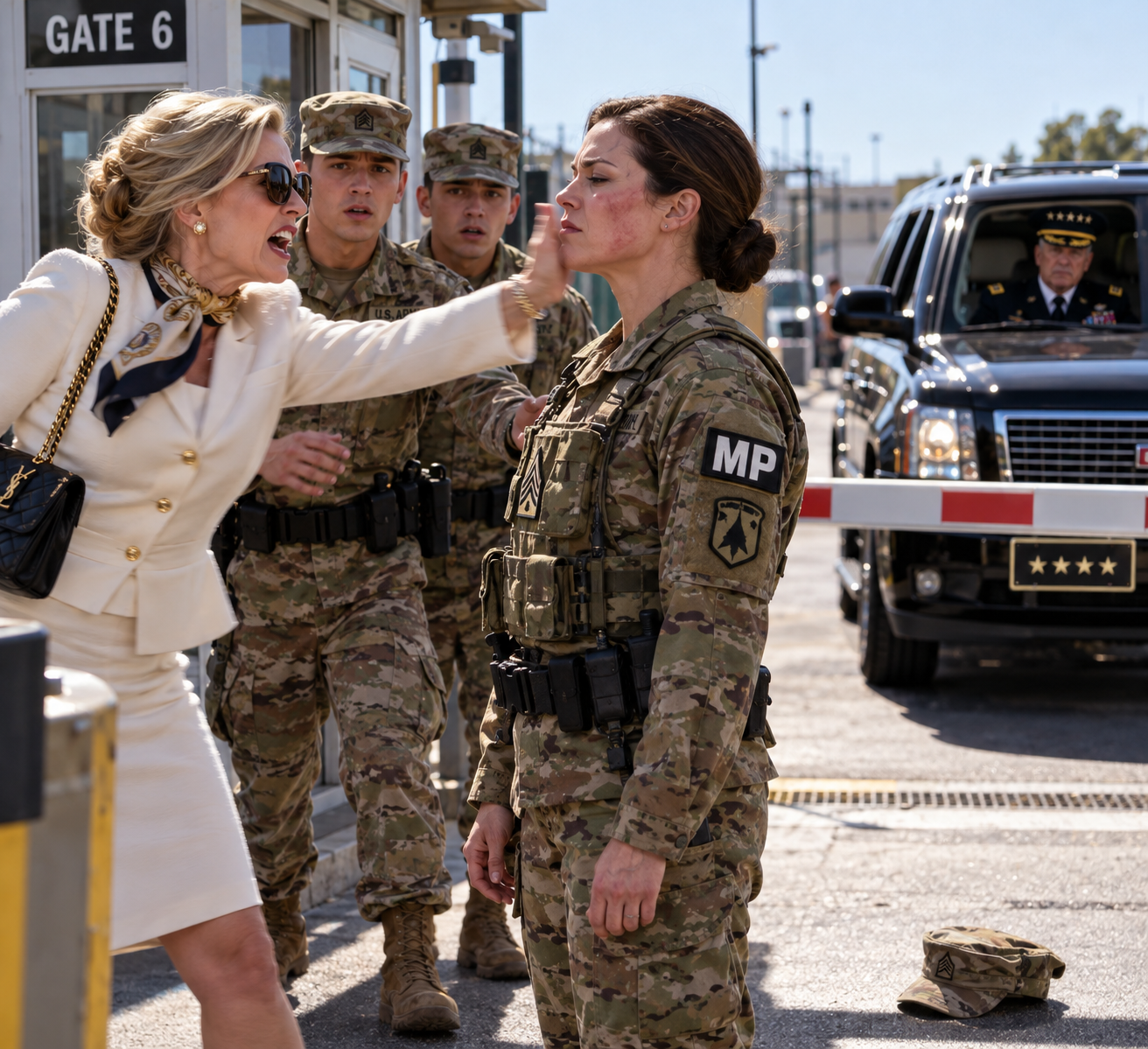
For several seconds, nobody moved. The four-star general stood beside the black truck, holding the sealed envelope as though it weighed far more than paper.
Vivian Harmon looked nothing like the powerful woman who had slapped me moments earlier. Her shoulders had stiffened, her face had gone pale, and her fingers were twisting the silk scarf around her neck.
“General,” she finally said, forcing a smile, “this is a personal misunderstanding. My husband will be happy to speak with you.”
“I expect he will.”
“You cannot detain me because of something that happened twenty-eight years ago.”
“I’m not detaining you for something that happened twenty-eight years ago. I’m investigating what happened at this gate today, along with evidence that has recently come to light.”
The general turned to a nearby military police officer who had arrived after hearing the commotion.
“Document the assault allegation. Preserve the checkpoint camera footage, obtain witness statements, and notify the installation’s legal office. No one is to interfere with the evidence.”
Then she faced me.
“Sergeant Conroy, you’re relieved from this post pending the initial report. You will not be punished for following a lawful order.”
I saluted. “Yes, General.”
She returned the salute. It was a small gesture, but after Vivian’s humiliation, it felt like someone had restored a piece of me.
Then the general introduced herself.
“I’m General Eleanor Whitaker. Twenty-eight years ago, I was a captain stationed at Camp Redstone.”
She looked at Vivian again.
“And I was the last officer to see Private Daniel Mercer alive.”
Vivian stumbled backward.
“That’s impossible.”
“No,” Eleanor replied. “What’s impossible is that an eighteen-year-old soldier was officially blamed for stealing classified documents when the evidence now indicates that he was trying to report their disappearance.”
The general opened the envelope. Inside were copies of old duty logs, a handwritten statement, and a photograph of a young soldier standing outside an administrative building.
On the back, someone had written a date.
August 17, twenty-eight years earlier.
“Private Daniel Mercer was your younger brother, wasn’t he?” I asked before I could stop myself.
Vivian stared at me. The general nodded.
“Daniel discovered that sensitive military records were being removed from a secure archive. Before he could report what he found, he was accused of theft. His career was destroyed, and within weeks, he died in a vehicle accident while traveling home.”
Vivian’s eyes filled with tears, but they weren’t the tears of someone remembering a beloved brother. They were tears of panic.
“My brother made terrible choices,” she whispered. “I had nothing to do with that investigation.”
“Perhaps,” Eleanor said. “That’s what we’re going to establish.”
She removed another document from the envelope.
“This is a copy of a letter Daniel wrote the night before his death. He named the person who ordered him to take responsibility for the missing records.”
Vivian shook her head.
“No.”
“The name is in this letter.”
“No! You don’t understand!”
“Then explain it.”
Vivian looked toward the installation road again.
But there was nowhere left to run.
PART 3
Twenty minutes later, a military vehicle pulled into the checkpoint.
Colonel Bruce Harmon stepped out, his expression furious.
“Eleanor, what is the meaning of this? My wife called me and said you’ve threatened her and accused her of crimes.”
General Whitaker handed him a copy of the document.
“Bruce, read it.”
He glanced at the first page. Then his expression changed.
“Where did you get this?”
“From the original archive collection recovered during a recent records review.”
His gaze moved to Vivian. She shook her head frantically.
“Bruce, don’t listen to her. She’s trying to destroy us.”
The colonel read the page again.
For the first time, he looked at his wife as though he didn’t recognize her.
“Vivian,” he said quietly, “you told me Daniel confessed.”
She began to cry.
“You said the investigation was closed,” he continued. “You told me you had the paperwork.”
“I was protecting you!”
“Protecting me from what?”
The general answered for her.
“Twenty-eight years ago, Bruce, you were a young captain responsible for the secure archive at Camp Redstone. Daniel discovered that documents were missing. Rather than report the breach immediately, you accepted Vivian’s explanation that the records had been transferred under proper authority.”
Bruce’s face drained of color.
“She told me the transfer had been approved.”
“And when the investigation began, Daniel was blamed. Your own statement supported the official account.”
“I was twenty-seven years old,” he whispered. “I thought I was following the correct procedure.”
“Then you should welcome an independent investigation,” Eleanor said. “If your account is accurate, the evidence will establish that.”
Vivian grabbed his arm.
“Bruce, tell her! Tell her you promised never to reopen this!”
He slowly pulled away from her.
“I promised to protect my family,” he said. “I never promised to lie forever.”
Her expression hardened.
“You owe me everything!”
“No,” he replied. “I owe Daniel the truth.”
General Whitaker turned to the legal officer who had arrived with her team.
“The letter is important, but we need the original transfer logs and the testimony of anyone who handled the records.”
“I know where the original logs are,” Vivian blurted out.
Everyone turned toward her.
Bruce stared at his wife.
“What did you just say?”
Vivian pressed both hands over her mouth.
The general’s voice became very quiet.
“Where are they?”
Vivian looked at the envelope. Then she looked at her husband.
“There’s a storage box in my father’s old property. I kept it after he died. The documents were inside when I found it.”
“Why didn’t you report them?” Bruce demanded.
“Because the papers could have implicated people who were still serving. I was afraid.”
“Afraid of what?” Eleanor asked.
Vivian’s answer came in a whisper.
“Of losing everything.”
PART 4 (END)
The general didn’t soften.
“Then you should have considered that before you struck a noncommissioned officer for refusing to violate a security restriction.”
Vivian lowered her head.
For the first time, she had no threat, no title, and no powerful husband willing to make the consequences disappear.
The documents were secured, and a formal investigation began. Bruce was instructed to cooperate fully, while Vivian’s alleged assault was referred through the appropriate military and legal channels. The old case would be reviewed separately, with investigators examining the records before drawing conclusions about responsibility.
Nothing would be settled by rank, money, or family connections this time.
Before leaving Gate Six, General Whitaker returned to me.
“Sergeant Conroy, I owe you an apology.”
I blinked.
“Ma’am?”
“Your duty was to enforce the restriction. You did that. You were struck while performing your assignment, and two soldiers were pressured to act against their training. You should never have been placed in that position.”
I swallowed the lump in my throat.
“Thank you, General.”
She glanced at my fallen cap, which Salas had carefully brushed clean.
“Your children must be proud of you.”
I thought of Bree, who sometimes complained that my uniform meant I missed school events. I thought of my twins, who liked to salute me at the kitchen table.
“I hope they will be someday, ma’am.”
Eleanor smiled faintly.
“Tell them that integrity isn’t measured by how loudly someone gives an order. It’s measured by whether you do what’s right when someone powerful tells you to do otherwise.”
Behind her, Dewitt and Salas stood at attention.
When the general turned toward them, both looked as though they were preparing for the worst.
“You were wrong to begin removing your sergeant without lawful authority,” she said. “Fear is not an excuse to abandon your training. But Private Salas, you ultimately told the truth. Private Dewitt, you stopped when you recognized what was happening. Learn from this.”
“Yes, General,” they answered together.
I looked at them.
I was still disappointed. But I knew young soldiers could make mistakes and learn from them.
What mattered now was what they chose to do next.
Several weeks later, the investigation uncovered additional records that contradicted the original account of Daniel Mercer’s actions. Investigators found evidence suggesting that the missing documents had been moved without proper authorization, and Daniel’s old case was formally reopened for further review.
Vivian’s actions at Gate Six were handled separately. The assault allegation proceeded through the appropriate channels, and her husband’s rank did not shield her from scrutiny.
Colonel Bruce Harmon also faced questions about his role in the original investigation. He cooperated with investigators, but cooperation did not erase the consequences of his earlier decisions.
As for me, I returned to duty.
One morning, an official letter arrived at my unit. It recognized my conduct during the checkpoint incident and commended my professionalism under pressure.
I placed it in a drawer at home.
My children were far more interested in the dinner I cooked that evening.
Bree read the letter twice before looking at me.
“Mom, you stood there while someone hit you, and you still didn’t break the rules?”
“I didn’t stand there because I was afraid of her,” I explained. “I stood there because I knew what my duty was.”
My youngest twin climbed into my lap.
“Were you the bravest soldier there?”
I kissed the top of his head.
“No, sweetheart. I was just a soldier who remembered what she was supposed to do.”
Months later, General Whitaker visited Fort Ansel again. Before leaving, she stopped at Gate Six.
I saluted her.
She returned it.
Then she looked at the barrier, the road, and the soldiers on duty.
“People sometimes believe power means getting everyone else to move out of their way,” she said. “Real leadership means knowing when to stand your ground—and when to answer for what you’ve done.”
I never saw Vivian Harmon at Gate Six again.
I didn’t need an apology from her to understand my own worth. And I didn’t need a general standing beside me to know that my uniform deserved respect.
I had earned that respect long before the black truck arrived.
THE END