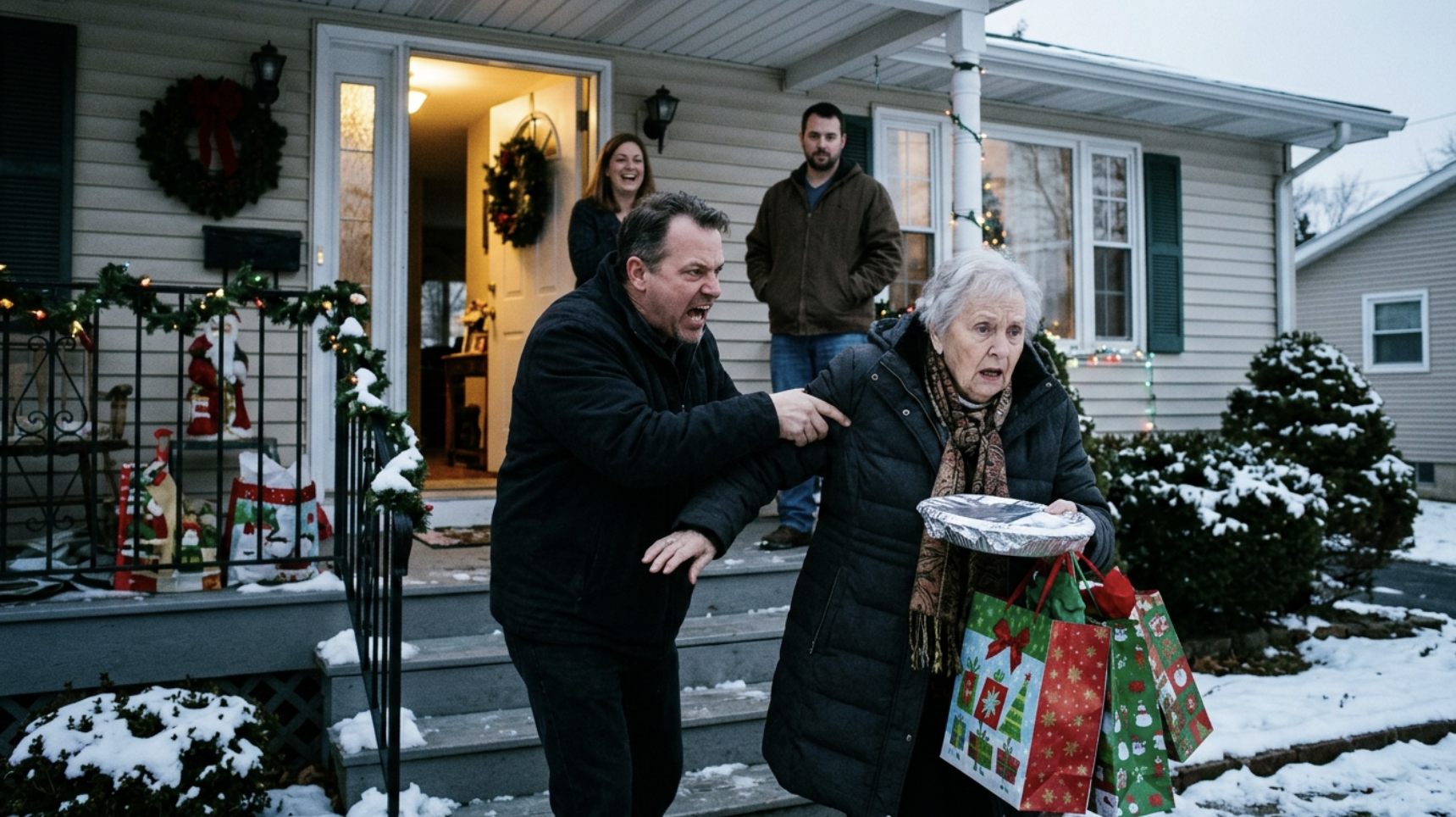
My Son Threw Me Out on Christmas Eve—Then 99 Calls Later, He Begged Me to Hide His Father’s Letter
PART 4
“Before you read that letter, I have something to show you.”
Grant placed a thick folder on the conference table.
Nobody moved.
Paul Whitaker sat to my right, his reading glasses resting low on his nose. Across from us sat the independent trustees, two outside attorneys, the company’s chief auditor, and six members of the board.
Grant had arrived ten minutes late.
For the first time in his career, he wasn’t the person everyone had gathered to congratulate.
He was the person everyone was waiting to hear.
“Go ahead,” the board chairman, Richard Lawson, said.
Grant opened the folder.
Inside were bank statements, consulting agreements, and printed emails. He arranged them carefully, as if the order of the papers might somehow control what they revealed.
“Over the past six months, I’ve been investigating irregularities in our consulting payments,” he began. “I didn’t disclose everything to the board because I wanted to establish the facts before making accusations.”
I glanced at Paul.
His expression remained neutral, but I knew him well enough to recognize his concern.
Grant continued.
“Some payments were approved through the finance department without the supporting documentation required by our internal procedures. I initially believed these were administrative failures. However, the amounts increased, and the explanations became inconsistent.”
He pulled out a sheet of paper.
“The consulting firm Northbridge Advisory Group received payments totaling approximately $2.4 million over three years. Another company, Westfield Strategic Properties, received additional payments for services that have not yet been adequately documented.”
My heart sank.
Two million four hundred thousand dollars.
Money that belonged to a company employing hundreds of people.
Grant looked directly at the board chairman.
“I have reason to believe our chief financial officer, Daniel Cross, concealed the true nature of these transactions.”
A murmur passed around the table.
Richard Lawson leaned forward.
“What evidence supports that conclusion?”
Grant slid several emails across the table.
“These messages show Daniel approving invoices and instructing staff to classify certain payments as operational consulting expenses. In several cases, he told employees not to send the documents to the board because the agreements were commercially sensitive.”
The chief auditor picked up the pages.
“Were these instructions verified against the original email system?”
“Yes.”
“Have you established whether the services were actually provided?”
“Not completely.”
“Have you established who ultimately received the money?”
Grant hesitated.
“Not completely.”
Richard folded his hands.
“Then we have allegations and preliminary evidence, not conclusions.”
“I understand.”
I looked at my son.
He seemed different from the man who had stood on my porch shouting that nobody wanted me.
He was still frightened. His hands trembled slightly as he turned the pages. But for once, he appeared to understand that confidence alone would not answer every question.
Then he turned toward me.
“Mom, I need you to understand something. I did not authorize those payments to benefit myself. I didn’t know where all the money was going.”
I met his eyes.
“I hope that’s true, Grant.”
He looked wounded by my answer.
Perhaps he had expected me to say that I believed him.
Perhaps he had expected the same unconditional reassurance I had given him since childhood.
But I had learned that believing someone was not the same as declaring them innocent before the evidence had been examined.
Richard Lawson cleared his throat.
“Mr. Gable, the board appreciates your disclosure. However, we still need to address the documents provided by the trust.”
He turned toward Paul.
“Mr. Whitaker, please explain the purpose of Mr. Gable’s father’s memorandum.”
Paul opened his briefcase.
He removed Charles’s letter and placed it on the table.
“This memorandum was prepared by Charles Gable during the final revision of the family trust. It explains why voting control was retained by the trust rather than transferred directly to his sons.”
He read the relevant passage aloud.
“My sons may one day possess the ability to lead this company. But leadership must remain separate from unchecked authority. The purpose of this trust is not to prevent them from succeeding. It is to ensure that no single person, including a member of my family, can place the company’s employees, pensioners, or financial stability at unnecessary risk.”
The room fell silent.
Paul continued.
“Charles specifically required independent oversight of substantial borrowing, transactions involving related parties, and any action that could materially affect employee retirement funds. Those provisions remain in force.”
Grant stared at the letter.
For a moment, he looked as though he had been transported back to his father’s funeral, standing beside the coffin while relatives whispered about who would take over the company.
“Dad never told me this,” he said quietly.
I spoke before Paul could answer.
“Your father tried to explain it to you, Grant. You believed he was questioning your ability.”
Grant turned toward me.
“You knew all these years?”
“I knew why the safeguards existed. I didn’t know what the current investigation would uncover.”
“You should have told me.”
“Yes,” I said. “Perhaps I should have explained more about your father’s concerns. But you also knew the trust existed. You signed the documents acknowledging its authority.”
He looked down.
For the first time, he had no immediate answer.
Richard Lawson asked the chief auditor to summarize the preliminary findings.
The auditor explained that the investigation had identified questionable invoices, incomplete records, and payments that required further examination. He emphasized that the available documents did not yet establish who had ultimately benefited from the transactions or whether any individual had committed a crime.
He also confirmed that the company had enough cash to meet its immediate payroll obligations, although its borrowing position required close monitoring.
The board then discussed the next steps.
Daniel Cross would be placed on temporary administrative leave while an independent forensic accounting firm examined the transactions. All relevant records would be preserved. The trust would retain its voting safeguards, and the board would review Grant’s executive responsibilities after receiving the initial investigation report.
No one declared Grant guilty.
No one declared him innocent.
For the first time in months, the company would allow evidence to determine what happened.
Then Richard looked toward me.
“Mrs. Gable, we understand that you have additional historical records.”
I nodded.
“Owen found a box in Charles’s old office. It contains records that may be relevant to the investigation.”
I handed Paul the box.
He explained where it had been found and how Owen had discovered it. The chief auditor documented the materials and arranged for them to be transferred securely to the forensic accountants.
When the meeting ended, Grant remained seated.
The other directors filed out.
Paul followed them after promising to call me once the next steps had been arranged.
Soon, only Grant and I remained at the long conference table.
He stared at his father’s letter.
Then he asked, “Did Dad think I was going to destroy everything?”
I pulled out the chair beside him.
“No.”
“Then why did he need all those restrictions?”
“Because he knew how much the company meant to you. And he knew that sometimes, when people become frightened of losing something, they begin making decisions they would never have made if they felt secure.”
Grant rubbed his forehead.
“He thought I was reckless.”
“He thought you were ambitious. He also worried that you sometimes confused being challenged with being disrespected.”
Grant gave a bitter laugh.
“Sounds like him.”
“Yes,” I said. “It does.”
He looked at me.
“Do you think I’m a bad person?”
The question caught me off guard.
For years, I had wished my son would ask himself that question before hurting someone.
Now that he had finally asked it, I realized it wasn’t the question he needed to answer.
“No, Grant. I think you’ve done things that hurt people. I think you’ve made decisions that need to be examined. And I think you’ve spent too long believing that admitting a mistake would make you weak.”
He swallowed.
“What if I’ve gone too far?”
“Then you begin by telling the truth.”
“And if the truth costs me everything?”
I looked at the letter on the table.
“Then you find out what remains when you no longer have your title, your money, or your authority to hide behind.”
He stared at me for a long time.
Then he asked the question I had been waiting for since Christmas Eve.
“Can you ever forgive me for what I did to you?”
My throat tightened.
I remembered the wet driveway. The warm pie. The presents scattered beside my car.
I remembered his hand gripping my arm and Melissa smiling from the doorway.
I remembered the years I had spent giving him second chances without asking him to change.
“I can forgive you,” I said slowly. “But forgiveness doesn’t mean I will pretend it never happened.”
He lowered his head.
“I understand.”
I wasn’t sure he did.
But for the first time, he had stopped arguing.
And that was a beginning.
THREE WEEKS LATER
The independent investigation uncovered more than any of us had expected.
Some consulting services had been provided, but the documentation was incomplete. Several invoices appeared to have been duplicated. Other payments had been approved without the authorization required by company policy.
The investigators also identified transactions involving Westfield Strategic Properties, the firm connected to Melissa’s brother, Scott.
The payments required further examination because the records did not adequately establish the services received or the ultimate beneficiaries.
Daniel Cross denied knowingly authorizing improper payments. He cooperated with the investigation through his attorney, and the company referred potentially unlawful transactions to the appropriate authorities for independent review.
No final criminal conclusion was announced.
But the financial consequences were serious enough.
The company had to revise its accounts, renegotiate several credit arrangements, and temporarily suspend expansion plans. A proposed acquisition was postponed. Senior executives had their compensation reviews delayed while the board examined the company’s financial controls.
Grant was not immediately dismissed.
Instead, the board appointed an independent executive adviser and temporarily restricted his authority over major financial transactions. He remained responsible for certain operational matters, subject to additional oversight.
He hated the arrangement.
I knew because he called me three days after the board meeting.
“They’ve put someone beside me to review every major decision,” he said. “I’m the CEO, and I need permission to do my job.”
“You agreed to cooperate with the investigation.”
“I agreed to cooperate. I didn’t agree to be treated like a child.”
I closed the book I had been reading.
“Grant, do you remember what you said to me when I asked why you were angry about the trust?”
He sighed.
“You’re going to tell me.”
“You said your father never trusted you.”
“And?”
“And now you are being asked to earn trust by showing that you can work within the safeguards he created.”
Silence.
Then he said, “You always take their side.”
“No. I take the side of what can be demonstrated to be true.”
He ended the call shortly afterward.
I didn’t call him back.
For the first time in my life, I allowed my son to be disappointed in me without treating his disappointment as an emergency.
During those weeks, Owen visited me every Sunday.
Sometimes he brought groceries. Sometimes he repaired something around the house that I could easily have hired someone to fix. Usually, we sat at the kitchen table and talked about ordinary things.
The weather.
His work.
A neighbor’s new dog.
Charles’s old photographs.
One Sunday, he brought a stack of pictures he had found while sorting through the warehouse records.
There was one of Grant at twelve, holding a fishing rod that was almost as tall as he was. Another showed Owen sitting on Charles’s shoulders during a company picnic.
At the bottom of the stack was a photograph of the four of us outside our old house.
Charles had one arm around me.
Grant stood beside his father, grinning proudly.
Owen was holding my hand.
We looked like a family that believed nothing could ever divide it.
Owen studied the photograph.
“I used to think Dad loved Grant more.”
I turned toward him.
“Why would you think that?”
“Because he talked about Grant taking over the company. He took Grant to meetings. He showed him the factory.”
“He did those things because Grant wanted to learn about business.”
“I wanted to learn too.”
I felt a sharp pang of regret.
“Why didn’t you tell me?”
Owen shrugged.
“I thought I wasn’t as good at it. Grant was always the one everyone noticed.”
I took his hand.
“Your father loved you both. He trusted Grant to sell a vision. He trusted you to understand how to make that vision work. Neither of those things was more important than the other.”
Owen looked down at the photograph.
“I wish I had understood that sooner.”
“So do I.”
We sat quietly for a while.
Then he asked, “Do you think the family will ever be the same?”
I looked toward the empty chair where Charles used to sit.
“No,” I said. “I don’t think it will.”
Owen looked disappointed.
“But that doesn’t mean it can never be good again,” I continued. “Sometimes things have to change before people can stop hurting each other.”
He nodded slowly.
Then he leaned forward and kissed my forehead.
It was such a small gesture.
But I felt more loved in that moment than I had during many of the elaborate family dinners I had spent years arranging.
THE CHRISTMAS THAT CAME AFTER
The following December, I received an invitation to Grant’s house.
It arrived in a plain white envelope.
Inside was a handwritten card.
Mom,
I would like you to come for Christmas dinner this year. I understand if you don’t want to.
The children miss you.
I miss you, too.
Love, Grant.
There was no mention of the company.
No request that I call Paul.
No demand that I speak to the board.
I placed the card on the kitchen table and read it several times.
Then I called Owen.
“Your brother invited me to Christmas dinner.”
“Are you going?”
“I don’t know yet.”
“Do you want to?”
I considered the question.
“I want to see my grandchildren.”
“Then perhaps you should go. But you don’t have to pretend everything is fine.”
He was right.
So I called Grant.
“Thank you for the invitation,” I said. “I’d like to see the children.”
“I’ll tell them.”
“But I need you to understand something.”
He went quiet.
“If I come, I won’t discuss the investigation at dinner. I won’t argue about the trust. And I won’t accept being shouted at, grabbed, or humiliated.”
“I understand.”
“If anything like that happens, I’ll leave.”
“I understand, Mom.”
I waited.
Then he added, “You won’t have to worry about that.”
I wanted to believe him.
But trust is not rebuilt by a promise made over the telephone.
It is rebuilt through what someone does when they have the opportunity to disappoint you again.
On Christmas Eve, I baked another apple pie.
My hands moved more slowly than they once had, but I still remembered Charles’s recipe by heart.
A little more cinnamon.
A little less sugar.
Cold butter.
And patience.
Especially patience.
I wrapped the pie in a clean cloth and placed it beside the presents.
This time, I had bought the children books, art supplies, and small gifts they had asked for themselves. I also brought a photograph of their grandfather standing outside the original warehouse.
I wanted them to remember that their family’s history was larger than the argument that had divided us.
When I arrived at Grant’s house, the front door opened before I could knock.
Sophie stood there.
She was twelve now, taller than I remembered, with her hair pulled back in a loose ponytail.
For a moment, she simply stared at me.
Then she ran forward and wrapped both arms around my waist.
“Grandma!”
I held her tightly.
“Oh, sweetheart.”
“I missed you.”
“I missed you too.”
Her brothers appeared behind her.
They were older, taller, and full of questions. They showed me their new toys, told me about school, and argued over which of them had built the better model airplane.
I listened to every word.
I didn’t want to miss another moment.
Melissa stood near the dining room doorway.
She wore a dark green dress and a careful expression.
“Hello, Eleanor.”
“Hello, Melissa.”
For several seconds, neither of us spoke.
Then she glanced at the pie.
“You brought dessert.”
“I did.”
She stepped aside.
“Come in.”
It wasn’t an apology.
But it was not a slammed door, either.
I entered the house.
The Christmas tree stood in the same corner as the year before. Beneath it were dozens of wrapped gifts, their ribbons shining beneath the lights.
And on the mantel sat a framed photograph of Charles.
Someone had placed a small silver ornament beside it.
I recognized the ornament immediately.
It was the one Sophie had made in school the year before her grandfather died.
I felt my eyes sting.
Grant came down the stairs.
He stopped when he saw me.
For a moment, neither of us moved.
Then he approached.
“Mom.”
“Grant.”
He looked at the pie in my hands.
“Apple?”
“Your father’s recipe.”
He nodded.
“I remember.”
Then he did something I had not expected.
He took the pie from me carefully, placed it on the kitchen counter, and turned back.
“Mom, can I talk to you for a minute before dinner?”
I followed him into the study.
The room was warm, with a fire burning in the fireplace. A photograph of Charles hung above the desk.
Grant closed the door.
“I owe you an apology.”
I waited.
He looked down at his hands.
“Not the kind I gave you over the phone. A real one.”
He swallowed.
“I was angry because I thought you had betrayed me. I believed you had given the board that letter to punish me for how I treated you.”
“And now?”
“Now I know you were trying to make sure the company was protected. I also know that I made it difficult for you to ask questions because I didn’t want anyone questioning my decisions.”
He sat down heavily.
“I told myself that because I had grown the business, I had earned the right to make every important decision. When the board challenged me, I treated them like enemies.”
He looked at me.
“And when you challenged me, I treated you worse.”
I felt tears rising, but I kept my voice steady.
“Yes, you did.”
He nodded.
“I know.”
For several seconds, he stared at the floor.
Then he said, “I am sorry for grabbing you. I’m sorry for throwing your presents outside. I’m sorry I made you feel like you had to earn the right to see your grandchildren.”
His voice broke.
“And I’m sorry I let you believe that your love meant you had to keep forgiving me without expecting anything to change.”
I sat down across from him.
That was the apology I had needed.
Not because it erased what happened.
Because he had finally named it without blaming me.
“Grant, I love you,” I said. “I have always loved you. But I need you to understand that I cannot be the only person responsible for keeping this family together.”
“I understand.”
“I will support you when you are trying to do the right thing. I will listen when you are struggling. I will forgive you when you make mistakes and take responsibility for them.”
He nodded.
“But I will not lie for you. I will not hide wrongdoing. And I will not accept cruelty simply because you are my son.”
He wiped his eyes.
“You shouldn’t have to.”
“No,” I said. “I shouldn’t.”
He sat quietly for a moment.
Then he asked, “Do you think Dad would be disappointed in me?”
I looked at the photograph above his desk.
“Your father would be disappointed by some of your choices. But he would also want to see what you chose to do next.”
Grant followed my gaze.
“I’ve been thinking about him a lot.”
“So have I.”
“I used to think he left the trust because he didn’t believe I could handle the company.”
“He left it because he knew no one should have to carry that much power without anyone being able to question them.”
Grant nodded slowly.
“I think I’m finally beginning to understand that.”
I reached across the desk and took his hand.
“Then let that understanding change how you live.”
He squeezed my fingers.
“I will try.”
For once, I believed he meant it.
Not because I knew he would never make another mistake.
Because he had finally stopped asking me to pretend he hadn’t made the ones before.
Dinner was not perfect.
Melissa remained distant. She did not apologize for laughing on the porch, nor did she explain the message she had sent me.
I did not force a conversation.
Some things would take longer.
But she did not insult me, and she did not interfere when the children sat beside me at the table.
Sophie asked me to tell the story of how her grandfather had started the company.
So I told them about the rented warehouse, the broken machinery, the long nights, and the first customer who had trusted Charles enough to place an order.
I told them how their grandfather had worked until his hands were covered in grease and how he sometimes came home so tired that he fell asleep before finishing dinner.
I told them that the company had not been built by one person alone.
It had been built by hundreds of people who arrived every morning, operated machines, delivered orders, balanced accounts, repaired equipment, and trusted the people leading them to treat their work with respect.
“Was Dad the boss?” one of the boys asked.
“Yes,” I said. “But your grandfather always said being the boss meant being responsible for more than yourself.”
Sophie looked at Grant.
“Dad, is that true?”
Grant set down his fork.
“Yes,” he said quietly. “It is.”
Then he looked at me.
“Your grandfather taught me that. I should have remembered it more often.”
Nobody spoke for a moment.
Then Sophie reached across the table and took my hand.
I squeezed it gently.
The dinner continued.
There was laughter. There were spilled drinks and arguments over dessert. The boys complained that I had brought too many vegetables, and Grant pretended not to notice when Sophie took an extra slice of pie.
For the first time in a long while, I felt something like peace.
Not the old peace, built on my silence.
A different kind.
One that allowed difficult truths to exist without destroying every good thing around them.
TO BE CONTINUED IN THE FINAL PART…
👉 Keep Reading — Click the next page below 👇