PART 3
When Grant had nightmares as a little boy, I had hurried to his bedroom. When he broke his arm falling from a tree, I had driven him to the emergency room with one hand on the steering wheel and the other holding his trembling fingers. When his first business failed, I had sold my wedding bracelet to help him start again.
And when his father died, I had held him while he cried into my shoulder and promised him that he would never have to face the world alone.
I had meant every word.
But somewhere along the way, Grant had confused my promise to love him with a promise to rescue him from every consequence of his own choices.
I unlocked the door but kept the chain fastened.
“What do you want, Grant?”
His expression changed when he saw me.
Perhaps he had expected me to be crying. Perhaps he thought I would immediately ask whether he had eaten breakfast or whether something terrible had happened at the company.
Instead, I stood in my own doorway and waited.
“Mom, we need to talk.”
“About what?”
He glanced toward the street, then back at me.
“Can you please open the door?”
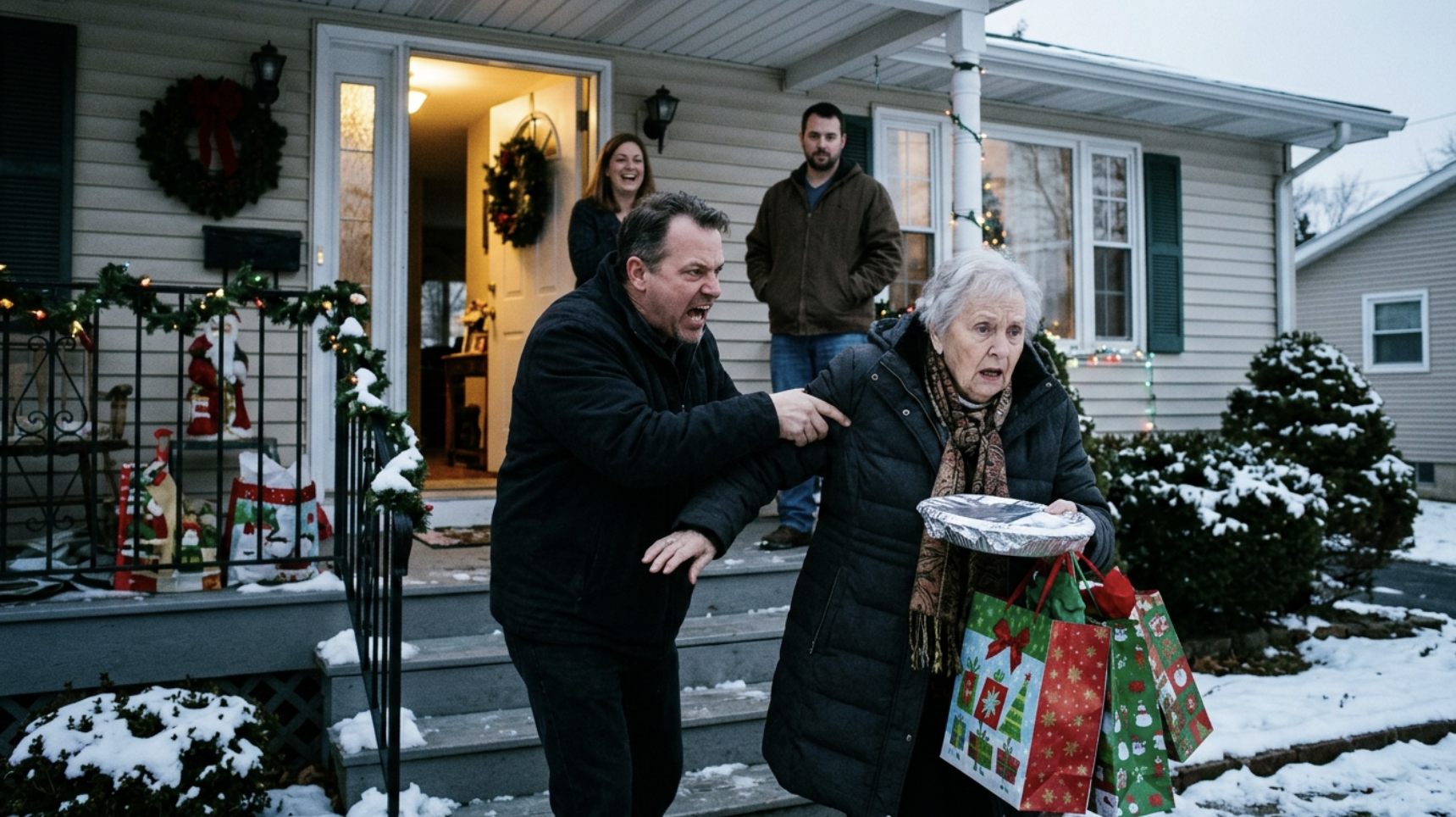
“Yesterday, you told me nobody wanted me at your house.”
His jaw tightened.
“That isn’t what this is about.”
“Then you shouldn’t have any trouble explaining it from there.”
For several seconds, he stared at me as if I had suddenly begun speaking a foreign language.
Finally, he lowered his voice.
“The board has frozen several pending transactions. They’re demanding financial records going back five years. They’re questioning the consulting agreements with Martin Hale, and Paul Whitaker is refusing to discuss the trust with me.”
I said nothing.
“Mom, do you understand what that means? They’re treating me like a criminal.”
“Are you being accused of a crime?”
“That’s not the point!”
His voice rose so suddenly that I instinctively stepped back.
He noticed.
For the briefest moment, something like shame crossed his face.
Then it disappeared.
“The company employs hundreds of people,” he continued. “Families depend on those paychecks. Suppliers are waiting for payments. If the board creates a panic, the banks could tighten our credit. We could lose everything Dad built.”
I looked at him carefully.
“Then I hope the company has been managed honestly.”
His mouth fell open.
“You think I haven’t managed it honestly?”
“I didn’t say that.”
“You gave them Dad’s letter!”
“Yes.”
The word seemed to strike him harder than a shout.
He gripped the doorframe.
“Why?”
“Because your father’s letter explains why the trust was created.”
“It’s twenty-three years old!”
“And the safeguards in it are still legally binding.”
“Dad wanted me to run the company!”
“He did.”
“Then why are you helping them take it away from me?”
I took a slow breath.
“Your father wanted you to lead the company. He did not want anyone, including you, to own every decision without accountability.”
Grant shook his head.
“You’ve always done this. You smile and pretend you’re helping me, but you never really trusted me.”
For the first time that morning, I felt anger rising in my chest.
Not because he accused me of distrusting him.
Because he had spent so many years believing that trust meant never asking questions.
“Grant, I trusted you enough to let you run a company employing hundreds of people. I trusted you enough to stay out of your daily decisions. I trusted you enough to believe your explanations when the numbers became troubling.”
“Then why didn’t you tell me about the audit?”
“Because I thought you would tell me the truth when you were ready.”
He stared at me.
I continued.
“I was wrong about that, too.”
He looked away.
For a moment, I saw the little boy who used to stand beside his father’s workbench, desperate to prove he could build something just as wonderful.
Then he spoke again, and the boy disappeared.
“If you don’t fix this, Mom, you’re going to destroy your own family.”
I studied his face.
“No, Grant. I’m no longer willing to destroy myself to protect the appearance of one.”
I closed the door gently.
He struck it once with his palm.
“Mom!”
I did not reopen it.
I stood in the hallway until I heard his car start and the tires roll away from the curb.
Then I returned to the kitchen, poured myself a cup of coffee, and sat beside Charles’s photograph.
“I hope you knew what you were doing,” I whispered.
The photograph offered no answer.
But my husband had never been a man who made important decisions without leaving a paper trail.
And somewhere inside that trust, I suspected, was a truth even Grant had never imagined.
At nine o’clock, Paul called.
“The board has scheduled a special meeting for tomorrow afternoon,” he said. “They want you there as a trustee.”
“I’ll come.”
“There is something else you should know.”
I set down my coffee.
“What is it?”
“Grant has retained separate counsel. His attorney contacted the trust company this morning.”
“Is that unusual?”
“Not necessarily. But he has requested a temporary suspension of the review, arguing that the disclosure of Charles’s memorandum violates the family’s confidential arrangements.”
I closed my eyes.
“Can he do that?”
“He can request it. Whether he has grounds to obtain it is another question.”
“And the trust company?”
“They’ve declined to suspend anything pending independent legal advice.”
I looked out the kitchen window at the bare apple tree in my backyard.
Charles had planted it the year we bought the house. Grant had been six then, and Owen had been three. Every autumn, Charles took the boys outside to collect apples while I baked pies for the winter.
Grant used to eat the smallest apples before they were ripe.
Owen preferred to collect them carefully in a basket.
Charles would laugh and tell me that the boys were different kinds of men.
He had never said one was better than the other.
“Paul,” I asked, “has Owen contacted you?”
“Yes.”
My heart skipped.
“What did he say?”
“He requested a copy of the notice sent to the board. He also asked whether the independent accountant would be willing to meet with him privately.”
“Why?”
“He didn’t explain.”
I gripped the telephone.
“Does he know something?”
“I can’t answer that, Eleanor. I can only tell you that Owen seemed very concerned.”
After we hung up, I called my younger son.
He answered after the sixth ring.
“Mom?”
His voice sounded exhausted.
“Owen, are you all right?”
“I’m fine.”
“You don’t sound fine.”
He exhaled.
“I haven’t slept.”
“Neither have I.”
Silence stretched between us.
Then he asked, “Did you really give Dad’s letter to the board?”
“Yes.”
He didn’t accuse me of betrayal.
He didn’t ask me to withdraw it.
Instead, he said something that made my stomach tighten.
“Then they’re going to find out about the second ledger.”
I sat up straight.
“What second ledger?”
Owen went quiet.
“Owen?”
“I shouldn’t have said that over the phone.”
“What do you mean, a second ledger?”
“Mom, I need to show you something. But I need you to promise me you won’t tell Grant until you’ve seen it.”
Every instinct in me told me to demand an explanation.
But I remembered Charles’s letter.
Do not remove every consequence simply because he is angry.
“Owen, if you have evidence of something wrong at the company, you must give it to the proper people.”
“I know.”
“And if it involves your brother, you must understand that I won’t help you hide anything from an investigation.”
“I don’t want you to.”
His voice cracked on the last word.
That frightened me more than anything else he had said.
“Where are you?” I asked.
“At the old warehouse.”
“The original one?”
“Yes.”
The warehouse where Charles had started the company nearly fifty years earlier.
“What are you doing there?”
“I found something Dad left behind.”
I glanced at the photograph on the kitchen table.
“What did you find?”
Owen took a breath.
“A box with your name on it.”
I arrived at the old warehouse just after noon.
The building stood at the edge of an industrial district that had changed almost beyond recognition since Charles first rented the space. New distribution centers surrounded it now, their loading bays busy with trucks and forklifts.
Our warehouse looked smaller than I remembered.
The paint had peeled from the metal siding. Weeds pushed through cracks in the concrete. A faded sign bearing the Gable Precision Systems name hung above the entrance.
Owen waited beside a side door.
At forty-two, he had his father’s broad shoulders and my habit of looking down when he was troubled. Unlike Grant, he wore no expensive coat or polished shoes. His dark sweater had a small tear near the cuff.
When he saw me, he hugged me.
It was the first time either of my sons had hugged me in months without a holiday or a photograph being involved.
I held him a little longer than usual.
“I’m sorry,” he whispered.
“For what?”
“For not coming to your defense yesterday.”
I stepped back.
“You saw what happened?”
He nodded.
“Melissa sent a video to the family group chat. She said you had become aggressive and Grant had to protect the children.”
My blood ran cold.
“A video?”
“She filmed the end of it. Just after Grant grabbed you.”
I looked toward the warehouse door.
“Why didn’t you say anything?”
He lowered his eyes.
“Because I was afraid.”
The honesty hurt.
But it was better than another excuse.
“Afraid of what?”
“Losing my job. Losing my brother. Losing the little bit of influence I still have at the company.”
He rubbed his face.
“That’s no excuse, Mom. I know that.”
“No,” I said quietly. “It isn’t.”
He nodded.
Then he opened the side door.
Inside, the warehouse smelled of dust, old wood, and machine oil. Sunlight fell through the high windows in pale strips. Most of the equipment had been removed years earlier, but a few old workbenches remained along the far wall.
Owen led me to a small office behind the loading area.
It had once belonged to Charles.
I hadn’t entered it since the year he died.
The old desk still stood beneath the window. Someone had covered it with a plastic sheet to protect it from dust. On the wall hung a faded photograph of Charles standing beside the first machine he had ever purchased for the business.
He looked so young.
So certain that hard work and honesty would be enough to carry him through life.
Owen pulled a chair away from the desk.
“Sit down, Mom.”
I remained standing.
“Show me what you found.”
He opened a metal filing cabinet and removed a brown cardboard box.
My name was written across the top in Charles’s unmistakable handwriting.
ELEANOR — KEEP SAFE.
I touched the words.
“Where was this?”
“Behind a false panel in the bottom drawer of Dad’s desk. I was looking for some old equipment records last week. The drawer wouldn’t close properly, so I took it apart.”
He set the box on the desk.
Inside were folders, handwritten notes, copies of bank statements, and a small black notebook secured with a rubber band.
I lifted the first folder.
The label read:
PENSION ACCOUNT REVIEW — ORIGINAL RECORDS.
I looked at Owen.
“What does this have to do with Martin Hale?”
“Everything, I think.”
He pulled another chair toward me and sat down.
“About six months ago, I noticed that the company had started paying a consulting firm called Northbridge Advisory Group. The invoices were vague. Strategy consulting. Operational restructuring. Financial analysis.”
“How much?”
“Initially, a few thousand dollars a month. Then the amounts increased.”
“Did you ask Grant?”
“Yes.”
“What did he say?”
“That the board had approved the arrangement and I should concentrate on operations.”
I frowned.
“Had the board approved it?”
“Not according to the minutes I reviewed.”
My heart began to pound.
“Did you report it?”
“I tried to get the supporting contracts. The finance department said they were confidential. Then Grant told me to stop digging.”
I looked down at the documents.
“Why didn’t you come to me?”
“Because I didn’t have proof of wrongdoing. I thought there might be a reasonable explanation.”
“That was sensible.”
He shook his head.
“No. It was partly an excuse. I was afraid that if I kept asking questions, Grant would push me out completely.”
I understood that fear better than he knew.
For years, Owen had lived in his brother’s shadow.
Grant was the public face of the company, the one who stood before investors and spoke confidently about growth. Owen managed production schedules, dealt with equipment failures, and worked with supervisors when a factory line stopped running.
When the company succeeded, Grant received the applause.
When something broke, Owen was expected to repair it.
Still, I had never imagined that he was carrying this burden alone.
“What is the second ledger?” I asked.
Owen pointed to the black notebook.
“Dad’s handwriting.”
I opened it.
The first pages contained ordinary business notes: machine purchases, employee names, delivery schedules, and reminders about meetings.
Then the entries changed.
Several pages listed payments made from the company’s pension fund to an outside consulting account decades earlier.
Beside some transactions, Charles had written question marks.
Beside others, he had written the words:
Authorization missing.
Invoice duplicated.
Payment recipient not verified.
My hands began to tremble.
These were the concerns Charles had described in his letter.
But the notebook continued well beyond the dates I remembered.
I turned another page.
There were references to a new account number, a different consulting firm, and the initials M.H.
Martin Hale.
The dates were recent.
Not twenty-three years old.
Recent.
I looked at Owen.
“Your father couldn’t have written these entries.”
“He didn’t.”
“Then who did?”
Owen swallowed.
“I think someone continued using his old system.”
“What system?”
“Dad used to keep a separate record of unusual transactions. He didn’t put accusations in the official books. He wrote down what needed to be verified and gave the supporting documents to the accountant.”
I looked again at the notebook.
“Who had access to this office?”
“Almost nobody. Dad’s office was locked for years. When the company renovated the warehouse, the cabinet was moved into storage. I brought it back last month because I thought the old records might help with an equipment inventory.”
“And you found the box?”
“Yes.”
I turned another page.
A name appeared repeatedly beside several recent payments.
Not Martin Hale’s.
Not Grant’s.
A name I recognized from the company’s current executive team.
Daniel Cross — Chief Financial Officer.
I had met Daniel at several company dinners. He was polite, quiet, and always careful to compliment Grant’s leadership.
He had also been the person who sent me the annual financial summaries I rarely questioned.
I stared at the entries.
“Are you saying Daniel has been taking money?”
“No.” Owen leaned forward quickly. “I’m saying the records raise questions. Some payments may have legitimate explanations. I don’t know who authorized them or where all the money went.”
I appreciated that distinction.
Evidence was not the same as proof.
And suspicion was not a verdict.
“What do the accountants say?”
“The independent accountant has been asking for documents. Some invoices were submitted without the supporting contracts. A few payments went to companies whose addresses appear to be registered offices.”
“Is that illegal?”
“Not necessarily. But it’s unusual enough that they want to investigate.”
I returned to the notebook.
One entry caught my attention.
It was dated three months before Charles died.
His handwriting was shaky, the letters pressed deeply into the paper.
If the same names appear again, do not assume the old problem has returned by accident. Follow the authorizations. Follow the beneficiaries. Protect the employees first.
I felt the room tilt around me.
Charles had feared this could happen again.
He had known that systems could be weakened over time, that people could become careless, and that the desire to protect a family name could eventually put the entire company at risk.
But he had also left something else in the box.
Beneath the notebook was a sealed envelope addressed to the company’s independent trustees.
I recognized the handwriting immediately.
Unlike the letter Charles had left me, this envelope had never been opened.
Owen watched as I lifted it.
“Mom, I think you should let Paul handle that.”
“I will.”
I turned the envelope over.
There was a short message written across the back.
To be opened only if a future investigation identifies unauthorized payments involving the company’s pension assets.
I sat down.
For several seconds, neither Owen nor I spoke.
Then I carefully placed the envelope back in the box.
“We’re not going to decide what this means ourselves,” I said.
Owen nodded.
“We’ll take everything to Paul. He can preserve the records and make sure the independent accountant receives what they need.”
He looked relieved.
Then his expression changed.
“There’s one more thing.”
I waited.
“The records don’t just involve Northbridge. Some payments were made to a company connected to Melissa’s brother.”
The room became very quiet.
I had met Melissa’s brother, Scott, perhaps a dozen times. He was a real estate investor who frequently talked about his latest ventures. He had once asked Charles for advice on a property deal and been politely told that the company did not invest in residential real estate.
“What is his company called?” I asked.
“Westfield Strategic Properties.”
I recognized the name from the invoices in the folder.
Owen continued.
“I don’t know whether Scott received the money personally. I don’t know whether Melissa knew anything about it. But the company paid Westfield for consulting services, and I haven’t found a clear explanation for those services.”
I closed the folder.
“Then we let the investigation establish the facts.”
Owen nodded.
For the first time since I had arrived, he looked directly at me.
“Mom, if this goes where I think it might, Grant could lose his position.”
I looked at the old photograph of Charles.
“Then we will have to face that possibility.”
“And if he loses everything?”
I thought about the grandchildren standing behind the window on Christmas Eve. I thought about the presents in the puddle and the way Grant’s hand had tightened around my arm.
I thought about the years I had spent making excuses for him because I was afraid that acknowledging his mistakes would mean acknowledging my own.
“If your brother has made mistakes, he deserves a fair chance to explain them,” I said. “If other people have acted improperly, they deserve the same fair process. But none of us gets to decide that the truth should be hidden simply because it might hurt.”
Owen lowered his head.
“I wish I’d learned that sooner.”
“So do I.”
I reached across the desk and took his hand.
“But you’re here now.”
For the first time in years, my younger son began to cry.
Not loudly.
Not dramatically.
He simply covered his face with one hand and let the tears come.
I moved my chair closer.
I didn’t tell him everything would be fine.
I had learned that promises like that could become another way of avoiding the truth.
Instead, I stayed beside him until he was ready to stand.
Then we carried the box to my car.
Neither of us noticed the black SUV parked across the street.
Not until Owen saw it in the side mirror.
His face changed.
“Mom.”
“What is it?”
He turned toward the window.
“That vehicle belongs to Daniel Cross.”
I looked through the glass.
The SUV remained motionless.
Its windows were dark.
Then the engine started.
The vehicle pulled away slowly, turned at the intersection, and disappeared behind a row of warehouses.
Owen stared after it.
“Do you think he knows?”
“I don’t know.”
I placed the box on the passenger seat and locked the doors.
But as I drove away from the warehouse, I couldn’t shake the feeling that someone had been watching us.
And if Daniel Cross had seen us carrying those records out of Charles’s old office, the next day’s board meeting might be far more complicated than Paul had expected.
That evening, I received a message from Melissa.
It arrived at 6:43 p.m.
For a moment, I thought she might be apologizing for what had happened on the porch.
I was wrong.
Her message contained a single photograph.
It showed my grandchildren sitting beside their Christmas tree, surrounded by gifts.
Underneath it, she had written:
The children are upset. You need to stop making this about yourself. Grant is under enormous pressure, and your actions are putting his future at risk. Whatever you think you found, please don’t drag the children into your problems.
I read it twice.
Then I noticed something in the photograph.
Sophie, my oldest granddaughter, was sitting at the edge of the sofa. Her face was turned away from the camera. In her lap lay the red gift box I had retrieved from the puddle the day before.
She had opened it.
Inside was a silver music box I had bought for her after remembering how she used to fall asleep listening to the one Charles had given me.
I zoomed in on the picture.
Sophie had placed her hand over the music box as though she were trying to protect it.
I felt tears sting my eyes.
I wanted to call her.
I wanted to tell her that I loved her, that none of this was her fault, and that she had done nothing wrong.
But I knew Melissa would likely answer the phone.
So I wrote a short message to my granddaughter and saved it without sending it.
My darling Sophie, Grandma loves you more than any argument, any company, or any amount of money. You never have to choose sides to deserve that love. I am always here for you.
Then I put my phone down.
For the first time in my life, I understood that loving someone did not always mean reaching for them immediately.
Sometimes it meant refusing to let them use your love as a weapon against you.
At 8:16 p.m., my phone rang again.
Grant.
I let it ring.
He called a second time.
Then a third.
Finally, a voicemail appeared.
I pressed play.
His voice sounded quieter than it had that morning.
“Mom, please. I need you to listen to me.”
A pause.
“I know I shouldn’t have treated you the way I did. I was angry, and I shouldn’t have put my hands on you. I’m sorry for that.”
I closed my eyes.
For a moment, I let myself feel the relief of hearing him acknowledge what he had done.
Then he continued.
“But you need to understand that Dad’s letter wasn’t meant to be used against me. You know how hard I’ve worked. You know what I’ve sacrificed for that company.”
He took a breath.
“The board wants me to step aside while they investigate. If I do that, everyone will assume I’m guilty. The banks will panic. Employees will start looking for other jobs. Suppliers will stop trusting us.”
His voice cracked.
“Please call Paul. Tell him you acted too quickly. Ask him to withdraw the letter.”
Then came the words that told me he still didn’t understand.
“Mom, you can fix this. You’ve always been able to fix things.”
I listened to the message again.
He had apologized for hurting me.
But he was still asking me to protect him from the consequences.
I set the phone beside Charles’s photograph.
“No, Grant,” I whispered. “I can’t fix this for you.”
And for the first time, I wasn’t sure I wanted to.
The following afternoon, I would sit before the independent trustees, the board members, and the people responsible for safeguarding the company my husband had spent his life building.
I would bring Charles’s letter.
I would bring the box from the old warehouse.
And I would tell the truth about what I knew—and what I did not know.
I had no idea what the investigation would uncover.
But I knew one thing.
The next person who asked me to choose between protecting my son and protecting the truth would have to understand that I was no longer willing to confuse the two.
And when the board meeting began the following afternoon, Grant walked into the room carrying a folder of his own.
He looked at me once.
Then he looked at the independent trustees.
And he said five words that made Paul’s face go completely still.
“Before you read that letter, I have something to show you.”
TO BE CONTINUED IN PART 4…
👉 Continue Reading — Click the next page below 👇