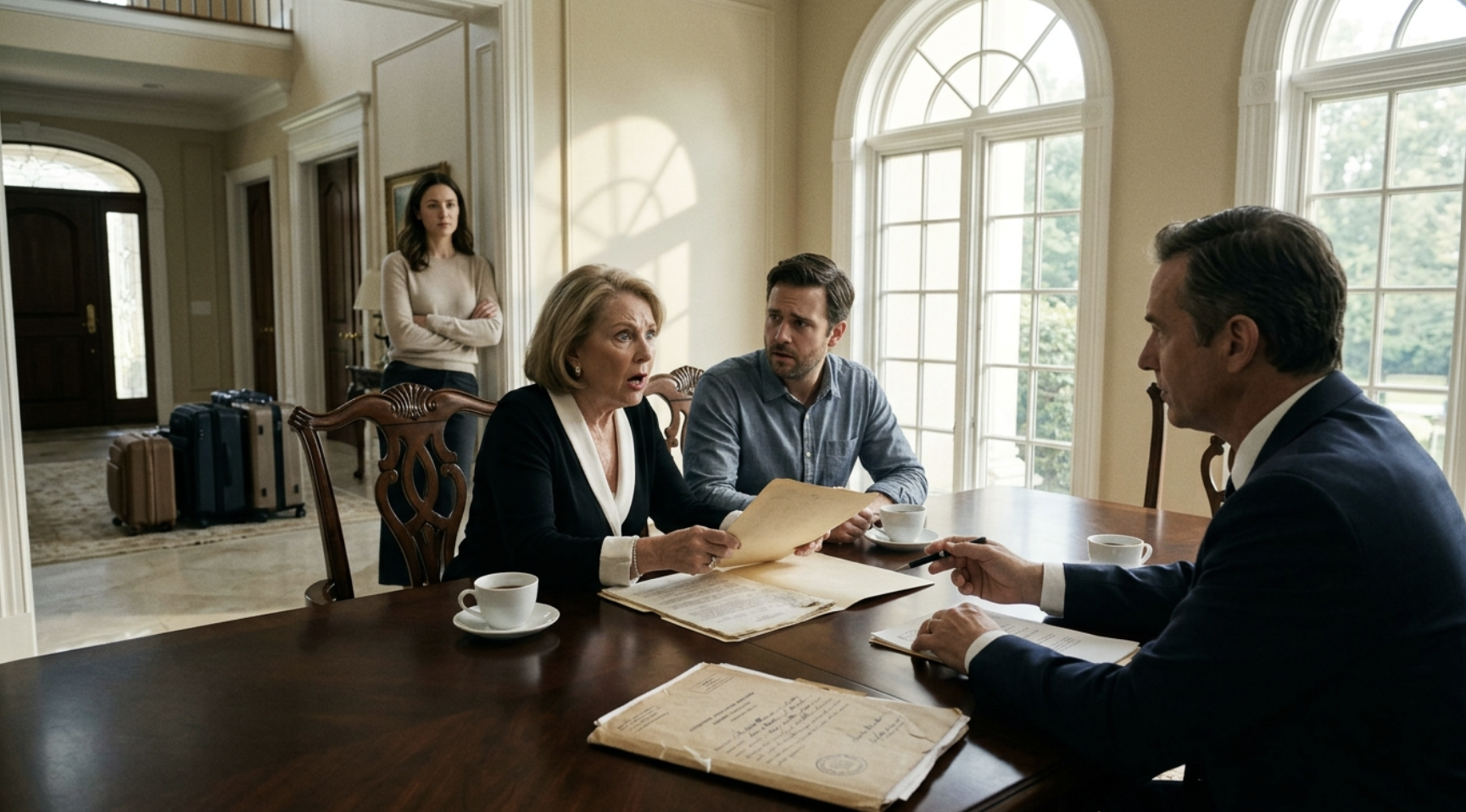
My Mother-in-Law Kicked Me Out of Her $2.8 Million Mansion—But One Letter From My Late Father-in-Law Changed Everything
PART 4
I stared at the sealed envelope on Charles Harrison’s desk.
For several seconds, neither of us spoke.
The envelope looked ordinary. Its edges had yellowed slightly with age, and Jonathan Richardson’s handwriting appeared across the front. But beneath the date, he had written a sentence that made my chest tighten.
To be opened only when someone in my family mistakes wealth for ownership of another person’s life.
I read it twice.
“Did Jonathan really write that?” I asked.
Charles nodded.
“He wrote it himself. I was present when he sealed the envelope.”
“Did he tell you what was inside?”
“No. He said the contents would make sense when the time came.”
Charles carefully opened the envelope.
Inside were three documents and a photograph.
The photograph showed Jonathan sitting on the back terrace of the mansion, smiling beside a woman I recognized immediately.
It was me.
But the photograph had been taken five years before I married Michael.
I remembered that afternoon. I had been working part-time for a small accounting firm, and Jonathan had invited several people to a charity fundraiser at the mansion. Michael had been away on business, and I had spent most of the afternoon helping an elderly guest who had become overwhelmed by the crowd.
Jonathan had thanked me afterward.
I had assumed he was simply being polite.
“Why would he keep this?” I whispered.
Charles examined the photograph.
“Because he wanted to remember something about you.”
He handed me the first document.
It was a record of a charitable donation made by Jonathan several years before his death. The donation had established a small financial assistance program for people who had lost their jobs or experienced unexpected hardship.
My name appeared in the supporting paperwork.
I frowned.
“I don’t understand. I never received money from Jonathan.”
“You didn’t,” Charles said. “You helped administer the program through the accounting firm you worked for at the time. You prepared some of the records and volunteered to help organize the donations.”
I slowly remembered.
For several months, I had helped process paperwork for the charity. I hadn’t known who had provided most of the funding because the donations had been made through a foundation.
Jonathan had apparently been one of its principal supporters.
“He recognized my name,” I said.
“More than that,” Charles replied. “He remembered that you insisted on checking every payment, even when doing so meant staying late. He told me you were one of the few people he had met who treated small amounts of money with the same care as large ones.”
I looked at the photograph again.
For years, I had believed I entered the Richardson family as an outsider who had to prove her worth.
Jonathan had met me long before that family became part of my life. He had seen how I behaved when I had nothing to gain from knowing him.
The second document was a letter from Jonathan to Charles.
It explained that Jonathan had become increasingly concerned about the way family decisions were being made. He worried that the mansion, the family investments, and the business interests attached to them had become more important to Eleanor than the people those assets were supposed to serve.
He had also noticed that Michael rarely challenged his mother’s decisions.
Jonathan did not accuse his wife of a crime. He did not claim his son was incapable of becoming a responsible adult.
Instead, he wrote that both had grown accustomed to avoiding difficult conversations.
I fear my son will confuse keeping the peace with doing the right thing, one sentence read.
I lowered the page.
That sentence described my marriage more accurately than anything I could have written myself.
Charles continued reading the letter.
Jonathan had arranged for an independent review of certain family financial accounts. He wanted to ensure that the estate would be administered according to its governing documents, rather than according to the wishes of whichever family member spoke the loudest.
He had also established a separate fund intended to support Michael’s future spouse in pursuing education, professional development, or independent living.
It was not a reward for marrying into the family.
It was protection against financial dependence.
The fund could not be controlled unilaterally by Eleanor, and its provisions could not be used to compel the beneficiary to remain in a marriage or residence.
I stared at the document.
“He wanted me to be able to leave if I needed to.”
Charles nodded.
“He believed that financial security should give someone choices, not take them away.”
For the first time, I understood the full meaning of Jonathan’s arrangements.
He had not tried to decide my future.
He had tried to make sure I could decide it for myself.
Then I noticed the third document.
It was a handwritten note addressed to Michael.
Charles explained that Jonathan had left it with instructions to deliver it if Michael ever became involved in a dispute over the estate’s property or the rights of someone living in the family home.
“Michael received a separate letter after his father’s death,” Charles said. “This one was intended for a more specific circumstance.”
I read the note silently.
Michael,
If you are reading this, ask yourself whether you have become the man you promised me you would be.
You do not have to agree with every decision your wife makes. You do not have to agree with every decision your mother makes either.
But you must never make someone you love pay the price for your fear of disappointing someone else.
If you allow another person to be humiliated because defending them would be uncomfortable, your silence becomes part of the humiliation.
I hope you learn this before you lose something that cannot be replaced.
Your father.
I sat back.
There was no accusation in the letter, no demand that Michael divorce his mother or abandon his family.
There was only an honest question.
Had he become the man he had promised to be?
I thought about Michael standing in the kitchen while his mother ordered me out. I remembered him carefully arranging my suitcases beside the door, as though organizing my departure could make it less cruel.
I wondered whether he had thought about that moment since.
“Charles,” I said, “I need to ask you something.”
“Go ahead.”
“If these documents protect me, does that mean I can take control of the mansion?”
“No,” he answered firmly. “And I want to be clear about that. The trust gives different people different rights. It does not automatically transfer ownership to you, and it doesn’t authorize you to take over the property.”
I nodded.
“Then I don’t want anyone pretending that is what I’m trying to do.”
“I understand.”
“I want the accounts reviewed. I want the legal arrangements respected. And I want to know why Eleanor believed she could force me out without even discussing it with me.”
Charles closed the folder.
“Those are reasonable questions. We will seek answers through the proper process.”
I left his office that afternoon carrying copies of the documents and Jonathan’s letter.
I had entered his office wondering whether I had any place in the Richardson family’s affairs.
I left knowing that my place in the world did not depend on their permission.
But the hardest conversation was still waiting for me.
Michael had called again that morning.
This time, I decided to answer.
The Husband Who Finally Had to Listen
“Lisa?”
Michael sounded exhausted.
“I’m here.”
“Can we meet? Just the two of us?”
I considered refusing.
Then I realized that I didn’t need to avoid him to protect myself. I needed to stop allowing his discomfort to dictate the terms of every conversation.
“Tomorrow afternoon,” I said. “Somewhere neutral. Not the mansion.”
We met at a quiet café near the park.
Michael was already there when I arrived. He stood as I approached, but I sat down without returning his nervous smile.
For a moment, he seemed unsure how to begin.
Finally, he said, “I read Dad’s letter.”
I waited.
“Charles sent me a copy after he explained what happened at the house. I didn’t know he had written that.”
“You knew he worried about your mother’s control over the family.”
Michael looked down.
“Yes.”
The admission surprised me.
He rubbed his hands together.
“When Dad was alive, he tried to get me to speak up more. He said I always waited until Mom made a decision and then convinced myself that agreeing was easier than arguing.”
“And what did you tell him?”
“That he didn’t understand how difficult she could be.”
I looked at him.
“Did he understand how difficult she was for me?”
Michael said nothing.
“That is what I needed you to understand five years ago,” I continued. “I wasn’t asking you to stop loving your mother. I was asking you to recognize that I was your wife, not an employee who had to earn permission to exist in your home.”
His eyes reddened.
“I know.”
“No, Michael. You understand it now because there are documents and lawyers involved. I need you to understand what it felt like before any of that existed.”
I told him about the dinners where Eleanor corrected me in front of guests. The holidays when I spent hours preparing food only to be reminded that I was fortunate to be included. The times she rearranged my belongings or criticized my clothes, and how he always told me to ignore her.
I told him about the loneliness of living in a mansion full of people and feeling that I had nowhere to belong.
Most importantly, I told him about the previous night.
“When I saw those suitcases, I realized you had made a decision about my life without asking me a single question. You didn’t even have the courage to look me in the eye.”
Michael covered his face.
“I thought if I did what Mom wanted, she would calm down. I thought we could talk afterward and work everything out.”
“You thought I would forgive you again.”
He slowly lowered his hands.
“Yes.”
For once, he didn’t offer an excuse.
“I have spent my entire life trying to keep her happy,” he admitted. “When Dad died, I felt responsible for her. I thought if I disagreed with her, I would be abandoning her.”
“And what did you think you were doing to me?”
His eyes filled with tears.
“I wasn’t thinking about you. Not the way I should have been.”
The honesty hurt more than another excuse would have.
I had wanted him to defend me for so long that I once believed one apology would repair everything.
But an apology could not return the years I had spent shrinking myself to make his family comfortable.
“Do you still want this marriage?” he asked.
“I don’t know.”
He flinched, but I continued.
“I love the man I believed you could be. I remember the person who made me laugh when we first met, who listened to my plans, who promised we would build a life together. But I cannot keep living with the man who disappears whenever his mother becomes unhappy.”
Michael nodded slowly.
“What do you need from me?”
“Time. Honesty. And change that doesn’t disappear the moment your mother gets angry.”
“I can do that.”
“You cannot promise it today. You have to prove it.”
He looked at me for a long moment.
Then he reached into his jacket and placed a small key on the table.
“What is this?” I asked.
“The key to the apartment I rented this morning.”
I stared at him.
“Why did you rent an apartment?”
“Because I need to learn how to live without having every decision made for me. And because I understand that you don’t want to return to the mansion right now.”
He paused.
“I also told Mom that I won’t participate in any decision about your belongings or your residence without first understanding the legal arrangements and speaking to you directly.”
It was the first meaningful action he had taken without asking me to manage his feelings about it.
But I wasn’t ready to reward him for doing what should have been ordinary.
“I’m glad you did that,” I said. “But it doesn’t change what happened.”
“I know.”
We sat quietly until our coffee grew cold.
When we finally stood to leave, Michael didn’t ask me to come home.
He didn’t ask me to forgive him.
He simply said, “I’m sorry, Lisa.”
This time, I believed that he understood what he was apologizing for.
Whether he could become a better husband remained a different question.
The Financial Records Reveal a Bigger Problem
Over the following two weeks, Charles worked with an independent accountant to examine the Richardson estate’s records.
I remained at the hotel for several nights before moving into a small furnished apartment.
It was nothing like the mansion.
There were no marble floors, no enormous windows, and no landscaped gardens. The kitchen was barely large enough for two people to stand in comfortably.
But I could leave my shoes wherever I wanted.
I could cook without someone inspecting my food.
I could sit in silence without wondering whether my presence was irritating anyone.
Every evening, I returned to that little apartment and felt a kind of peace I hadn’t experienced in years.
Meanwhile, the financial review uncovered several questionable transactions.
The property company receiving recurring payments had been established by an associate of Eleanor’s. Some of the invoices described services that had not been adequately documented. Other payments appeared to overlap with expenses already recorded elsewhere.
The accountant could not yet determine whether the transactions represented improper payments, careless recordkeeping, or legitimate expenses supported by missing documents.
But the pattern was serious enough to warrant a more thorough examination.
Charles sent a formal request for the remaining records.
Eleanor responded with anger.
She accused him of humiliating her and allowing Lisa to interfere in private family matters.
Charles replied that the review was required by his professional responsibilities and the estate documents.
Then came a discovery that changed the entire dispute.
A transfer of funds had been made from an account associated with the estate into a separate investment account. The transaction was not automatically unlawful, but the authorization records were incomplete, and the money had not been clearly accounted for in the estate’s summaries.
The amount was large enough that the accountant recommended an independent investigation.
Charles contacted the appropriate professionals, preserved the records, and advised the family not to move or dispose of any disputed assets while the matter was being examined.
When Eleanor learned about the recommendation, she called Michael.
I wasn’t present for the conversation, but he told me about it afterward.
“She said Dad would be ashamed of me,” he explained during one of our scheduled conversations.
“What did you say?”
“I told her Dad’s wishes couldn’t be established by whichever one of us shouted loudest. I told her we had to let the review happen.”
“And how did she react?”
“She said I had changed.”
I looked at him.
“What did you tell her?”
“That I hoped I had.”
For the first time, Michael had disagreed with his mother without immediately calling me afterward to complain about how upset she was.
It was a small step, but it was a real one.
The review continued.
Several weeks later, the accountant concluded that some payments had been poorly documented and that certain transfers required further explanation. There was not enough evidence to establish that Eleanor had personally stolen money, and Charles cautioned everyone against making accusations before the investigation was complete.
The estate’s trustees restricted certain transactions while they obtained additional records.
Eventually, the property company produced some of the missing invoices. Several expenses were legitimate, but others could not be adequately substantiated. The disputed sums were referred for further review, and the trustees began the process of recovering amounts that could not be justified under the governing arrangements.
Eleanor was furious.
She claimed that everyone had turned against her.
But the documents did not care who felt betrayed.
They simply required answers.
And for the first time, Eleanor could not end a difficult conversation by declaring that the house belonged to her and everyone else needed to obey.
The Confrontation at the Mansion
Three months after I left, Charles arranged a meeting at the mansion.
The purpose was to review the findings, explain the trust’s requirements, and discuss how the household would operate going forward.
I almost declined.
I had no desire to return to the place where I had been humiliated.
But I decided that if I was going to close this chapter of my life, I would do so on my own terms.
When I arrived, Eleanor was sitting in the drawing room.
She wore her usual pearls and cream blouse, but her expression was different. The old certainty had been replaced by a brittle defensiveness.
Michael stood near the window.
Charles placed the final review documents on the table.
“The investigation has clarified several important issues,” he began. “The mansion remains subject to the family trust. Eleanor retains the rights granted to her under its terms, while other decisions must be made in accordance with the trust’s provisions. No individual family member has unrestricted authority over every aspect of the property.”
Eleanor looked away.
“The financial review also identified expenses that were inadequately supported. Some have now been explained, while others remain subject to recovery or further review. The trustees will continue to manage those matters according to their legal obligations.”
She pressed her lips together.
Then she turned to me.
“Are you happy now?”
I had imagined this moment many times.
In some versions, I would tell her everything I had wanted to say for five years. I would describe every insult and every humiliation. I would make her understand how much damage she had done.
But sitting across from her, I realized I no longer needed her to understand me in order to move forward.
“No,” I answered quietly. “I’m not happy that the family has gone through this. I’m relieved that the truth is finally being examined.”
She gave a dismissive laugh.
“You could have stayed out of it.”
“You told me to leave the house. Your son packed my belongings. I had every right to understand my legal position.”
“You could have handled it privately.”
“I tried handling things privately for five years. I stayed quiet when you criticized me. I stayed quiet when you treated me as though I didn’t belong. I stayed quiet when your son refused to defend me.”
I paused.
“Being quiet didn’t make the situation better. It only made it easier for everyone else to ignore.”
Eleanor’s eyes flashed.
“You have turned Michael against me.”
“No,” I said. “Michael is responsible for his own choices. I cannot control his relationship with you, and I don’t want to. I only want him to understand that loving you doesn’t require him to mistreat me.”
For a long moment, she said nothing.
TO BE CONTINUED IN THE FINAL PART…
👉 Keep Reading — Click the next page below 👇