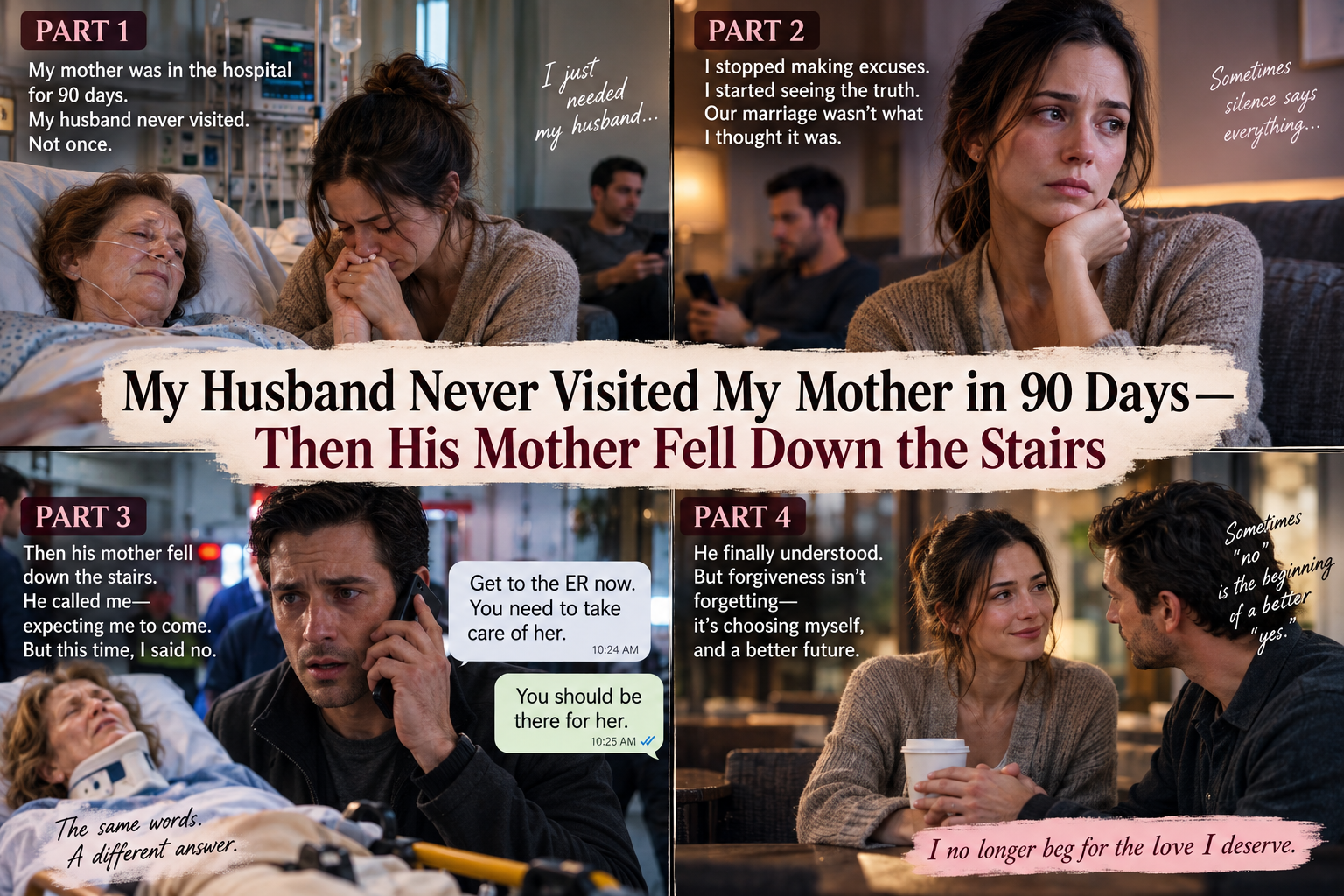
PART 1 — The Call That Changed Everything
“Rachel, get to the ER. My mother needs you.”
I stared at Grant’s message for nearly a minute.
My fingers hovered over the screen, but I didn’t type anything.
I couldn’t.
Because one year earlier, my own mother had spent ninety terrifying days in a hospital bed.
Ninety days of surgeries.
Ninety days of complications, sleepless nights, medical updates, and whispered prayers.
And during all ninety of those days, my husband had never once walked through the hospital doors.
Not once.
Now his mother was lying in an emergency room, and suddenly Grant needed me.
Not asked.
Needed.
He expected me to drop everything and come running.
Just like I always had.
But he didn’t know something important.
The woman who would have done anything for him a year ago was gone.
I slowly placed my phone on the kitchen counter.
Then I looked at the message again.
Get to the ER now. You need to take care of her.
I almost laughed.
Instead, I typed six words.
You should be there for her.
Then I pressed send.
Within thirty seconds, my phone started ringing.
Grant.
I let it ring.
Then it rang again.
And again.
For the first time in our marriage, I didn’t feel guilty for ignoring him.
To understand why, you need to go back to the beginning.
A year earlier, my mother called me from the parking lot of a small medical clinic.
“Rachel, don’t worry,” she said.
That was always how my mother began bad news.
“Why are you telling me not to worry?”
“The doctor wants me to have some additional tests.”
“What kind of tests?”
There was a pause.
“They found something near my stomach.”
My heart immediately sank.
“What do you mean, something?”
“They aren’t sure yet.”
“Mom, where are you?”
“I’m still at the clinic.”
“I’ll come get you.”
“You don’t have to leave work.”
“I already am.”
“Rachel—”
“I’ll be there in twenty minutes.”
I hung up before she could argue.
My mother’s name was Helen.
She was the strongest person I knew.
She had worked through fevers.
She once broke her wrist and continued working for almost an entire day before admitting she was hurt.
She hated hospitals.
She hated being treated like a patient.
And she especially hated making other people worry.
So when she called me herself and admitted that something was wrong, I knew it was serious.
I stopped at our condo before going to the hospital.
Grant was sitting on the sofa watching television.
He looked up when I grabbed my coat.
“What’s going on?”
“My mom needs more tests.”
“Is she okay?”
“They found something.”
He frowned.
“What kind of something?”
“I don’t know yet.”
He nodded.
“Keep me posted.”
That was it.
No hug.
No offer to come with me.
No concern beyond those three words.
But I didn’t think much about it.
Not then.
Grant had always been uncomfortable around sickness.
That was what I told myself.
He wasn’t a bad person.
He just didn’t know how to deal with hospitals.
I had spent seven years finding explanations for his behavior.
I didn’t realize I was also finding excuses.
The tests led to a biopsy.
The biopsy led to a specialist.
And three days later, my mother and I sat in a small examination room while the doctor gave us the diagnosis.
Cancer.
For several seconds, nobody spoke.
My mother’s hand tightened around mine.
I stared at the doctor.
“What happens now?”
“We need to move quickly,” he explained. “The first step will be surgery.”
“How soon?”
“Next Thursday.”
I nodded even though my mind felt completely numb.
That evening, I told Grant.
He was in the kitchen opening a bottle of wine.
“My mom has cancer.”
He stopped.
“What?”
“They found a tumor.”
“Is it serious?”
“Yes.”
“What happens next?”
“Surgery next Thursday. They may need to do more afterward.”
Grant poured wine into his glass.
“That soon?”
“The doctor doesn’t want to wait.”
He nodded slowly.
“That’s terrible.”
I waited.
I don’t know what I expected.
Maybe:
I’ll come with you.
Maybe:
You don’t have to go through this alone.
Instead, he asked:
“Should I order something for dinner?”
I stared at him.
“No.”
He looked confused.
“Okay.”
I walked into the bedroom and closed the door.
That was the first night I cried over my mother’s diagnosis.
And the first night I wondered whether my husband understood what I needed from him.
My mother’s first surgery lasted almost six hours.
I sat alone in the waiting room, staring at the clock.
Grant sent one message.
Any update?
I replied:
Still in surgery.
His answer came almost immediately.
👍
Just one symbol.
When the surgeon finally came out, I stood so quickly that my chair nearly fell behind me.
“The surgery went as planned,” he said. “But the next few days are important.”
I thanked him.
Then I called Grant.
“Can you come?”
“Now?”
“Yes.”
“I have an early meeting tomorrow.”
“You don’t have to stay all night.”
“Rachel, she’s stable.”
“I know.”
“So what would I do there?”
I swallowed.
“You could sit with me.”
Silence.
Then he said:
“The hospital is almost an hour away.”
I closed my eyes.
“Forget it.”
“Don’t be upset.”
“I’m not.”
“I’ll come tomorrow.”
He didn’t.
The next day, he had a client dinner.
After that, he said he wasn’t feeling well.
Then he had work.
Then another excuse.
Days became weeks.
And my mother remained in the hospital.
During the second week, my mother’s condition became more complicated.
An infection developed.
Her doctors changed her medication.
She needed additional monitoring.
I practically lived at the hospital.
I worked from my mother’s room.
I answered emails beside her bed.
I ate whatever I could find in the cafeteria.
Some nights I slept in a chair.
Grant, however, had a different concern.
One night, I came home after ten.
The kitchen was full of dirty dishes.
Laundry was piled beside the washing machine.
Grant was lying on the bed scrolling through his phone.
“There isn’t any clean laundry,” he said.
I stared at him.
“I’ve been at the hospital all day.”
“I know.”
“Then why are you telling me?”
“Because I’m just saying.”
I walked toward the bathroom.
“Rachel.”
I stopped.
“You’ve been really irritable lately.”
I turned around.
“My mother has cancer.”
“I know.”
“She almost died during surgery.”
“I know.”
“Then maybe don’t complain to me about laundry.”
His expression hardened.
“You don’t have to talk to me like that.”
I went into the bathroom and locked the door.
I stood in front of the mirror.
My hair was a mess.
My eyes were swollen.
My sweater still smelled like hospital coffee.
And suddenly, I didn’t recognize myself.
I had become so focused on keeping my mother alive that I had forgotten to ask whether my marriage was alive.
A few weeks later, my mother needed another operation.
The doctor warned us that the recovery would be difficult.
I called Grant.
“They’re taking Mom into surgery tomorrow.”
“I’m sorry.”
“Will you come tonight?”
“I have dinner with Marcus.”
“Cancel it.”
“Rachel…”
“My mother is having another operation.”
“And me sitting beside you won’t change the outcome.”
His words were quiet.
But they hurt.
Because he was talking about my mother’s surgery as though the only purpose of his presence would be to change the doctor’s decisions.
“You’re right,” I whispered.
“What?”
“You don’t have to come.”
“Rachel—”
“I understand.”
I ended the call.
That night, I sat beside my mother’s bed until morning.
And something inside me began to change.
Christmas came.
My mother was still in the hospital.
Grant’s family planned their usual Christmas Eve dinner at his mother’s house.
Diane had prepared everything weeks in advance.
Grant expected me to attend.
“I’ll come if Mom is doing well,” I said.
“She’ll have nurses there.”
“She needs me.”
“She’ll be asleep most of the evening.”
“I still want to stay.”
Grant sighed.
“Rachel, you’re making everything about the hospital.”
“My mother has cancer.”
“I know.”
“Then come with me.”
“I already told you how I feel about hospitals.”
I looked at him.
“No.”
He frowned.
“No what?”
“You told me how you feel about hospitals.”
I picked up my coat.
“You never told me how you feel about me.”
His face went still.
Before he could answer, my phone rang.
It was the hospital.
My mother’s blood pressure had suddenly dropped.
I grabbed my bag.
“I’m going back.”
Grant followed me toward the door.
“Now?”
“Yes.”
“Are you still coming to dinner?”
“I don’t know.”
“My family has been waiting all week for this.”
“My mother might need another procedure.”
Grant shook his head.
“You can’t keep doing this.”
I looked at him.
“Doing what?”
“Choosing the hospital every time.”
I couldn’t believe what I was hearing.
“That’s my mother.”
“She has doctors.”
“And I am her daughter.”
He sighed.
Then he said something I would remember for the rest of my life.
“If you need someone to sit with her, hire a private nurse.”
I stared at him.
“I don’t need a nurse.”
“What do you need?”
My voice broke.
“I need my husband.”
Grant looked away.
“I can’t do this tonight.”
He drove me to the hospital.
He didn’t even get out of the car.
I opened the trunk and pulled out my mother’s bag myself.
Then I walked inside.
At 9:40 p.m., Grant sent me a photograph from his family’s Christmas dinner.
Everyone was smiling.
Everyone looked happy.
His message said:
Wish you were here.
I stared at the screen.
Then I looked at my mother.
She was asleep beneath a white blanket, surrounded by machines.
And for the first time, I stopped asking myself how to save my marriage.
I asked a different question.
What would happen if I stopped trying?
I didn’t know it then.
But that question would change everything.
And almost exactly one year later, Grant would finally understand what it meant to need someone who wasn’t there.
Because his mother would fall down a staircase.
And he would call the one person he had spent ninety days abandoning.
Me.
PART 2 — The Marriage I Could No Longer Pretend Was Fine
The thought stayed with me long after midnight.
I sat beside my mother’s hospital bed with my phone turned face down on my lap, listening to the steady beeping of the machines.
Every few minutes, a nurse passed the doorway.
Every few minutes, I looked at my mother.
And every few minutes, I thought about Grant.
Not the Grant who had stood beside me on our wedding day.
Not the man who used to bring me coffee every morning when we were newly married.
Not the husband I had spent years defending whenever someone questioned him.
I was thinking about the man who had watched me walk into a hospital alone on Christmas Eve and never once considered following me inside.
For years, I had told myself that Grant simply handled difficult situations differently.
That he was uncomfortable around sickness.
That he didn’t know what to say.
That he showed love in other ways.
But sitting there that night, I finally realized something.
I had spent years explaining his absence because admitting the truth was too painful.
He wasn’t confused about what I needed.
I had told him.
Again and again.
He simply hadn’t considered my needs important enough.
The next morning, my mother opened her eyes.
“Did you sleep?”
“A little.”
She smiled weakly.
“You look exhausted.”
“So do you.”
She laughed softly.
Then she noticed my phone.
“Did Grant come?”
I hesitated.
“No.”
Her smile disappeared.
“He must have been busy.”
I looked at her.
“Mom…”
“He’s working hard.”
“You don’t have to defend him.”
“I’m not.”
“You are.”
She reached for my hand.
“Rachel, marriage isn’t always easy.”
“I know.”
“You love him.”
I looked down at our hands.
“I thought I did.”
My mother studied my face.
“What does that mean?”
I didn’t answer.
Because I wasn’t sure.
Over the next few weeks, I started noticing things I had ignored for years.
Grant rarely asked how my mother was doing unless I mentioned her first.
When he did ask, it was usually followed by a question about work.
He never asked what the doctors had said.
He never asked whether I was sleeping.
He never asked whether I was scared.
But he did notice when dinner wasn’t ready.
He noticed when his shirts weren’t ironed.
He noticed when I came home late.
One evening, I walked through the door after spending eleven hours at the hospital.
Grant was standing in the kitchen.
“Did you pick up my dry cleaning?”
I stopped.
“No.”
“You forgot?”
“I’ve been at the hospital.”
“I know.”
“Then why are you asking?”
“Because I needed it for tomorrow.”
I put my bag down.
“Grant, my mother is fighting cancer.”
He sighed.
“I know that.”
“Do you?”
His eyes narrowed.
“What is that supposed to mean?”
“It means I don’t think you understand what the last month has been like.”
“I’ve been supportive.”
I stared at him.
“You sent flowers.”
“I also called.”
“When?”
He opened his mouth.
Then closed it.
He couldn’t remember.
Neither could I.
Because there hadn’t been many calls.
My mother’s recovery became complicated again.
She developed another infection.
Her doctors changed her treatment.
One afternoon, the specialist told me they needed to keep her in the hospital longer.
I sat beside her bed after he left.
My mother looked at me.
“Don’t cry.”
“I’m not.”
“You are.”
I wiped my face.
“I’m just tired.”
She squeezed my hand.
“You need to take care of yourself too.”
“I will.”
That evening, I called Grant.
“Can you come to the hospital tomorrow?”
“What time?”
“Whenever you can.”
“I have meetings.”
“After work?”
“I’ll see.”
I waited.
“Grant?”
“What?”
“Please.”
Another pause.
“Okay. I’ll try.”
The next day came.
He didn’t come.
He didn’t even call.
At 11:30 that night, I received a text.
Sorry. Long day.
I stared at the message.
Then I deleted it.
Not because I was angry.
Because I was finally tired of being disappointed.
By the time my mother had been in the hospital for almost ninety days, something inside me had become strangely calm.
I stopped asking Grant to visit.
I stopped asking him to call.
I stopped telling him every detail about my mother’s condition.
Not because I didn’t care.
Because I had finally learned that begging someone to care doesn’t create love.
My mother eventually improved enough to go home.
The day she left the hospital, I helped her into my car.
She looked at the hospital entrance behind us.
“I’m glad that’s over.”
“So am I.”
Then she looked at me.
“Are you going home?”
I knew what she meant.
“Eventually.”
She didn’t ask anything else.
Three months later, I made a decision.
I moved into the guest room.
Grant noticed immediately.
“What are you doing?”
“Sleeping here.”
“Why?”
“Because I want some space.”
He stared at me.
“Are you serious?”
“Yes.”
“Because of my mother?”
“No.”
“Then what?”
I turned toward him.
“Because of yours?”
He looked confused.
“What does my mother have to do with anything?”
“Nothing.”
I shook my head.
“That’s exactly the problem.”
Grant tried to fix things.
For a while, he was attentive.
He came home earlier.
He brought flowers.
He asked about my mother.
He even suggested that we take a weekend trip together.
But every gesture felt late.
Like someone arriving at a burning house with a bucket of water after the fire was already out.
I didn’t hate him.
That surprised me.
I had expected anger.
Instead, I felt sadness.
I was grieving the marriage I thought I had.
Almost a year passed.
My mother became stronger.
She still had difficult days, but she was home.
She could walk around the neighborhood.
She could cook simple meals.
She laughed again.
And slowly, so did I.
I started rebuilding the parts of myself I had neglected.
I saw old friends.
I returned to hobbies I had abandoned.
I stopped arranging my entire life around Grant’s schedule.
For the first time in years, I made decisions without wondering whether he would approve.
Then one Tuesday afternoon, everything changed.
My phone rang.
It was Grant.
I answered.
“Rachel?”
His voice sounded different.
Shaky.
“What happened?”
“It’s my mom.”
My stomach tightened.
“Diane?”
“She fell.”
“What?”
“She fell down the stairs.”
I stood up.
“Is she conscious?”
“I don’t know.”
I heard sirens behind him.
“The ambulance is taking her to the emergency room.”
I grabbed my purse.
“Which hospital?”
Then Grant said something I never expected to hear.
“Get there now.”
I froze.
“Why?”
“You need to take care of her.”
For several seconds, I couldn’t speak.
Then I looked down at my phone.
One sentence repeated itself in my head.
You need to take care of her.
A year ago, those words would have sent me running.
This time, they did something completely different.
They reminded me of Christmas Eve.
My mother lying in a hospital bed.
My hands shaking.
My voice begging Grant to come inside.
And his answer.
I can’t spend every evening in a hospital because your mother is sick.
I slowly sat back down.
Grant was still talking.
“Rachel? Are you listening?”
“Yes.”
“Then come.”
I closed my eyes.
And for the first time in our marriage, I knew exactly what my answer was going to be.
“No.”
PART 3 — The Call I Never Thought I Would Receive
“No.”
The word came out quietly.
But Grant heard it.
“What did you say?”
“I said no.”
“Rachel, this isn’t the time for this.”
I almost smiled.
He still didn’t understand.
“You’re right,” I said. “It isn’t.”
“My mother is in the emergency room.”
“I know.”
“She fell down the stairs.”
“I heard you.”
“Then why aren’t you getting in your car?”
I looked toward the window.
For years, I had believed that being a good wife meant being available whenever Grant needed me.
His family needed something?
I was there.
His mother needed help?
I went.
His sister needed a favor?
I rearranged my schedule.
And when my mother needed me, I had expected Grant to stand beside me.
He hadn’t.
Now he was asking me to do exactly what he had refused to do.
“Grant,” I said calmly, “you need to stay with your mother.”
“I am with her.”
“Then stay.”
“She needs someone to handle things.”
“You can handle them.”
“You don’t understand.”
I let out a quiet breath.
“Oh, I understand perfectly.”
There was silence on the phone.
Then Grant lowered his voice.
“Are you punishing me?”
“No.”
“Then what is this?”
“A boundary.”
“You’re my wife.”
“Yes.”
“And my mother needs help.”
“I hope she gets better.”
“That isn’t enough.”
I closed my eyes.
One year earlier, I had said almost the same thing.
I need my husband.
Grant had answered with excuses.
Now I was giving him the answer he had given me.
Not out of revenge.
Not because I wanted Diane to suffer.
But because I couldn’t keep abandoning myself just to make someone else comfortable.
“I’ll help if there’s something I can reasonably do from here,” I said.
“But you’re not coming?”
“No.”
“Rachel…”
“I have to go.”
I ended the call.
My hands were trembling.
Not because I felt guilty.
Because I realized how difficult it had been to say one simple word.
No.
Twenty minutes later, my phone rang again.
Grant.
I answered.
“Rachel, please.”
His voice sounded completely different now.
There was fear underneath it.
“The doctors think she may have a head injury.”
“Is she awake?”
“Yes, but she’s confused.”
“Then stay with her.”
“I am staying.”
“Good.”
“Can you at least come for an hour?”
I looked down at my hands.
“No.”
He was silent.
Then he asked:
“Why?”
I swallowed.
“Because when my mother was lying in that hospital bed, I asked you for an hour.”
Nothing.
“You couldn’t give me one.”
“I know.”
“You said the hospital was too far.”
“I know.”
“You said you had work.”
“I know.”
“You told me to hire someone.”
His voice cracked.
“Rachel, I know.”
“And now you’re asking me to do what you refused to do.”
“I was wrong.”
Those three words stopped me.
Grant had never said them before.
Not like this.
“I was wrong,” he repeated. “I should have been there.”
I sat quietly.
Part of me had waited a year to hear those words.
But hearing them now didn’t erase the past.
“I wish you had understood that before today,” I said.
Then I ended the call.
That night, I went to see my mother.
She was sitting at the kitchen table, carefully peeling an apple.
“You look troubled,” she said.
“Grant’s mother had an accident.”
My mother’s hands stopped.
“Is she okay?”
“She fell down the stairs. She’s in the hospital.”
“Oh, Rachel.”
“I didn’t go.”
My mother looked at me.
“Why?”
“Because Grant told me to go take care of her.”
My mother was quiet.
Then she asked:
“What did you want to do?”
“I wanted to say yes.”
“But you didn’t.”
“No.”
She nodded slowly.
“Then maybe you finally listened to yourself.”
I looked down.
“I feel guilty.”
“That’s because you’re used to putting everyone else first.”
She reached across the table.
“Being kind doesn’t mean you have to keep hurting yourself.”
Her words stayed with me.
The next morning, Grant came to my mother’s house.
I was surprised to see him standing outside.
He looked exhausted.
His shirt was wrinkled.
His eyes were red.
“Can we talk?”
My mother looked at me.
I nodded.
We stepped onto the porch.
“How is Diane?”
“She had a concussion and a broken leg. The doctors want to keep her for observation.”
“I’m glad she’s stable.”
Grant looked at me.
“I stayed all night.”
I nodded.
“You should.”
He looked away.
“I kept thinking about your mother.”
I said nothing.
“I remembered you sitting beside her.”
Still nothing.
“I remembered you asking me to come.”
His voice became quieter.
“And I remembered walking away.”
I looked at him.
“What do you want me to say?”
“I don’t know.”
He rubbed his face.
“I thought I was being practical back then.”
“You were.”
He looked confused.
“You were practical,” I continued. “You just weren’t compassionate.”
That hurt him.
I could see it.
But I didn’t take the words back.
Grant sat on the porch steps.
“I was selfish.”
“I know.”
“I thought because your mother had doctors and nurses, she didn’t really need me.”
“She needed her daughter.”
“And you needed your husband.”
“Yes.”
He nodded.
“I understand now.”
I looked at him.
“No.”
He frowned.
“You don’t understand now.”
“Why not?”
“Because understanding what it feels like to be afraid for someone doesn’t automatically teach you how to show up for someone else.”
He lowered his head.
“You’re right.”
“I don’t want you to say I’m right.”
“Then what do you want?”
I thought about it.
“I want you to become the person you should have been before you needed to learn this lesson.”
He didn’t answer.
For a long moment, we sat in silence.
Then he said:
“Can I start?”
I looked at him.
“Start what?”
“Changing.”
I didn’t promise anything.
I didn’t tell him everything would be okay.
I simply said:
“That’s up to you.”
Three days later, Diane was released from the hospital.
Grant became her primary caregiver.
He arranged her medications.
He drove her to appointments.
He helped her move around the house.
And for the first time, I saw him doing the things he had once told me were unnecessary.
One evening, he called me.
“She asked about you.”
“How is she?”
“She wants to thank you.”
“For what?”
“For not abandoning her.”
I was quiet.
Then I understood the irony.
I had never abandoned Diane.
I had simply refused to abandon myself.
A week later, Diane called me herself.
“Rachel?”
“Hi, Diane.”
“I owe you an apology.”
“You don’t owe me anything.”
“I do.”
She took a breath.
“I should have asked about your mother.”
I didn’t know what to say.
“I knew she was sick,” Diane continued. “But I never understood how serious it was.”
“You could have called.”
“I know.”
“And Grant should have come.”
There was a pause.
“Yes.”
Her voice became softer.
“I didn’t teach him to ignore you.”
“I know.”
“But I should have noticed.”
I appreciated that more than she probably realized.
“I’m glad you’re recovering,” I told her.
“Thank you.”
Then she said something that surprised me.
“I hope one day you can forgive my son.”
I looked out the window.
“Forgiveness isn’t the same as going back.”
“I understand.”
And that was exactly the point.
I wasn’t trying to punish Grant.
I was trying to decide whether there was anything left worth rebuilding.
Two weeks later, Grant asked me to meet him at the same coffee shop where we had gone on our second date.
He was already waiting when I arrived.
There were no flowers.
No dramatic speech.
Just two cups of coffee.
“I don’t expect you to forgive me today,” he said.
“Good.”
He smiled sadly.
“I deserve that.”
I sat down.
He pushed one of the cups toward me.
“I’ve been thinking about what you said.”
“Which part?”
“That I needed to become the person I should have been before I learned the lesson.”
I nodded.
“I started therapy.”
I didn’t react.
“I’ve also started helping my mother every day.”
“That’s good.”
“And I apologized to your mother.”
I looked at him.
“You did?”
“Yes.”
“What did she say?”
“She told me I had been an idiot.”
I laughed despite myself.
“That sounds like Mom.”
Grant smiled.
Then his expression became serious.
“I can’t change what happened.”
“No.”
“But I can decide what happens next.”
I looked at him for a long time.
For the first time, I didn’t see the husband who had failed me.
I saw a man who had finally realized that love wasn’t something you claimed.
It was something you demonstrated.
Still, I wasn’t ready to go home.
“I need time,” I said.
“I’ll give you time.”
“And I don’t want promises.”
“Okay.”
“I want actions.”
He nodded.
“You’ll have them.”
I stood up.
“Then we’ll see.”
As I walked away, my phone buzzed.
It was a message from my mother.
Dinner Sunday? I’m making your favorite.
I smiled.
For the first time in a long time, my future didn’t feel like something I had to fear.
It felt like something I could choose.
And I had no idea that one final conversation with Grant would force me to make that choice.
PART 4 — The Choice I Had Been Avoiding
Three weeks passed after that conversation at the coffee shop.
Grant didn’t pressure me.
He didn’t send long messages asking me to come home.
He didn’t make promises he couldn’t keep.
Instead, he did something I had never seen him do before.
He simply showed up.
Not for me.
Not to win me back.
But because he had finally learned that showing up was part of loving someone.
He visited my mother.
The first time he walked through her front door, I wasn’t there.
My mother told me about it later.
“He stayed for almost two hours,” she said.
“What did you talk about?”
“Mostly nonsense.”
She smiled.
“He helped me fix the loose cabinet door in the kitchen.”
I laughed.
“That sounds like him.”
Then she became quiet.
“He apologized.”
I looked at her.
“What did he say?”
“That he should have been there.”
My mother looked down at her hands.
“He said he couldn’t understand why he had been so distant.”
I didn’t know what to feel.
Part of me was relieved.
Another part wondered why it had taken a crisis involving his own mother for him to finally understand mine.
A month later, Grant asked if I would visit Diane.
I agreed.
Diane was recovering slowly.
She was still using a walker, but she was stronger.
When I entered her living room, she smiled.
“Rachel.”
“Hi.”
“Come sit.”
I sat beside her.
For a few moments, neither of us spoke.
Then Diane said:
“I’ve been thinking about something.”
“What?”
“What happened to your mother.”
I waited.
“I kept telling myself that Grant was simply uncomfortable with hospitals.”
She shook her head.
“But I realize now that I helped him make excuses.”
“You didn’t know everything.”
“I should have asked.”
I looked at her.
She continued.
“When my son called you from the emergency room, I heard him say that you needed to come take care of me.”
She gave a small, embarrassed smile.
“I told him something.”
“What?”
“I told him that you weren’t my nurse.”
I couldn’t help smiling.
“What did he say?”
“He didn’t say anything.”
Diane looked directly at me.
“Rachel, you were his wife. You were never supposed to be responsible for everyone while he stood on the sidelines.”
Those words hit harder than I expected.
I reached for her hand.
“Thank you.”
She squeezed mine.
That evening, Grant drove me home.
We sat in the car outside my building.
The engine was off.
Neither of us moved.
“I want to ask you something,” he said.
“Okay.”
“Do you still love me?”
I stared through the windshield.
It was the question I had been avoiding.
“I don’t know.”
He nodded.
“I was afraid you’d say that.”
“I still care about you.”
“That isn’t the same thing.”
“No.”
He looked down.
“I understand.”
I turned toward him.
“Do you?”
“Yes.”
He took a slow breath.
“I used to think marriage meant knowing that someone would always be there.”
I said nothing.
“Now I understand that it means making sure the other person knows you’ll be there.”
I looked at him.
“That should have been obvious.”
“It should have.”
He didn’t defend himself.
He didn’t ask me to forget.
He simply accepted the truth.
“I can’t promise that I’ll trust you immediately,” I said.
“I know.”
“I can’t promise that we’ll stay married.”
His eyes lowered.
“I know.”
“And I can’t promise that the past won’t come back sometimes.”
“I know.”
I took a breath.
“But I can promise one thing.”
He looked at me.
“I won’t lie to myself anymore.”
He nodded.
“That’s fair.”
I opened the car door.
Before I stepped out, Grant said:
“Rachel?”
I turned.
“Thank you for not becoming cruel.”
I looked at him.
“I almost did.”
“I know.”
“But I realized something.”
“What?”
“Your failure doesn’t have to become my character.”
He smiled sadly.
“I hope I can become someone worthy of the person you are now.”
I closed the door.
Six months later, my mother invited both of us to dinner.
I wasn’t sure whether it was a good idea.
But I went.
Grant arrived carrying a small bag of groceries.
My mother looked at him.
“You brought food?”
“I figured you could use some help.”
She smiled.
“Then you can chop the vegetables.”
Grant laughed.
“Yes, ma’am.”
I watched them from the doorway.
It was strange.
Not because everything was suddenly perfect.
It wasn’t.
Trust doesn’t return because someone says sorry.
A marriage doesn’t heal because one person finally understands what they did wrong.
Healing takes time.
Sometimes a lot of it.
But Grant was different.
And more importantly, I was different.
I no longer measured my worth by how much I could sacrifice for someone else.
I no longer believed saying “no” made me selfish.
And I no longer confused forgiveness with forgetting.
After dinner, my mother went into the kitchen.
Grant stayed behind.
“I have something for you,” he said.
He reached into his jacket and handed me a small envelope.
Inside was a photograph.
It was from the hospital.
My mother was sitting in a chair beside the window.
She was smiling.
On the back, Grant had written:
I should have been there. I’m sorry I wasn’t.
I stared at the photograph.
“You don’t have to keep apologizing.”
“I know.”
“Then why write this?”
“Because I never want to forget.”
I looked at him.
He wasn’t asking me for anything.
No forgiveness.
No promise.
No second chance.
Just acknowledgment.
I placed the photograph carefully inside my purse.
“Thank you.”
That night, as I walked my mother to the door, she whispered:
“Are you happy?”
I looked at Grant waiting beside his car.
Then I looked back at her.
“I think I’m learning what happiness actually means.”
She smiled.
“What does it mean?”
I thought for a moment.
“Being with someone who makes you feel less alone.”
My mother nodded.
“That’s a good answer.”
Grant and I didn’t magically return to the marriage we had before.
We built something different.
Something slower.
Something more honest.
There were still difficult conversations.
There were still moments when the past hurt.
But now, when one of us needed the other, we showed up.
Not because we were obligated.
Not because someone demanded it.
Because we finally understood what love required.
A year after Diane’s accident, my mother and I went back to the hospital where her treatment had begun.
We stood outside the entrance for a moment.
She took my hand.
“You know,” she said, “I don’t think you’ll ever forget this place.”
“No.”
“Neither will I.”
I looked at the doors.
For a long time, I had remembered that hospital as the place where my marriage had fallen apart.
Now I saw it differently.
It was also the place where I learned to stop abandoning myself.
My mother squeezed my hand.
“Ready?”
I smiled.
“Ready.”
We walked forward together.
And behind us, the past stayed where it belonged.
Because sometimes the person who refuses to stand beside you during your darkest moment eventually learns what your absence feels like.
But the real lesson isn’t about making them suffer.
It’s about realizing that you never have to beg for the kind of love that should have been freely given.
And sometimes, saying “No” isn’t the end of a relationship.
Sometimes, it’s the beginning of finally respecting yourself.