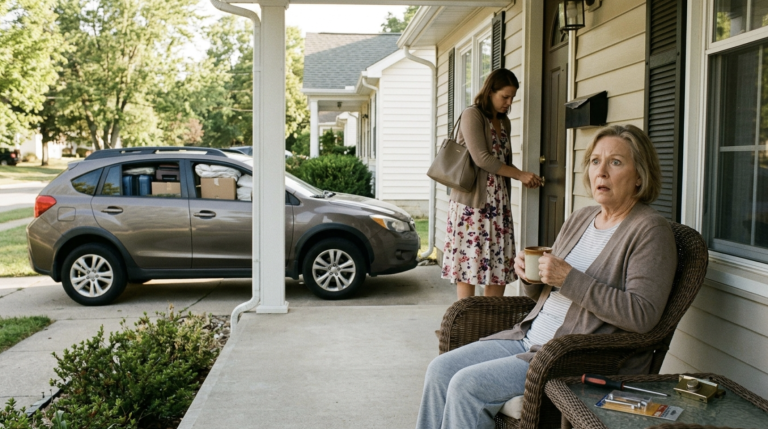
PART 3
“Who are you waiting for?” I asked.
“Nobody.”
“You looked down the street.”
“I was checking for Curtis.”
“Curtis is at work.”
She went silent.
I watched her face.
She was calculating.
I had seen that look before, though I had never given it a name.
It was the look she wore whenever she wanted something from me.
A signature.
A password.
A favor.
A check.
A decision.
She would smile first.
Then she would explain how tired she was.
Then she would remind me that Curtis was busy.
Then she would say something about how difficult it was taking care of an elderly woman.
And somehow, by the end of the conversation, I would be apologizing.
Not today.
Today I knew what she was doing.
I knew because I had finally heard her when she thought I couldn’t.
“You called me confused,” I said.
Bridget’s expression changed.
“You were confused.”
“You told your sister I sign whatever you put in front of me.”
“That was taken out of context.”
“I was standing in the hallway.”
“You were listening to a private conversation.”
“I was walking to the kitchen in my own house.”
She opened her mouth.
Nothing came out.
I held up the folder.
“Is this the sale paperwork?”
“No.”
“Then why does it say SALE?”
“It is an old folder.”
“Why is my silver chest in your back seat?”
Her eyes moved toward the car.
“It was just being moved.”
“Moved where?”
“To storage.”
“Why?”
“Because the house is being cleaned.”
I looked at her.
“Who told you to clean my house?”
“You can’t manage everything anymore.”
There it was.
The sentence she had been waiting four years to say.
Not you need help.
Not let me make things easier.
Not what would you like?
You can’t manage everything anymore.
I breathed slowly.
“You’ve been waiting to say that.”
“No.”
“Yes.”
“You’re twisting this.”
“Am I?”
She stepped closer.
“Eleanor, listen to me. You’re getting older. Things have changed. Curtis and I have been trying to make decisions that protect you.”
“Protect me from what?”
“From yourself.”
That one hurt.
Not because I believed it.
Because I remembered how many times I had defended her.
To neighbors.
To Rosalind.
Even to Curtis.
Whenever Rosalind said, “That girl is getting too comfortable,” I would shake my head.
“She helps.”
Whenever someone asked why Bridget had started using the downstairs bedroom, I said, “It makes sense. She does a lot around here.”
When Bridget stopped asking before using Walter’s study, I told myself she was just trying to feel at home.
When she began answering my phone, I said she was saving me trouble.
When she started opening my mail, I said she was helping me organize.
When she began telling doctors what medications I needed, I told myself she was being responsible.
And when she started calling the house “our house,” I corrected her once.
Only once.
After that, I let it go.
That was my mistake.
I looked at the silver chest in the back seat.
“Take it out.”
Bridget blinked.
“What?”
“The chest.”
“Eleanor—”
“Take it out.”
“I can’t right now.”
“Then I’ll call someone who can.”
Her face tightened.
“You’re making a scene.”
“This is my driveway.”
“People are going to see.”
“I hope they do.”
That stopped her.
I had spent years avoiding scenes.
That morning, I realized something.
People like Bridget depend on quiet people staying quiet.
She picked up the phone.
“I’m calling Curtis.”
“Good.”
She dialed.
I could hear the ringing.
Once.
Twice.
Three times.
No answer.
She tried again.
Still nothing.
Then she looked at me.
“His phone is probably in a meeting.”
“He’ll call back.”
“I need him here.”
“No.”
She frowned.
“No?”
“Not yet.”
“You don’t get to tell me when my husband comes home.”
“I don’t.”
I looked at the folder.
“But I do get to decide when my son learns what you’ve been doing.”
Her face drained.
That was the first time I saw fear.
Real fear.
Not irritation.
Not anger.
Fear.
And I knew I had finally found the right door.
I reached into my robe pocket and pulled out my phone.
Bridget stared at it.
“What are you doing?”
“Calling Rosalind.”
Her shoulders dropped slightly.
Then I saw her eyes move toward the folder.
That told me everything.
“Wait,” she said.
I didn’t press the call button.
I looked at her.
“Why?”
“I can explain.”
“Then explain.”
She swallowed.
“The folder isn’t what you think.”
“Then tell me what it is.”
“It is paperwork.”
“For what?”
She didn’t answer.
“For what, Bridget?”
“It was something Curtis asked me to look into.”
I almost smiled.
“My son asked you to sell my house?”
“No!”
“Then what did he ask you to do?”
“He wanted to know what the house was worth.”
“Why?”
She looked away.
“Because…”
She stopped.
“Because what?”
“Because he was worried about you.”
“Worried enough to sell my house?”
“No one said anything about selling.”
I held up the folder.
“Then why does it say SALE?”
She looked at the green sticker.
For a second, I thought she might grab it.
Instead she said quietly, “You don’t understand how these things work.”
“I understand enough.”
“You don’t.”
“I understand that a folder with my name on it was in your car.”
“It doesn’t have your name.”
“It has my house.”
“No.”
“It has my property.”
“No.”
“It has my belongings.”
She said nothing.
“And it has the word SALE written across it.”
Bridget’s jaw tightened.
“You’re becoming paranoid.”
There it was again.
The word she had probably been practicing.
Paranoid.
Confused.
Forgetful.
Unable to manage.
Too old.
Too fragile.
I realized then that this had never been about the house alone.
It was about creating a story.
A story where Eleanor was an elderly woman who couldn’t be trusted with her own decisions.
A story where Bridget was the exhausted caregiver.
A story where Curtis was the dutiful son.
And a story where anyone who questioned them was cruel.
I had almost become a character in their story.
Almost.
I took a step toward the porch.
“I’m going inside.”
Bridget moved in front of me.
“You can’t.”
I stopped.
“What?”
“You can’t go inside.”
I looked at her.
“My house?”
“Our house.”
“No.”
She stared.
I pointed toward the door.
“That is my house.”
“Curtis lives here.”
“Curtis does not own it.”
“He’s your son.”
“I know.”
“And I’m his wife.”
“I know.”
“So you can’t just throw me out.”
“I didn’t throw you out.”
“You changed the locks!”
“Yes.”
“Without telling us.”
“Yes.”
“You can’t do that!”
“I just did.”
She looked furious now.
“You’re going to regret this.”
“Maybe.”
“You don’t know what you’re doing.”
“I know exactly what I’m doing.”
She laughed.
It wasn’t a happy laugh.
It was the laugh people use when they think they are about to regain control.
“You really think Curtis is going to choose you over me?”
That sentence stayed between us.
I looked at her.
“That’s not the question.”
“What is?”
“Whether Curtis chooses you or me.”
I held up the folder.
“The question is whether Curtis knew.”
She stopped breathing for half a second.
I saw it.
The tiny hesitation.
That was enough.
“You told him about the paperwork,” I said.
“No.”
“You told him about the house.”
“No.”
“You told him you were preparing something.”
“I said no.”
“Then why are you afraid?”
She looked down.
“I am not afraid.”
“You are.”
“I am angry.”
“Those are different things.”
She reached for the folder.
I pulled it away.
“Don’t.”
Her hand dropped.
Then a car turned onto the street.
Bridget looked up.
I looked too.
It was not Curtis.
It was Rosalind.
She parked at the curb, climbed out of her Buick, and walked toward us carrying her enormous black handbag.
She looked at Bridget.
Then at me.
Then at the open car door.
Then at the silver chest.
“Well,” Rosalind said.
She stopped beside me.
“I see you found it.”
Bridget’s face went white.
“You knew about this?”
Rosalind looked at her.
“I knew about several things.”
Bridget looked at me.
“You’ve been planning this.”
“No,” I said.
Rosalind corrected me.
“She has been planning it.”
She nodded toward Bridget.
“Eleanor has been responding.”
Bridget took a step backward.
“What did you tell her?”
Rosalind smiled.
“The truth.”
Bridget looked furious.
“You have no right to interfere in this family.”
Rosalind laughed softly.
“I’ve known Eleanor longer than you’ve been married to her son.”
“This is none of your business.”
“When someone tries to take advantage of my friend, it becomes my business.”
Bridget’s eyes narrowed.
“You’re poisoning her against us.”
“No.”
Rosalind pointed at the folder.
“You did that yourself.”
Silence.
Then Rosalind held out her hand.
“Give me the folder, Eleanor.”
I hesitated.
“Why?”
“Because I want to see whether they were stupid enough to leave the original documents in there.”
I handed it over.
Rosalind opened the folder.
She turned the first page.
Then the second.
Then the third.
Her expression changed.
“Eleanor.”
“What?”
“You need to sit down.”
My stomach tightened.
“What is it?”
Rosalind looked at Bridget.
“This isn’t just a sale packet.”
Bridget said nothing.
“What is it?” I asked again.
Rosalind pulled out a document.
“This is a listing agreement.”
I stared at her.
“A listing agreement?”
“Yes.”
“For my house?”
“Yes.”
I felt something cold move through my chest.
“Who is the agent?”
Rosalind looked at the bottom of the page.
“Martin Hale.”
I knew the name.
He had sold three houses on our street.
“Does it have a date?”
“Yesterday.”
Yesterday.
Not someday.
Not next month.
Yesterday.
I looked at Bridget.
“You already listed my house.”
“No.”
“Your signature is here.”
“That doesn’t mean anything.”
“Your name is printed underneath it.”
“I was only discussing options.”
Rosalind flipped another page.
“No, Bridget.”
She pointed.
“This is an authorization.”
Bridget moved toward her.
“Give me that.”
Rosalind stepped back.
“No.”
“You have no right.”
“Neither did you.”
Bridget suddenly lunged.
I had never seen her move that fast.
Rosalind pulled the folder against her chest.
Bridget stopped herself.
For a moment, none of us moved.
Then Rosalind said quietly:
“Eleanor, there is something else.”
“What?”
She reached into the folder.
Pulled out another sheet.
“This is a property disclosure.”
I frowned.
“What does that mean?”
“It tells a buyer what they are purchasing.”
“I know what a disclosure is.”
“Then look at the owner information.”
I leaned closer.
Rosalind held it where I could see.
My name was there.
But beside my name was another name.
Curtis.
I stared.
“Why is my son listed?”
“I don’t know.”
Bridget whispered, “Because he’s your heir.”
“That isn’t how ownership works.”
“I was told it was.”
“By whom?”
She didn’t answer.
Rosalind looked at me.
“Eleanor, we need to make a phone call.”
“To whom?”
“Your attorney.”
I hadn’t had an attorney for years.
Walter handled everything.
After he died, I kept his old lawyer’s number in a drawer but never called.
I had always believed I could manage.
Rosalind looked at me.
“Do you remember Mr. Bennett?”
“Yes.”
“Call him.”
Bridget suddenly spoke.
“No.”
We both turned toward her.
She realized too late what she had said.
I smiled.
“Why not?”
“Because he’s retired.”
Rosalind shook her head.
“No, he isn’t.”
Bridget stared at her.
“He moved his practice downtown,” Rosalind continued. “He’s seventy-two, not dead.”
Bridget looked at me.
“Eleanor, you don’t need an attorney.”
“I think I do.”
“You are overreacting.”
“Maybe.”
“You’re making a mistake.”
“Maybe.”
“You’re going to destroy your relationship with Curtis.”
I looked at her.
“No.”
She blinked.
“You already did.”
Her eyes filled with tears.
For the first time, I almost felt sorry for her.
Almost.
Then she said something that made that feeling disappear.
“You don’t know what Curtis has been doing.”
I froze.
“What?”
She looked at the ground.
Rosalind stared at her.
“What has Curtis been doing?”
Bridget didn’t answer.
I stepped closer.
“You said I don’t know what Curtis has been doing.”
“I shouldn’t have said that.”
“What has he been doing?”
“Nothing.”
“Bridget.”
She shook her head.
“Ask him.”
“What does that mean?”
“Ask your son why he needed the house.”
“Why?”
She looked at me.
Then she said the sentence that changed everything.
“Because he has debts.”
I felt my knees weaken.
Rosalind grabbed my arm.
“Sit.”
I sat on the porch step.
Bridget continued.
“He lost money.”
“How much?”
She looked away.
“How much?”
“Enough.”
“That’s not an answer.”
“He owes people.”
“What people?”
“I don’t know.”
“You don’t know?”
“I know some.”
“Who?”
She swallowed.
“Private lenders.”
Rosalind’s face hardened.
“How much?”
Bridget closed her eyes.
“About two hundred and eighty thousand.”
The porch seemed to tilt.
“Two hundred and eighty thousand?”
“Yes.”
I looked toward the street.
My son.
My little boy who used to sleep with a baseball glove under his pillow.
My son who cried when Walter taught him to ride a bicycle.
My son who had once told me, “Mom, I’ll take care of you when you’re old.”
Two hundred and eighty thousand dollars.
“How?”
“Business.”
“What business?”
“Investments.”
“What investments?”
“Crypto. Stocks. A restaurant deal.”
Rosalind shook her head.
“And the house?”
Bridget said nothing.
I answered for her.
“The house was going to pay his debt.”
Bridget looked at me.
“We were trying to save the family.”
“No.”
I stood.
“You were trying to save Curtis.”
“Yes.”
“And yourself.”
She didn’t answer.
“And you were willing to put me in Fairview to do it.”
Her face crumpled.
“We thought it would be better for you.”
“No.”
“It is a good place.”
“No.”
“You need help.”
“No.”
“You can’t live alone forever.”
“That is my decision.”
“You don’t understand.”
“I understand enough.”
Bridget started crying.
But I had seen her cry before.
I knew how quickly those tears could turn into apologies.
How quickly apologies could turn into hugs.
How quickly hugs could become another signature.
So I didn’t move toward her.
I simply said:
“Call Curtis.”
She wiped her face.
“He won’t answer.”
“Call him.”
She took out her phone.
Her hands were shaking.
She dialed.
This time, he answered.
“Bridget?”
His voice came through the speaker.
She looked at me.
I nodded.
“Curtis,” she whispered.
“What?”
“We have a problem.”
There was silence.
“What happened?”
She looked at me again.
“She knows.”
Another silence.
Then my son’s voice changed.
“What does she know?”
I leaned toward the phone.
“Everything.”
The line went completely quiet.
I heard him breathe.
“Mom?”
“Yes.”
“What did Bridget tell you?”
I looked at Rosalind.
Then at the folder.
Then at the silver chest sitting in the back seat of the car.
“That depends,” I said, “on what you are finally ready to tell me.”
“Mom, listen—”
“No.”
“I can explain.”
“You have been explaining things for four years.”
“Please.”
“You don’t need to explain yet.”
I looked at Bridget.
“You need to come home.”
“I am home.”
“No.”
My voice became quieter.
“You are standing outside my house.”
Neither of them spoke.
I continued.
“And when you come here, you will come alone.”
“Mom…”
“No Bridget.”
I could hear my son breathing.
“You.”
Silence.
“Come home, Curtis.”
He finally whispered:
“Okay.”
The call ended.
Bridget looked at me.
“What are you going to do?”
I looked at the locked front door.
Then at the woman who had spent four years telling everyone she was protecting me.
“I don’t know yet.”
And for once, that was the truth.
Because I had spent the entire morning believing the worst thing I would discover was that Bridget wanted my house.
I was wrong.
The house was only the beginning.
There was still one question I hadn’t asked.
If Curtis owed nearly three hundred thousand dollars…
why had Bridget already signed papers to sell a house worth nearly six hundred thousand?
Where was the other money supposed to go?
Rosalind seemed to read the question on my face.
She opened the folder again.
Her fingers stopped on the final page.
She didn’t speak.
I looked at her.
“What?”
She slowly turned the page around so I could see it.
At the bottom was a handwritten note.
Four words.
Four words that made my blood run cold.
“Buyer already has keys.”
I stared at the sentence.
Then I looked at the house.
The new locks suddenly didn’t feel like enough.
Because someone, somewhere, had already been preparing to move into my home.
And they were expecting me to be gone.
TO BE CONTINUED IN PART 4…
👉 Continue Reading — Click the next page below 👇