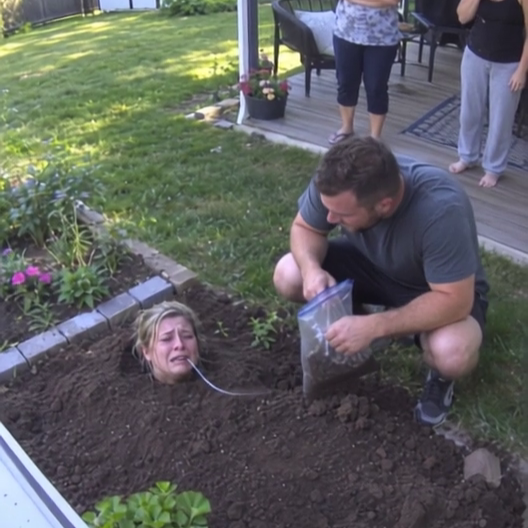
They drank cold drinks, checked their phones, and spoke about ordinary things while I listened from the ground.
Mara complained about someone at work.
My husband’s mother discussed groceries.
My husband answered a call and told the person on the other end that I was resting.
He said pregnancy had made me emotional and that he was taking good care of me.
The lie came easily because he had practiced smaller versions of it for months.
At family dinners, he answered questions directed at me.
When I disagreed, he laughed and said I was tired.
When I became quiet, he told people I was embarrassed about overreacting.
He had built a version of me that could not be trusted.
Now he believed that version would protect him.
The phone beneath the dirt held another story.
It held the scrape of the pitcher on the porch railing.
It held his mother’s warning about leaving visible marks.
It held Mara asking whether they should let me use the bathroom and my husband saying I had lost that privilege.
It held every time they used the word family as though it excused what they were doing.
I did not know whether the recordings would survive the dampness.
I did not know whether the battery would last.
I did not know whether anyone would ever hear them.
Still, touching the button gave me one decision that belonged only to me.
That afternoon, clouds moved over the yard, and the temperature dropped enough to make my teeth chatter against the straw.
The porch light came on before sunset.
My husband carried a folded blanket outside and placed it across the back of Mara’s lawn chair.
No one brought anything for me.
His mother stood near the doorway and said the neighbors might notice if I remained outside much longer.
My husband reminded her that the fence was tall.
Mara asked what they would say if anyone came over.
He answered without hesitation.
He would say I had gone to stay with a friend after an argument.
His mother said that sounded believable.
Mara asked which friend.
He named someone I had not spoken to in almost a year.
Then he told Mara that nobody would check because people were tired of my drama.
I moved my finger against the screen and recorded every word.
The baby shifted again, stronger this time, and I had to fight the urge to react.
My husband had been watching for weakness all day.
I could not let him see which fear still controlled me.
Late that afternoon, the phone vibrated beneath the soil.
The sound was faint, more sensation than noise, but Mara heard something.
She straightened in her chair and looked toward the yard.
“Was that the sprinkler timer?” she asked.
The sprinkler box was attached to the opposite fence.
My husband did not answer her.
He set his drink down and stepped off the porch.
The others stopped laughing.
I felt the change before he reached me.
Until then, he had believed the yard belonged entirely to him.
Now there was something in it he had not placed there.
“What was that?”
I kept my lips around the straw.
He walked slowly at first, scanning the dirt around my shoulders.
His mother came to the edge of the porch.
Mara stayed in her chair, but her hands tightened around the armrests.
My husband crouched beside me and pressed one palm into the wet earth.
He searched near my left shoulder first.
His fingers moved through the surface soil, breaking apart the crust that had dried in the sun.
Then he shifted closer to my right side.
“You didn’t bring something out here, did you?” he demanded.
I looked at the ground between us.
His voice lost the calm tone he used for witnesses.
He dug faster.
The movement pushed dirt against my neck, and I fought to keep breathing evenly through the straw.
His fingernails scraped the freezer bag.
For a second, neither of us moved.
He had found it.
His eyes locked on the cloudy plastic showing through the mud.
The fear on his face was not fear for me or for the baby.
It was fear of being remembered accurately.
He hooked two fingers beneath the edge of the bag and pulled.
The phone shifted against my buried hand.
I had one chance before he tore it free.
My finger found the side button beneath the soil.
The screen lit through the cloudy plastic.
My husband jerked backward, but he did not release the bag.
Mara stood so quickly that her lawn chair tipped onto the grass.
His mother came down one porch step and stopped.
A calm woman’s voice came through the dirt.
“Sheriff’s dispatch,” she said. “We have your location. Keep him talking.”
My husband stared at the phone as though it had spoken in a language only he could understand.
The confidence disappeared from his posture before it left his face.
His hand remained frozen in the mud.
The dispatcher spoke again, asking whether I could hear her.
I could not answer without releasing the straw.
Instead, I moved my finger against the phone’s side.
A small electronic tone sounded from beneath the plastic.
“I heard that,” the dispatcher said. “Help is coming.”
My husband looked toward the house.
His mother immediately stepped backward into the doorway.
Mara did not move.
The tipped lawn chair lay beside her, one metal leg slowly sinking into the mud she had spent two days avoiding.
My husband’s eyes returned to me.
For the first time since they had lowered me into the hole, he was no longer deciding what happened next.
He opened his mouth, and the patient voice returned by instinct.
“This is a misunderstanding,” he said loudly, aiming the words at the phone instead of me.
The dispatcher told him to step away.
He tightened his grip on the freezer bag.
I kept breathing through the straw.
The phone had remembered everything.
Now someone else was listening.
My husband tore the freezer bag from the dirt, but the call remained connected.
Muddy water ran across the glowing screen as the dispatcher repeated my address and asked whether I could still hear her.
He stared at me as if I had suddenly become someone he no longer recognized.
Then his neighbor voice returned.
“My wife is having an episode,” he said. “She’s pregnant, confused, and making accusations.”
The dispatcher did not argue.
Instead, she asked him to explain why his pregnant wife could only breathe through a straw.
For the first time, he had no smooth answer ready.
His mother stepped out of the doorway and told him to end the call.
Mara remained beside her lawn chair, both hands pressed tightly against her mouth.
My husband crouched lower and held the phone near my face.
“Tell her you agreed to this,” he whispered.
I could feel the baby shifting again.
I drew one careful breath through the straw.
Then I spoke loudly enough for the microphone to catch every word.
“I did not agree. They buried me here, and they have kept me here for days.”
Silence followed.
Then the dispatcher asked whether all three of them were still present.
“Yes.”
My husband’s fingers tightened around the bag.
He told Mara to go inside.
She did not move.
For the first time, she looked directly at me instead of at the mud surrounding my body.
A distant siren rose somewhere beyond the neighborhood street.
His mother grabbed Mara’s arm.
“We need to tell the same story,” she whispered.
Mara pulled free.
Then she stepped into the yard.
She knelt several feet from my head and spoke toward the phone in my husband’s hand.
“My name is Mara,” she said.
Her voice shook.
“I was here the whole time.”
My husband told her to stop.
She looked at him, then back at the phone.
She gave the dispatcher her full name anyway.
“And I need to tell you what we did.”
The words seemed to drain the air from the yard.
My husband stared at his sister.
His mother told Mara she did not know what she was saying.
Mara shook her head.
“I know exactly what I’m saying.”
Another siren grew louder.
This time, none of them pretended it was something else.
My husband looked toward the gate.
His mother started crying.
Mara remained on her knees.
And I kept breathing through the straw, feeling the dirt against my skin and the baby moving beneath it.
For days, they had treated my silence as proof that they controlled me.
They had laughed because they thought the dirt had buried my voice.
But the one thing they had failed to take from me was the ability to remember.
The phone had remembered for me when I could barely move.
It had captured every threat, every laugh, every lie, every cruel explanation they had offered for what they were doing.
And now the dispatcher was listening.
The sirens came closer.
My husband finally released the freezer bag.
It fell into the mud beside my shoulder.
He stood there with his hands hanging at his sides, no longer looking like the man who had spent days telling everyone he was teaching his wife a lesson.
He looked toward the approaching lights.
Then he looked at me.
For once, he had nothing to say.
Mara wiped her face and stayed where she was.
His mother stepped away from the porch.
And I took another breath through the straw.
It was shallow.
It hurt.
But it was mine.
The first patrol car turned onto the street.
Red and blue lights washed over the fence.
My husband closed his eyes.
I opened mine.
The dirt was still around my neck.
The straw was still between my lips.
The baby was still moving.
And this time, when I heard footsteps coming toward the yard, I knew they belonged to people who had come to get me out.