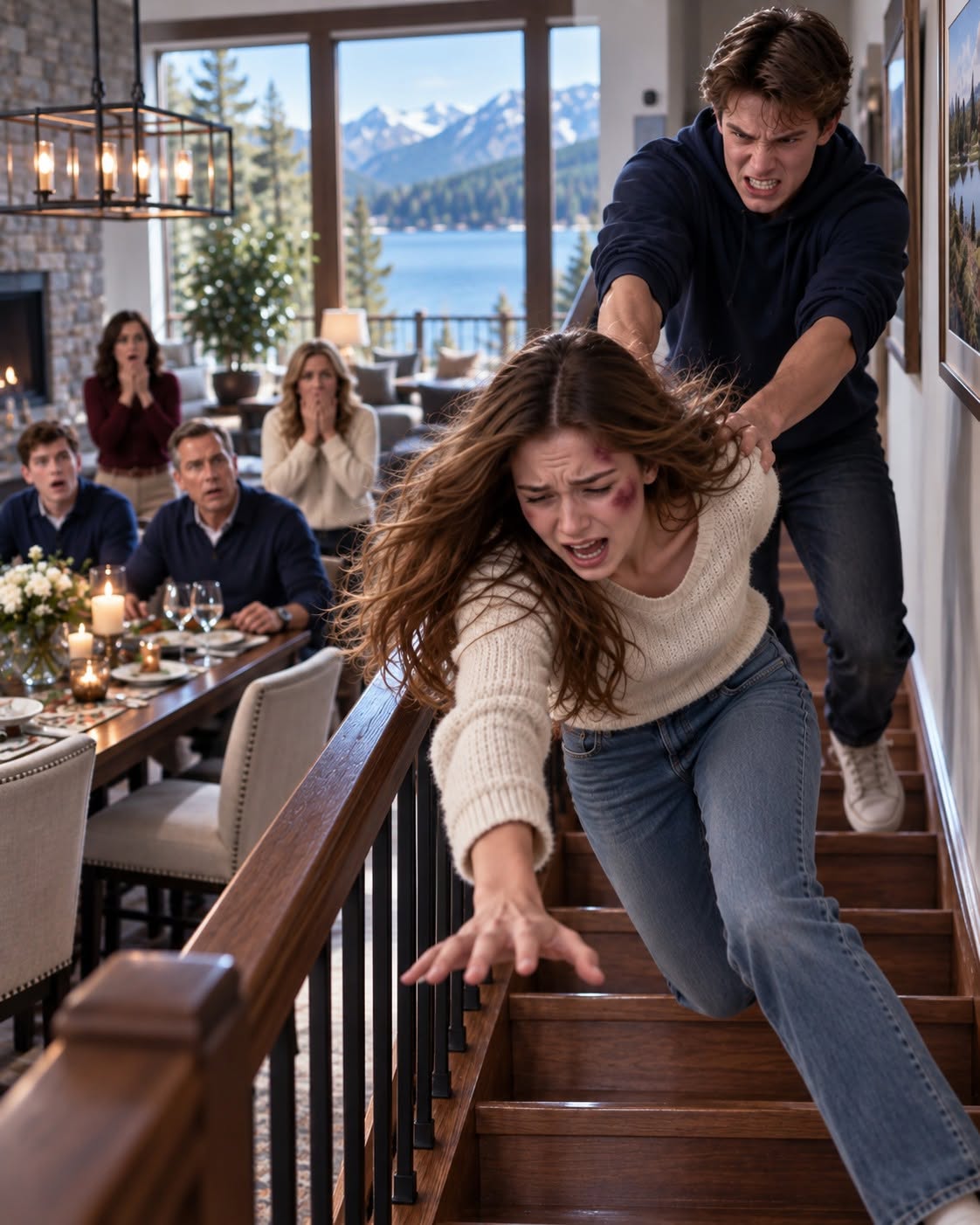
PART 4 ( The End) THE FALL THAT MADE US LISTEN: A FAMILY’S LONG ROAD BACK TO TRUST 7247 029
By Christmas, I could climb stairs without thinking about them.
That sounded small until you had once learned to fear the top step.
My back had healed well.
The follow-up MRI showed that the syrinx had not grown. My symptoms were still present, but with adjustments, monitoring, and a treatment plan, they had become something I could describe instead of something I had to defend.
For the first time in years, I kept a headache journal.
Not to prove anything.
For myself.
Date.
Duration.
Trigger.
Symptoms.
What helped.
The notebook was ordinary and blue.
I loved it.
Evidence no longer felt like a weapon.
It felt like information.
Mom had her own neurological evaluation that fall.
Her MRI did not show the same findings as mine, but her headaches were finally diagnosed properly and treated.
She joked that our family had apparently needed an entire medical awakening because none of us knew how to make appointments.
Susan told her that wasn’t funny.
Then she laughed anyway.
Tyler stayed away from the house longer than anyone expected.
He returned to college early and continued counseling there.
We exchanged occasional messages.
Nothing sentimental.
How’s your back?
Better.
How’s school?
Fine.
Dad says Mom threw out his recliner.
It was older than we are.
It had dignity.
It had springs sticking out.
Traitor.
Somehow those messages mattered.
They were not forgiveness.
They were construction materials.
Small pieces.
One at a time.
In November, Tyler asked if I would be willing to meet somewhere public when he came home for Thanksgiving.
I stared at the message for most of an afternoon.
Then I showed Susan.
“What do you think?”
She looked at me over her reading glasses.
“I think it matters less what I think than whether you want to go.”
“I don’t know what I want.”
“That’s allowed.”
“What would you do?”
“I’d ask myself whether I was going because I wanted something from the conversation or because I felt responsible for his feelings.”
That was annoyingly useful.
I thought about it overnight.
Then I messaged him.
Coffee. One hour.
We met at a café near the university.
Tyler was already there when I arrived.
For the first time in my life, he stood when I approached.
Not theatrically.
Almost nervously.
“Hey.”
“Hey.”
We sat.
He had changed.
Not dramatically.
He was still Tyler.
Same crooked smile.
Same habit of turning the cardboard sleeve around his coffee cup.
But something about him seemed quieter.
“I’m not going to make a speech,” he said.
“Thank God.”
He smiled.
Then stopped himself, as if uncertain whether he was allowed.
I almost felt sorry for him.
Almost.
“I wanted to apologize in person.”
“You already did.”
“I apologized in a letter.”
“That counts.”
“Not enough.”
I waited.
He looked down.
“I pushed you.”
“Yes.”
“I was angry because you were walking away.”
“Yes.”
“I told myself I was just stopping you.”
I said nothing.
“But I knew you wanted space, and I didn’t want to give it to you.”
That was perhaps the most important thing he said.
Not that he misjudged the distance.
Not that he slipped.
Not that he never intended for me to fall.
He finally understood the choice that came before the accident.
He had decided his desire to keep the argument going mattered more than my desire to leave.
“I’m sorry,” he said. “For that night. And for a lot of years before it.”
I looked through the café window.
People crossed the street carrying shopping bags.
A dog pulled a woman toward a tree.
Life kept moving with almost offensive normality.
“Do you remember when I broke the china cabinet?”
Tyler blinked.
“Yeah.”
“What happened?”
“You tripped.”
“Why?”
His expression changed.
I waited.
He leaned back.
“I put my backpack behind you.”
“You thought it was funny.”
“I was being stupid.”
“You told everyone I wasn’t looking where I was going.”
He looked miserable.
“I know.”
“That’s the kind of thing I mean.”
“I know.”
“No, Tyler. I don’t think you did before.”
He nodded.
“You’re right.”
I had spent years imagining a confrontation with him.
In every version, I said something devastating.
He finally understood exactly how much I hated him.
Then I walked away victorious.
Reality was quieter.
I didn’t hate Tyler.
That made everything more difficult.
He was my brother.
I remembered building snow forts with him.
I remembered him sitting beside me in the emergency room when I needed stitches at nine.
I remembered him teaching me to parallel park and nearly sacrificing three mailboxes in the process.
People could hurt you without every memory becoming false.
That was one of the hardest things I learned that year.
“What happens now?” he asked.
“I don’t know.”
“Do you want me to stay away?”
“Not forever.”
His eyes lifted.
“But I don’t want to go back to how things were.”
“I don’t either.”
“If you make me the joke in the room again, I’m leaving.”
“Okay.”
“If you tell people I’m dramatic when I say something is wrong, I’m leaving.”
“Okay.”
“And if you ever block me from walking away from an argument again—”
“I won’t.”
I held his gaze.
He corrected himself.
“If I do, you leave. And I don’t follow you.”
That was better.
He was learning the difference between promises and boundaries.
Before we left, Tyler said, “There’s something else.”
I nearly laughed.
Our family had developed a terrible habit of saying that phrase.
“What?”
“I changed my major.”
I stared at him.
“From finance?”
“Yeah.”
“To what?”
“Education.”
I genuinely thought he was joking.
“You?”
“Apparently.”
“What does Dad think?”
Tyler smiled.
“He went silent for forty-seven seconds.”
“You timed it?”
“Obviously.”
“And then?”
“He asked what kind of teaching.”
“What did you say?”
“History.”
I shook my head.
“You hate teenagers.”
“I hate eighteen-year-old me. Different thing.”
I laughed before I could stop myself.
Tyler laughed too.
Then both of us became quiet.
The sound had surprised us.
It was the first time we had laughed together since the lake house.
And nothing bad happened afterward.
Thanksgiving was deliberately small.
Susan hosted.
No lake house.
No giant crowd.
No bourbon.
Not because alcohol had become forbidden, but because Dad said he wanted to remember the entire evening without the comfortable haze he had relied on for years.
Mom made too much food.
Dad burned the rolls.
Susan insisted burned was a subjective culinary category.
Tyler arrived carrying flowers for Susan and an apple pie that had clearly come from a bakery despite his claim that he had “participated emotionally” in making it.
Nobody teased me.
At first that was almost worse.
Everyone was so careful that dinner felt like a meeting between diplomats.
Finally I put down my fork.
“You know you can joke around.”
Dad looked relieved.
Tyler said, “Thank God, because Susan’s potatoes—”
Susan pointed a serving spoon at him.
“Choose your next words with extreme care.”
“—are a triumph of modern agriculture.”
The table laughed.
I did too.
That was when I understood something I had once thought impossible.
Safety did not mean silence.
It meant knowing laughter would not be used to erase you.
In January, I moved back home.
Not because Susan wanted me gone.
She repeatedly informed me that I was the only person in the family who understood how to load her dishwasher correctly.
I returned because I wanted to test whether the changes my parents had promised could survive everyday life.
There were mistakes.
Of course there were.
One Saturday, I complained that a headache was starting and Dad automatically said, “Maybe you’re just tired.”
The room went still.
His face fell.
Then he shook his head.
“Nope. Let me try that again.”
He turned toward me.
“What do you need?”
It was such a small correction.
It nearly made me cry.
Another time, Mom began answering a question for me at a medical appointment.
She stopped in the middle of the sentence.
“Sorry. That’s hers.”
Then she leaned back.
Trust did not return as one grand moment.
It returned through interruptions.
People catching themselves.
People saying, I did the old thing again.
People trying another way.
In February, my symptoms worsened for several weeks.
More headaches.
More numbness.
A second specialist reviewed my case along with Dr. Patel.
After careful discussion, we decided that decompression surgery was reasonable because the symptoms were affecting daily life and the syrinx remained present.
The decision frightened me.
But fear felt different when nobody dismissed it.
Mom came to every appointment I invited her to.
Dad took notes.
Susan researched pillows as though she had been appointed to the National Commission on Neck Support.
Tyler called the night before surgery.
“You scared?”
“Yes.”
“Want distraction or honesty?”
I smiled.
“When did you learn to ask that?”
“Therapy is expensive. I’m trying to get my money’s worth.”
“Distraction.”
He spent twenty minutes telling me about a professor who had accidentally lectured the wrong class for half an hour.
I went into surgery laughing.
Recovery took time.
There were difficult days.
But the procedure went well.
Gradually, the pressure headaches that had followed me for years became less frequent.
My hands tingled less.
The strange heaviness at the base of my skull eased.
Three months later, Dr. Patel showed me the follow-up scan.
“Looks good,” he said.
I studied the image.
I still couldn’t read an MRI properly.
But I had learned enough to understand that this one was not an accusation.
It was simply a picture of my body.
Something worth listening to.
That summer, nearly one year after the fall, Dad asked whether I wanted to go back to the lake house.
My stomach tightened.
“I don’t know.”
“We can sell it,” he said.
“You don’t have to sell it because of me.”
“I’m not asking because of you.”
That interested me.
He sat across from me at the kitchen table.
“I realized we spent years treating that place like some perfect family tradition. Every weekend had to be fun. Every holiday had to be peaceful.”
I smiled faintly.
“Our family was terrible at peaceful.”
“Exactly.”
He rubbed his chin.
“If somebody was upset, we treated the upset as the problem instead of asking why they were upset.”
That might have been the smartest thing Dad had ever said.
“So what do you want to do?”
He shrugged.
“I thought maybe the five of us could go up for one afternoon. You, me, Mom, Tyler, Susan. No party. No performance. If you hate being there, we leave.”
I considered it.
“Okay.”
The lake looked exactly the same.
That annoyed me.
I had imagined the place becoming darker somehow.
Instead sunlight flashed across the water.
Pine trees leaned toward the shore.
A neighbor’s boat hummed in the distance.
Inside, the Monopoly box remained under the coffee table.
The china cabinet still had one replacement panel that didn’t quite match.
And the staircase waited against the far wall.
I stood at the bottom.
Tyler came into the room carrying grocery bags.
He saw where I was looking.
Neither of us spoke.
Then he set the bags down.
“I can use the back stairs.”
“No.”
He stopped.
“I’m okay.”
“You sure?”
“Yes.”
That question mattered.
You sure?
Not because he doubted me.
Because he was giving me a choice.
I walked upstairs.
Slowly.
My hand rested on the railing.
At the landing, I stopped.
The view from there was painfully familiar.
I remembered the room full of faces.
I remembered trying to make myself smaller.
Then I looked down.
Mom was arranging food in the kitchen.
Dad was outside arguing with the grill.
Susan sat on the couch reading.
Tyler remained near the grocery bags, waiting instead of following me.
Nothing had been erased.
I didn’t want it erased.
Forgetting was not the same thing as healing.
Healing, I had learned, was being able to remember without handing the memory control over everything that came next.
I walked the rest of the way upstairs.
That afternoon we ate burgers on the deck.
No one mentioned the previous summer until sunset.
Then Tyler leaned against the railing.
“I used to think families were either good or bad.”
Susan glanced at him.
“That sounds exhausting.”
“You know what I mean.”
I did.
Mom looked at the lake.
“What do you think now?”
Tyler considered.
“I think families are habits.”
Dad raised an eyebrow.
“Very profound.”
“I’m serious.”
“So am I.”
Tyler continued.
“You do something enough times and everybody starts thinking that’s just who you are. Then someone changes one thing and suddenly everyone else has to decide whether they’re going to change too.”
Susan smiled.
“Maybe education is the right major.”
“Please don’t tell Dad.”
“I’m sitting here,” Dad said.
For a moment we all laughed.
Then Mom looked at me.
“What do you think?”
A year earlier, I might have said nothing.
I had been trained to protect peaceful weekends.
Now I thought before answering.
“I think loving someone doesn’t automatically mean you know how to listen to them.”
Nobody spoke.
“So you have to learn,” I continued. “And sometimes relearn.”
Dad nodded.
“I can live with that.”
We stayed until stars appeared over the lake.
Before we left, I went inside alone.
The house was dark except for the light above the stove.
I walked toward the staircase one last time.
At the top step, I paused.
For years, I had believed strength meant enduring things quietly.
Dad believed that too.
Mom had mistaken silence for wellness.
Tyler had mistaken sensitivity for weakness.
I had mistaken being easy to live with for being loved.
We had all been wrong in different ways.
The MRI had not magically fixed us.
Neither had therapy.
Neither had apologies.
What changed us was much less dramatic.
Mom started asking instead of assuming.
Dad learned that toughness without tenderness was only another kind of distance.
Tyler learned that an apology mattered most when it changed the next decision.
And I learned that speaking clearly did not make me difficult.
Sometimes it simply made me visible.
The following month, I enrolled at the university I had wanted from the beginning.
Environmental design.
Two hours from home.
Close enough for Sunday dinner when I wanted it.
Far enough to build a life that belonged to me.
Move-in day arrived beneath a bright August sky.
Mom made my bed despite being told repeatedly not to.
Dad assembled a bookshelf backward, blamed the instructions, then rebuilt it.
Susan brought three plants and announced that if I killed them she would consider it a personal betrayal.
Tyler carried boxes.
At one point he held up the blue headache journal.
“You still need this?”
“Sometimes.”
He handed it to me.
“No jokes?”
He looked almost offended.
“I’m growing.”
“Slowly.”
“Still counts.”
Mom eventually began crying.
Dad pretended he had something in his eye.
Susan told both of them to get out before they embarrassed the family permanently.
At the doorway, Tyler hung back.
“You good?”
I looked around my room.
My books.
My desk.
My drawings.
A window facing west.
“I’m good.”
He nodded.
Then he did something that would have seemed meaningless to anyone else.
He stepped aside.
He left the doorway completely open.
“See you, little sister.”
“See you.”
After everyone left, I sat beside the window.
Students crossed the lawn below carrying boxes and lamps and impossible-looking pieces of furniture.
Somewhere down the hall, someone was playing music too loudly.
A door slammed.
Then reopened.
Voices called to one another.
I touched the scar hidden beneath my hair.
For a long time I had thought the worst day of my life was the day I fell.
I no longer saw it that way.
The fall was terrible.
What happened afterward was painful and complicated.
But the truth that emerged from it was not that my family had never loved me.
It was that love alone had not been enough.
Love without listening could miss important things.
Love without respect could become careless.
Love without humility could keep repeating the same mistakes while calling them traditions.
My family had learned that.
So had I.
My phone buzzed.
A message from Dad.
Home feels too quiet.
Then Mom.
Ignore him. He has already watched three football games.
Then Tyler.
IMPORTANT QUESTION.
I smiled.
What?
His answer came immediately.
Who gets your chair at Thanksgiving?
I looked at the message.
The chair nearest the wall.
My old disappearing place.
I typed back.
Nobody.
Why?
Because I’m taking a different one.
Three dots appeared.
Then:
Good.
I set the phone down.
Outside, the evening sun stretched across campus.
For once, I wasn’t planning how little space I could take.
I wasn’t wondering whether I was too sensitive.
I wasn’t rehearsing evidence for feelings I already knew were real.
I stood, opened my door, and walked toward the voices in the hallway.
Behind me, the room remained waiting.
Ahead of me was a life I had not yet learned.
And for the first time, that uncertainty felt less like something to fear than an invitation.