PART 3 THE FALL THAT MADE US LISTEN: A FAMILY’S LONG ROAD BACK TO TRUST 7247 029
I didn’t confront Mom about the records the next morning.
That surprised everyone, including me.
Old me would have needed answers immediately.
Old me would have rehearsed the conversation until every sentence felt sharp enough to protect me.
But something had changed.
Maybe it was exhaustion.
Maybe it was the hospital room.
Or maybe, for the first time, I understood that knowing the truth did not require me to solve it before breakfast.
At eight thirty, a neurosurgery resident named Dr. Chen came in.
She was young enough that Dad later whispered she looked like she should still be taking exams, but the moment she started speaking, the room settled around her.
She reviewed the imaging.
The compression fracture would heal.
The Chiari malformation and small syrinx needed further evaluation, but there was no immediate emergency.
“We look at symptoms, imaging, neurological findings, and progression,” she explained. “An MRI finding alone doesn’t automatically mean surgery.”
I liked her instantly for not turning my life into a countdown.
“What happens now?”
“Additional imaging. A detailed neurological exam. Then you meet with the attending specialist. We build the plan from there.”
“Can I go home?”
“Probably tomorrow if your pain is controlled.”
Home.
The word no longer meant one place.
It meant our main house in Denver.
The lake house.
Mom’s kitchen.
Dad’s television turned too loud.
Tyler’s shoes by the door.
I looked toward my parents.
“I don’t want Tyler there.”
Dad answered before Mom could.
“He won’t be.”
Simple.
No argument.
It should not have felt revolutionary.
But it did.
A patient advocate named Marisol arrived later that morning.
Elena had apparently requested her.
Marisol talked to me alone.
She explained that because I was eighteen, I could control who received medical information and who participated in decisions. She also explained that I could speak to law enforcement again, consult an attorney, or do neither immediately.
“You don’t have to decide every part of your future today,” she said.
That became the sentence I carried through the next several weeks.
I didn’t have to decide everything today.
When Mom came in that afternoon, I showed her the screenshots.
She sat beside the window.
“I know.”
“Why did you send them?”
“Because you should have them.”
“Why didn’t you tell me before?”
“I don’t have a good answer.”
“You must have an answer.”
Mom looked out at the traffic below.
“I have explanations. I’m not sure any of them are good.”
I waited.
“Your father had just been laid off from the company he’d worked for since before you were born. We changed insurance. Tyler was having trouble his first year away at school. My mother was recovering from surgery.”
“I remember all of that.”
“I know.”
“None of it explains why you didn’t tell me.”
“No.”
There was something strangely relieving about hearing her stop defending herself.
She folded her arms.
“I thought if there were something seriously wrong, the doctor would insist.”
“He did recommend follow-up.”
“Yes.”
“You decided I was fine.”
“Yes.”
“Why?”
She looked at me then.
“Because I wanted you to be.”
That answer hurt more than I expected.
Not because it was malicious.
Because it was human.
“I had spent that entire year feeling like everything in the family was coming apart,” she continued. “Your father was scared. Tyler was struggling. Grandma needed help. And you—”
“I what?”
“You kept saying you were fine.”
I stared at her.
“Because every time I said I wasn’t, somebody told me I was overreacting.”
Mom went silent.
There it was.
The circle.
They taught me not to complain.
Then used my silence as proof I had nothing to complain about.
She pressed her lips together.
“You’re right.”
I hadn’t expected those words either.
“I don’t need you to agree with me because I’m in a hospital bed.”
“I know.”
“I need you to understand what happened.”
“I’m trying.”
“No. I think you’re understanding the medical part. I’m talking about everything else.”
She waited.
I tried to explain.
The problem had never been one canceled appointment.
It was the pattern.
I would say something hurt.
Tyler would joke.
Dad would dismiss it.
Mom would smooth everything over.
Then I would question myself.
Eventually I became easier for them to live with because I stopped saying anything.
Mom listened without interrupting.
By the time I finished, I was crying quietly.
So was she.
But neither of us reached for the other.
That mattered.
For once, she let me have my feelings without rushing to make them disappear.
Before she left, she said, “I’m going to do something differently.”
“What?”
“Instead of asking you to forgive me, I’m going to give you reasons to trust me again.”
I didn’t answer.
But I remembered it.
I went home the next afternoon.
Not to my parents’ house.
To Aunt Susan’s.
That had been my idea.
She lived twenty minutes away in a narrow brick townhouse filled with plants and books and furniture nobody was afraid to scratch.
Her guest room overlooked a maple tree.
She placed a stack of clean towels on the dresser and said, “The kitchen is downstairs. Help yourself to anything. I work from home most days.”
Then she added, “And you don’t have to talk.”
It was perhaps the kindest thing anyone had said to me all week.
The first few days passed slowly.
I slept.
I watched bad television.
I answered messages from friends.
Dad brought over clothes and left them with Susan.
Mom dropped off my favorite soup but didn’t come inside.
Tyler remained at our uncle’s cabin.
Then, five days after the fall, a letter appeared under Susan’s front door.
My name was written in Tyler’s handwriting.
I stood over it for almost an hour.
Eventually I opened it.
It was four pages.
The first sentence was:
I keep trying to write that I didn’t mean for you to fall, but I know that sentence is about me, not you.
I sat on the edge of the bed.
The rest was uneven.
Tyler admitted he had spent years turning me into a family joke because it made people laugh and because, once everyone expected me to be the sensitive one, he could always win an argument before it started.
He admitted something else too.
He had been jealous.
Not of attention.
Of the fact that I had wanted a different life.
I had applied to schools outside Colorado.
I wanted to study environmental design.
Tyler had chosen the college Dad preferred and the major Dad suggested.
He wrote:
You were always the one who said when you didn’t like something, even if you got quiet afterward. I acted like that made you weak because I didn’t know how to admit I was afraid to say what I wanted.
I read that paragraph three times.
It did not excuse him.
But for the first time Tyler existed in my mind as something more complicated than the person blocking the stairs.
He had been hurting me with the role our family gave me.
He had also been trapped inside his own.
The golden son.
The funny one.
The easy one.
The child who never needed anything.
Families could build cages out of compliments too.
His letter ended:
I’m not asking you to answer. Dad says I can’t come home until you’re comfortable with it, and I told him not to put that decision on you. I’m staying with Uncle Mark through the end of the month and then going back to school early. I started meeting with a counselor here. I should have done it before.
I put the letter in the dresser drawer.
I did not reply.
Two weeks later, I had my specialist appointment.
Dr. Chen was there, along with Dr. Patel, the attending neurosurgeon.
They had reviewed the new imaging.
The syrinx was small but real.
The Chiari malformation was significant enough to explain at least some of my symptoms.
For now, because my neurological exam was stable, Dr. Patel recommended careful monitoring and another scan before deciding whether surgery was necessary.
I should avoid activities that aggravated symptoms.
Track headaches.
Report new weakness or numbness.
Follow up.
Follow up.
Such a simple phrase.
It became almost sacred to me.
People were going to keep looking.
Nobody was closing the file because I had a good day.
Dad drove me back to Susan’s.
We sat in his truck outside her townhouse.
He turned off the engine but didn’t move.
“I’ve been thinking about something you asked me.”
I knew immediately.
“Whether you would have believed me without the MRI?”
He nodded.
“And?”
“No.”
The honesty stung.
But I preferred it to comfort.
Dad stared through the windshield.
“I grew up in a house where being sick meant you worked anyway. Being scared meant you kept quiet. My father thought concern made people soft.”
“I know the stories.”
“I used to think I was different from him.”
“You are.”
“Not different enough.”
That was the first time I saw Dad understand that good intentions did not erase habits.
He rubbed his hands together.
“I kept thinking I was teaching you resilience.”
“You were teaching me not to trust myself.”
“I know.”
We sat quietly.
Then Dad said something unexpected.
“I quit drinking for a while.”
I looked at him.
“You don’t drink that much.”
“Probably not. But almost every memory I have of laughing when Tyler went too far happened with a glass in my hand.”
He shrugged.
“I don’t like that.”
This wasn’t a dramatic confession.
Dad had never been an alcoholic.
Bourbon was simply woven through the rituals of weekends, barbecues, vacations, football games.
But I understood what he was doing.
He was looking at the details.
Not just the big mistake.
The smaller conditions that allowed it to keep happening.
“I’m also seeing someone.”
“A therapist?”
He grimaced.
“Apparently.”
I smiled despite myself.
“There’s the enthusiasm.”
“Don’t tell Susan.”
“She probably arranged it.”
“She did.”
That night, I laughed for the first time since the fall.
Not because anything was fixed.
Because something had moved.
September arrived.
I began physical therapy for my back.
I deferred one semester of college so I could finish medical evaluation without trying to move into a dorm at the same time.
That choice would once have humiliated me.
I would have imagined everyone thinking I was falling behind.
Instead, I felt oddly relieved.
There was no universal schedule for becoming yourself.
Mom came to Susan’s every Wednesday.
Sometimes we talked.
Sometimes she brought groceries and reorganized Susan’s refrigerator until Susan threatened to revoke her visitation privileges.
One afternoon, Mom brought a folder.
“I found something.”
My stomach tightened.
“What now?”
“Not bad.”
She set it on the table.
Inside were old school forms, pediatric records, and photographs.
At the bottom was a yellowed envelope.
“I was cleaning the desk,” she said. “This was behind the file cabinet.”
The envelope had my name on it.
Not in Mom’s handwriting.
In Grandma’s.
My grandmother had died three years earlier.
I opened it carefully.
Inside was a birthday card I had apparently never received.
I remembered the birthday—my sixteenth.
The year of the choir incident.
Grandma’s handwriting leaned heavily across the page.
Most of the card was ordinary.
She told me she loved me.
She told me sixteen felt old until you became seventy.
Then, near the bottom, she had written:
Your mother told me you’ve been having headaches again. I hope she takes you back to the doctor. You remind me too much of myself at your age, always pretending you feel better so nobody worries.
I looked at Mom.
“What did she mean?”
Mom had gone pale.
“I don’t know.”
“Did Grandma have headaches?”
“Yes. Migraines. We always thought they were migraines.”
“Anything else?”
Mom sat down.
“She had neck problems. Tingling in her hands when she got older.”
My pulse quickened.
“Did she ever have an MRI?”
“Not that I remember.”
I looked again at the card.
The specialist had said Chiari malformations could sometimes appear in families, though inheritance was not straightforward.
Mom seemed to reach the same thought.
“There’s more,” she said.
She opened the folder and removed a photocopy of an old medical form.
Grandma’s handwriting filled the emergency-history section.
One line had been underlined by someone years ago.
History of fainting episodes in adolescence.
For a moment neither of us spoke.
The discovery didn’t prove anything.
It wasn’t a diagnosis.
Grandma was gone, and there would be no MRI to explain the symptoms she had carried through her life.
But the possibility changed something in Mom.
She touched the edge of the paper.
“My mother complained about pain all the time when I was young,” she said softly.
I waited.
“My father called her dramatic.”
The word hung between us.
Mom closed her eyes.
“Oh.”
It was almost a whisper.
I understood before she said anything else.
This had not started with me.
Maybe not even with Tyler.
A sentence had traveled through generations.
Dramatic.
Sensitive.
Too much.
Grandpa had used it for Grandma.
Mom had grown up hearing it.
Dad had absorbed it.
Tyler turned it into jokes.
And I had inherited the silence beneath all of it.
Mom stared at the old form for a long time.
“I thought I was nothing like my father.”
I remembered Dad saying almost the same thing.
Maybe adulthood was partly discovering all the people you had accidentally become.
Mom looked at me.
“I need to ask Dr. Patel whether family history matters.”
“It might.”
“I should probably get checked too.”
“If you have symptoms.”
“I’ve had headaches my whole life.”
That surprised me.
“You never said.”
She gave a sad little laugh.
“Apparently our family is very talented at that.”
That evening we sent a copy of Grandma’s medical history to my specialist.
Two days later, Dr. Patel replied that it was relevant enough to document, though it did not establish a hereditary diagnosis.
Mom scheduled an appointment for herself.
It felt strangely hopeful.
Not because we had discovered another problem.
Because this time someone followed up.
That night, I took Tyler’s letter from the drawer.
For the first time, I wrote back.
Only three sentences.
I read your letter.
I’m not ready for things to be normal.
Maybe normal is part of what needs to change.
I stared at the message.
Then I sent it.
His answer arrived ten minutes later.
I agree.
Nothing more.
I put the phone down.
Outside Susan’s window, rain had started tapping gently against the glass.
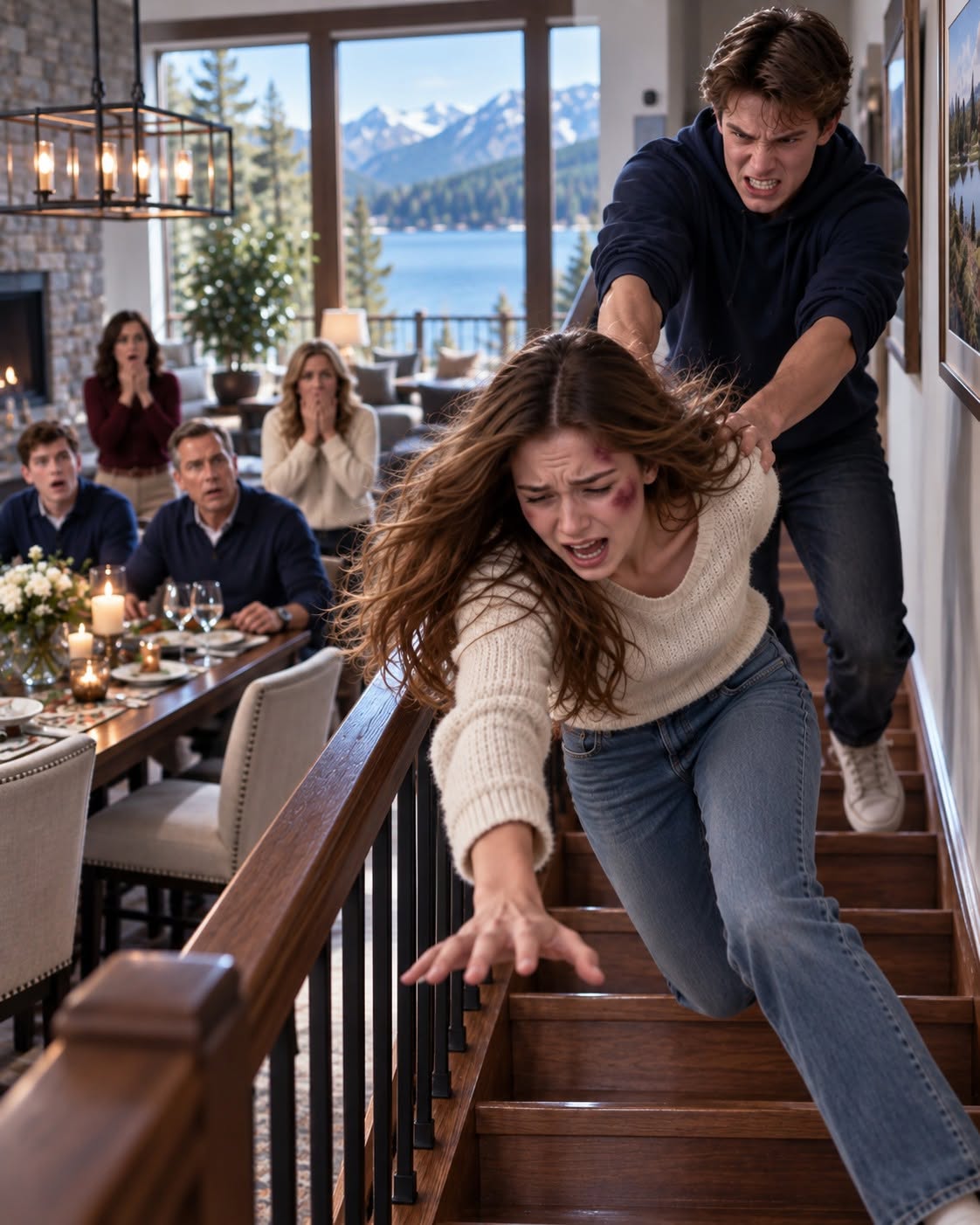
I thought the story of my family had begun on a staircase.
Then I thought it began with a canceled neurologist appointment.
Now, holding Grandma’s old birthday card, I understood that neither was true.
Our story had begun much earlier—with people who loved one another, misunderstood one another, and passed down ways of surviving without ever examining what those ways cost.
The MRI had revealed something inside my body.
But the harder discovery was what the rest of us were beginning to see.
And for the first time, nobody was looking away.
TO BE CONTINUED IN PART 3…
👉 Keep Reading — Click the next page below 👇