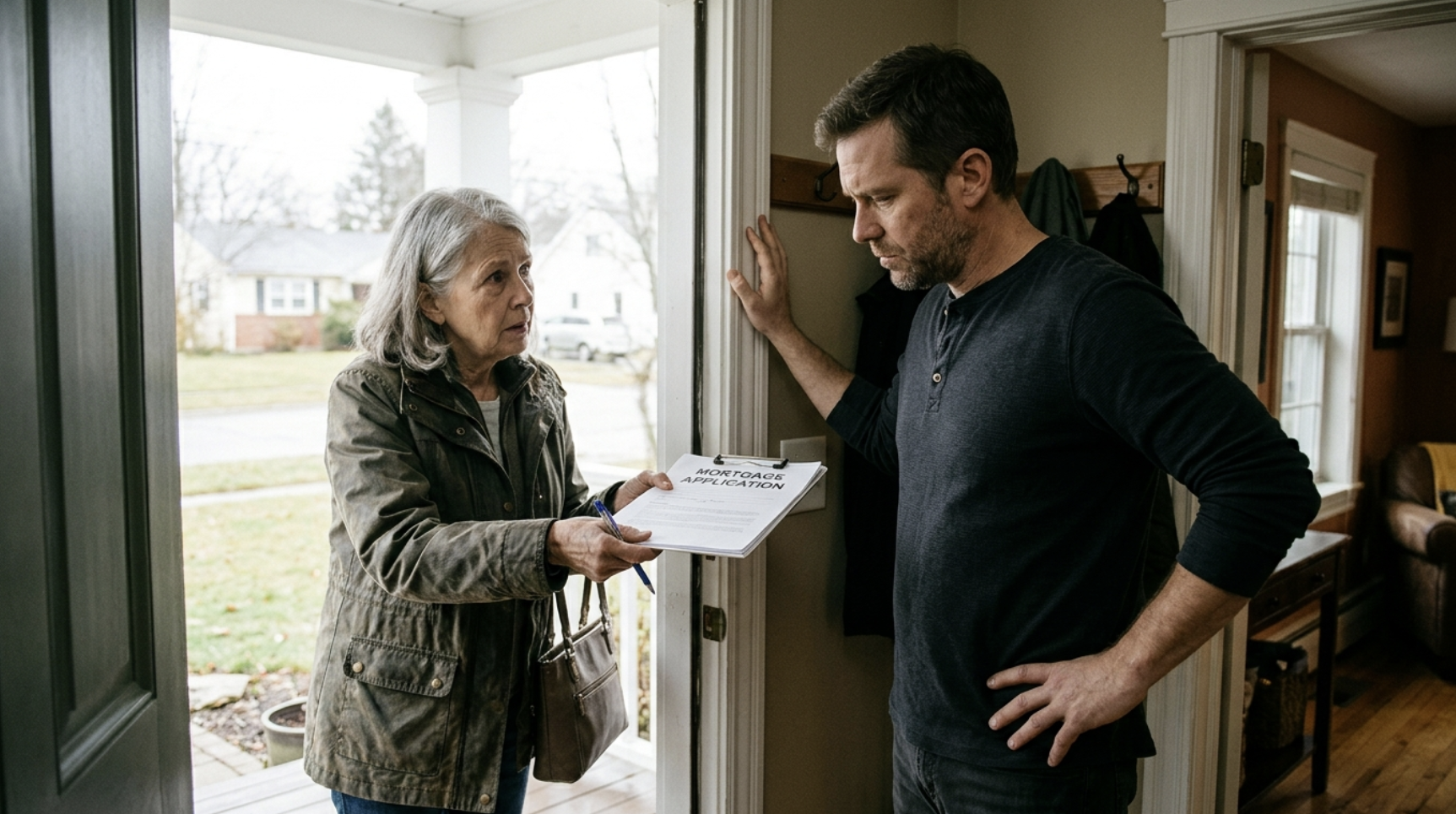
PART 3
I looked at my mother.
She suddenly became very interested in the papers sitting in front of her.
“I never agreed to that,” I said.
Mom waved her hand.
“Joel, we discussed it at your house. You said you would help us.”
“I said no. Twice.”
“Not about this. You said you would think about it.”
“No, Mom. I said I wasn’t signing.”
Mr. Haskins turned toward his keyboard.
“Did you personally authorize anyone to enter your information into this application?”
“No.”
“Did you provide your Social Security number?”
“No.”
“Did you authorize a credit inquiry?”
“No.”
He nodded and typed something.
Then he looked at my parents.
“Mrs. Joel’s information was entered into the application before he attended this meeting. We need to establish how that information was obtained and whether he consented to its use.”
Mom’s face turned red.
“I’m his mother. I have his information. I’ve had it for years.”
“That doesn’t answer the question,” I said.
Dad finally spoke.
“Can we please stop making this into something bigger than it is?”
I turned toward him.
“Dad, you signed a trust giving Nick everything. You let me pay the mortgage for six years. Now you’ve allowed my personal information to be placed on a loan application without my permission. How much smaller would you like me to make this?”
Dad looked down.
Nick shifted in his chair.
“Man, you’re acting like somebody stole your identity.”
I stared at him.
“Did you know my information was on the application?”
He didn’t answer immediately.
That was enough.
“Nick.”
“Mom said you’d probably sign eventually.”
I slowly turned toward my mother.
She had brought me into a bank with a completed application, a signature line waiting for me, and a story that everyone had supposedly agreed upon.
Nobody had asked whether I wanted to take on thirty years of debt.
They had simply decided that I would.
Mr. Haskins closed the application on his computer.
“I want to be very clear,” he said. “We cannot proceed with adding Mr. Joel as a borrower without his direct authorization. I will also document that he has disputed the representation that he agreed to participate.”
Mom looked horrified.
“You’re going to put that in the file?”
“Yes, ma’am. That’s part of my responsibility.”
She turned toward me.
“Are you happy now?”
I almost laughed.
Not because anything was funny, but because even after everything that had happened, she still believed I was the one creating the problem.
“I didn’t put my name on that application,” I said. “I didn’t create the trust. I didn’t choose the balloon mortgage. And I didn’t ask Nick to build his business in Dad’s workshop without paying rent.”
Nick sat forward.
“Leave my business out of this.”
“Why? It’s part of the property you’re inheriting.”
“I’m not inheriting anything yet.”
I reached into my folder and pulled out another copy of the trust.
“November 12. That’s when Mom and Dad signed it. You’re the successor trustee. The house, the fifteen acres, the workshop, and everything inside it go to you.”
Nick glanced at the document.
“I know what it says.”
“Then you know exactly why I stopped paying.”
He leaned back again.
“You’re making it sound like I forced them to do that.”
“Did you ask them to put everything in your name?”
He looked at Mom.
She looked at Dad.
Dad rubbed his forehead.
Nobody answered.
And suddenly, I understood something I had spent six years refusing to see.
My parents didn’t believe I was helping them.
They believed I was fulfilling an obligation.
They had turned my kindness into a monthly bill, and somewhere along the way, my sacrifices had become so normal that they no longer looked like sacrifices to them.
Mr. Haskins gathered the documents.
“I suggest everyone speak with independent legal counsel before proceeding. There are some issues here that need clarification.”
Mom stood up.
“We don’t need lawyers. We’re family.”
I looked at her.
“That’s exactly what I thought.”
Then I picked up my folder and walked out.
I didn’t wait for anybody.
My phone started ringing before I reached the parking lot.
Mom.
I let it ring.
Then Dad.
I ignored that one too.
Nick sent a text.
Nick: You embarrassed everybody today. Hope you’re proud.
I sat inside my truck and read it twice.
Then I typed:
Me: I didn’t embarrass anybody. I refused to sign a loan I never agreed to take responsibility for.
He replied almost immediately.
Nick: You’re going to regret this when the bank takes the house.
I stared at the message.
For six years, I had been terrified of that exact sentence.
I had imagined my parents losing their home, Dad sitting in an empty living room, Mom crying over boxes, and relatives whispering that I had abandoned them.
That fear had kept my bank transfers running even when my own savings were disappearing.
But now I had a different question.
Why was I the only person in this family expected to be afraid of losing something?
Nick had a business.
Dad had a pension.
Mom had her own income.
And they had fifteen acres of property that they had chosen to leave entirely to my brother.
I started my truck.
For the first time in six years, I drove away from a family financial emergency without promising to fix it.
And it felt strange.
It also felt right.
But the feeling didn’t last long.
Three days later, I received a letter from Delta Ridge Bank.
It was addressed to my rental house, and the return address was the bank’s loan department.
I opened it while standing beside my kitchen counter.
The letter thanked me for attending the January 29 meeting and confirmed that I had declined to participate in the refinancing application.
That part was fine.
Then I reached the second paragraph.
It stated that the bank had received supporting financial documents associated with the application, including income information and copies of financial records.
I read the paragraph again.
I had never provided those documents.
I called Mr. Haskins.
He answered after two rings.
“Mr. Joel, I was actually hoping you would call.”
“Can I ask you something? Where did the financial information on that application come from?”
There was a short pause.
“The application was initially submitted with supporting information by your parents. Some of the documents appear to have been provided by the primary applicant.”
“Which documents?”
“I can’t discuss every detail over the phone, but I can tell you that your name was included in the initial application notes.”
I closed my eyes.
“Mr. Haskins, I need you to understand something. I never agreed to be part of this loan.”
“I understand. That’s why I’ve documented your objection.”
“Please make sure nobody uses my information for another credit inquiry.”
“We’ll note that request.”
I thanked him and hung up.
Then I called a local attorney named Rebecca Collins.
I had found her through a recommendation from a coworker who had dealt with an inheritance dispute.
I explained the situation.
Six years of mortgage payments.
The living trust.
The property going entirely to Nick.
The refinancing application.
My personal information being entered without my permission.
She listened without interrupting.
When I finished, she asked me one question.
“Joel, do you have proof of every mortgage payment?”
“Yes. I have the bank transfers.”
“Do you have the trust?”
“I photographed every page.”
“Good. Bring everything to my office.”
I arrived the following Monday with a folder thick enough to barely close.
Rebecca spent nearly two hours reviewing the documents.
She looked through the payment history, examined the trust, and wrote down several dates.
Finally, she leaned back in her chair.
“I’m going to tell you something that may disappoint you.”
“What?”
“Paying your parents’ mortgage doesn’t automatically give you an ownership interest in their property.”
I nodded.
“I figured.”
“But that doesn’t mean you have no rights or options. We need to determine whether those payments were intended as gifts, loans, or something else. We also need to understand the circumstances surrounding the refinancing application.”
She tapped the trust document.
“And we need to establish whether this trust was properly executed and whether there are any other documents that affect the property.”
“Can they legally leave everything to Nick?”
“Generally, parents can choose how to distribute their property. It doesn’t mean their decision is fair. But unfairness alone isn’t necessarily a legal claim.”
I looked down at my hands.
“I wasn’t asking for the whole property.”
“I understand.”
“I just thought if I helped keep the house, I would at least be treated like I mattered.”
Rebecca’s expression softened.
“Sometimes the hardest part of a family dispute isn’t the money. It’s realizing that the people you were trying to protect may not have been protecting you.”
I sat quietly.
Then she asked me to explain something.
“Why did your parents need refinancing now? You mentioned a balloon payment.”
I explained that the mortgage had a five-year balloon provision and that the balance was scheduled to become due on January 31.
Rebecca looked at the dates again.
“Did you know they had been discussing refinancing since November?”
“Mr. Haskins told me the application had been open since November 10.”
She stopped writing.
“November 10?”
“Yes.”
“And the trust was signed November 12?”
“That’s right.”
She looked at me for several seconds.
“Joel, I want you to obtain the complete loan application file through the appropriate process. The timing is worth examining.”
I asked what she thought might be happening.
“I don’t want to speculate before we have the documents. But I would like to know who submitted the application, what information was represented, and whether your parents were planning to use your income before or after they decided to exclude you from the property.”
That sentence stayed with me.
Before or after.
For the next several days, I concentrated on work.
I stopped checking my phone every five minutes.
I stopped worrying about whether Mom had made the mortgage payment.
I even started looking at houses again.
Not expensive houses.
Just a small three-bedroom place with a garage where I could keep my tools and park my truck.
I found one outside Jonesboro.
It needed new flooring and some work on the kitchen cabinets, but it had a decent roof, a fenced backyard, and enough space for me.
The asking price was $189,000.
Six years earlier, I could have afforded something similar.
I called the listing agent and arranged a viewing.
For the first time in a long while, I was making plans that belonged to me.
Then, on February 5, my father called.
I almost didn’t answer.
But something in me still wanted to hear his voice.
“Hello?”
“Joel.”
“Hey, Dad.”
He sounded tired.
“Your mother says you’re talking to lawyers.”
“I am.”
“Why?”
“Because I need to understand what happened.”
“Nothing happened. Your mother and I made a decision about our property.”
“And I made a decision about my money.”
He sighed.
“Your mother is upset.”
“I know.”
“She’s been crying.”
I looked out my kitchen window.
“Dad, did you know my information was on that refinancing application?”
Silence.
“Dad?”
“I knew they were going to need another borrower.”
“Did you know they put my information on it?”
“I don’t know exactly what your mother submitted.”
“Did you know the application started on November 10?”
Another pause.
“Joel, this isn’t the time to argue about dates.”
“Then when is the time?”
He lowered his voice.
“Your mother and I are in trouble.”
I closed my eyes.
There it was.
Not an apology.
Not an explanation.
Not even a question about how I was doing.
Just another emergency.
“What happened?”
“The bank hasn’t approved the refinancing.”
“I thought they were willing to refinance.”
“They need additional income verification.”
“Then Nick can provide it.”
“Nick’s business has been slow.”
“Then maybe he needs to find another way to make the payments.”
Dad’s voice became sharper.
“You know that’s not easy.”
“I know. I’ve been doing it for six years.”
He didn’t answer.
Then he said something I wasn’t expecting.
“Your brother is trying to help us.”
I almost dropped the phone.
“Dad, Nick hasn’t paid a single mortgage payment in six years.”
“He has responsibilities with the business.”
“So do I.”
“You’re in a better position financially.”
I stared at the wall.
“Being financially responsible doesn’t mean I owe everybody else’s responsibilities.”
Dad exhaled heavily.
“Your mother thinks you’re punishing us.”
“I’m not punishing anybody. I’m simply no longer paying for a house that belongs to Nick.”
“It’s still our home.”
“Then you should have considered that before signing it over.”
He hung up.
I sat there for a long time.
Then I opened my email and sent Rebecca a message explaining the conversation.
Two days later, she called me back.
“Joel, I have something I want you to see.”
I drove to her office after work.
She had obtained additional information through the proper channels and reviewed the documents I had provided.
On her desk was a printed copy of a financial statement.
“Do you recognize this?”
I looked at the page.
It was a list of estimated monthly expenses associated with my parents’ household.
Mortgage.
Utilities.
Insurance.
Property taxes.
Maintenance.
At the bottom was a section titled Proposed Household Support.
Beside it was a monthly amount.
$1,850.
Exactly what I had been transferring.
I looked at Rebecca.
“This is my payment.”
“Yes.”
“Why is it in their financial statement?”
She pointed to a note beside the amount.
“Your parents represented that this support was expected to continue after refinancing.”
I felt my stomach tighten.
“So they were counting on me to keep paying.”
“That’s what the document appears to indicate.”
I read the page again.
There was another section listing the intended use of the property.
Nick’s automotive business was identified as the primary occupant of the workshop.
A separate note described the workshop as an asset that would remain available to Nicholas under the family trust.
I looked up.
“They used my payments to make the property look affordable, while planning to leave the property to him?”
Rebecca didn’t answer immediately.
“We need to be careful about conclusions. But the documents raise important questions.”
I turned the page.
At the bottom was a handwritten note.
I recognized my mother’s handwriting immediately.
It said:
Joel has always helped. He will continue once everything is finalized.
I read it twice.
Then I put the page down.
For six years, I had believed my parents needed help temporarily.
But according to that note, my support had become part of their long-term financial plan.
And they had apparently expected it to continue even after they signed the property away.
Rebecca folded her hands.
“Joel, I recommend that you stop discussing financial arrangements directly with your parents until we understand the full situation. Keep every message, every document, and every bank record.”
I nodded.
Then she said something that changed the way I understood the entire dispute.
“There is one more document I want you to look at. It wasn’t included in the original packet you brought me.”
She slid a photocopy across the desk.
It was a document concerning the workshop.
The date was October 28.
Almost two weeks before the refinancing application began.
I looked at the first page.
Then I saw Nick’s signature.
My brother had signed a document acknowledging that he would receive exclusive use of the workshop and that his business would occupy it under the terms of the family arrangement.
But it was the second page that made my hands go cold.
There was a handwritten paragraph at the bottom.
It read:
Any future financing required to preserve the residence shall be supported by Joel’s continued monthly contributions, as previously arranged.
I looked at Rebecca.
“Previously arranged?”
She nodded.
“Did you ever agree to this arrangement in writing?”
“No.”
“Verbally?”
“No. I agreed to help my parents pay their mortgage. I never agreed to finance Nick’s inheritance.”
She placed the document back in the folder.
“Then that’s exactly what we need to establish.”
I walked out of her office that evening feeling something I couldn’t quite describe.
Anger was part of it.
But beneath the anger was something worse.
I was beginning to understand that my family had not simply forgotten to appreciate my help.
They had built their plans around it.
And they had never intended to ask whether I wanted to continue.
When I reached my truck, my phone showed three missed calls from Mom.
There was also a new text.
Mom: Your father and I need you to come home Sunday. We have something important to discuss. Please don’t bring your lawyer into family matters.
I stared at the message.
Then another one arrived.
Mom: Nick will be there too. We need to settle this before the bank makes things worse.
I didn’t respond.
Instead, I forwarded both messages to Rebecca.
Then I opened the real estate listing I had saved earlier.
The little house outside Jonesboro was still available.
I called the agent and asked whether I could make an offer.
For six years, I had helped my parents keep their dream alive.
Now I was finally considering building one of my own.
But Sunday was coming.
And I had a feeling that whatever my parents wanted to tell me, it wasn’t going to be an apology.
PART 4
Sunday arrived with a cold wind blowing across northeastern Arkansas.
I had spent most of Saturday thinking about whether I should visit my parents.
Part of me wanted to stay home.
I had already spoken with Rebecca, documented everything, and made my position clear.
But another part of me wanted to hear what they had to say.
Not because I expected an apology.
I simply wanted to know whether my parents understood what they had done.
At 11:30 a.m., I drove toward Bono.
The same road I had traveled dozens of times over the previous six years.
The same driveway.
The same brick ranch-style house.
The same fifteen acres that I had helped keep out of foreclosure.
But something felt different when I pulled into the driveway.
Nick’s truck was parked beside the workshop.
Dad’s old pickup sat near the front porch.
And Mom was standing behind the living room window, watching me arrive.
I parked and walked toward the front door.
Mom opened it before I knocked.
“Come in, honey.”
I stepped inside.
Dad was sitting in his usual recliner.
Nick was at the dining table, looking at his phone.
A stack of papers sat between them.
Mom pointed toward an empty chair.
“Sit down. We need to talk.”
I remained standing for a moment.
Then I sat.
Dad cleared his throat.
“We’ve been thinking about everything.”
I waited.
Mom folded her hands.
“We know you’re upset about the trust.”
“I’m not upset about the trust anymore.”
She looked surprised.
“Then what are you upset about?”
I looked at her.
“The six years I spent helping you while you were planning to leave everything to Nick. The fact that you expected me to continue paying even after you signed the trust. And the fact that you put my information on a loan application without asking me.”
Mom shook her head.
“We didn’t think you would react this way.”
“That doesn’t make it better.”
Nick pushed his phone across the table.
“Look, I’ve been talking to Dad. We have a solution.”
I glanced at the papers.
“What solution?”
He pulled one document toward me.
“Dad is going to transfer the workshop to my business officially. That way, I can use the building as collateral to get a business loan.”
I looked at Dad.
“Is that true?”
Dad nodded slowly.
“Nick needs the money to get his business back on track.”
“And what does that have to do with me?”
Mom answered before Dad could.
“We need you to keep helping with the mortgage for another six months. Once Nick gets the loan, things should settle down.”
I stared at her.
“Another six months?”
“Just temporarily.”
I almost smiled.
That was exactly what she had said six years earlier.
Temporarily.
Six years had passed.
I looked at Nick.
“How much are you contributing toward the mortgage?”
He frowned.
“What?”
“How much money are you putting toward the house?”
“I’m working on the business.”
“That wasn’t my question.”
He leaned back.
“I don’t have extra money right now.”
“Then how are you going to pay the mortgage when the property becomes yours?”
“That’s what the refinancing is for.”
“Which requires another borrower.”
He looked at Mom.
She looked away.
I continued.
“And you want me to keep paying while you use the workshop as collateral for your business?”
Nick’s expression changed.
“It’s not like that.”
“Then explain it.”
He rubbed his face.
“Joel, you don’t understand how difficult it is to run a business.”
I looked around the room.
“I understand how difficult it is to work. I understand how difficult it is to save money. I understand what it means to give up something you want because somebody else needs help.”
I pointed toward the papers.
“But I don’t understand why everybody else’s future has to come before mine.”
Nobody spoke.
Then Mom began crying.
“After everything we’ve done for you, this is how you treat us?”
I looked at her.
“What exactly have you done for me?”
She seemed shocked.
“We raised you!”
I nodded.
“Yes. You did. And I appreciate that. But raising your child doesn’t mean you own his paycheck for the rest of his life.”
Dad stood up.
“That’s enough.”
I turned toward him.
“No, Dad. I think we’ve spent enough years pretending everything is fine.”
I reached into my jacket and pulled out a folded sheet of paper.
It was a simple calculation I had prepared the night before.
I placed it on the table.
“Seventy-two payments. Eighteen hundred and fifty dollars each. That’s $133,200.”
Mom looked at the paper.
I continued.
“Then there’s the $2,300 insurance shortage. The repairs I paid for when the water heater failed. The money for the property taxes when the escrow account came up short.”
Dad looked down.
“I never asked you to write that down.”
“No. You didn’t. Because you never had to.”
I took a breath.
“I didn’t help because I expected to get rich. I helped because I loved you. I thought you needed me temporarily, and I believed we were keeping the family home safe.”
I looked directly at Nick.
“But apparently, I was just paying for the property you were going to inherit.”
Nick slammed his hand against the table.
“You’re acting like I stole something from you!”
I shook my head.
“You didn’t steal it. Mom and Dad gave it to you. But you knew who was paying for it.”
He stood up.
“I never forced you to send money.”
That sentence hurt more than I expected.
Because technically, he was right.
Nobody had held a gun to my head.
Nobody had forced me to transfer $1,850.
I had done it willingly.
But I had done it believing I was helping people who would never deliberately take advantage of me.
I stood up.
“That’s true, Nick. You didn’t force me. I made the choice. And now I’m making another one.”
Mom wiped her cheeks.
“What choice?”
“I’m done paying.”
Dad’s voice became quiet.
“Joel, the mortgage is due tomorrow.”
I looked at him.
“Then you need to contact the bank.”
“We don’t have enough.”
“Then talk to Nick.”
Nick shook his head.
“My business can’t cover it.”
I nodded.
“Then you have a problem that the three of you need to solve.”
Mom stood up.
“You can’t just walk away from your family!”
I looked at her for a long moment.
“I’m not walking away from my family. I’m walking away from a financial arrangement that has been hurting me for six years.”
Then I left.
Nobody followed me to the truck.
For the first time, I didn’t feel guilty about that.
The Bank’s Final Decision
The following Tuesday, Rebecca called.
“Joel, I have an update.”
I was taking a break at the pipeline site.
“What happened?”
“Delta Ridge has reviewed the refinancing application. They are not moving forward with you as a borrower.”
I felt relieved.
“Good.”
“There is more. The bank has also requested additional documentation from your parents because the financial support listed in their application was not independently verified.”
I leaned against the side of my truck.
“What does that mean for them?”
“It means they need to demonstrate that they can afford the loan without relying on income or contributions that aren’t guaranteed.”
I already knew the answer.
They couldn’t.
Rebecca continued.
“The bank has also confirmed that the existing balloon payment remains due under the original loan agreement. Your parents need to speak with their lender immediately about their options.”
I thanked her.
Then I asked something that had been bothering me.
“Can they come after me for the money I’ve stopped paying?”
“Not simply because you previously helped them. You’re not a borrower on the existing mortgage. However, we’ll keep monitoring any attempts to represent you as financially responsible.”
That was all I needed to hear.
Later that afternoon, Mom called.
I answered.
“Hello?”
“Joel, the bank says they won’t approve the loan.”
“I heard.”
“Your father is devastated.”
“I’m sorry to hear that.”
“They’re saying we need more income documentation.”
“Then give them what they need.”
“We can’t qualify without you.”
I closed my eyes.
“Mom, I have already answered this.”
“But you’re the only one who can help us.”
“No. I’m the only one you’ve been asking.”
She began crying again.
Then she said something I will never forget.
“Nick has a future to protect. You have a good job. You’ll be fine.”
I stood completely still.
There it was.
The explanation behind everything.
Nick needed protection because his future was uncertain.
I didn’t need protection because I was responsible.
Nick deserved an inheritance because he was struggling.
I deserved nothing because I was capable of surviving without one.
I spoke quietly.
“Mom, I have a future too.”
She didn’t answer.
“I wanted a house. I wanted savings. I wanted to get married someday and have a family without worrying about whether I could afford my own life.”
“Joel—”
“I gave up a house once because you told me you couldn’t make the payments without me. I don’t regret helping you when you needed it. But I regret believing that my own future could wait forever.”
She started sobbing.
I ended the call.
Not angrily.
Just firmly.
The Workshop Wasn’t the Golden Ticket
A week later, something happened that I hadn’t expected.
Nick called.
I almost ignored it, but curiosity got the better of me.
“What?”
“Can we talk?”
“About what?”
“The workshop.”
I waited.
He sounded uncomfortable.
“Dad talked to an attorney.”
“And?”
“He says the workshop can’t just be used as collateral the way I thought.”
I leaned back in my chair.
“Why not?”
“Because of the way the trust is structured. The property is still subject to the existing mortgage, and the bank has its own requirements. The business loan people want everything documented.”
I said nothing.
Nick continued.
“They also want to know whether the business actually owns the equipment inside the workshop.”
“Does it?”
“Some of it.”
“Some?”
He sighed.
“Dad owns a few of the older machines.”
I remembered the building.
The old compressor.
The welding equipment.
The storage cabinets.
The tractor parts.
Years of accumulated equipment that Dad had purchased long before Nick started using the workshop.
“What are you trying to tell me?”
“I’m trying to figure out what to do.”
I looked at the clock.
“Then figure it out.”
He became irritated.
“Can you stop acting like you don’t care?”
I laughed softly.
“Nick, when was the last time you asked me how I was doing without needing money?”
He didn’t respond.
I continued.
“When was the last time you offered to pay part of the mortgage? When was the last time you asked whether I could afford my own place?”
Silence.
Then he said:
“I thought you were okay.”
“Because I never complained?”
“Yeah.”
I looked toward my kitchen window.
“That’s the problem, Nick. I was quiet, so everybody assumed I had no limits.”
He finally lowered his voice.
“I didn’t think Mom and Dad would leave you out completely.”
I believed that he might be telling the truth.
But it didn’t change anything.
“You knew what the trust said.”
“Yeah.”
“And you never told me.”
He sighed.
“I didn’t know what to say.”
“You could have said something before I spent another month paying for it.”
He had no answer.
Before hanging up, he said:
“I’m sorry, man.”
It was the first apology I had heard from him.
But it wasn’t enough to rebuild six years of silence.
“Thank you,” I said.
Then I ended the call.
The House I Finally Bought
In March, I received an unexpected phone call from the real estate agent.
The little house outside Jonesboro was still available.
The seller had lowered the asking price.
I had already spent several weeks reviewing my finances and speaking with a mortgage lender.
Without the $1,850 monthly payment to my parents, my financial position looked completely different.
I had a steady income.
My credit was good.
My savings were not as large as they should have been, but they were enough to make a reasonable down payment.
I made an offer.
The seller accepted.
When the lender approved my mortgage, I sat in my truck outside the pipeline office and stared at the email.
Approved.
One word.
After six years of helping somebody else keep a roof over their heads, I was finally getting a home of my own.
I didn’t tell my parents immediately.
I didn’t want their reaction to become another reason to delay something I had worked hard for.
The closing took place on April 18.
I signed the paperwork, received the keys, and drove to the property.
It wasn’t a mansion.
It wasn’t even particularly impressive.
The kitchen needed updating.
The backyard fence had a few loose boards.
The garage door made an awful noise whenever I opened it.
But it was mine.
I walked through the empty living room.
Then I stood in the kitchen and looked at the sunlight coming through the window.
I thought about the house in Bono.
I thought about the fifteen acres.
The workshop.
The $133,200.
And I realized something.
I had spent six years believing I was losing my chance to own a home because my parents needed me.
But the truth was that I had been putting my own life on hold for people who had already made plans that didn’t include me.
I took out my phone and sent one message to my parents.
Me: I bought a house today. I’m finally moving forward with my own life. I hope you both understand.
Mom responded twenty minutes later.
Mom: Congratulations, honey. I wish you had told us before.
I stared at the message.
Then I put my phone away.
There was no point explaining that I had kept my plans private because every time I had tried to build something for myself, somebody had made me feel selfish for doing it.
I spent that evening cleaning the garage.
It was the happiest work I had done in years.
The House on Fifteen Acres
Things became more difficult for my parents over the next two months.
The bank gave them a short extension while they explored refinancing and other arrangements.
They eventually spoke with another lender, but the numbers still didn’t work.
Dad’s pension wasn’t enough to qualify for the amount they needed.
Nick’s automotive business had outstanding equipment loans and inconsistent revenue.
The house had significant equity, but that didn’t mean the bank would automatically approve a new mortgage.
Eventually, my parents had to face a decision.
They could sell the property voluntarily or continue pursuing financing they couldn’t comfortably afford.
Rebecca explained to me that I had no automatic ownership claim simply because I had made the mortgage payments.
I understood.
I wasn’t going to spend the rest of my life fighting over a house I had never legally owned.
I only wanted the financial responsibility to end.
In June, Dad called.
“Joel, we’re going to sell the property.”
I sat down.
“I’m sorry, Dad.”
He sighed.
“Your mother doesn’t want to leave.”
“I know.”
“Nick says he might have to move his business.”
I didn’t know what to say.
Then Dad asked:
“Would you consider helping us with the moving expenses?”
I looked at the wall.
For a moment, I almost said yes automatically.
That was my old habit.
The instinct to solve every problem before anybody else had to worry.
But I stopped myself.
“Dad, I can help you find affordable moving companies. I can help organize boxes. But I can’t pay for everything.”
He was quiet.
Then he said:
“Okay.”
It wasn’t the answer I expected.
A few weeks later, my parents accepted an offer from a buyer.
The property sold for $412,000.
After the outstanding mortgage, closing costs, and other obligations were paid, my parents had money remaining.
The proceeds were handled according to the ownership and trust documents, and their attorney helped them understand how the sale affected the trust.
Nick moved his automotive business into a smaller rented building.
My parents moved into a modest two-bedroom home closer to town.
It wasn’t the life they had imagined.
But they had a roof over their heads.
And they were no longer relying on my monthly transfers to keep it.
I didn’t celebrate their difficulties.
I didn’t feel victorious watching them leave the property.
I simply accepted that their decisions had consequences.
The Conversation I Had Waited Six Years to Hear
In August, Mom asked whether she could visit my new house.
I hesitated before answering.
But eventually, I agreed.
She arrived on a Saturday afternoon carrying a homemade apple pie.
She looked around the living room.
“You’ve done a lot with the place.”
“Just paint and some repairs.”
“It looks nice.”
“Thanks.”
She placed the pie on the kitchen counter.
For several minutes, we talked about ordinary things.
The weather.
My work.
Her new neighborhood.
Then she became quiet.
“Joel, there’s something I’ve wanted to tell you.”
I leaned against the counter.
“Okay.”
She looked down at her hands.
“I know you’re still hurt.”
I didn’t respond.
“We shouldn’t have put your information on that loan application without asking.”
“No, you shouldn’t have.”
“And I know we should have told you about the trust.”
I nodded.
She took a deep breath.
“When your father stopped working, I was scared. I thought we were going to lose everything. You were doing well, and Nick was struggling. I kept thinking that if we protected the property for Nick, at least one of our children would have something secure.”
I listened.
“But I never thought about what it was doing to you.”
I looked at her.
“That’s what hurt the most, Mom.”
Her eyes filled with tears.
“I know.”
“No, I don’t think you do.”
She looked up.
I continued.
“Every month, I sent that money. Sometimes I worked extra shifts. Sometimes I postponed buying things I needed. I stopped looking at houses because I didn’t want you to worry.”
My voice became quieter.
“And when I found out about the trust, I realized you had been making plans for the future without ever considering that I might need one too.”
She started crying.
“I am sorry.”
I looked at her for a long time.
I wanted to hear those words for years.
But hearing them didn’t suddenly erase everything.
“I appreciate you saying that.”
She reached across the counter and touched my hand.
“Can we go back to how things were?”
I gently pulled my hand away.
“I don’t think we can.”
Her expression changed.
“Why not?”
“Because I can’t go back to being the person who fixes everything while pretending it doesn’t hurt.”
She nodded slowly.
“I understand.”
“I still want a relationship with you and Dad. But it has to be different.”
“What does that mean?”
“It means I love you. I’ll visit. I’ll call. I’ll help when I reasonably can. But I won’t be responsible for your mortgage, your debts, or Nick’s business.”
She wiped her cheeks.
“Okay.”
Then she looked around my kitchen.
“You really did buy yourself a nice home.”
I smiled.
“Yeah. I finally did.”
For the first time, she smiled too.
And that afternoon, we ate apple pie at my kitchen table.
It wasn’t a perfect reconciliation.
But it was a beginning.
Nick’s Apology
Nick took longer.
For months, we barely spoke.
Then one evening in September, he showed up at my house.
He was carrying a small cardboard box.
I opened the door.
“What are you doing here?”
“Can I come in?”
I stepped aside.
He placed the box on the kitchen table.
Inside were several old photographs.
Pictures of us growing up.
One showed us standing beside Dad’s old truck.
Another showed Nick sitting on my shoulders at a county fair.
There was even one of us fishing together when we were teenagers.
I smiled despite myself.
“Where did you find these?”
“Mom had them in a box.”
He sat down.
“I wanted to talk.”
I pulled out a chair.
“Okay.”
He looked uncomfortable.
“Business hasn’t been easy.”
I nodded.
“I figured.”
“I had to move into a smaller shop. I’m paying rent now, and I had to sell some equipment.”
“That’s tough.”
He rubbed his hands together.
“I used to think you were lucky because you had a steady job. I thought you always had money.”
I didn’t say anything.
“Then I started thinking about what you were actually doing. Every month, you were sending almost two thousand dollars to Mom and Dad. You were giving up things so they could keep that property.”
He looked at me.
“And I was using the workshop for free.”
I nodded.
“Yeah.”
He looked down.
“I should have offered to help.”
“Yes.”
“I should have told you about the trust.”
“Yes.”
He swallowed.
“I knew it would upset you.”
I leaned back.
“That’s why you didn’t tell me?”
He nodded.
“I thought if I stayed quiet, everything would work out.”
I looked at my brother.
For years, I had imagined that if Nick ever apologized, I would tell him exactly how much he had hurt me.
But sitting there, looking at him, I realized I didn’t want to spend another year arguing about the past.
“I don’t hate you, Nick.”
He looked up.
“I don’t want you to.”
“But I need you to understand something. I can’t be your backup plan anymore.”
“I understand.”
“If you need advice, I’ll listen. If you need help figuring something out, I’ll try. But I’m not financing your life.”
He nodded.
“Fair enough.”
Before he left, he looked at the photographs again.
“Remember when we used to work on Dad’s old truck together?”
“Yeah.”
“You always knew how to fix everything.”
I laughed.
“Not everything.”
He smiled.
“Maybe not.”
Then he picked up the empty box and walked toward the door.
At the entrance, he stopped.
“I’m sorry, Joel.”
This time, I believed he meant it.
I shook his hand.
“Take care of yourself, Nick.”
“You too.”
He left.
And although we weren’t suddenly best friends again, we had finally started speaking honestly.
The Final Lesson
A year later, I was sitting on the back porch of my house, watching the sun disappear behind the trees.
The garage was finished.
I had replaced the kitchen cabinets, repaired the fence, and built a small workbench along one wall.
My savings account was growing again.
I had also started dating someone named Emily, whom I met through a coworker.
For the first time in years, I was making plans without calculating how much money I needed to send to Bono on the first of every month.
Mom and Dad were doing reasonably well in their new home.
Dad had started helping a neighbor with occasional repair work.
Nick’s business was smaller, but he was slowly building it back up.
We weren’t a perfect family.
Some conversations were still uncomfortable.
Some wounds hadn’t completely healed.
But I had established boundaries, and I intended to keep them.
One evening, Mom called.
“Joel, your father wants to know if you can come over for dinner Sunday.”
“Sure. What time?”
“Five o’clock.”
“Okay. I’ll be there.”
She paused.
Then she said something that made me smile.
“And don’t bring any money. We’re cooking.”
I laughed.
“Sounds good, Mom.”
After we hung up, I looked toward the small garden I had planted behind the garage.
There was nothing extraordinary about my house.
It wasn’t the fifteen-acre property.
It didn’t have a massive workshop or a long driveway.
But every payment belonged to me.
Every improvement was mine.
And every decision about my future was finally my own.
I thought about the $133,200.
For a long time, I had viewed that money as something I had lost.
But eventually, I realized the biggest cost hadn’t been the money.
It had been the years I spent believing that being a good son meant putting myself last.
I still loved my parents.
I still cared about my brother.
But I no longer confused love with unlimited financial responsibility.
The last mortgage payment I made for my parents was in December.
I remembered the first one.
I remembered Mom hugging me and saying it would only be temporary.
And I remembered the message that started everything.
You’re late this month.
If she sent that message today, my answer would still be the same.
Ask Nick. It’s his house.
But I would add something else.
And this time, I’m taking care of mine.
Because sometimes the people you love won’t understand the sacrifices you make until you stop making them.
And sometimes, the most important thing you can do for your family is stop allowing them to destroy your future in the name of keeping theirs comfortable.
I didn’t get the fifteen acres.
I didn’t inherit the workshop.
I never received a single dollar back from those six years of mortgage payments.
But I got something I had nearly forgotten I was allowed to have.
My own life.
And that was worth protecting.