She Wasn’t Pretending
Part 1 — “She’s Faking It”
My mother-in-law rose from the gallery, pointed straight at me, and told the judge, “She’s faking it. She does this whenever a room stops listening to her.”
My husband Nathan sat beside his lawyer and smiled like she had just scored him a point. Sixty seconds later my knees folded under me on the courtroom floor — and the only person in that room who knew what was happening to me was a man I had never seen before in my life.
I had been gripping the wooden rail beside the witness stand because the room would not stay level. The lights hummed. Every whisper sounded too close. My heart was doing something deep in my chest that I had no words for — a slow, stumbling drumbeat, then nothing, then a thud that made my vision narrow.
Judge Briggs peered over his glasses. “Mrs. Bennett, can you continue?”
I wanted to say yes more than I have ever wanted anything. Nathan had spent the whole morning teaching that courtroom to hear my illness as a character flaw. His lawyer had taken a year of dizzy spells, blackouts, emergency rooms and bone-deep exhaustion, and polished it all into one word: unstable. Because no doctor had yet given my condition a name, Nathan’s side argued there was nothing wrong with me at all. His mother Diane sat behind him the whole time, nodding along, as if every terrifying episode of my year had been a performance she had finally caught me in.
What nobody in that room could see was how alone I was standing there. My own lawyer had withdrawn two weeks before, after Nathan drained our joint account and I could no longer pay the retainer. So I stood by myself, trying to explain why my seven-year-old daughter Grace had started crying on transition days, and why she had begun hiding her schoolbag so she would not have to go to her father’s house. Every time I found the words, his lawyer objected. Every objection landed. My little girl was disappearing behind legal language I had no training to fight.
Then the floor tipped again. I heard myself whisper, “Your Honor, I need a minute,” and I heard Nathan laugh — quietly, the way you laugh when the other side has just proved your case for you.
Diane shook her head. “Drama,” she said, loud enough for the first three rows.
I remember seeing two of Nathan, then three. I remember reaching for the rail and finding only air.
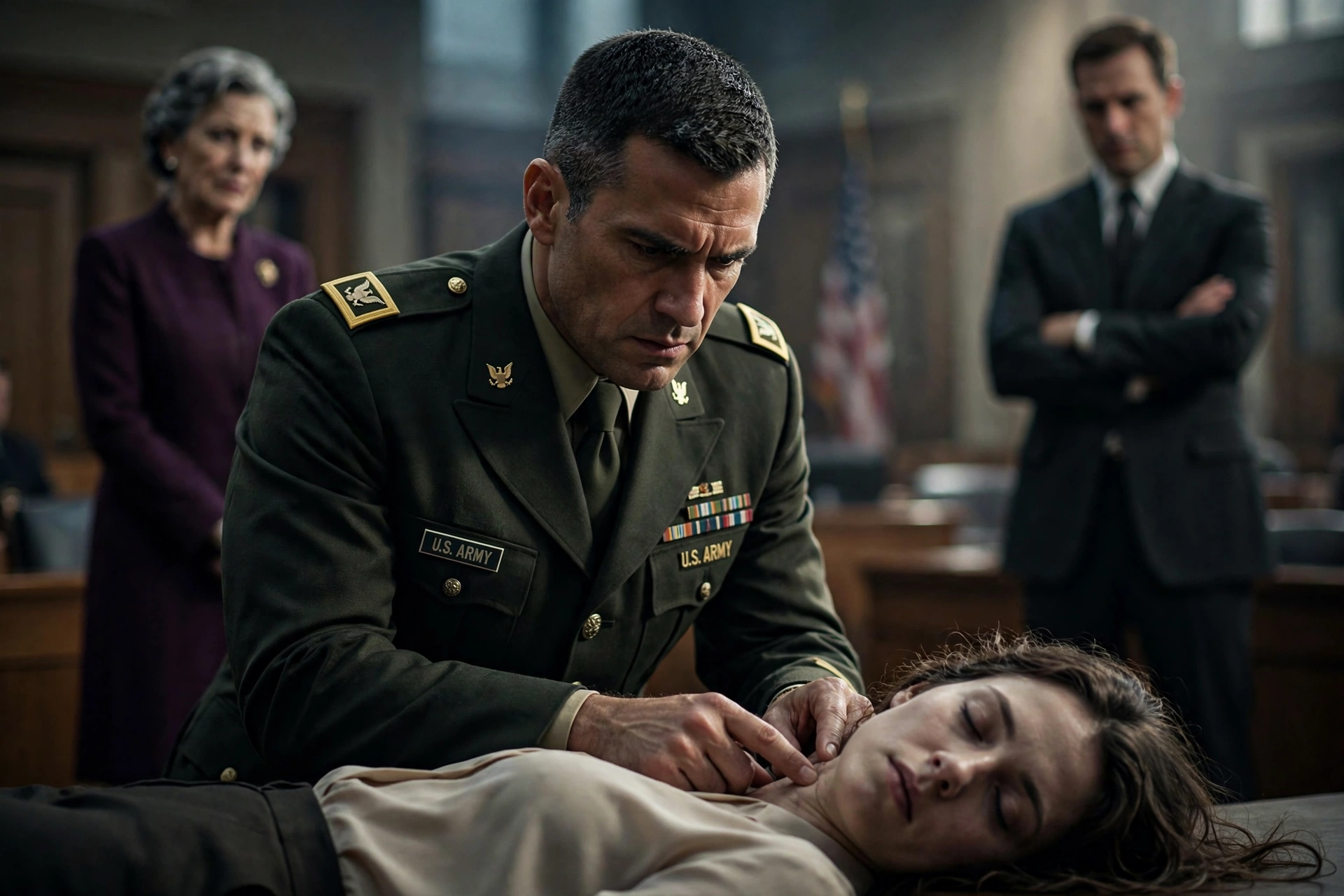
My shoulder struck the floor hard enough to knock the breath out of me, but strangely, I felt almost calm. The voices went far away, like a radio in another house. Chairs scraped. Shoes hurried across the wood. Then a tall man in a dark green uniform was on his knees beside me, two fingers pressed firmly into the side of my neck. His name tag read MERCER. Whatever he felt under those fingers wiped every trace of calm off his face.
“Ma’am, stay with me. Can you hear me?”
I tried to answer. My tongue would not cooperate.
Behind him, Nathan stood up. “She’s fine,” he said. “She does this.”
The man did not even turn around at first. When he did, his voice was quiet and absolute. “I’m Colonel David Mercer, Army Medical Corps. And she is not fine.”
Diane scoffed that a stranger couldn’t possibly know such a thing. Mercer ignored her completely. He checked my pulse a second time, lifted one of my eyelids, and asked how long the dizziness and blackouts had been going on. I got out one word: “Months.” His jaw tightened. He looked up at the bench and said, “Your Honor, this woman needs an ambulance. Now.”
For a moment, nobody moved. Maybe it was shock. Or maybe a room that has listened all morning to two people call a woman a liar forgets what a real emergency looks like. Then Mercer’s voice cracked across the courtroom like a rifle shot: “CALL 911.”
The bailiff lunged for the phone. Judge Briggs came down off the bench. And for the first time that day, Diane stopped talking.
The paramedics brought oxygen, wires, a cuff, a monitor. One of them went very still looking at the screen and said my heart rate was thirty-six. Another called out a blood pressure so low that even I, half-conscious, knew it was the kind of number that ends lives. A few feet away, Nathan’s voice changed for the first time. “Is she actually—” He couldn’t finish it.
Colonel Mercer looked at him and said the four words I had been waiting a year to hear from anyone:
“Sir, she is not pretending.”
Judge Briggs suspended the hearing on the spot. Nathan started to protest and the judge cut him off mid-sentence: custody would not be discussed until I was medically able to take part. As they lifted me onto the stretcher, I saw Diane standing beside her son — and for the first time since this nightmare began, neither of them looked like they were winning.
What the hospital found that night changed everything.
Part 2 — Numbers on a Screen
I kept apologizing to the cardiologist. That is the thing I remember most about that first night in the hospital — lying there wired to a monitor, saying sorry to Dr. Nair, as if my own heart needed an excuse.
She was very kind about it. Then she showed me the screen.
Dr. Nair explained that the electrical signal that tells my heart to beat was sometimes failing to get through — a conduction block. My pulse would drop into the thirties and stay there, starving my brain of blood until the room tilted, the lights smeared, and I went down. Stress can make a person feel faint, she told me. Stress cannot do that to a sleeping woman’s heart while a monitor records it.
“You may need a pacemaker,” she said.
I was thirty-four years old. A pacemaker was something grandfathers had. I asked her, very quietly, if I was dying, and she said no — but she did not dress it up, either. They were keeping me overnight, because they needed to know whether it would happen again.
My phone came back to me that evening with a string of missed calls. Nathan’s early messages asked what the doctors had found. The last one read: “Your stunt has now delayed everything.” Diane’s message was softer and somehow worse: “You frightened everyone today. Let us know when you are ready to be reasonable about Grace.”
I did something then that I am prouder of than almost anything in this story. I took screenshots of both messages before I could talk myself out of it.
For years, deleting had been my worst habit. Nathan would say something cruel, apologize beautifully two days later, and I would erase the proof because I wanted the sorry version of him to be the real one. I had helped him tidy up the story of our marriage every single time he hurt me. Lying in that hospital bed, listening to my own heart stumble on a screen, I understood I was done tidying.
Then the court clerk called. Judge Briggs had suspended the hearing until I was medically cleared — and he had ordered both sides to preserve the complete medical records used in the case. That word, complete, would not leave my head. Nathan’s lawyer had shown the court pages of my records. But I suddenly remembered a hospital visit back in May that had not sounded anything like the way he described it.
I opened my patient portal with shaking hands and found the note. The doctor who saw me in May had written that my repeated near-fainting episodes required further cardiac evaluation — she had specifically recommended a heart monitor worn for two weeks — and that an intermittent rhythm problem could not be ruled out.
Nathan had been sitting in that room. He had heard her say it with his own ears.
In court, his lawyer had read out exactly one line from that visit: discharged in stable condition. One line, lifted out and polished, made to sound like the doctors had examined me and found me perfectly fine. Nobody had mentioned the recommendation. Nobody had mentioned the warning. The truth of my body had not been destroyed. It had been edited — trimmed down until it told the story Nathan needed it to tell.
That night, sound asleep, with no courtroom, no audience and nothing to gain, the monitor alarm went off over my bed. My heart rate had dropped into the thirties again while I did nothing but sleep.
By morning, Dr. Nair had stopped saying “might.”
“You need the pacemaker,” she said. I asked her one final time whether fear or anxiety could create what they had recorded, because some worn-down part of me apparently still needed a doctor’s permission to believe my own body. She shook her head. “You cannot decide to produce the abnormality we captured. Being frightened does not mean you imagined the thing that frightened you.”
Before they took me down for the procedure, I downloaded every record I could find. The May note. Every emergency visit. Every report of a blackout. A full year of my body trying to tell the truth in a language nobody around me would learn.
For months I had believed my problem was finding the right diagnosis. That morning I understood I had a second problem waiting for me back in that courtroom: someone had already used half my medical story to decide what kind of mother I was.
Part 3 — The Timeline
The morning after the pacemaker went in, I stood up beside my hospital bed and waited for the room to go dark.
It didn’t.
I took ten slow steps down the corridor without touching a wall, without the floor tilting, without that familiar gray curtain closing over my ears. Then I stood in the middle of a hospital hallway and cried like a child — because my body was finally, simply, staying with me.
Nathan visited that afternoon. He looked at the bandage under my collarbone and said, “You actually got one?” — as if there had remained some chance, right up to that moment, that all of it had been theater. I reminded him he had testified under oath that there was nothing seriously wrong with me. He said he had only believed what the tests showed. So I asked him about May. About the doctor. About the words heart monitor and cannot be ruled out — spoken in a room where he had been sitting holding my coat.
His eyes moved away from mine for exactly one second. “I don’t remember that conversation.”
“Nathan. She said my heart might be stopping and restarting.”
“Doctors write things like that to cover themselves,” he said — too fast. Far too fast for a man who didn’t remember.
That was the second my anger changed shape. For months I had tortured myself wondering whether Nathan truly believed I was inventing my illness, or whether the belief was simply useful to him. Now I knew. He had heard a doctor say more testing was needed, and he had still sat in a courtroom while his lawyer described my symptoms as evidence that I was unfit. I stopped trying to make him admit it. I started preparing to prove it.
The court appointed a guardian ad litem for Grace — a woman named Laura Finch whose only job was my daughter’s interests. Laura met with Nathan, with me, and with Grace separately. She was honest that her role was not to crown a better spouse. She wanted to know what this war was doing to our seven-year-old, and somehow that frightened me more than the surgery had.
When she called me, she told me Grace had been absorbing the adults’ arguments about whether my illness was real. My little girl had heard about the dizzy spells, the hospital visits, the accusations of pretending — all of it, in pieces, from grown-up mouths that should have known better. Laura would not give me every detail over the phone. But she said one sentence I will carry for the rest of my life:
“Grace should never be put in the position of deciding whether her mother’s condition is real.”
The written report came the next morning. Grace loved her father. She liked his house, his cooking, his terrible jokes. She was not claiming he hurt her. But she was anxious at every handover. She felt pressure when she missed me. And she believed — this is the part that still makes my hands cold — that it was somehow her responsibility to watch me, to notice whether I “looked sick,” and to report it.
Then I reached the sentence that undid me completely. Grace had told Laura, in the careful voice of a child repeating something she has heard many times:
“Grandma says Mommy gets sick when she wants people to feel sorry for her.”
Diane had not kept her contempt inside the courtroom. She had poured it, drop by drop, into my daughter’s ears.
I stood in my kitchen doorway and watched Grace on the couch with her plastic horses lined up in a row, her stuffed rabbit — the one she has slept with since she was two — tucked under her arm. She was seven years old. She should have been deciding nothing more serious than which horse won the race. That night I made a decision that changed my whole case: I would not go back to court to destroy Grace’s relationship with her father. I would go back to stop the adults from making her choose between us.
I built a timeline out of nothing but facts. Emergency visit. The May note, with its recommendation. A blackout at the grocery store. Another emergency visit. Nathan’s custody filing, describing my symptoms as imaginary. The courtroom collapse. A pulse of thirty-six. The telemetry. The pacemaker. Laid out by date, in order, the thing I had lived through stopped looking like a mess and started looking like what it was: a story with pieces deliberately removed.
The new hearing was set for October 3rd. The night before, Grace climbed into my bed and asked if I was going to fall down in court again. I told her no — the doctors knew what was wrong now, and so did I. She leaned her whole warm weight against my side and whispered:
“I knew you weren’t pretending, Mommy.”
I held her and told her she never, ever had to prove that to anybody. After she slept, I sat at the kitchen table with five folders in a row: medical records, messages, court filings, Laura’s report, and my timeline. The first time I walked into that courtroom, I had tried to convince everyone I was a good person.
This time, I was bringing facts they could not talk their way around.
Part 4 — “Counsel, I Was Present”
The courtroom looked smaller the second time.
Nathan was already seated beside his lawyer. Diane was in the gallery behind them, in the same seat as before. And near the aisle, in a plain dark suit this time, sat Colonel David Mercer — the stranger whose two fingers on my neck had changed the course of my daughter’s life.
Judge Briggs confirmed I was medically cleared to proceed. Then Nathan’s lawyer rose and, in the smooth voice of a man stepping around something on the pavement, said his side had never intended to suggest my newly diagnosed heart condition was fabricated.
Judge Briggs took off his glasses.
“Counsel,” he said, “I was present.”
He did not raise his voice. He did not need to. Something in the room rearranged itself around those four words, and for the first time, the confidence on Nathan’s side of the aisle looked like what it was: an act, performed by people who had expected never to be contradicted.
Colonel Mercer was called first. Nathan’s lawyer tried to shrink him — the colonel had never been my doctor, had he? Had never treated me before that day? Mercer agreed to all of it pleasantly. He could only testify to what he personally observed. Then he added, in the same even tone: “I observed a woman in the middle of a genuine medical emergency, while the people closest to her told the room she was pretending.”
Nathan did not look at him again.
When my turn came, I asked the colonel three questions. Had we ever met before that morning? No. Could I have known he would be in that courtroom? No. And could a person simply decide to slow her own heart to thirty-six beats a minute? He turned slightly toward the bench. “Not by deciding to, Your Honor.”
Then came the May record. Judge Briggs read the recommendation aloud himself — the heart monitor, the words cannot be ruled out — and asked Nathan’s lawyer, mildly, whether that document had been available to his side before the first hearing. There was a pause you could have driven through. “It had, Your Honor.” The judge nodded slowly and observed that there was no final diagnosis yet and there was no reason to suspect a physical cause were not the same sentence, and his courtroom was not the place to pretend otherwise.
Nathan testified that he had never meant to mislead anyone. He had truly believed my symptoms were anxiety — that was simply how they looked to him. So I showed him his own message, sent the night I lay in a cardiac ward: “Your stunt has now delayed everything.” He said he had been angry. I asked him what exactly he had been angry about — that the hearing was delayed, or that I had collapsed in front of witnesses who could not be managed? He had no clean answer. The room heard the absence of one.
Then I asked the question I had carried out of that courtroom on a stretcher. “Nathan. When I fell — when I was lying on the floor and a stranger had to run to me — why didn’t you come?”
His lawyer objected. Judge Briggs allowed it.
Nathan looked at the table for a long time. “I thought you were doing what you always do,” he said at last. “Making things bigger than they are.”
Diane’s testimony nearly undid her son’s whole case, because she tried to renovate it. She had never said I was faking, she explained — only that I exaggerated. I asked her what medical training she had. None. Whether she had ever read my complete records. She had not. How, then, she had known — before I even hit the floor — that nothing was wrong with me. She looked toward Nathan, and then she gave me the truest sentence she has ever spoken:
“I knew her.”
There it was. She had never needed evidence, because she had decided who I was years ago, and every symptom since had been filtered through that decision until nothing I said could possibly count as true. I sat down, and I let the silence after her words do work that no argument of mine ever could.
Laura Finch testified last. Grace loved both her parents, she said, and needed both of us — and then she described a seven-year-old who believed it was her job to monitor her mother’s body and judge her honesty, who had been handed adult contempt in a grandmother’s voice and told to carry it. Nathan’s problem, Laura said, was not whether he could feed or house or love his daughter. It was whether he could keep his war with me out of her small hands.
Judge Briggs listened to all of it without interrupting once. Then he announced a recess before he issued temporary orders.
Outside, in the corridor, Nathan came up to me. “You made me look terrible in there.”
I said, “I asked questions. The answers did the rest.”
The bailiff opened the doors and called us back in. Nathan walked to his table. Diane sat down behind him. I returned to the same spot where, weeks earlier, I had needed a railing just to remain standing — and I stood there, steady, on my own two feet, with my heart ticking evenly in my chest like a small, faithful machine.
Judge Briggs entered with several pages of handwritten notes. He sat. He looked at Nathan for a long moment, and then at me. And then he began to speak.
Part 5 — The Ruling
Judge Briggs did not read his ruling like a man in a hurry.
He began with the facts, laid end to end the way I had laid them in my kitchen at midnight. A year of symptoms. A medical recommendation, made in May, in the father’s presence, for monitoring that never happened. A filing that described a documented medical question as a mother’s invention. A collapse in his courtroom, witnessed by an Army physician, with a recorded heart rate of thirty-six beats per minute. A diagnosis. A device now keeping rhythm in my chest. And threading through all of it, a seven-year-old girl who had been taught to watch her mother for signs of lying.
“Custody,” the judge said, “is not a prize for the parent who argues best. It is an arrangement for a child. And this court will not build an arrangement on a story that had to be edited to be believed.”
The temporary orders were these.
Grace would live primarily with me while I completed my cardiac follow-up. Nathan would have her every other weekend and one evening a week — real time, generous time, because Grace loves her father and this court, the judge said, does not punish a child for her parents’ war.
But there were conditions, and he read them slowly.
Neither parent would discuss the case, the other parent’s health, or the other parent’s honesty with Grace — ever, at all, in any form that reached her ears. Grace was never again to be asked, by anyone, whether her mother “seemed sick” or “seemed fine.” She was a child, not an instrument.
Both of us would complete a co-parenting program within ninety days. Nathan would attend counseling of his own, and the court would review his progress at the next hearing.
And Diane — the judge turned, at last, to the gallery — would have no unsupervised contact with Grace until she had completed the same parenting program and demonstrated, to the guardian ad litem’s satisfaction, that she understood why a grandmother’s contempt becomes a child’s burden. “Grandparents are a gift in a child’s life,” Judge Briggs said. “They are not a second front in a war.”
I had braced myself for years to be either rescued or destroyed in a courtroom. Nobody warned me what it would feel like to simply be believed, in full sentences, by a man with a gavel. I sat very still with my hands folded so that nobody would see them shaking — not from my heart this time. From relief, which turns out to have its own weather.
Nathan did not appeal. Outside the courtroom, with his lawyer already walking away, he stopped beside me and looked at the floor and said the closest thing to an apology I may ever get from him: “I really did think—” He ran out of road. “I don’t know what I thought.”
I said the kindest true thing I could find. “Grace needs her dad. Be the version she already believes in.”
It has been four months since the ruling. The pacemaker and I have become unremarkable to each other, which is the great miracle of it — I climb stairs, I carry laundry, I chase a seven-year-old around a playground, and I do not think about my heartbeat at all. Nathan finished his program two weeks early. He is not a different man, but he is a more careful one, and careful, I have learned, is where different starts.
Diane completed her classes. Her first supervised visit, she brought Grace a small wooden horse she had painted herself, and she did not say one word about me in either direction. It is a beginning. Beginnings are allowed to be small.
Last week, Grace asked me out of nowhere whether the “battery heart” would need new batteries someday, and whether it would hurt, and whether she could be there. I told her doctors handle all of that, and her only job — now and always — is to be seven.
She considered this with enormous seriousness. Then she said, “Okay. But I knew you weren’t pretending,” the way other children say the sky is blue, and went back to her horses.
People ask me sometimes what finally won my case, expecting a dramatic answer — the colonel, the collapse, the four words in open court. Those things mattered. But that is not the truth of it.
I did not win because I finally performed well enough to be believed.
I won because, for the first time, all the pieces of my story were allowed into the same room, in their proper order, at the same time — the symptoms and the May note and the messages and the monitor and my daughter’s small frightened voice. My story had never been empty. It had been edited.
If you are living inside a story someone else keeps trimming down to make you look like the problem — keep your records. Save the messages. Write the dates. And get your ending in full, in order, in front of someone whose job is the truth.
It worked for the woman they called a liar in open court.
It can work for you.
— THE END —
Thank you for reading “She Wasn’t Pretending.” More true-to-the-heart stories every week at dailyhubs.vip.