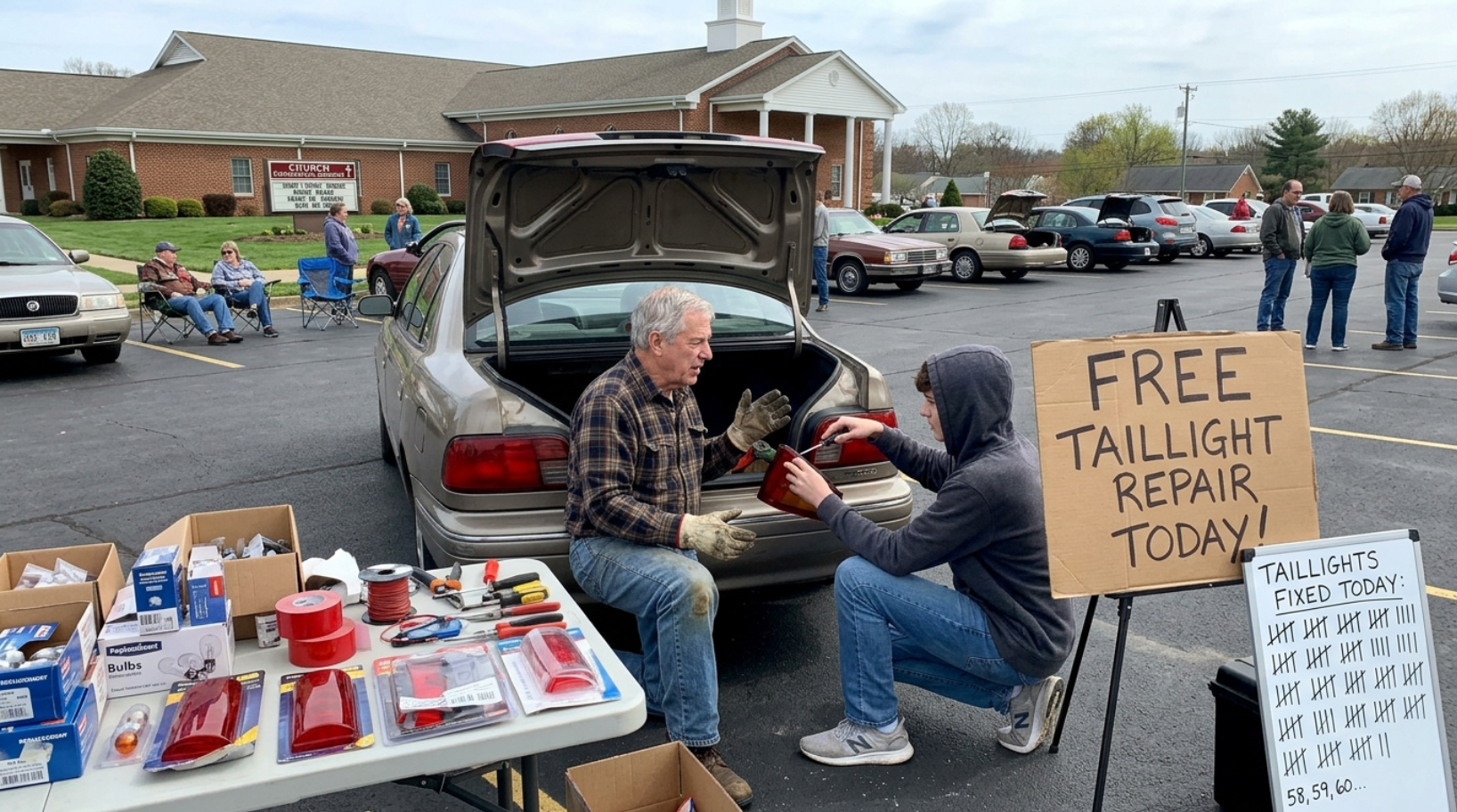
My Son-in-Law, a County Deputy, Towed My Grandson’s $1,800 Car Over a Cracked Taillight—So We Fixed 64 Cars for Free, and He Never Expected What Happened Next
PART 4
Monday morning, I drove to the county sheriff’s office with the towing receipt, the vehicle release paperwork, and a copy of the order Craig had written that night.
Tyler wanted to come with me.
I told him he didn’t have to.
He came anyway.
We sat across from Sheriff Miller in a small office that smelled of coffee and printer paper. He examined the paperwork carefully, asking when Tyler had ordered the replacement taillight, when it had been expected to arrive, and whether Craig had explained why the vehicle needed to be towed rather than allowing Tyler to arrange a repair.
I answered what I knew.
Tyler answered the rest.
When we finished, the sheriff folded his hands on the desk.
“I want to be clear about something,” he said. “This review isn’t about whether Deputy Craig likes your family. It’s about whether he followed department policy and whether his actions were justified.”
Tyler nodded.
“That’s all we want,” I said.
Sheriff Miller looked at my grandson.
“Tyler, I know this situation has been difficult. I also want you to understand that traffic laws exist for a reason. If your vehicle isn’t safe, you need to fix it.”
“I understand, sir.”
“And if an officer stops you, remain calm and follow lawful instructions.”
“Yes, sir.”
The sheriff glanced at the documents again.
“But there is a difference between enforcing a safety requirement and using enforcement to punish someone. That’s what we need to determine here.”
For the first time since that Saturday night, Tyler looked as though someone in authority was listening to him rather than looking for a reason to blame him.
We thanked the sheriff and left.
Outside, Tyler stood beside my car, staring at the courthouse across the street.
“Grandma?”
“Yes?”
“What if he says Craig did nothing wrong?”
I considered the question.
“Then we’ll accept the decision if it’s supported by the facts. And if we disagree, we’ll ask what options we have. But we won’t invent anything, and we won’t exaggerate.”
Tyler nodded.
“And what if he says Craig was wrong?”
“Then Craig will have to take responsibility for what he did.”
Tyler opened the passenger door.
“I hope he does.”
“So do I.”
But neither of us was prepared for what happened that afternoon.
Because at 3:17 p.m., my daughter Lisa appeared at my front door.
And she was crying.
I found her standing on the porch with her purse hanging from one shoulder and her wedding ring twisted around her finger.
She looked exhausted.
“Mom, can I come in?”
“Of course.”
She walked into the living room and sat down without removing her coat.
Tyler was in the garage organizing the tools we had used at the church. He heard her voice and came to the doorway.
“Mom?”
Lisa looked at him.
For a moment, neither of them moved.
Then she stood.
“Oh, Tyler.”
She crossed the room and wrapped her arms around him.
My grandson stiffened at first. Their relationship had been strained for so long that affection had become something he didn’t quite know how to receive.
Then he hugged her back.
Lisa began to cry harder.
“I’m sorry,” she whispered.
Tyler didn’t answer immediately.
She pulled back enough to look at his face.
“I should have asked you what happened with your car. I should have listened to you before I listened to everyone else.”
He swallowed.
“It’s okay, Mom.”
“No.” She shook her head. “It wasn’t okay. And I don’t want to pretend it was.”
I turned toward the kitchen to give them a little privacy, but Lisa reached for my hand.
“Please stay, Mom. I need to say this to both of you.”
So I sat down.
Lisa wiped her eyes.
“Craig told me he was teaching Tyler responsibility. He made it sound as though Tyler had been careless and disrespectful, and I believed him because I wanted to believe my husband was handling things properly.”
She looked at Tyler.
“But you had already ordered the part, hadn’t you?”
“Yes.”
“And you paid for it yourself?”
“Yes.”
She pressed her lips together.
“I didn’t even ask to see the receipt.”
Tyler shrugged, looking uncomfortable.
“It’s just a taillight, Mom.”
“No, sweetheart. It isn’t just a taillight.”
Her voice broke.
“It’s the fact that you did everything you were supposed to do, and I didn’t give you the chance to explain.”
The room went quiet.
I watched my daughter struggle with something I had seen her avoid for years: the possibility that keeping peace in her marriage had come at the cost of her relationship with her son.
Finally, she turned toward me.
“I need to tell you something else.”
I waited.
“Craig is furious about the video. He says people are making him look like a monster.”
“Did Hailey call him one?” I asked.
“No.”
“Did Tyler?”
“No.”
“Did I?”
Lisa shook her head.
“Then perhaps he needs to consider why the facts are making him uncomfortable.”
She stared at the floor.
“He says you are trying to get him fired.”
“Lisa, I have never asked anyone to fire your husband.”
“But you want him held accountable.”
“Yes.”
She looked up.
“And if that costs him his job?”
I took a breath.
“That’s a decision for the department, based on what happened. I won’t lie to protect him, and I won’t lie to hurt him. I will tell the truth.”
Lisa nodded slowly.
“I think that’s fair.”
It was the first time I had heard her say those words without immediately following them with a reason to defend Craig.
Tyler sat beside her.
“Mom, I don’t want Craig to lose his job.”
She reached for his hand.
My Son-in-Law, a County Deputy, Towed My
“I know.”
“I just want him to stop treating me like I’m always doing something wrong.”
Lisa closed her eyes.
“I know that now, too.”
For a few minutes, the three of us sat together.
Nobody promised that everything would be fixed overnight.
Nobody pretended that an apology could erase four years of hurt.
But something had changed.
For the first time in a long time, Lisa was listening.
And Tyler was finally being heard.
The next Saturday, we returned to the church parking lot.
I expected twenty cars.
We had prepared enough bulbs for thirty.
By 8:30 a.m., there were already seventeen vehicles waiting.
Pastor Ron stood beside the entrance, directing traffic. Dale from the parts store arrived with two boxes of additional bulbs. Hailey brought a fresh notebook, and Walt showed up carrying a thermos of coffee large enough to serve an entire construction crew.
“You people are going to make an old man famous,” he announced.
Tyler laughed.
“Only if you let us fix your truck again.”
“Not a chance. That thing is running better than it has in ten years.”
The atmosphere was different this time.
People weren’t just coming for repairs.
They were coming to help.
A retired mechanic offered to inspect brake lights and wiring. Two high school students volunteered to organize tools. A local business donated work gloves and safety vests.
One woman arrived with a bag of sandwiches and a note that read:
I couldn’t afford to replace my light last month. Thank you for making people like me feel less embarrassed to ask for help.
Tyler read it and carefully folded the note into his pocket.
By noon, we had repaired another thirty-eight lights.
Then a silver sedan pulled into the parking lot.
I recognized the driver immediately.
Craig.
He was not in uniform.
He stepped out wearing jeans and a plain gray jacket. For a moment, he stood beside his car, looking at the volunteers.
Tyler noticed him.
His hands stopped moving.
Hailey glanced at me.
I gave her a small nod, telling her not to make a scene.
Craig walked toward us.
“Tyler,” he said.
My grandson straightened.
“Craig.”
The word was respectful but distant.
Craig looked at the tools on the table.
“I heard you’re doing this again.”
“We are,” Tyler replied.
Craig nodded.
“Looks like a lot of people showed up.”
“They need the help.”
Craig glanced toward the line of cars.
“Can I talk to you for a minute?”
Tyler looked at me.
I didn’t answer for him.
This was his decision.
After a moment, he nodded.
They walked several feet away, stopping near the church’s side entrance.
I couldn’t hear every word, but I could see Craig’s hands moving as he spoke.
Then Tyler said something.
Craig stopped gesturing.
His shoulders lowered.
They continued talking for another minute before returning.
Tyler walked back to the worktable without saying anything.
Craig remained beside the car.
I approached him.
“Are you here to see Tyler?”
He nodded.
“I wanted to talk to him.”
“Did you?”
“Yes.”
He looked uncomfortable.
“I also wanted to speak with you, Marge.”
I waited.
Craig took a breath.
“I was wrong to have his car towed the way I did.”
The words were quiet.
For a moment, I wasn’t certain I had heard him correctly.
He continued.
“I knew he had ordered the part. I knew he was planning to fix it. I told myself I was teaching him responsibility, but I let my frustration with him influence how I handled the stop.”
He looked toward Tyler.
“I should have handled it differently.”
I studied his face.
“Why are you telling us this now?”
Craig looked down.
“Because the sheriff reviewed the incident, and I had to explain my decisions. Because I realized the video wasn’t the only thing people were looking at. And because I finally had to look at what I actually did.”
He paused.
“I don’t expect everyone to forgive me because I said I’m sorry.”
That surprised me more than the apology itself.
For once, he wasn’t demanding that an apology immediately restore his authority.
“What do you expect?” I asked.
“To do better.”
I nodded slowly.
“Then start by doing it.”
Craig looked at me.
I continued.
“Tyler doesn’t need another speech about responsibility. He needs you to treat him fairly, even when you’re frustrated with him. He needs you to correct him when he’s wrong without assuming the worst about him. And he needs to know that being part of this family doesn’t mean he has to prove himself to you every single day.”
Craig swallowed.
“I understand.”
“Do you?”
He looked toward Tyler again.
“I think I’m beginning to.”
It wasn’t a perfect answer.
But it was the first honest one I had heard from him in years.
That afternoon, Sheriff Miller called.
The department’s review had concluded that Craig’s handling of the stop was inconsistent with its expectations for impartial enforcement. The sheriff had issued formal discipline and required additional training on discretion and professional conduct.
The sheriff did not discuss private personnel details with us, and I did not ask him to.
He also made it clear that Tyler had not been accused of any wrongdoing in connection with the church project.
I thanked him.
Then I told Tyler.
He listened quietly.
“Is Craig going to lose his job?”
“The sheriff didn’t say that, and we shouldn’t guess.”
Tyler nodded.
“Okay.”
I studied his face.
“Are you disappointed?”
He shook his head.
“No. I just wanted someone to look at what happened and decide fairly.”
“That is what happened.”
He looked toward the parking lot, where Craig was helping Dale carry a box of bulbs.
“Grandma?”
“Yes?”
“I think I can forgive him someday.”
I smiled gently.
“You don’t have to rush that decision.”
“I know.”
He looked down at his greasy hands.
“But I don’t want to spend the rest of my life being angry.”
I pulled him into a hug.
“Then don’t. Just remember that forgiveness doesn’t mean you have to accept the same treatment again.”
He hugged me back.
“I won’t.”
Across the parking lot, Craig glanced in our direction.
For once, he didn’t call Tyler over to correct him.
He simply returned to work.
And that small decision mattered more than he probably realized.
The following weeks brought changes that no one in our family had expected.
Craig began attending some of the community repair events, always in plain clothes and never using his position to direct anyone.
At first, people watched him carefully.
Some refused to speak to him.
Others were willing to give him a chance.
He didn’t complain.
He carried boxes, cleaned tools, and listened when the mechanic explained why certain repairs needed professional attention.
One afternoon, I found him standing beside Walt’s truck.
Walt was explaining how he had driven the same vehicle for nearly twenty years.
Craig listened without interrupting.
Later, he came over to me.
“I never realized how much people worry about small repairs,” he said.
I looked toward the line of vehicles.
“For some people, a forty-dollar part means giving up groceries for the week.”
He nodded.
“I know that now.”
“Knowing it is a start.”
He looked at Tyler, who was helping a young mother understand why her brake light wasn’t working.
“I was hard on him because I thought he needed to become tougher.”
“Tyler is already tough,” I said. “He just doesn’t believe that being tough means making other people feel small.”
Craig was quiet for a moment.
Then he said, “I wish I’d understood that sooner.”
“So do I.”
Our relationship didn’t transform overnight.
There were still awkward family dinners. There were still moments when Craig slipped into his old habit of correcting Tyler before hearing the whole story.
But now, when that happened, Lisa spoke up.
“Craig, let him finish.”
Sometimes he listened immediately.
Sometimes he needed a minute.
But he began trying.
And Lisa began doing something even more important.
She stopped asking Tyler to keep quiet simply to avoid upsetting her husband.
One evening, she called me and said, “Mom, I thought a peaceful home meant nobody argued. I didn’t realize that sometimes it meant one person was swallowing everything they wanted to say.”
I sat quietly on the other end of the phone.
“It’s difficult to recognize that when you’re living inside it,” I told her.
“I know. I wish I’d seen it sooner.”
“You’re seeing it now.”
She sighed.
“Do you think Tyler will ever trust me the way he used to?”
I looked at the photograph on my kitchen shelf: Lisa at sixteen, standing beside Tyler’s father, holding their newborn son.
“Trust takes time,” I said. “But you can start earning it today.”
And she did.
She began visiting Tyler every Wednesday evening.
Sometimes they cooked dinner together. Sometimes they went for a drive. Sometimes they talked about school, college applications, and his plans after graduation.
She stopped making promises she couldn’t keep.
She stopped asking him to pretend that the past hadn’t happened.
Slowly, their relationship began to heal.
Not because Craig had apologized.
Not because the video had gone viral.
But because Lisa finally understood that being a mother required more than loving her son in private.
It required standing beside him when it mattered.
Three months later, the church held a community appreciation dinner.
There were folding tables in the fellowship hall, paper plates stacked beside the serving dishes, and flowers in old glass jars.
Walt brought a pie.
Dale brought more bulbs than anyone could reasonably use in a year.
Pastor Ron stood at the front and thanked the volunteers.
Then he called Tyler’s name.
My grandson looked horrified.
“Grandma, no.”
I smiled.
“Go on.”
He walked to the front, his face turning red as people applauded.
Pastor Ron handed him a small framed certificate recognizing his volunteer service.
Then he gave me one, too.
“For Marge,” he said, “who reminded all of us that when something goes wrong, we don’t always have to respond with anger. Sometimes we can respond by helping the next person.”
People applauded again.
I wiped my eyes.
But the moment I remember most clearly came afterward.
Craig approached Tyler while I was helping clear the dessert table.
He carried a small envelope.
“Tyler,” he said, “I wanted to give you something.”
Tyler opened it.
Inside was $280.
The exact amount I had paid to release the Grand Prix.
Tyler stared at the money.
“What is this?”
Craig took a breath.
“It’s what your grandmother paid to get your car back. I should never have put your family in that position, and I want to repay the cost.”
Tyler looked at him for a long moment.
“You don’t have to do this.”
“Yes,” Craig said. “I do.”
Tyler closed the envelope.
“Thank you.”
Craig nodded.
Then, after a moment, he added, “And I owe you another apology. Not just for the tow. For the way I’ve treated you since I married your mother.”
The noise in the fellowship hall seemed to fade around them.
Craig continued.
“I kept expecting you to prove you deserved my respect. I didn’t stop to consider that you deserved it already.”
Tyler’s eyes shone.
“I wanted you to like me,” he admitted.
Craig looked down.
“I know.”
“I tried really hard.”
“I know that now, too.”
For a moment, neither of them spoke.
Then Craig held out his hand.
Tyler looked at it.
Instead of shaking it, he stepped forward and gave Craig a brief, awkward hug.
Craig froze for half a second.
Then he returned it.
I turned away before they could see me crying.
Not because everything had been repaired.
But because something had finally begun.
A year after the first taillight was replaced, Tyler graduated from high school.
He had been accepted into a technical college, where he planned to study automotive technology.
He wanted to become a mechanic.
Not because he hated law enforcement.
Not because he wanted to prove Craig wrong.
But because he had discovered something important in that church parking lot.
A broken part didn’t make a person broken.
And helping someone fix a problem could change far more than the machine itself.
On graduation day, I sat between Lisa and Hailey in the school auditorium.
Craig sat on Lisa’s other side.
When Tyler’s name was called, we all stood.
He crossed the stage with his usual crooked smile, accepted his diploma, and looked directly toward us.
I cheered so loudly that Lisa laughed.
Afterward, we gathered in the parking lot for photographs.
Tyler hugged his mother first.
Then Hailey.
Then me.
When he reached Craig, they shook hands before Craig pulled him into a hug.
It wasn’t the embrace of a perfect father and son.
It was the embrace of two people who had hurt each other, acknowledged it, and decided to try again.
That was enough for that day.
Later, as we drove home, Tyler sat in the passenger seat of his Grand Prix.
The car was still running beautifully.
Its taillights shone red in the afternoon sun.
He looked at me and smiled.
“Grandma, remember when you said we should stand behind people?”
“I remember.”
“I think that was the best thing anyone ever taught me.”
I laughed softly.
“You learned that from yourself, sweetheart.”
He shook his head.
“No. I learned it because you stood behind me first.”
I had to look away for a moment.
Because he was right.
That was what the whole story had been about.
Not a cracked taillight.
Not a tow truck.
Not a viral video or a deputy’s discipline.
It was about what happens when a young person makes a mistake—or even when he doesn’t—and the adults around him choose whether to humiliate him or help him grow.
Craig had believed authority meant making Tyler obey.
I had believed love meant making sure Tyler knew he mattered.
Eventually, Craig began to understand that respect could not be forced, and Tyler learned that he could stand up for himself without becoming bitter.
And Lisa learned that keeping peace at any cost wasn’t the same as keeping a family together.
As for me, I learned something, too.
Sometimes the strongest response to being wronged isn’t revenge.
It’s refusing to let the wrong turn you into someone you don’t want to be.
Two Saturdays later, we held another free repair day at the church.
This time, Tyler led the volunteers himself.
He wore a clean work shirt with his name stitched over the pocket. Hailey managed the sign-in table, Dale supplied the bulbs, and Pastor Ron directed cars into the lot.
Craig arrived halfway through the morning.
He parked his own vehicle and walked over to Tyler.
“Where do you need me?”
Tyler pointed toward a stack of boxes.
“Could you help Dale organize those?”
“Sure.”
And that was all.
No speech.
No argument.
No demand for recognition.
Just a man asking how he could help.
By the end of the afternoon, we had assisted fifty-one drivers.
As the last car pulled away, Tyler stood beside me near the church steps.
The sky was turning gold, and the bell tower cast a long shadow across the parking lot.
“Grandma,” he said, “do you think the whole thing would have happened if Craig hadn’t towed my car?”
I considered that.
“Probably not in exactly the same way.”
He nodded.
“It’s strange. That night, I thought everything had gone wrong.”
“And now?”
He looked across the parking lot at the people packing away the tools.
“Now I think something good came out of it.”
I smiled.
“That’s often how life works. It doesn’t make the bad thing right. It just means the bad thing doesn’t get to be the end of the story.”
Tyler leaned his head against my shoulder.
Then he said something I will carry with me for the rest of my life.
“I’m glad you were there.”
I squeezed his hand.
“Always, sweetheart.”
And as we walked toward the car, I glanced back at the church parking lot.
Sixty-four taillights had started it all.
But the greatest thing we repaired that year wasn’t a single light on a vehicle.
It was a family that had forgotten how to listen.
We didn’t fix it in one afternoon. We didn’t fix it with a viral video or a perfect apology.
We fixed it one honest conversation at a time.
One boundary at a time.
One act of kindness at a time.
And that, I finally understood, was the kind of lesson worth teaching.