The Story Continues After Part 2
Then he went dead still.”What on earth is this?”
Jessica appeared at the top of the stairs.
I kept sipping my coffee…
Colin read the first page again, slower this time.
“Notice of termination of residential occupancy arrangement,” he said.
His eyes went to the next page.
“Proposed new lease terms?
What lease?
We own this house.”
“Do you?” I asked.
Jessica came down three stairs at a time, snatched the paper from him, and began scanning it.
Her jaw tightened in that way I had come to recognize from evenings when a client at her firm gave her an answer she didn’t like.
“This is a scam,” she announced.
“Some company is trying to frighten us into paying rent.”
“I would call the attorney listed at the bottom,” I said.
She stared at me.
“Why are you acting so calm?”
“Because I already know what the letter says.”
Colin turned toward me.
In his face I could see the boy who once asked me to explain why the moon followed our car, and the grown man who had told me to vacate my bedroom so his son could have it.
“Mom,” he said carefully, “what have you done?”
“Nothing to your house,” I said.
“I’ve simply decided what to do with mine.”
The kitchen went quiet, except for the small metallic click of the coffeemaker turning itself off.
Jessica threw the papers onto the counter.
“That’s impossible.”
I took another sip.
“You might want to finish reading.”
At the bottom of the second page was the name of the legal owner, the name of its manager, and the date the property had changed hands.
A&M Property Holdings, LLC.
Managing member: Margaret E.
Vance.
Colin gripped the edge of the counter.
“How?” he whispered.
I had spent ten months imagining this moment.
Strangely, now that it was here, I felt no triumph.
I felt tired.
I felt relieved.
And beneath both feelings was a grief that had been accumulating quietly in me for years.
“Sit down,” I said.
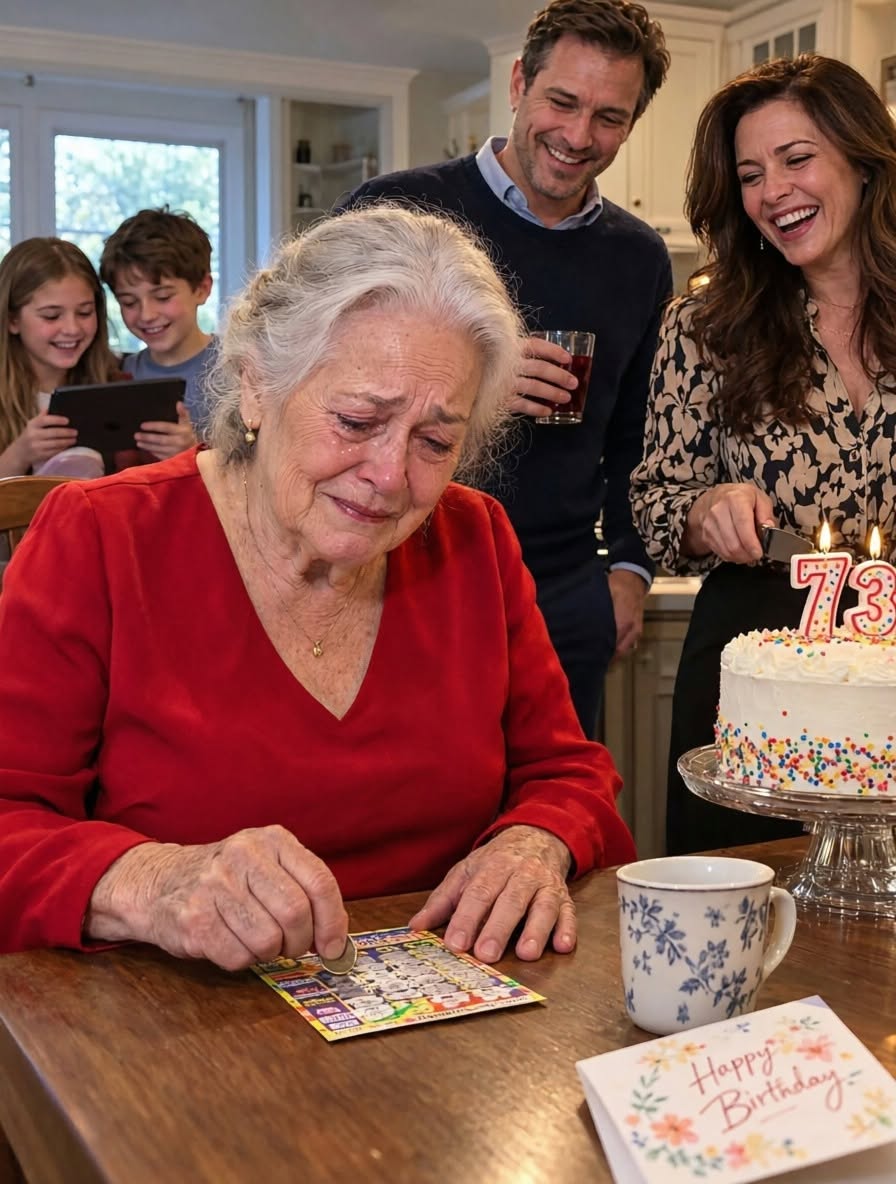
“I think it’s time you learned what that birthday ticket actually bought.”
PART 3
The ticket had not been worth bus fare.
It had been worth enough to make the clerk at the gas station stop smiling and call the lottery office for instructions.
I did not claim it at the convenience store.
Richard made that much clear the Monday after my birthday, when we met in an office above a bookstore downtown.
He asked me to put the ticket in a protective sleeve, photographed both sides, and arranged for an accountant to walk me through the claim and taxes.
The advertised prize was five million dollars.
I chose the cash option, and after the applicable withholdings and later tax planning, what remained was still a sum so enormous that I had to write it down before I believed it.
Richard did not celebrate by telling me to buy a car.
He asked a question no one in my family had asked in years.
“What do you want your life to look like?”
I almost answered that I didn’t know.
Then I realized I did know.
I wanted a front door I could close without someone demanding an explanation.
I wanted to wake up on Saturday without being told which errands needed doing.
I wanted to be treated like an adult rather than a broken appliance still useful enough to keep around.
“Start by helping me understand my options,” I said.
We spent weeks assembling a careful plan.
I established updated estate documents, reserved money for taxes, and put most of the proceeds into a diversified, conservatively managed portfolio.
I gave myself a monthly budget.
I made no expensive promises to anyone.
The house entered the conversation only later.
I had assumed Colin and Jessica owned it.
Colin had been proud of the beautiful limestone place in a quiet Austin neighborhood, with a large oak shading the driveway and a downstairs bedroom for me.
But one afternoon I overheard an argument through the laundry room door.
“The owner wants the property sold,” Colin said.
“We can’t keep delaying.”
Jessica answered, “Then buy it somehow.
I am not moving the children again.”
That evening I looked up the public property records.
The house was owned by an investment company, not my son.
Colin and Jessica had a long-term lease with a purchase option they could not afford to exercise.
I spoke to Richard the next day.
He contacted the owner through a separate attorney.
After an appraisal, inspections, title review, and weeks of negotiation, my new holding company bought the property at a market price.
No special tricks.
No secret alteration of anyone’s contract.
The lease remained in force, and Colin kept paying rent to the same management service, which now sent the proceeds to my company.
I hadn’t purchased the house to punish my son.
I bought it because it was a sound investment and because it gave me a choice.
The decision to reveal myself came much later.
Back in the kitchen, Jessica interrupted.
“You’re saying you bought this entire house without telling us?”
“Yes.”
“With money from my birthday gift?”
“Yes.”
Her cheeks reddened.
Colin sat down abruptly.
“Why didn’t you tell me?” he asked.
I looked at the brochure still lying on the table.
“Because I wanted to know how you’d treat me if you thought I had nothing.”
PART 4
Jessica recovered first.
She always did.
Her face changed from disbelief to calculation, like a person turning a page to find a more advantageous argument.
“Margaret,” she said, “we were trying to do the responsible thing.
You have to understand that.”
“By choosing a room for me without asking whether I wanted to go?”
“Colin was worried about you.”
“Was he worried about me, or worried that Lucas needed my bedroom?”
Colin rubbed his forehead.
“Mom, it isn’t that simple.”
“No,” I said.
“It isn’t.
That’s why you should have talked to me.”
Jessica tapped the document.
“Even if this is legitimate, you can’t just make us leave.
There are laws.”
“I know.
Richard does too.
The letter says exactly that.
You’re tenants with a valid lease.
You have every protection you’re entitled to.
The notice explains what happens when the lease expires and offers terms for renewal.
Nobody is being thrown onto the street.”
That seemed to disappoint her.
She had prepared herself to fight a cruel landlord.
It was harder to fight a woman who had already decided not to behave cruelly.
Colin looked from her to me.
“You bought it months ago.
You could have said something before we made plans.”
“You had ten months to ask whether I was happy.
You had four years to ask whether I wanted to spend the rest of my life doing your laundry.
You had every opportunity to speak to me as a person, Colin.”
He stared at the table.
I could see that the words were reaching him, though I could not tell whether he understood them yet.
“Are you evicting us?” he asked finally.
“No.
I’m moving out.
I’ve already signed the purchase contract on a smaller place closer to the river.
You can complete your lease here and decide whether you want to renew on the terms set out in that letter.
I will not subsidize it, and I will not be the household help.”
Jessica gave a brittle laugh.
“So this is revenge.”
“Revenge would be treating you the way you treated me,” I said.
“This is me stopping.”
A door opened upstairs.
Twelve-year-old Lucas called down, asking where his clean soccer jersey was.
Without thinking, Jessica turned toward me.
“Margaret, did you wash his—”
She stopped mid-sentence.
I set my empty cup in the sink.
“The laundry room is on your left.”
And that was the moment Jessica understood the letter was not the only thing that had changed.
PART 5
At eleven that morning, Richard arrived with a folder containing copies of the closing documents and an explanation of the lease provisions.
He wore an ordinary blue suit and carried a worn satchel.
He did not look like anyone’s idea of a wealthy woman’s attorney, which is one reason I liked him.
Colin insisted on seeing the deed.
Jessica scrutinized the pages line by line, looking for a loophole.
Richard gave her room to read and answered each legal question precisely.
He did not raise his voice.
“Your lease isn’t being canceled today,” he explained.
“The owner changed earlier this year.
The existing contract survived that transfer.
The notice sets out an offer for what happens when the present term ends.
Your response period is in the letter.”
“And what if we refuse?” Jessica asked.
“Then the existing agreement governs until it ends.
Afterward, any disagreement follows ordinary Texas procedures.
Nothing here authorizes an unlawful lockout.”
She appeared almost offended by his calm.
Colin kept returning to the same question.
“If she won five million dollars, why does she care about rent?”
“Because I’m not your bank,” I said.
It hurt to say.
For years I had been the person who paid unexpected school expenses, bought groceries when Jessica forgot, and handed Colin money for household repairs without ever asking whether it would be returned.
No single favor had ruined our relationship.
It was the way every favor had quietly become an obligation.
After Richard left, I carried my suitcase outside.
My best friend, Helen Mercer, was waiting by the curb in her little red car.
Helen had been a widow longer than I had, and she understood the difference between being alone and being left in peace.
She stepped out when she saw me.
“Ready?”
“I think so.”
Colin followed me onto the porch.
“You’re leaving right now?”
“Yes.”
“You could have told us.”
“I did.
I told you I agreed with your plan to move.”
He looked toward the open car trunk.
“Where will you go?”
“For a while, I’m staying with Helen.
Then I’m moving into my new home.”
The word home made his expression tighten.
“Will you tell me where it is?”
“When I’m ready.”
I hugged him, because my anger had not destroyed my love.
His arms stayed stiff at first, then closed around me.
When he whispered, “I’m sorry this got so out of hand,” I felt how far we still had to go.
He was sorry there was a crisis.
I needed him to understand what had caused it.
I climbed into Helen’s car.
As we pulled away, I looked back once at the limestone house and its beautiful oak tree.
For the first time in four years, I did not wonder whether dinner would be ready on time.
PART 6
Helen lived in a modest bungalow with blue shutters and a garden that smelled of rosemary.
The guest bedroom was small, with a quilt her mother had stitched and a window facing the street.
I slept nearly ten hours that first night.
When I woke, Helen was reading the newspaper at the kitchen table.
She slid a mug toward me.
“I made coffee,” she said.
“If you hate it, make your own.”
I laughed so hard I spilled some onto the saucer.
It was a simple joke, but I had forgotten what it felt like to be in a house where nobody expected me to anticipate their needs.
We ate toast, discussed a film we’d both seen, and made plans to visit a small gallery.
At three in the afternoon, I took a nap simply because I wanted to.
My phone rang repeatedly.
Colin left a message asking whether I was safe.
Jessica sent three texts, each progressively less polite.
The first requested the contact information for Richard.
The second asked how they were supposed to explain the change to Lucas and his younger sister, Sophie.
The third claimed I was frightening the children.
I called Colin back.
“Tell them Grandma moved into a home of her own,” I said.
“Tell them I love them and will see them soon.”
“Lucas thinks you hate us.”
“That is not something I told him.”
He hesitated.
“Jessica’s upset.”
“So am I.”
“I thought you liked living here.”
I leaned against Helen’s windowsill.
“Did you ever ask?”
He did not answer.
“Colin, do you remember the year you broke your arm and I slept in the chair next to your hospital bed?”
“Of course.”
“Did I tell you to be grateful that I did it?”
“No.”
“Because love isn’t an invoice.
I helped with your children because I loved them.
But love doesn’t mean I surrender the right to decide how I spend every day.”
He drew a slow breath.
“I didn’t realize you felt that way.”
“I know.
That is part of the problem.”
After we hung up, I cried.
I hated that he sounded lost.
I hated that even in this moment, my first instinct was to drive back and reassure everyone.
Helen found me wiping my face with a tissue.
“Being kind to yourself doesn’t require you to stop loving them,” she said.
I knew she was right.
Knowing it and living it were two different things.
PART 7
The day after I left, Jessica called Richard’s office and demanded to know whether I was mentally competent to manage my assets.
Richard told me about the inquiry without editorial comment.
“She says you have exhibited sudden secretive behavior,” he said.
“She asked whether a guardianship evaluation might be appropriate.”
I was sitting in Helen’s garden when he called.
A monarch butterfly drifted over the last flowers of the season.
For a moment I simply watched it.
“Do you think she would try?” I asked.
“I can’t predict what she will do.
But secrecy about private finances is not proof of incapacity.
We’ve documented your decisions, and you’ve been fully engaged in every step.
If someone takes formal action, we’ll answer it with appropriate evidence.”
I thanked him and asked him to keep copies of all communications.
That evening, I told Helen.
She put down her knitting.
“She wants to turn your independence into a symptom.”
“I think she wants control.”
“Then it’s good she doesn’t have it.”
The next week, I met with Dr.
Priya Menon, my longtime physician, for a routine appointment I had scheduled before any of this began.
I told her about my move, my grief after Arthur’s death, and the tension with Colin.
She listened without rushing me.
We reviewed my medications, my health history, and the practical things I could do to remain independent as I aged.
I was not seeking a certificate that said I was a good old lady.
I wanted sound medical advice and a clear record of my decisions.
Dr.
Menon suggested strength exercises, a fall-prevention assessment for my future house, and finally following through on the swimming lessons I’d been threatening to take for years.
At the end of the visit, she said, “Having money doesn’t remove your need for friends, movement, or purpose.”
“I know,” I said.
“It just gives me more choices about where to find them.”
I joined a water-aerobics class two days later.
My first attempt was spectacularly ungraceful.
I splashed a woman beside me and apologized so many times she finally told me to stop being ridiculous.
Her name was Delia, and by the end of class we’d agreed to have lunch.
I began to understand that my future might be much bigger than the family crisis I had left behind.
PART 8
Richard had warned me the legal notice might provoke more than anger.
He was right.
Four days after my move, Colin asked to meet privately at a café near his office.
He arrived looking exhausted.
He ordered coffee, then never touched it.
“Jessica thinks you’re trying to bankrupt us,” he began.
“The market rent in the renewal offer is supported by an independent appraisal.
If you cannot afford it, you don’t have to renew.
The existing lease continues until its end.”
“That’s easy for you to say.”
“Is it?”
He looked away.
“We’re already stretched.
School tuition, the cars, Jessica’s student loans.
I didn’t want to tell you.”
I waited.
“We’ve been using credit cards to cover things,” he admitted.
“We thought we’d buy the place when I got my promotion.
Now the owner won’t sell to us.”
“The owner sold to me.”
“Exactly.” He pressed both palms to the table.
“You could sell it to us.”
“If you can qualify and offer a fair price, you can make a proposal like anyone else.”
He stared.
“You’re my mother.”
“I am.
Does that mean I must make a multimillion-dollar decision you haven’t shown me you can support?”
He looked offended at first, then deflated.
I took out a small envelope.
Inside was a list of names of accredited nonprofit credit counselors, along with the number of an independent financial planner who could help him prepare a realistic budget.
I had paid no fees on his behalf and promised no money.
“This is what I can offer,” I said.
“Information, if you want it.
The decisions are yours.”
He turned the envelope over without opening it.
“It’s like you don’t trust me anymore.”
I looked at him for a long moment.
“I trust that you love your children.
I trust you work hard.
I no longer trust you to decide what’s best for me without asking.”
He finally opened the envelope.
We sat quietly for a few minutes.
Before he left, he said, “I really thought Oakridge was nice.”
“It may be.
That’s not the point.
You can recommend a place to me, Colin.
You cannot choose my life for me.”
He nodded once.
It was a small movement, but it was the first time he’d listened without asking me to take care of his discomfort.
PART 9
My new house sat on a quiet street not far from the trail beside Lady Bird Lake.
It was a single-story brick home with a ramp discreetly integrated into the front walk, wide hallways, and a sunny room at the back where I could paint or read.
Arthur would have loved the workshop behind the garage.
“I never expected to be buying a house at this age,” I told Richard.
“Why not?”
“I suppose I thought new beginnings belonged to younger people.”
He smiled.
“The paperwork makes no such distinction.”
After he left, I walked from room to room, deciding where Arthur’s reading chair would go.
I planned a small garden of tomatoes and basil.
I arranged for sturdy handrails and good exterior lighting.
These things weren’t grand, but they mattered to me.
Then I found a yellowed envelope at the bottom of one of the boxes I had brought from Colin’s house.
Inside was a letter Arthur had written a few months before he died.
I had forgotten it was there.
Maggie, he wrote, you have a habit of letting everyone stand under your umbrella while you get soaked.
I love that your heart is generous.
I worry that you forget you deserve shelter too.
I sat down on the floor and read it twice.
Arthur had not been a perfect husband.
We had argued about money, family holidays, and whether the kitchen needed remodeling.
But he had seen me clearly.
It hurt to think how often I had stopped seeing myself after he was gone.
I placed his letter on the windowsill where the afternoon sun could reach it.
I did not need to become someone new in order to reclaim my life.
I needed to remember the woman who had been there all along.
PART 10
My first real test came from Sophie.
She was nine, a serious child with dark curls who liked drawing animals and taking apart broken clocks to see what made them tick.
She called me on a Sunday morning and whispered, “Grandma, are you still mad?”
“I’m not mad at you, sweetheart.”
“Mom says you bought the house to make everybody leave.”
“That isn’t true.
Your parents still have their lease.
I’m living somewhere else now because I wanted a home of my own.”
She was quiet.
Then she asked, “Will I still be able to come over and bake cookies?”
“Of course.
I’ll ask your parents to arrange a visit.
I even have an oven that works better than the old one.”
“Do you have my purple mixing bowl?”
“I packed it by accident,” I said.
“I was hoping you’d come claim it.”
She giggled.
That small sound broke my heart open in the best possible way.
I later called Colin and asked whether both children could visit for an afternoon.
He agreed, but Jessica sent a lengthy message setting conditions.
I was not to discuss the ownership of the house, the lottery, their finances, or the senior living brochure.
I responded with one sentence: I won’t use the children to settle adult disagreements, and I expect the same from everyone.
On the day of the visit, Helen came by to help me unpack the kitchen.
Lucas entered first with the cautious expression of someone who had heard two versions of a story and wasn’t sure which to believe.
Sophie raced toward the back room, delighted by the sunlit windows.
We made sugar cookies.
Lucas tried to pretend he was too old to enjoy decorating them, then spent fifteen minutes building a frosting design of a soccer field.
Later he asked, “Did you really win the lottery?”
“Yes.”
“How much?”
“Enough to make sure I’m comfortable if I make wise decisions.”
“Are you going to buy us things?”
I handed him a dish towel.
“Today I’m buying you the privilege of helping me clean up.”
He laughed, and for an hour we were simply a grandmother and her grandchildren in a kitchen that smelled of vanilla.
PART 11
Jessica’s next move was more serious than a text message.
A letter arrived from a lawyer I’d never met.
It alleged that I had exerted undue influence over the prior seller and suggested that a property transaction arranged without informing my family raised questions about my judgment.
Richard read it in my living room.
He made notes in the margin before setting it down.
“It’s a collection of insinuations,” he said.
“We have the contract, the appraisals, the seller’s independent counsel, and the closing records.
We will reply with the facts.”
“Can she actually undo the purchase?”
“Anyone can make allegations.
Whether they have merit is another question.
We won’t assume a threatening letter is a court order.”
I nodded.
I was beginning to learn not to treat every confident sentence from a lawyer as a final judgment.
Richard sent a measured response asking them to specify any actual claim and directing future legal communications to his office.
He also reminded them of the existing lease terms and requested that nobody interfere with my access to financial records or contact my doctors without authorization.
For a week, there was no answer.
Then Colin called.
“Mom, did you really hire another lawyer to threaten us?”
“No, I hired a lawyer to answer a letter Jessica’s lawyer sent me.”
He sounded stunned.
“She said she was just checking the paperwork.”
“Then she should be happy to have a complete set.”
He sighed.
“Everything is becoming a fight.”
“Because every decision I make for myself is being treated like an attack on you.”
A long silence followed.
When he spoke again, his voice had changed.
“She didn’t tell me she sent the letter.”
I closed my eyes.
“That is something the two of you need to discuss.”
“I don’t know what to believe anymore.”
“You can start with documents.
They’re useful.”
It was the sort of thing Arthur might have said, and I laughed despite myself.
Colin didn’t laugh.
He asked whether he could come over and talk without Jessica.
I said yes, but I made it clear that I would not be signing over the house, lending money, or changing my estate plan in a kitchen conversation.
He agreed.
For the first time since I moved out, he sounded more interested in understanding what had happened than in finding a way around it.
PART 12
Colin arrived carrying a cardboard box from the attic.
It held old photographs, a chipped ceramic mug he’d made in second grade, and a blue scarf Arthur had given me on our twentieth anniversary.
“I found these,” he said.
“I thought you’d want them.”
I was touched that he’d noticed what mattered to me.
I was also wary of turning the gesture into more than it was.
We unpacked the box together.
One photograph showed Colin at six, grinning beside Arthur on a fishing trip.
Another showed all three of us standing outside our first house with paint on our clothes.
“Dad looks happy,” Colin said.
“He was.”
“He made everything seem easy.”
I shook my head.
“He worried about plenty.
He just didn’t make every worry your responsibility.”
Colin sat back and studied me.
“I think I did that to you.
I made you responsible for every little thing in our house.”
I waited.
It was hard not to fill the silence for him, but I had done enough of that over the years.
“I don’t remember asking you to cook every day,” he continued.
“You didn’t.
But when I didn’t cook, everybody asked what was for dinner.
When I stopped buying milk, nobody bought it.
Things like that teach a person what the household expects.”
He looked down.
“I should have seen it.”
“Yes,” I said.
“You should have.”
His eyes filled.
I reached for his hand.
“I don’t say that to hurt you.
I say it because I don’t want us to pretend this happened by accident.”
He told me he had been afraid of losing his job.
His company was reorganizing, and the promotion he’d counted on had vanished.
Jessica’s law firm had reduced bonuses.
They had built a life around income they assumed would keep increasing, and when it didn’t, every month became a scramble.
“Why didn’t you tell me?” I asked.
“I didn’t want you to worry.”
“So instead you arranged my retirement into a facility I hadn’t chosen?”
He winced.
“I know how it looks.”
“It’s not about how it looks, Colin.
It’s about what it was.”
He apologized then, plainly and without a justification attached.
It didn’t heal everything.
But it sounded different from the apology on the porch.
I told him I loved him, and that rebuilding trust would take time.
After he left, I placed the fishing photograph on the mantel.
Some relationships deserve the effort of repair, but repair only begins when the damage is named.
PART 13
That December, I volunteered at a neighborhood community center that offered financial literacy classes.
I had spent most of my working years managing the books for Arthur’s small supply business and helping friends organize their household budgets.
It was work I enjoyed, and I realized I missed being useful in a way that was chosen rather than demanded.
The director, a woman named Denise Harper, asked why I wanted to help.
“I have some time,” I said.
“And I know what it feels like to be frightened by numbers.”
Denise laughed.
“That is the most practical answer I’ve heard all month.”
I began by helping people sort bills into folders and understand the difference between a regular expense and an emergency.
There were no dramatic speeches.
A retired bus driver wanted to stop overdraft fees.
A young mother needed to compare childcare costs.
A widower brought a stack of unopened letters and sat for a long time before he could say he was scared.
I couldn’t solve their problems with a check.
Nor would that have been responsible.
But I could sit beside them, ask questions, and help them prepare for appointments with qualified counselors.
When I told Helen what I was doing, she said, “So you’ve traded one kind of unpaid labor for another.”
“There’s a difference,” I told her.
“Here I can say no, and everyone still treats me with respect.”
One afternoon Denise asked whether the center could accept a small donation from me toward computers and accessible furniture.
I consulted my adviser before giving an amount that fit my charitable budget.
I asked them not to put my name on a wall.
“I don’t need a plaque,” I said.
“I need people to be able to read the screens.”
I went home that night more tired than I’d been in months, but the tiredness felt different.
It came from spending a day on something that mattered to me.
On my way inside, I noticed a package at the front door.
Inside was a handmade Christmas ornament: a little blue house with a tiny green door.
On the back, Sophie had written, Grandma’s new place.
There was no letter from Colin or Jessica.
Just the ornament.
I hung it on the tree and sat watching it until the room grew dark.
PART 14
The first major disagreement over the lease came when Jessica called the management company demanding a reduction in rent because the property had changed owners.
The manager explained that a sale did not automatically alter the rent specified in an existing lease.
Jessica asked whether she could pay the old landlord directly instead.
The answer, of course, was no.
A few days later, she showed up at my door unannounced.
I let her in, but I didn’t offer to negotiate from the doorway.
We sat at the dining table.
“You’ve turned my family upside down,” she said.
I looked at her carefully.
“What did you hope would happen when you told me you had chosen where I would live?”
“That you would realize we were trying to help.”
“Without asking whether I wanted help.”
She brushed a strand of hair from her face.
“You don’t know what it’s like to balance two jobs and children.”
“I raised Colin while working and helping Arthur run his business.
I know it’s difficult.
I also know difficulty doesn’t make another adult your servant.”
Her face flushed.
“I never called you a servant.”
“You didn’t have to.”
She stood, then sat again.
“We thought you had a pension and a little savings.
We didn’t think you could afford your own place.”
“That is exactly why your treatment of me matters.”
Jessica looked at the window.
“I’m angry because it feels like you were testing us.”
“I was trying to decide whether telling you about the ticket would make my life better or worse.
Every time I considered it, something happened that made me afraid it would become another thing you expected me to hand over.”
She opened her mouth, then closed it.
“I did not buy the house to trap you,” I continued.
“But I will not lie and say it hurt nothing to hear you decide where I should go.”
She left without an apology.
Before she reached the car, she turned back.
“Do you want us to lose the house?”
“No,” I said.
“I want you to make an honest plan you can afford, whether that’s here or somewhere else.”
For the first time, she had no quick answer.
PART 15
Christmas was awkward.
I had invited Colin, Jessica, and the children for lunch, making it clear that nobody needed to bring presents and nobody was required to stay longer than they wished.
Colin accepted.
Jessica said she’d think about it.
On Christmas morning, Sophie arrived carrying a drawing of my house with all of us standing outside.
Lucas brought a board game.
Colin carried a pie from a bakery, which made me smile because baking had never been his talent.
Jessica came last.
She had a small paper bag in her hand.
Inside was a framed photograph of the grandchildren.
No expensive wrapping, no performance.
She handed it over and said, “I thought you might like this.”
“I do,” I answered.
We ate roast chicken and green beans.
The children talked about school.
Helen joined us for dessert, and her stories rescued the table whenever conversation threatened to stall.
I didn’t mention the house, the lease, or the lottery.
Neither did Colin.
When the children went to the living room, Colin helped with the dishes.
Jessica joined him without being asked.
I stood at the counter, surprised to discover how strange it felt not to be the only adult cleaning up.
Later, as they prepared to leave, Jessica lingered by the door.
“I wasn’t kind about the birthday ticket,” she said abruptly.
“No,” I agreed.
“I thought it was funny.
I didn’t think about how it sounded.”
I thought about the cake I’d baked myself and the grandchildren laughing because they were following their parents.
“Sometimes a joke tells the person hearing it exactly how little you value them,” I said.
She looked embarrassed.
“I know that now.”
I wanted to believe her.
I also knew a single admission was not the same as a changed habit.
“Thank you for saying it,” I told her.
That evening, when the house was quiet again, I opened the drawer where I kept the original ticket in its protective sleeve.
I had kept it not as a trophy but as a reminder of how unexpectedly a life can change.
I thought the biggest change had been the numbers printed on the ticket.
That Christmas, I began to suspect it was my willingness to speak aloud when something was wrong.
PART 16
The new year brought a letter from Oakridge Estates addressed to me.
It was a polite follow-up about the January placement Colin and Jessica had reserved.
The deposit was refundable, and the facility wanted to know whether I wished to schedule a tour.
I called the director myself.
“I won’t be moving in,” I said.
“But I’d like to ask you something.
How do you make sure prospective residents actually want to live there?”
She sounded genuinely troubled when I explained the circumstances.
“Our policy requires the prospective resident’s informed participation.
Families sometimes start inquiries for a loved one, but we don’t admit capable adults without their agreement.”
I thanked her.
She offered to mail me information about optional short-term stays and community programs.
I accepted.
There was no reason to blame a facility for what my family had done, and I might someday want services I did not need now.
After the call, I mailed the brochure back to Colin with a short note: I hope you understand why this hurt.
Choosing to live somewhere should never be taken away from a person simply because she is old.
He called that night.
“I get it,” he said.
“I didn’t at first.”
“What changed?”
“I talked to a counselor.
I thought about Dad.
If someone had handed him a brochure and said he’d already been assigned a room, he would have been furious.”
I smiled sadly.
“He would have given a speech longer than the brochure.”
Colin laughed.
Then he told me he had also met with a debt counselor.
He and Jessica were selling one of their cars and reviewing school expenses.
They had not made a decision about the lease.
“That sounds responsible,” I said.
“I kept hoping you’d offer to pay it all.”
“I know.”
“Maybe it’s good you didn’t.”
I didn’t rush to agree.
Financial troubles can be frightening, and I didn’t want my son to mistake boundaries for indifference.
“If you ever have an actual emergency,” I told him, “you can tell me the truth.
That doesn’t mean I’ll always solve it with money.
But I will listen.”
He thanked me.
When we ended the call, I felt something I hadn’t felt about him in a long time: cautious hope.
PART 17
In February, a small misunderstanding threatened to undo some of that progress.
Lucas told me during a visit that his parents were planning to move to a smaller house, and that it was “because Grandma wants us out.”
I didn’t contradict him angrily.
I asked what he had heard.
“Dad says we spend too much on the big house.
Mom says you’re charging more rent.”
“Both can be true without anyone being a villain,” I said.
“Your parents are deciding what works best for their budget.
I am offering a new lease at a market rate when the current one ends.
They can choose.”
Lucas considered this.
“It’s like when Coach says I can’t make the team by asking for special treatment.”
“Something like that.”
He frowned.
“But you’re family.”
“We are.
Family means we’ll keep loving each other even if we live in different houses.”
That night I called Colin.
I told him Lucas was worried and suggested they explain the move in a way that didn’t place responsibility on a child or turn me into a threat.
He sounded weary.
“We are looking at smaller places.
It isn’t all about you.
You’re right.”
“Then tell him that.”
He agreed.
Three weeks later, he invited me to tour a modest rental house with them.
I hesitated.
I didn’t want to return to being the person who chose everything.
Then I realized they weren’t asking me to decide.
They were asking me to share an afternoon.
The house had a sunny kitchen, three bedrooms, and a small patch of grass.
Sophie loved the tree in the backyard.
Lucas claimed a room with enough wall space for his soccer posters.
Jessica asked what I thought of the kitchen.
I said it looked easy to clean, and she laughed with a sheepish expression.
“We’d have to do that ourselves,” she said.
“Yes,” I replied, “you would.”
We didn’t discuss whether they should take the house.
It was their choice.
On the way home, I thought about how strange it was that a smaller house might hold more dignity than a grand one, if everyone inside it understood their responsibilities.
PART 18
The following month, Jessica asked whether we could talk.
I expected another disagreement over money.
Instead, she came to tell me something about her own mother.
“When I was growing up,” she said, “my grandmother lived with us.
My parents talked about her as if she couldn’t understand things.
Every decision was made around her, never with her.”
“Did she object?” I asked.
“All the time.
We called her stubborn.”
Jessica looked down at her hands.
“I guess I learned that was normal.”
It was the first time she’d offered an explanation without turning it into an excuse.
I listened while she described a house full of resentments, people sacrificing things without being asked, then punishing one another for the sacrifices.
“I thought I was the practical one,” she said.
“I thought you were lonely and would be better off somewhere with organized activities.”
“Perhaps I would have enjoyed some of those activities.
But you never asked.”
“I know.”
She drew a breath.
“And the room for Lucas.
That was selfish.”
“Yes, it was.”
She nodded, accepting the answer.
We talked for almost an hour.
I told her about Arthur, about how lonely the house felt after he died, and about why I had accepted Colin’s invitation in the first place.
I admitted that I had sometimes stayed silent rather than asking for changes, because I feared being unwelcome.
“I couldn’t tell the difference between being needed and being loved,” I said.
Jessica pressed her lips together.
“I think I made that harder.”
“You did.”
She cried then, quietly and without asking me to comfort her.
I passed her a tissue.
We did not hug.
Not every apology requires immediate intimacy.
As she left, she paused beside the little blue house ornament I’d kept hanging from a hook near the front window.
“Sophie talks about this place all the time,” she said.
“She’s always welcome when we plan it.”
Jessica nodded.
“Thank you for not making the children choose sides.”
“Children should never have to pay for the failures of adults,” I said.
For once, we understood each other.
PART 19
Spring arrived with bluebonnets along the roadside and the smell of freshly turned soil.
I planted tomatoes behind my house.
Delia, my friend from water aerobics, helped me choose herbs and insisted I needed a birdbath even though I had never owned one.
“You have already had seventy-four birthdays,” she said.
“A person should have a birdbath by then.”
I pretended this was established law and bought one.
The lottery money remained mostly where my advisers and I had agreed it should stay.
I had learned to resist the small intoxicating thought that every problem could be solved simply by spending more.
The portfolio rose and fell with markets.
Taxes arrived on schedule.
Property maintenance had real costs.
Money made my choices broader, but not limitless.
Richard and I reviewed my estate plan.
I wanted the grandchildren to have opportunities for education without creating a fight over immediate cash.
I wanted Colin to know I loved him without putting my finances under his control.
And I wanted a portion of my estate, when the time came, to support practical services for older adults who faced isolation and financial exploitation.
We discussed trusts, independent trustees, and the importance of clear written instructions.
Richard also suggested I write a personal letter to accompany the legal documents.
“What do you want them to remember?” he asked.
I thought a long time.
“That money is not proof of love,” I said.
“And neither is obedience.”
He looked up from his notes.
“That’s a good beginning.”
I wrote the letter in my own handwriting, with several false starts and crossed-out sentences.
I told Colin I was proud of the father he was trying to become, that I hoped he’d remember Arthur’s patience, and that I would always love him.
I also told him I had a right to enjoy the remaining years of my life without asking anyone’s permission.
When I finished, I folded it into an envelope and put it with the documents Richard kept on file.
It was strange to think that the greatest gift I could leave might not be an amount in a bank account.
It might be a clear example of what self-respect looks like at any age.
PART 20
In April, Colin and Jessica decided not to renew the lease.
They found a smaller house in a neighborhood closer to the children’s schools.
When Colin told me, his voice held disappointment but no accusation.
“We’ve signed it,” he said.
“We’ll be moved before the lease ends.”
“I’m glad you found somewhere that works.”
He paused.
“Do you think we’re failures?”
“Because you’re choosing a house you can afford?
No.
I think that might be one of the smartest things you’ve done.”
The move was not easy.
There were boxes everywhere, and Sophie was upset about leaving the big oak tree.
I offered to take the children for an afternoon while their parents handled movers, and this time I made clear that it was a specific favor, not the beginning of another unpaid schedule.
Colin thanked me and confirmed the pickup and return times without asking for more.
That Saturday I took the children to a park near the lake.
We watched kayaks on the water, ate sandwiches, and played a card game under a pavilion.
Lucas asked why adults got so upset about houses.
“Because a house can hold our memories,” I told him.
“Sometimes we confuse the place with the people.”
“Are you going to keep our old house?”
“For now.
It’s an investment.
Later I may decide to sell it.”
He looked thoughtful.
“I liked my room there.”
“That’s okay.
You can miss something and still be happy somewhere new.”
On the drive back, Sophie fell asleep with her head against the window.
Lucas quietly adjusted the blanket around her shoulders.
It reminded me of Colin caring for his little cousin when he was young.
Families repeat habits without realizing it.
Some are worth keeping.
When we returned, Jessica thanked me.
She looked tired but steady.
“We couldn’t have finished today without those few hours,” she said.
“I’m glad I could help.”
And because the boundaries were clear, I meant it without resentment.
PART 21
At the end of the lease, the property manager inspected the limestone house and returned the deposit after accounting for the ordinary items required by the contract.
Jessica had been anxious about the inspection, but there was no drama.
The appliances worked, the carpets needed routine cleaning, and the oak tree still shaded the driveway.
I visited the empty house one final time before deciding whether to lease it again.
Without furniture, the rooms looked almost unfamiliar.
The kitchen where Jessica had laughed over my birthday ticket was silent.
My old bedroom stood empty, sunlight making a bright square on the floor.
I expected anger to rise.
Instead, I remembered small things: Sophie’s first lost tooth, Lucas building a fort with couch cushions, Arthur’s photograph on the mantel after the funeral.
The house had contained love as well as hurt.
Neither fact erased the other.
Richard called while I was standing by the kitchen window.
“Have you made a decision about the property?”
“Not yet,” I said.
“I don’t want the next chapter of my life organized around proving a point.”
“Then don’t rush.”
I ultimately chose to rent the house to an unrelated family through the management company, at market terms and with a standard lease.
I liked knowing it could become a place for new memories.
I didn’t need to stand at the door and guard the past.
That evening Colin stopped by my place with a photograph Sophie had taken on moving day.
It showed him, Jessica, Lucas, and Sophie standing on their new porch.
Their faces were tired, but the children were smiling.
“Do we look okay?” he asked.
“You look like a family beginning something.”
He took a breath.
“I’ve been wanting to say something for months.
I used you.
Maybe I didn’t mean to, but I did.
I got used to you making things easy.
When you stopped, I was angry because suddenly I had to be responsible for my own life.”
I felt tears gathering.
“Thank you for telling me.”
“I don’t expect you to forgive me because I said it once.”
“I forgive you for being imperfect,” I said.
“Trust is what we’ll keep rebuilding.”
He hugged me.
This time his arms were not stiff.
PART 22
My seventy-fifth birthday arrived on a bright Saturday.
I woke early, brewed coffee, and sat in the garden watching sparrows splash in the birdbath.
Arthur’s old reading chair was beside the back window.
Sophie had made a paper banner with stars across it, and Helen was coming over with flowers.
Colin asked if he could host a birthday lunch at his new house.
I said yes, provided nobody expected me to bake the cake.
When I arrived, Lucas opened the door and greeted me with a clumsy hug.
Sophie had made place cards for everyone.
Colin had cooked pasta, and Jessica had baked a cake with lemon frosting.
It leaned a little to one side, but nobody complained.
There were gifts wrapped on the table.
A book of watercolor techniques from Lucas.
A hand-painted flowerpot from Sophie.
A framed photograph of Arthur and me from Colin, restored from an old print.
Jessica gave me a pair of comfortable gardening gloves and said, “I asked Helen what you actually wanted.”
I laughed.
“That was a very good idea.”
After lunch, Colin brought out one more envelope.
“Before you open it, don’t panic,” he said.
“It’s not another brochure.”
Inside was a card bearing a simple promise in his handwriting: One Saturday a month, I’ll bring lunch and help with whatever project you choose.
You are allowed to say no.
I stared at the words, blinking quickly.
“That’s a much better present,” I said.
Jessica looked at me.
“I think we finally understood that the problem wasn’t that you needed more things.
It was that we stopped asking what you needed at all.”
I didn’t make a speech.
I simply thanked them.
Later, when we gathered around the cake, Sophie insisted I make a wish before blowing out the candles.
I closed my eyes and wished for more afternoons like this one.
Imperfect, noisy, full of people who were trying.
No one gave me a scratch-off ticket that year.
I didn’t mind.
PART 23
Several months after that birthday, I received a letter from a woman who had attended one of our financial workshops.
Her name was Alma, and she was seventy-eight.
She wrote that she had always assumed it was too late to learn new things.
After our classes, she had opened her own checking account, arranged automatic bill payments, and finally told her nephew she would no longer sign papers she didn’t understand.
She wrote, I thought independence meant doing everything without help.
Now I know it means having a say, even when help is needed.
I read the letter twice, then pinned it to the corkboard in my study.
I began working with Denise to expand the classes.
We invited volunteer attorneys to explain powers of attorney in ordinary language, and local counselors to discuss housing choices.
We made sure every workshop included a reminder that no single seminar could replace personalized legal or financial advice.
What mattered was giving people questions to ask and confidence to ask them.
At home, I continued the small rituals that brought me joy.
Wednesday morning swimming.
Friday lunch with Delia.
Dinner with Helen when neither of us felt like cooking.
Time with the children arranged in advance, when all of us could enjoy it.
Colin honored his birthday-card promise, though he missed one month when Lucas had the flu.
He called to explain rather than assuming I’d rearrange my life.
I thanked him for remembering.
Once, while we were planting a young peach tree, he asked, “Do you ever wish you had told me about the ticket right away?”
“Sometimes,” I admitted.
“Perhaps we’d have avoided some pain.
Or perhaps we’d have argued about how I should spend it before I understood what I wanted.”
He pressed soil around the roots.
“You must have been scared.”
“I was.
Not of losing the money.
Of discovering I couldn’t trust the people closest to me with the truth.”
He looked up at me.
“I’m sorry we gave you reason to feel that way.”
It was another apology, but by then it came with evidence of change.
We finished planting the tree together.
PART 24
I still have the two-dollar ticket.
It rests in a sleeve inside a small wooden box beside Arthur’s letter, though copies of all the important records are kept safely elsewhere.
Sometimes visitors ask whether winning the lottery changed my life overnight.
I tell them the truth: the money changed what I could afford.
The rest took much longer.
It took courage to sit in a lawyer’s office and ask how to protect a future I wasn’t sure I deserved.
It took restraint not to reveal my secret simply to impress people who had treated me as unimportant.
It took heartbreak to watch my son hand me a brochure for a place I’d never chosen and realize he thought that counted as caring for me.
It took even more courage to accept that I could love my family without letting them manage every decision I made.
Colin and Jessica are still learning.
So am I.
There are disagreements, school performances I miss because I have plans, lunches that run late, and occasional remarks we all wish we could take back.
But now we can stop, apologize, and choose differently.
My house is not enormous.
Its kitchen fits only a small table, and the garden needs more watering than I’d expected.
I know where every switch is.
I decide when the lights go out.
The first time I spent an entire rainy afternoon reading there, I looked up at the clock and realized nobody had called to ask where dinner was.
That may sound like a small freedom to someone who has always possessed it.
To me, it felt like the whole world opening.
I have thought often about the morning Colin opened the certified envelope.
I remember the steam rising from my coffee, the way Jessica folded the pages into sharp creases, and the fearful expression that crossed my son’s face.
At the time, I thought the letter marked the end of something.
It did, but not in the way I expected.
It ended the arrangement where everyone assumed my silence meant agreement.
It ended the notion that a mother’s generosity was an unlimited resource nobody needed to replenish.
It ended a version of our family in which love was measured by how much one person was prepared to give up.
We nearly lost one another in the process.
That matters, and I won’t turn it into a cheerful lesson with all the painful parts erased.
There were nights I wondered whether I had been too severe, and mornings when Colin wondered whether I would ever forgive him.
We both had to learn that being right about one thing doesn’t make you right about everything.
I could defend my choices while admitting I might have communicated sooner.
He could regret his choices without pretending that apologies instantly restored trust.
And Jessica could begin treating me with consideration without expecting the past to disappear at her convenience.
There is no legal document in Richard’s office that could have done that work for us.
We had to do it ourselves, one honest conversation at a time.
Last week Sophie visited and asked to see the famous scratch-off.
I showed her the ticket without discussing all the money behind it.
“Was this really the best birthday present you ever got?” she asked.
I thought of Helen’s friendship, Arthur’s letter, Lucas’s awkward hugs, and Colin on his knees beside the peach tree.
I thought of the years I’d spent confusing usefulness with love, and the lessons that had cost all of us more than any ticket was worth.
“No, sweetheart,” I said.
“It was the present that reminded me I could still give myself a better life.”
She considered that answer with the seriousness only a child can manage, then asked whether we could bake a cake.
“We can,” I said.
“But this time you and I are doing the dishes together.”
She grinned. “Deal.”
And as we stood in my own kitchen, measuring flour and getting frosting on our sleeves, I finally understood something I wish I’d learned years earlier.
Growing older had never made me less deserving of respect.
Having less money had never made me less worthy of love.
And winning a fortune had not made me more valuable than the woman who had quietly baked her own birthday cake.
I was Margaret Vance before the ticket.
I was Margaret Vance when they laughed.
And I was still Margaret Vance when I opened my own front door and chose, at last, how I wanted to live.